
Events in the Piazza
1288
The Storming of Palazzo del Popolo
In 1288, the Capitano del Popolo, Count Ugolino della Gherardesca was defeated by the Ghibelline faction led by Archbishop Ruggieri. Near-contemporary sources tell us that the soon-to-be Piazza dei Cavalieri was the setting for both the initial negotiations and the violent armed clash that followed. The episode culminated in Ugolino's imprisonment and death in the Tower of Famine, events immortalised in Dante's famous verses.
Throughout the Middle Ages, as communities continuously redefined the uses and meanings of their public spaces, Piazza dei Cavalieri (known by the toponym ‘delle Sette Vie’ before the early modern period) served as an arena where the factions driving the Commune’s political life engaged in armed conflict. The metonymic expression ‘prendere la piazza’ [to seize the piazza], found in some ancient chronicles, indicated the military occupation of the city’s administrative centre and thus its political control. Perhaps the most notorious case concerns the clash that led to the imprisonment of Ugolino della Gherardesca and his family members. The most ‘sharp-tongued’ source (to use Mauro Ronzani’s apt expression), is the Fragmenta historiae pisanae, which describes the episode in great detail. Written probably at the end of the thirteenth century, this anonymous chronicle narrates the events of Pisa from 1190 to 1293 (with an appendix focusing on the period 1327-1336). The only manuscript preserving it is the Additional 10027 in the British Library, while a printed copy comes to us from the scholar Ludovico Antonio Muratori, who published the text in his work Rerum Italicarum Scriptores. Although it is difficult to make well-founded hypotheses about the author’s identity or the circumstances of the text’s production, various narrative details (particularly regarding responsibility for the prisoners’ deaths) suggest an orientation not particularly hostile to Ruggieri and the Ghibelline front.
In October 1284, Ugolino was elected podestà, a position that would be exceptionally granted to him for ten years just a few months later. His nephew Nino Visconti worked alongside him, becoming Capitano del Popolo in 1286. After a turbulent period of shared leadership at the helm of the commune, the two leaders exchanged roles: Ugolino became Capitano del Popolo, moving into the magistrate’s palace in the Sette Vie area, while Nino became podestà. On 30 June 1288, while Ugolino was at his castle in Settimo in Pisan territory, Nino was driven from the city (likely with Ugolino’s support) by a Ghibelline coalition led by Archbishop Ruggieri, who installed himself in the Palazzo del Comune. The count rushed back and began delicate negotiations over future governance arrangements in San Sebastiano alle Fabbriche maggiori (on the site where Santo Stefano dei Cavalieri stands today), which continued until the first of July. The Fragmenta reports: The aforementioned count and the archbishop were together in the church of Santo Bastiano on the morning of the first of July, and they did not reach agreement in the morning and were to return after nones [‘lo dicto conte, e l’arcivescovo l’autro die di calende luglio la matina funno insieme in de la chiesa di Santo Bastiano, e non s’acordonno la matina, e doveanovi tornare di po’ nona’]. During a break in the meeting, news spread that Brigata, Ugolino’s nephew, was trying to open the city gates to Tieri Bientina, the count’s son-in-law, who led a company of a thousand armed men. The opposing faction’s leaders, fearing treachery, engaged in bitter armed conflict.
The retelling of the confrontation opens with a striking acoustic observation: the bells placed on the towers of the two highest magistracies rang out in support of the warring factions: the ‘People’s’ bell, housed in its eponymous building, rang for Ugolino while the bell of the Palazzo del Comune (located in Piazza Sant’Ambrogio, in the area of present-day Piazzetta Lischi, formerly known as del Castelletto) rang for the archbishop. Fighting on foot and horseback spread through the streets surrounding the square: San Frediano, San Sebastiano (now identifiable as Via Consoli del Mare) and ‘l’autre vie’ [the other streets] ). The battle was bloody: there were several notable casualties (including Archbishop Ruggieri’s nephew), and it lasted about half a day (‘da di po’ nona in fine a presso a di po’ vespero’ [from after nones until nearly after vespers], i.e., from past midday until sunset). The Ghibelline forces eventually prevailed over the count’s men, who were forced to retreat. Count Ugolino, barricaded himself with his family inside the Palazzo del Popolo (or Palazzo degli Anziani, specifically the right wing – as viewed from the front – of what is now Palazzo della Carovana), faced the final phase of the conflict. Ruggieri’s loyal men (the entire population of Pisa, according to Giovanni Villani’s chronicle) finally stormed the building ‘with fire and brute force’ [‘con fuoco, e per battaglia’ ], overcoming the last resistance and imprisoning the ‘traitor’ count and his family members.
1292
Feast of the Assumption
The proceedings of the Feast of the Assumption are documented in municipal records from the thirteenth and fourteenth centuries. On the eve of the Feast, a procession would set out from the lavishly decorated square later known as Piazza dei Cavalieri. The procession followed the Anziani and the Capitano del Popolo—Pisa's highest magistrates—to the Cathedral for the presentation of ceremonial candles.
The Feast of the Assumption was undoubtedly one of medieval Pisa’s most important solemnities. Following an ancient Christian tradition, it celebrated the ascension into Heaven of Christ’s mother, the Virgin Mary. The sources that provide detailed accounts of both the preparations and formal celebrations include the Annali pisani (Pisan Annals) compiled by the seventeenth-century scholar Paolo Tronci, as well as a series of official documents preserved in the Archivio di Stato di Pisa and the Archivio dell’Opera del Duomo. In a notable contribution to Italian historical scholarship, Pietro Vigo offered a precise and insightful reconstruction of this key aspect of communal life in an 1882 text, which he later incorporated into a broader volume published in 1888. His reconstruction drew partly on archival sources and partly on Tronci’s description of the feast, which he dated to 1292.
As with the Corpus Christi procession, public institutions exercised pervasive oversight of the two-day Assumption celebrations (the vigil on 14 August and the main celebrations the following day). While the exact origin of these celebrations remains unclear, municipal decrees concerning them continued throughout the thirteenth and fourteenth centuries. The celebrations were announced by public proclamation well ahead of time, though sources vary on the precise advance notice given. Twenty young citizens, who paraded through Pisa’s streets in two parallel lines, were charged with this task. ‘They wore extremely rich clothing of a rather bizarre form’ [‘abiti ricchissimi e di forma assai bizzarra’], while their horses were covered entirely in scarlet cloth bearing the Community’s arms [‘coperti tutti di panno scarlatto con le armi della Comunità’]. The first pair of youths carried the flags of the Comune and the People, the next pair bore the imperial standards, while the third pair carried two live eagles symbolising the Republic. The procession concluded with a retinue of trumpeters and pipers.
The future Piazza dei Cavalieri was crowned with flags on the day of this proclamation. According to Tronci (though Vigo disputes this), the banners of the Commune, the Capitano del Popolo, and the imperial eagle were displayed on all the city’s towers (which he claimed numbered sixteen thousand). This practice was also observed at the seats of civic magistracies, including the Palazzo degli Anziani.
According to the documents, the piazza served as the starting point for an elaborate procession on the eve of the feast. From here, the Anziani and the Capitano del Popolo would be escorted to the Cathedral of Santa Maria Assunta for vespers. The Anziani proceeded ‘with great pomp and majesty’ [‘In gran pompa e maestà’] led by ‘young attendants dressed in new livery, and trumpeters accompanied by the Capitano with his retinue and all other lower magistrates’ [‘donzelli vestiti di nuova livrea e così i trombetti accompagnati dal Capitano colle sue masnade e da tutti gli altri inferiori magistrati’].
Another central aspect of the ceremony was the ‘offering’ of candles (in reality, a mandatory contribution required from all citizens, as well as from the boroughs and villages of Pisan territory) to be deposited at the Cathedral on the eve of the feast. As Vigo notes, ‘three days before the Assumption, the Podestà would prescribe to everyone, under penalty at his discretion, to present their candle at the Cathedral, so that all offerings would be brought there in the customary order’ [‘tre giorni prima dell’Assunzione, il podestà faceva prescrivere a ciascuno, sotto pena da darsi a suo arbitrio, di andare a presentare al Duomo il proprio candelo, affinché tutte quante le offerte fossero quivi recate nell’ordine consueto’].
Even the form of the candles to be provided by the highest magistracies was carefully prescribed by public ordinances. The documents reveal vivid details: the ‘candeli’ were transformed into complex artistic creations through the work of specialised craftsmen. They were painted and decorated with figures, and often embellished with banners and fringes. The candle of the Anziani—likely the most elaborate—was adorned, for example, with ‘fringes and standards’ [‘fimbria et pennones’] .
The ceremonial presentation of candles at the Cathedral involved an elaborate procession: although specific references are lacking, it is reasonable to suppose that the procession offering the Anziani’s candle began from the Piazza delle Sette Vie. Placed on a ‘trabacca’ (which Vigo identifies as a pavilion likely mounted on a cart to protect the candle from the elements), it was accompanied by twenty-six men, paid for the occasion by the Commune, and trumpet players.
These accounts of the Assumption celebrations show that the urban landscape, later transformed under the Medici, served as a central stage of Pisan social life of the republican era. The piazza hosted the city’s most significant ceremonies, which embodied the communal ethos and reinforced both the harmony among different powers and the unity of the civil and religious order.
These documents and celebrations reveal a piazza in constant transformation, its character shaped by its varied uses. The decorations, symbols, temporary stages, processions, and shifting crowds created an ever-changing scene: though the physical space remained unchanged, its appearance was perpetually renewed.
1312
Enrico VII and the Turris leonis
To commemorate Emperor Henry VII's visit to Pisa in 1312, he was given a lion, probably by the Comune. In the following decades, the city continued to cover expenses for maintaining a lion in the town (though perhaps not the same lion that was given as a gift). This commitment by the city magistrates has suggested identifying the animal's place of captivity at the future Piazza dei Cavalieri, where a Lion's Tower (Turris Leonis) was documented during those same years.
At the turn of the fourteenth century, Pisa found itself in a precarious position. The city was burdened by harsh peace terms imposed after its defeat by Genoa at Meloria (1284), threatened by land from the Guelph cities of Florence and Lucca, and challenged at sea by the papacy, which, in alliance with the Aragonese crown, sought to strip Pisa of its control over Sardinia. Given these circumstances, the Commune placed its hopes in Henry VII.
Henry, elected emperor in 1308, immediately declared his intention to lead a campaign in Italy. In spring 1310, he sent ambassadors to Pisa, as he did to other cities, to assess the situation before his descent into Italy. In this climate, the Pisans, in March 1310, turned to Federico da Montefeltro, one of Italy’s most prominent Ghibelline leaders, granting him extraordinary powers through the combined offices of Podestà and Capitano generale of the Comune. By doing so, they were renewing a relationship with the Montefeltro family that had been established through Federico’s father, Guido, who had ended the joint rule of Count Ugolino and Nino Visconti.
In that same year of 1310, as soon as he crossed the Alps, Giovanni Zeno Lanfranchi and the jurist Giovanni Bonconti went to meet the emperor to offer him Pisa’s unconditional support. In November, other Pisan citizens travelled to the court at Asti, where they took their oaths as royal counsellors.
Pisa’s hopes for Henry’s arrival were openly displayed when he reached the city on March 6, 1312. The Emperor arrived by sea from Genoa, making his first stop at the important pilgrimage sites at San Pietro a Grado. From there, he proceeded to the city, where at the city walls, he was greeted by the citizens who presented him with magnificent gifts: a purple canopy studded with gold and gems (as described by the chronicler Ferreto Vicentino) and a precious sword. Waiting to welcome ‘Alto Arrigo’ (‘Noble Henry’), as Dante would call him (Paradiso, XXX, 137), were not only the citizens of Pisa but also the cream of Tuscan Guelph exiles. Among them were likely the famous poet himself and the young Petrarch, accompanied by his father.
The first residence to host Henry was the archepiscopal palace near Pisa’s primatial church, which was opened to him by the archepiscopal vicar Enrico da Montarso. On March 17, documents were drawn up formalising the emperor’s complete control over the city. These granted him the power to appoint the Anziani (city elders) directly and required oaths of loyalty from both the Commune’s magistrates and all citizens. The ceremonies marking this transfer of power were held in front of the ecclesia maior of the Blessed Virgin Mary. A few days later, however, Henry moved his court to the south of the city, taking up residence in the elegant palace of brothers Gherardo and Bonaccorso Gualandi in the Chinzica district.
Despite the wealth of information surrounding the emperor’s two stays in the city, no notable events are recorded as taking place in what is now Piazza dei Cavalieri, even though this nerve centre of Pisan political life must surely have witnessed public celebrations and ceremonies in the shadow of its palaces. However, it is important to note a detail recently brought to light by historical studies: the appearance, among the court’s expense records during the Pisan stay, of payments for maintaining a lion, recorded on March 28 and April 15 (before Herny’s departure from Pisa on the 23rd of the month).
The beast was likely presented to the emperor as a diplomatic gift from the Pisan Comune, carrying clear symbolic value of royal dignity. Significantly, the only other living lion kept in the city during the fourteenth century and recorded in sources was an animal owned by the Comune, documented in 1317 and 1337. Two provisions from those years concern the maintenance of a lion, and the second one (July 18, 1337) specifically mentions ‘a messenger of the Pisan Comune’schamber’ [‘nuntius camerae pisani Communis’] who ‘gave and must give food to the lion of the Pisan Comune’ [‘dedit et dare debet pastum leoni pisani Communis’]. Pio Pecchiai, who discovered these documents in the early twentieth century, connected the reference to the lion with a ‘Turris leonis’ documented in 1330 near Piazza degli Anziani (later Piazza dei Cavalieri). Though the place name might simply reflect a heraldic emblem, the reference remains plausible. This raises the intriguing possibility that during the imperial stay in Pisa, a lion given as a gift to Henry VII was kept near the central square of civic power, similar to other symbolic animals raised in the square’s buildings, such as the eagles in the Tower of Famine. The name Torre del leone remained in use for some time, although court expense records tell us that the lion given to Henry accompanied him to Rome, where it disappears from royal accounting records.
1355
Public Convictions and Executions
In late May 1355, while Charles IV of Luxembourg was in Pisa, Piazza del Popolo was the scene of a brutal and isolated episode tied to the city’s newly reasserted political authority: the public sentencing and execution of those deemed enemies or traitors of the empire.
The triumphal entry into Pisa in January 1355 of Charles IV, King of the Romans and soon-to-be emperor, was followed by an oath of fealty sworn to him by the institutional bodies of the Pisan Comune. As a direct consequence, he assumed the role of guarantor of civic peace and justice. It is therefore unsurprising that one of the first measures enacted under his authority was an edict requiring all citizens to submit petitions concerning any wrongs suffered directly to him.
Over the following months, Charles’s powers expanded—thanks largely to the support of the Raspanti, a city faction that had backed him from the outset—culminating in his formal recognition as Lord of Pisa and Lucca by a specially convened council. These developments are clearly documented in the writings of Ranieri Sardo, the principal local chronicler of Charles’s time in Pisa.
When Charles returned to Pisa in May 1355 from his coronation in Rome, accompanied by his wife, Anna of Świdnica, he found the city in turmoil over reports that Lucca had broken away from Pisan control. It was against this backdrop of unrest that a dramatic episode unfolded. On 26 May 1355, following their conviction for treason and for plotting to assassinate Charles IV, Francesco, Lotto, and Bartolomeo Gambacorta—sons of Bonaccorso and vocal opponents of the Empire—were publicly beheaded in the Piazza del Popolo (later Piazza dei Cavalieri). They met this gruesome fate alongside Neri Papa, Ugo Guitti, Giovanni delle Brache, and Cecco Cinquina. The executions took place in front of the Palazzo degli Anziani (later Palazzo della Carovana).
The sentence, issued by the court of the capitano del Popolo, Mellino da Tolentino, is preserved in a document long known to scholars. According to Ranieri Sardo’s Cronaca di Pisa, the condemned were led from Via Santa Maria to the foot of the staircase leading to the municipal palace, where the judgment was read aloud before they were beheaded in front of the assembled Pisan crowd.
Matteo Villani, in his Cronica, described the events similarly, adding that the condemned ‘were led in their shirts, bound with cords and belts, and, like the vilest of thieves, pulled and dragged by boys, were thus ignominiously conducted from the Cathedral of Pisa to Piazza degli Anziani’ [‘furono menati in camicia cinti di strambe e di cinghie, e a modo di vilissimi ladroni tirati e tratti da’ ragazzi, furono così vilmente condotti dal Duomo di Pisa alla Piazza degli Anziani’] .
The episode is also recorded in the Cronica di Pisa (MS Roncioni 338, Archivio di Stato di Pisa), where an anonymous author offers a shorter account and dates the events to 28 May rather than 26. Centuries later, Jacopo Arrosti adopted the same date in the first book of his Cronica di Pisa (1654). Clearly, within the rich fourteenth-century historiography of Pisa, the episode was considered so extraordinary that it became a defining and indispensable reference point for narrating the exercise of imperial lordship over the Commune in the mid-fourteenth century.
Ranieri Sardo also records that in August 1397 (Pisan calendar), another member of the Gambacorta family, Carlo di Gherardo—a canon of the Cathedral—was sentenced to death in Pisa’s main square. Unlike earlier members of his family, he was not accused of offending imperial majesty, but of repeatedly conspiring with the Florentines to seize castles in the Pisan countryside—an episode also noted by the Florentine author of the Cronica volgare, formerly attributed to Piero di Giovanni Minerbetti.
The execution, however, did not take place in the square but at the ‘mercato delle bestie’ (livestock market) on the morning of 12 August, five days after Carlo’s capture and imprisonment in the Citadel.
An order was then issued across the city forbidding anyone from approaching the bodies, which were initially meant to remain on display in the square until 29 May. Further valuable testimony comes from Giovanni Porta da Annoniaco’s Liber de Coronatione Karoli IV Imperatoris, who reports that the executioner had been instructed to act without delay to prevent any attempt by the Bergolini—another Pisan faction—to rescue the condemned. This urgency may explain why the bodies, instead of remaining on display for the planned three days, were left exposed for only an hour, after which Charles granted the citizens permission to bury them.
Whilst sources indicate that the public reading of sentences at the foot of the staircase leading to the Palazzo degli Anziani occurred on multiple occasions (Sardo, for instance, records a financial penalty announced in this manner in January 1398), executions in Piazza del Popolo were far from routine. The case of the three Gambacorta brothers and the four members of the Popolo faction in the late spring of 1355 was highly exceptional, driven by the particular political circumstances arising from the emperor’s presence in Pisa.
1361
Feast of Corpus Christi
First documented in 1361, the Feast of Corpus Christi in Pisa featured a procession that began and ended at the Cathedral, winding its way through various streets and passing through the future Piazza dei Cavalieri, the city's political heart. This symbolic connection between Piazza del Duomo and Piazza dei Cavalieri gave the medieval community a powerful image of unity and harmony between the Commune’s governing powers.
During the Middle Ages, religious festivals – in Pisa as in many Italian city-states – were central to community life. Their significance can often be gleaned from the meticulous detail with which public ordinances, accumulated through decades of legislative activity, regulated even the most minute aspects of these elaborate and rigorous ceremonies.
Documents relating to civil and religious authorities’ deliberations, particularly from the thirteenth and fourteenth centuries (preserved in the Archivio di Stato di Pisa), reveal a strong determination to formalise rituals crucial to civic life: every detail was carefully regulated – from offerings and official dress codes to the organisation and pathways of processions. Notably, the path winding through the city’s streets and squares was designed to symbolically embrace political and religious power centres, reflecting a concordia ordinum fundamental to the commune’s civic religion. Within this framework, Piazza degli Anziani or del Popolo, later known as Piazza dei Cavalieri, became an essential stop on all civic ceremonial routes.
According to the anonymous fourteenth-century Cronica di Pisa, the first celebration of the Feast of Corpus Christi took place on May 27, 1361. The same source attributes its establishment to the ‘Operaio of Santa Maria Maggiore, who went by the name Ser Bonagiunta Masca’ [‘Operaio di Santa Maria Maggiore, il quale avea nome Ser Bonagiunta Masca’]. Eight days before the feast, heralds employed by the Anziani (city elders) would ‘with the sound of trumpets’ summon the city’s inhabitants: ‘All persons, men and women, must go on the morning of the Feast of Corpus Christi to the Duomo, the major church, and accompany the Body of Christ in procession’ [‘ogni persona, maschi e femmine, debbiano andare la mattina della festa del Corpo di Cristo a Duomo, alla Chiesa maggiore, e alla processione accompagnare lo Corpo di Cristo’].
All participants were required to carry a candle, whose size was strictly determined by the bearer’s social rank: private citizens typically carried half-pound or one-pound candles (‘according to their means’), while the Anziani carried two-pound candles. The procession began at the Primatial Cathedral of Santa Maria Assunta, continued along Via Santa Maria, and then likely detoured through what is now Via dei Mille. From there, it entered the Piazza, paying tribute to the city’s political heart, before continuing on a route that would return it to the Duomo: ‘And they departed from the Duomo along Via Santa Maria, to Piazza delli Anziani, through the Borgo, along the Arno by Piazza delli Pesci, and the Ponte nuovo ; and then, following Via Santa Maria, they returned to the Duomo’ [‘E si partì di Duomo per Via Santa Maria, ed alla Piazza delli Anziani, e per Borgo, e per di Lungarno dalla Piazza delli pesci, e del Ponte nuovo; e per Via Santa Maria tornonno a Duomo’]. The direct connection between Piazza del Duomo and Piazza dei Cavalieri conveyed a powerful image of unity and harmony between the commune’s governing powers.
According to the witness’s account, the procession’s centrepiece was the host (for Catholics, the symbol of Christ’s Body) enshrined in a golden tabernacle carried by the archbishop. The head of the commune’s religious authority was accompanied by the Cathedral’s canons who held ‘a fine silk pallium’ [‘un palio di seta drappo fine’], followed by the highest secular officials: the Anziani, the Podestà (chief magistrate), the Capitano del Popolo, and the Imperial Vicar. The procession concluded with ‘men and women, adults and children of the City’ [‘uomini e donne grandi e piccoli della Città’].
From the account, we learn that this ceremony was preceded ‘When the Sun had risen two hours’ [‘Levato lo Sole a due ore’, i.e., at around eight in the morning] by a procession of ‘Friars and Priests and all the Companies of the Flagellants of the City of Pisa, and then the Archbishop of Pisa’ [‘Frati e di Preti e di tutte le Compagnie de’ Battuti della Città di Pisa, e poi l’Arcivescovo di Pisa’]. The Flagellants were members of lay civic confraternities who practised penitential self-flagellation: ‘And all these Flagellants went about whipping themselves while wearing sackcloth, each with their own standard’ [‘E tutti questi Battuti andavano battendosi col sacco in dosso, ciascuno col suo Gonfalone’]. Although one might reasonably assume that this earlier procession followed the same route as the main one and therefore passed through the Piazza, the chronicler is not clear on this point.
1382-1383
Supplicatory Processions to Ward off the Plague
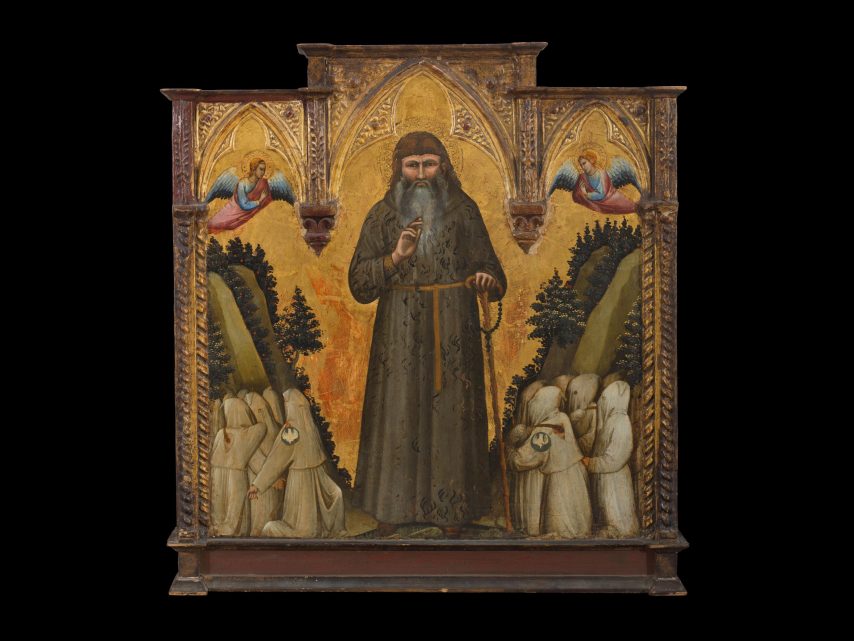
To stem the relentless plague that afflicted the city between 1382 and 1383, the city magistrates took responsibility for both the permissions and expenses needed to transfer the relics of Saint William of Maleval from Castiglion della Pescaia to Pisa. Here, after a solemn blessing in the Cathedral, they were preserved in Palazzo degli Anziani (later the Palazzo della Carovana) and became an object of devotion for the citizenry.
From 1348 onward, the Black Death maintained an endemic presence in Italy, its catastrophic periodic resurgences affecting every urban centre across the Peninsula. Pisa was no exception; after 1348, it endured violent outbreaks in 1362, 1372, 1382-1383, and 1391. Among these, the plague that raged from the summer of 1382 through the autumn of 1383 provides a particularly valuable lens through which to examine how the city responded to the spread of the disease and what forms of spirituality it turned to, as this outbreak was described in meticulous detail in the anonymous Cronaca(known as Roncioni), dating from the late fourteenth century.
During Pietro Gambacorta’s rule over Pisa (1369–1392), he took on the titles of Capitano di Guerra (War Captain) and Difensore del Popolo (Defender of the People), roles that underscored his leadership during a period when Pisa’s communal institutions were in decline. Although the city’s republican governing bodies continued to function nominally, Gambacorta had effectively become Pisa’s leading authority.
Since the limited sanitary measures proved inadequate against the contagion, the Commune and ecclesiastical authorities united in promoting spiritual practices they believed would best secure divine intervention and deliverance from the plague. The anonymous chronicler lists multiple processions that took place from October 1383 onward, with the participation of the people, clergy, and civic magistrates, including the college of Anziani, the Podestà, and the Capitano del Popolo. As Cecilia Iannella has rightly observed, the processional route likely followed the one described by the anonymous chronicler in his account of the first Corpus Domini procession, which took place in Pisa in June 1361. It began at the cathedral, continued along Via di Santa Maria, and then reached the ‘piassa delli Ansiani’ – that is the urban space later known as Piazza dei Cavalieri – then along the Borgo and following the Lungarno (the embankment along the Arno River) westward to the bridge, where the procession turned back onto Via di Santa Maria to return to the Duomo.
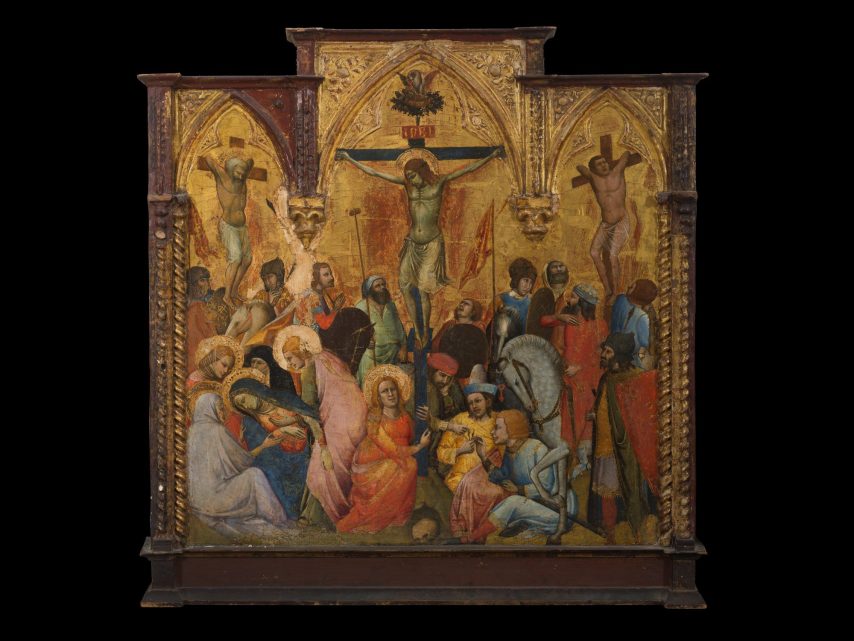
The communal institutions did not limit themselves to participating in religious processions. According to both the anonymous chronicler and later sources, the Commune itself took the initiative to seek papal permission for transferring Saint William of Maleval’s relics from Castiglion della Pescaia to Pisa and subsequently organising a series of religious events to secure the protection of the saint, who was believed to guard against the plague. On August 4, 1383, the relics entered the city through the Porta San Marco. On 4 August 1383, the relics entered the city through Porta San Marco. They were received by the Anziani, city clergy, general populace, and companies of flagellants. Among these groups, the Compagnia di San Guglielmo held particular prominence. This confraternity, likely established during the 1372 plague a decade earlier, commissioned the beautiful processional banner by Antonio Veneziano that is now preserved in the National Museum of San Matteo.
After the procession, the relics were taken to the Cathedral for a solemn mass, meticulously described by the chronicler; however, following the celebration, the chest containing the remains was transferred to Palazzio degli Anziani (later Palazzo della Carovana), where it remained, guarded day and night and secured by two keys, one held by the prior of the Anziani, the other by the abbot of the hermitage of San Guglielmo at Castiglione. The processions were repeated during August – from the 10th through the 13th and again on the 18th. Each followed the identical route, concluding at the Cathedral, where a solemn mass was celebrated and the relics were displayed. According to the chronicler, these ceremonies gave rise to numerous miraculous healings and exorcisms.
However, the same source specifies that between 16 and 18 August, the relics were displayed morning and evening for public devotion at the Palace of the Anziani, ‘in della chiostra giuso che vvi si fecie uno altare, e quine si mostravano le ditte erelique’ [in the lower cloister where an altar was erected, and there the said relics were shown]. This makeshift shrine in the semi-public space drew crowds of faithful citizens: some came with monetary offerings, others brought candles, and many approached to kiss the bier, each seeking the saint’s healing power. The relics were returned to Castiglione on 26 August; nevertheless, in Pisa, the cult of the hermit saint persisted for a long time, as evidenced by iconographic sources and the survival, until the eighteenth century, of the confraternity dedicated to him.
The funeral of podestà Jacopo da Bologna, who died during the 1382 plague outbreak, provided another opportunity for communal institutions to demonstrate their leadership role. The Commune funded the ceremonies, which centred on a procession – evidently the most common expression of the bond between the citizenry and its institutions – from the Palazzo del Podestà, where the body lay in state, to its final resting place in the church of San Francesco.
Media gallery
1406
The Last Celebration of the ‘Gioco del Mazza-scudo’
From at least the mid-twelfth century, a recurring carnivalesque festival with a martial theme, known as the Gioco del Mazza-scudo ('Mace and Shield Game'), was held in the future Piazza dei Cavalieri and, at times, in other parts of the city. Involving the male population of Pisa, the event was already regarded in earlier periods as a precursor to the Gioco del Ponte, a grand public spectacle inaugurated in 1568 under the Medici. The Gioco del Mazza-scudo was abolished following the onset of Florentine rule in 1406.
A commemorative plaque, affixed in 1985 to the outer wall of the Oratory of San Rocco, reminds passers-by that in the medieval period the so-called Gioco del Mazza-scudo was regularly held the ‘Sette Vie’ area—later renamed Piazza dei Cavalieri—a practice common to many Italian communes. Local historians consider the event the most likely pre-modern precursor to Pisa’s festive tradition of the Gioco del Ponte, a historic contest between the city’s Mezzogiorno and Tramontana factions—each comprising six magistrature, or neighbourhoods—still proudly re-enacted each June on the Ponte di Mezzo.
Although they provide no detailed description, two later chronicle-style accounts—Raffaello Roncioni’s Istorie pisane(completed around 1605) and Jacopo Arrosti’s Croniche di Pisa (1654)—confirm that the custom was firmly established in the city by at least the mid-twelfth century. Roncioni’s earliest reference dates to the winter of 1168 (according to the Pisan calendar), although on that occasion the event took place not in the square, but on the frozen river Arno. Both authors, however, present it as a much older tradition, without offering further detail.
Arrosti adds that the arrival of the Florentines brought the game to an end, and that the Pisans were forced to hand over the maces used in the contest to the new governors — a detail that echoes a fifteenth-century Cronichetta on the city’s siege, published in the late nineteenth century alongside other anonymous texts.
Following the inauguration of the Gioco del Ponte in 1568, several literary works began to frame the Mazza-scudo as a kind of mediation between local customs of presumed Roman origin and the newly imposed Medici culture under Cosimo I. One such example is Giovanni Cervoni’s Descrizione delle pompe e feste fatte nella città di Pisa (Description of the Pageantry and Festivities Held in the City of Pisa, 1588–1589).
As for the nature and organisation of the event itself, our knowledge relies on a handful of earlier literary accounts—all of them, however, written after the competition had already vanished.
Puccino d’Antonio di Puccino da Pisa’s Lamento di Pisa (early fifteenth century, over 300 verses) and Giovanni di Iacopo di Talano da Pisa’s Lamento di Pisa (1452, 117 stanzas) both mention that the game took place in the ‘piazza’—most likely referring to the future Piazza dei Cavalieri—though without offering specific details. Far richer in information is an anonymous vernacular poem, Il Giocho del massa-schudo, composed in the early fifteenth century. Though the original poem is now considered lost, in 1882, dottor Stefano Monini, Prior of Bagni di San Giuliano and owner of the manuscript containing it, published the work in a wedding book, editing it at Tito Nistri’s typography.
Comprising forty-four stanzas of eight lines each, the poem confirms 1406 as the final year in which the festival was held in the city. It describes how, at least in its later years, the square was prepared: a central space between the surrounding buildings was enclosed by a ring of chains with two opposing openings, allowing participants to enter. The two principal factions of knights—known as the Gallo [Cock] and the Gazza [Magpie], distinguished by yellow and red helmets respectively—anticipate the structure of the later Gioco del Ponte. Each faction was further subdivided into groups known as compagnie or magistrature, each with its own banners and uniforms.
After the opening parade through the streets and the positioning of the participants, the tournament began with individual duels between men armed with a mace and a shield, each competing for the favour of a woman watching from the crowd. This was followed by a group clash between the two factions, signalled by the sound of a trumpet. The poem also records that the event took place annually between Christmas and Carnival. The buildings facing the square were lavishly decorated, their balconies and windows adorned and ready to receive spectators, while in the ‘palagio maggior’ (i.e. Palazzo degli Anziani), ‘i signuori cho’ cittadini de la terra i maggiori’ [the lords together with the town’s leading citizens] took their seats.
The presence of the Commune’s political figures observing from within the Palazzo degli Anziani gave the festival a distinctly public character—one later reinterpreted in grand-ducal form with the Gioco del Ponte. However, as recent scholarship has noted, there is no evidence of a direct link between the spectacle practised under Medici-Lorraine rule and its medieval precursor.
The scant historical record of the Gioco del Mazza-scudo suggests that the event—ideologically embraced by Pisan communal institutions and regularly staged in their immediate vicinity—ceased to exist following the city’s loss of autonomy in the early fifteenth century.
1406
Gino Capponi’s Speech After the Conquest of Pisa
On 9 October 1406, Gino Capponi entered Pisa with his troops and, meeting no resistance, immediately assumed control. This marked the beginning of Florence’s definitive conquest of the city and the establishment of a government that would remain in place, uninterrupted, for nearly a century—until 1494, two years after the death of Lorenzo the Magnificent.
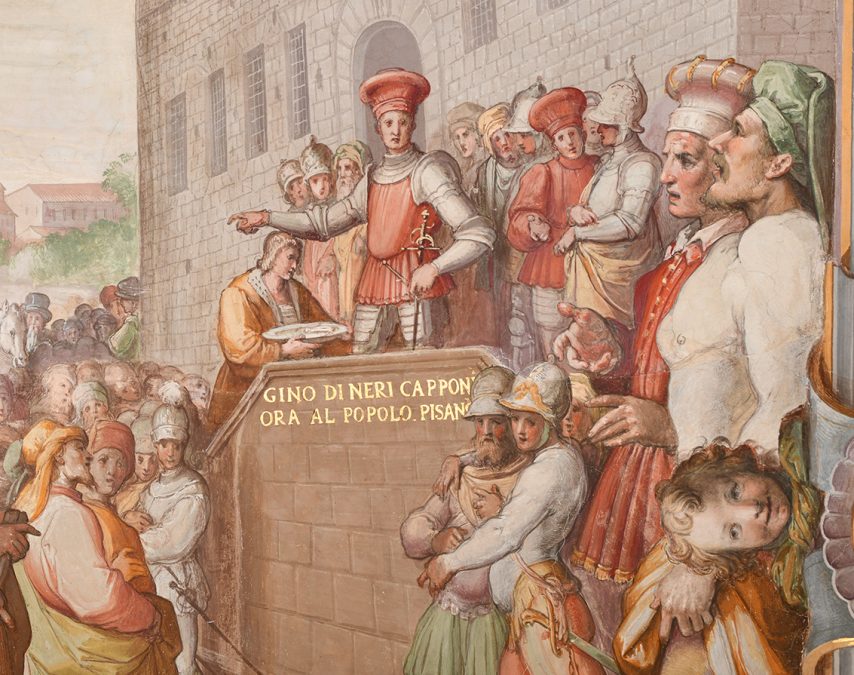
This fresco, painted in 1585 by Bernardo Barbatelli—better known as Bernardino Poccetti—on the vault of the Great Hall in Palazzo Capponi, depicts Gino di Neri Capponi delivering a public speech in the summer of 1406. He is shown addressing assembled citizens and civic authorities gathered in Piazza del Popolo (later known as Piazza dei Cavalieri), speaking from the top of the external staircase of the Palazzo degli Anziani (later known as Palazzo della Carovana). Although no extant documentary evidence confirms the specific episode portrayed in Poccetti’s work—created nearly two centuries after the event—the fresco remains closely linked to the early fifteenth-century developments that culminated in Florence’s political and military conquest of Pisa, prior to the Medici era.
Gino Capponi (Florence, c. 1350–1421) was a prominent politician who played a leading role in the conquest of Pisa and became its first governor under Florentine rule. A member of a merchant family, he began holding public office in the late fourteenth century, having aligned himself with the Albizzi. In the spring of 1405, as Florence sought to incorporate Pisa into its external dominions, Capponi served on the magistratura dei Dieci della Guerra, the council of ten senior officials responsible for military policy and wartime decisions. He was sent to Genoa, Livorno, and Pietrasanta to negotiate—first with Jean Le Maingre Boucicault, who had governed Genoa for four years, and later with Gabriele Maria Visconti, Pisa’s lord since the death of his father, Gian Galeazzo, in 1402. After five months of diplomacy, as a peaceful resolution appeared within reach, the occupation of Pisa’s fortress on 31 August 1405 triggered an unexpected uprising, which Capponi quickly suppressed by leading the Florentine army to besiege the city.
Numerous fifteenth-century sources—produced by both the victors and the vanquished—document the events of 1406. Some of these accounts help reconstruct what occurred in Piazza del Popolo following Florence’s entry into the city and Pisa’s immediate surrender.
Among the Florentine sources, one of the earliest and most significant is Giovanni di Ser Piero’s Capitoli dell’acquisto che fe’ il Comune di Firenze, di Pisa, a poem in Dantesque terza rima composed in 1408 during his tenure as podestà of Castel Fiorentino. The poem recounts the gradual encirclement of Pisa by Gino Capponi’s troops, beginning in mid-May 1406 and culminating in an agreement with Giovanni Gambacorta, who had seized power during the city’s political vacuum and was granted governance of Bagno di Romagna in return.
On the evening of Saturday, 9 October 1406, the feast day of Saints Denis of France and Domninus, the Florentines entered Pisa through Porta San Marco without armed assault or looting, finding themselves before a population starved by months of siege. As Giovanni di Ser Piero’s verses recount, one of the first acts carried out by Gino Capponi and his men upon entering the city was having ‘preso del palagio signoria’, that is, the seizure of Palazzo degli Anziani, the quintessential symbol of Pisa’s now-collapsed communal civic power.
Decades later, Neri Capponi—likely the governor’s eldest son—composed the Commentari di Gino di Neri Capponi dell’acquisto, ovvero presa di Pisa seguita l’anno MCCCCVI, probably based on his father’s notes. The work was later translated into Latin by Bernardo Rucellai. These accounts report that, upon entering the Piazza del Popolo, the young Florentine Jacopo Gianfigliazzi was immediately knighted, while Chancellor Scolaio d’Andrea di Guccio was sent to the Palazzo degli Anziani to secure suitable lodgings for the captain and commissioners. A parade through Pisa’s main streets then followed.
Other Florentine sources include an anonymous vernacular chronicle, traditionally attributed to Piero di Giovanni Minerbetti, which covers the years 1385 to 1409 in an annalistic format; Bartolomeo di Michele del Corazza’s Diario fiorentino, composed as a series of brief entries between 1405 and 1439; and Giovanni di Pagolo Morelli’s Ricordi, compiled up to July 1421. While broadly consistent with one another, these accounts are more succinct than earlier sources such as Giovanni di Ser Piero’s poem and Neri Capponi’s Commentaries. Del Corazza’s Diario, in particular, concentrates on the celebratory atmosphere in Florence’s streets following news of the victory.
Matteo Palmieri’s treatise De captivitate Pisarum, written in 1445 by the Florentine humanist born in 1406, also deserves mention. Though not a contemporary witness, Palmieri reworked earlier sources—most notably Neri Capponi’s Commentaries, to which his treatise is dedicated. Significantly, he locates the events of 9 October in front of what he already refers to as the Priorum palatium [Palace of the Priori], the future Palazzo della Carovana, rather than the earlier residence of the Anziani—thus reflecting the Florentine magistracy occupying the building at the time of his writing. He also notes that the ‘insignia of the Florentine people’ [‘Florentini populi signa’] were affixed to the palace façade that same day.
Turning to the Pisan perspective, an anonymous Cronichetta and a set of equally anonymous Ricordi were transcribed by Giuseppe Odoardo Corazzini in his 1885 volume compiling unpublished sources on the siege of Pisa. The Cronichetta contributes little beyond what is already found in Florentine accounts such as Giovanni di Ser Piero’s poem and Neri Capponi’s Commentaries. The Ricordi, however, are of particular value: alongside Capponi’s Commentaries, they constitute the only known contemporary record to preserve Gino Capponi’s oration in the Piazza delle Sette Vie.
Matteo Palmieri’s De captivitate Pisarum includes a lengthy speech, reimagined in humanistic style as a reworking of the version found in Neri Capponi’s account. In its second book, Jacopo Arrosti’s Croniche di Pisa (1654) focuses exclusively on the events that took place in the Piazza and at the Palazzo degli Anziani on 9 October, the day of the Florentines’ entry into the city. Capponi, however, delivered his public address only the following day, 10 October, speaking to the Elders as they prepared to vacate their residence, and to the assembled Pisan citizens.
The orations preserved in the Commentari and Ricordi differ markedly in form, yet both adopt a tone that is at once triumphant and conciliatory towards a people newly deprived of the autonomy they had proudly upheld for centuries.
Media gallery
1565
Founding Ceremony of the Church of Santo Stefano
Following the established tradition for beginning major construction projects, the laying of the foundation stone of the Conventual Church of Santo Stefano dei Cavalieri was marked by an official ceremony attended by Duke Cosimo de' Medici, Cardinal and Metropolitan Archbishop of Pisa Angelo Niccolini, the local clergy, and a large group of knights clad in the order’s formal attire. Medals bearing Cosimo's likeness, struck in various metals, were cast into the building's foundations.
As part of Giorgio Vasari‘s unified design for Piazza dei Cavalieri, which followed the construction of Palazzo della Carovana, plans included a church—a necessity for a military order dedicated to defending Christianity. The building, dedicated to Saint Stephen (Pope, martyr, and namesake of the Order), was erected on a site combining the old church of San Sebastiano alle Fabbriche maggiori and private plots of land. Its facade was perfectly aligned with the adjacent Vasarian palazzo. For roughly three years, while the crumbling walls of San Sebastiano were being demolished and new foundations excavated, the Order’s members – who had received papal approval from Pius IV in 1562 – held their services temporarily at the nearby church of San Sisto. This continued until construction of their new conventual building commenced in April 1565.
Scholars disagree on the exact dates of the church’s early construction phases, partly because historical sources used different calendar systems. Some documents followed the Pisan calendar, which began on 25 December and ran nine months ahead of the modern calendar, while others used the Florentine calendar, which ran nearly three months behind. According to Giovanni Capovilla, who discovered and analysed the relevant archival documents, construction began on 12 April 1565, when the Order’s Council granted its authorisation. However, marble slabs carved by Stoldo Lorenzi under architect Davide Fortini‘s direction, bearing the date of 6 April 1565, were cast into the building’s foundations, suggesting that work likely began several days earlier. These slabs contained the following inscription:
Cosmus Medices Florentiē et Senarum Dux Inclytus | Fundata hac pietiss. A Nobilium equitum universitate | ad Reip. Christiane decus et incrementum, voluit eam esse | in fide et tutela Divi Stephani Pape et Martyris | Fanum hoc Divo eidem extruendum dedicandumque curavit | Lapidem primum, privumque, primus ipse iecit | Angelus Nicolinus Pontifex Pisanus et Cardinalis verba de more preivit | Actum anno a Servatoris ortu MDLXV | VI | Aprilis | Kyrianus Stroza Philosophie et Humanarum literarum professor, eiusdemque | Ducis in re literaria Administer Pisis
[Cosimo de’ Medici, illustrious Duke of Florence and Siena, having founded this most devout college of noble knights for the glory and advancement of the Christian republic, wished it to be in the faith and under the protection of Saint Stephen, Pope and Martyr. He had this temple built and dedicated to the same saint. The Duke laid the first stone, with the rite initiated by Cardinal Angelo Niccolini, ‘Pontiff of Pisa’, who spoke the words according to custom. Done in the year 1566 from the birth of our Saviour, on 6 April. Ciriaco Strozzi, Professor of Philosophy and Humanistic Letters and the Duke’s minister for literary matters in Pisa.]
A widespread custom adopted by Italian courts (and beyond) since the fifteenth century, the burial of commemorative slabs and medals in the foundations of new buildings left an indelible record for posterity. This practice was particularly cherished by the Medici family, as evidenced – to cite just two examples among many possible ones – by similar ceremonies involving the placement of medals bearing the likenesses of Cosimo and Francesco de’ Medici in the foundations during the construction of the fortresses ‘della Stella and del Falcone in Portoferraio’ on Elba Island and Terra del Sole in Castrocaro Terme (1565).
As for the laying of the foundation stone, in 1815, Giovanni Domenico Anguillesi incorrectly linked this event to Cosimo’s appointment as Grand Master of the Order on 15 March 1562 (1561 in the Florentine calendar), while it is now clear that the event must have taken place in April 1565. Capovilla believed he could identify the exact day as the seventeenth of the month, a date derived from an expense note presumably written after the fact. However, the reliable seventeenth-century account by Giuseppe Setaioli describes the solemn procession that took place on April 8, 1565 (1566 in the Pisan calendar) ‘at approximately eleven o’clock […] with the attendance of Cardinal Niccolini Archbishop and two bishops, the canons and all the clergy and the regulars, and about one hundred knights dressed in ceremonial attire, with the customary ceremonies’ [‘a hore 11 incirca […] con l’assistenza del cardinale Niccolini arcivescovo e due vescovi, li canonici e tutto il clero et li regolari e circa cento cavalieri vestiti d’abito con le solite cerimonie’].
The first slab of the conventual church, laid ‘under the corner in front of the church facing the palace’ [‘sotto il canto avanti la chiesa verso il palazzo’] by Duke Cosimo, who had come to Pisa specifically for the occasion, bore an impressed Medici coat of arms surmounted by the cross of Stephen ‘with some Latin letters and around its corners were some round hollows […] where the Duke, after the ceremony, placed several medals in gold, silver, and metal-bearing his image, and above these four copper plates covering said medals, and above another stone similar to the first, set with metals’ [‘con alcune lettere latine et attorno sui canti vi era alcuni incavi tondi […] dove il duca, fatta la cerimonia, pose più medaglie d’oro, d’argento, di metallo con la sua impronta e sopra quattro piastre di rame che coprivano dette medaglie e sopra un’altra pietra simile alla prima incastrata con metalli’ ]. It is not clear which Cosimian medals were used for Santo Stefano. Fifty bronze specimens, mentioned without further details in the Medici Guardaroba, were sent to Pisa for this purpose in 1565. According to a previously published reconstruction, these medals are most likely the pieces bearing the Duke’s effigy on the obverse and the Uffizi building on the reverse, which had already been struck by Domenico Poggini. However, it cannot be ruled out that these were likely medals created by the same artist according to a new, specific design. Indeed, two bronze specimens (inv. 6407; Dep. 2990) are still preserved today at the Museo Nazionale del Bargello, which bear not only Cosimo’s image on the obverse but, significantly, display on the reverse the inscription ‘RELIGIONIS ERGO’ alongside the Florentine lily—an emblematic choice that perfectly suited the occasion.
1585
The Tenshō Embassy in Pisa
During the spring of 1585, Francesco I de' Medici received in Pisa the visit of four young Japanese ambassadors who had departed from Nagasaki for Europe. The occasion allowed the Grand Duke to showcase the wealth of the Order of the Knights of Saint Stephen and the magnificence of its headquarters: the guests were taken on a tour of both Palazzo della Carovana and the church of Santo Stefano, where they had the opportunity to attend a sacred ceremony.
The expedition was conceived by the Jesuit Alessandro Valignano (1539-1606), who served as Visitor of the Indies. As the Society of Jesus’s representative in Asia, Valignano sought to showcase his order’s remarkable success in spreading Christianity throughout the region. Valignano carefully selected four young converts from Japan’s noble families for this mission to the Holy See and Pope Gregory XIII. Two represented Japan’s feudal lords: Itō Sukemasu, baptized as Mancio, and Chijiwa Seizaemon, baptized as Michele. The other two were nobles in their own right: Nakaura Jingorō and Hara Nakatsukasa, who took the Christian names Giuliano and Martino respectively. The expedition later became known as the ‘Tenshō Embassy’ (Tenshō shōnen shisetsu, meaning ‘mission of the youths in the Tenshō era’) and was the first Japanese embassy to reach Europe.
The exceptional significance of the event is documented in various contemporary printed pamphlets and chronicles, such as Guido Gualtieri’s Relazioni della venuta degli ambasciatori giapponesi a Roma sino alla partita di Lisbona (1586). The De missione Legatorum Iaponensium ad Romanam Curiam (1590) holds extraordinary documentary value as a fictional dialogue between the four young protagonists as they travel, likely written in Spanish by Valignano himself and translated into Latin by the Portuguese Jesuit Duarte de Sande. According to these and other contemporary sources, the embassy undertook an extraordinary journey: after crossing the Indian Ocean and circumnavigating Africa, they made their first European landfall at Lisbon. From there, they travelled to Madrid to visit the court of Philip II, then sailed from Alicante to reach the Italian peninsula, finally disembarking at the Tuscan port of Livorno. After visiting several cities in the grand ducal state, they proceeded to Rome, where Gregory XIII granted them a private audience on 23 March 1585. Although Valignano had planned their itinerary carefully, the Japanese princes had to agree to numerous deviations: one of these long diversions occurred at the Medici court in Pisa, where the embassy stayed for five days, from 2 to 7 March 1585.
Francesco I de’ Medici, who then resided in this city with Grand Duchess Bianca Cappello, thus had the privilege of being the first Italian ruler to welcome the travellers to his state. Having landed in Livorno on 1 March 1585, the young Japanese were received by his emissary, who invited them to reach Pisa the day after their landing in grand ducal carriages, where ‘they found a palace richly prepared for them’. Following this welcoming gesture, they were formally received by Francesco I, his brothers Pietro and Ferdinando, and the Grand Duchess, who invited the missionaries to stay in the family’s ancient Pisan residence, situated near the church of San Matteo (today the site of the Prefecture).
A sixteenth-century volume printed in Florence in 1585 recounts that on this occasion, Mancio, to satisfy the Grand Duke’s ‘ethnological’ curiosity, appeared before him dressed in traditional Japanese clothing, displaying ‘a pair of most delicate shoes of mottled-coloured leather, with knitted stockings of various colours, […] a pair of hanging trousers in Turkish style reaching to the ankle, woven of gold cloth and embroidery, with emeralds, pearls and rubies, […] a long sleeveless coat, embroidered to the waist with similar jewels, with most superb and rich workmanship.’ [‘un paro di scarpe dilicatissime di corame di color mascherezato, con calzetti agucchiati di varii colori, […] un paro di calzoni pendenti in foggia turchesca fino sul collo del piede, tessuti di drappo d’oro, e di ricamo, con smeraldi, perle e rubini, […] una casacca lunga senza maniche, fino alla cintura ricamata di simili gioie, con superbissimi e ricchissimi lavori’.] Thus, admirably attired, the noble Mancio – continues the anonymous chronicler – was reportedly ‘painted in portrait by Buontalenti’. This final anecdote appears in neither Gualtieri’s chronicle nor in the De missione. There is only mention of the Grand Duke and Duchess’ great admiration for the young men’s traditional garments.
During their stay in Pisa, which coincided with the transition from Carnival to Lent, the Japanese legates divided their time between social gatherings, religious ceremonies, and visits to the city’s monuments. On the very evening of their arrival, the group attended an event at Palazzo Medici, where Grand Duchess Bianca was hosting a sumptuous court ball; here, as recounted in a lively passage of the De missione, the young foreigners provoked general amusement among the noble attendees by demonstrating their inexperience with European dances.
The following day, according to the same source, they devoted themselves to visiting the ‘templum maximum miris sumptibus aedificatum’[‘the major temple (i.e., the Duomo of Pisa) built with great wealth’], and then the ‘conventum eorum, qui Divi Stephani equites appellantur’, or the [convent of those who are called Knights of Saint Stephen], most likely the Palazzo della Carovana. After a brief digression on the prestigious chivalric orders established by princes and kings across Europe, Michele— who is tasked with narrating the embassy’s Pisan sojourn in the fictional dialogue De missione, describes the visit to the headquarters of the Order of Saint Stephen, specifically the eponymous church and the conventual palace, and highlights the remarkable wealth possessed by this knightly institution. His account particularly emphasises the knightly institution’s great wealth. In this setting, Francesco I de’ Medici’s distinctive role as patron of a religious-military order clearly impressed the four travellers, who came to regard the Grand Duke as having authority equal to that of a king.
Inside the church of Santo Stefano, the four travellers had the opportunity to attend and participate in the Ash Wednesday liturgy: on the first day of Lent 1585, in the presence of eighty Stephanian knights and, naturally, their Grand Master (the Grand Duke himself), the young Japanese also received the imposition of ashes on their foreheads. Francesco I sat on a high seat near the main altar, and, facing him, the four guests were accommodated in an equally prominent position. Before the ritual began, the knights, arrayed in in their ceremonial robes, bowed before the foreigners, then knelt before the altar and gracefully paid their respects to the Grand Duke with the kissing of his hand. After the Mass, the travellers admired the church walls adorned with numerous battle standards – trophies captured from pirate ships by the Order’s galleys. According to De missione, the Order maintained a fleet of four swift, well-equipped vessels at this time.
Although it still was still lacking its façade in 1585, the church of Santo Stefano did not fail to garner the group’s keen admiration: the narrator describes its architectural structure as ‘as remarkable as that of the order’s headquarters’, referring to the nearby Palazzo della Carovana. This building constituted the final stop on the Pisan ‘tour’ offered by Francesco I to the young Japanese princes, who were shortly afterwards invited to continue on to Florence. Inside the palace, further confirming the triumphal enterprises conducted by the Knights of Saint Stephen, the group of ambassadors could contemplate the ‘many sacred relics, a most rich treasury, and a cabinet full of all manner of weapons’ [‘molte sacre reliquie, un ricchissimo tesoro, un armadio pieno di ogni specie di armi’].
1588
Entry of Ferdinando I into Pisa
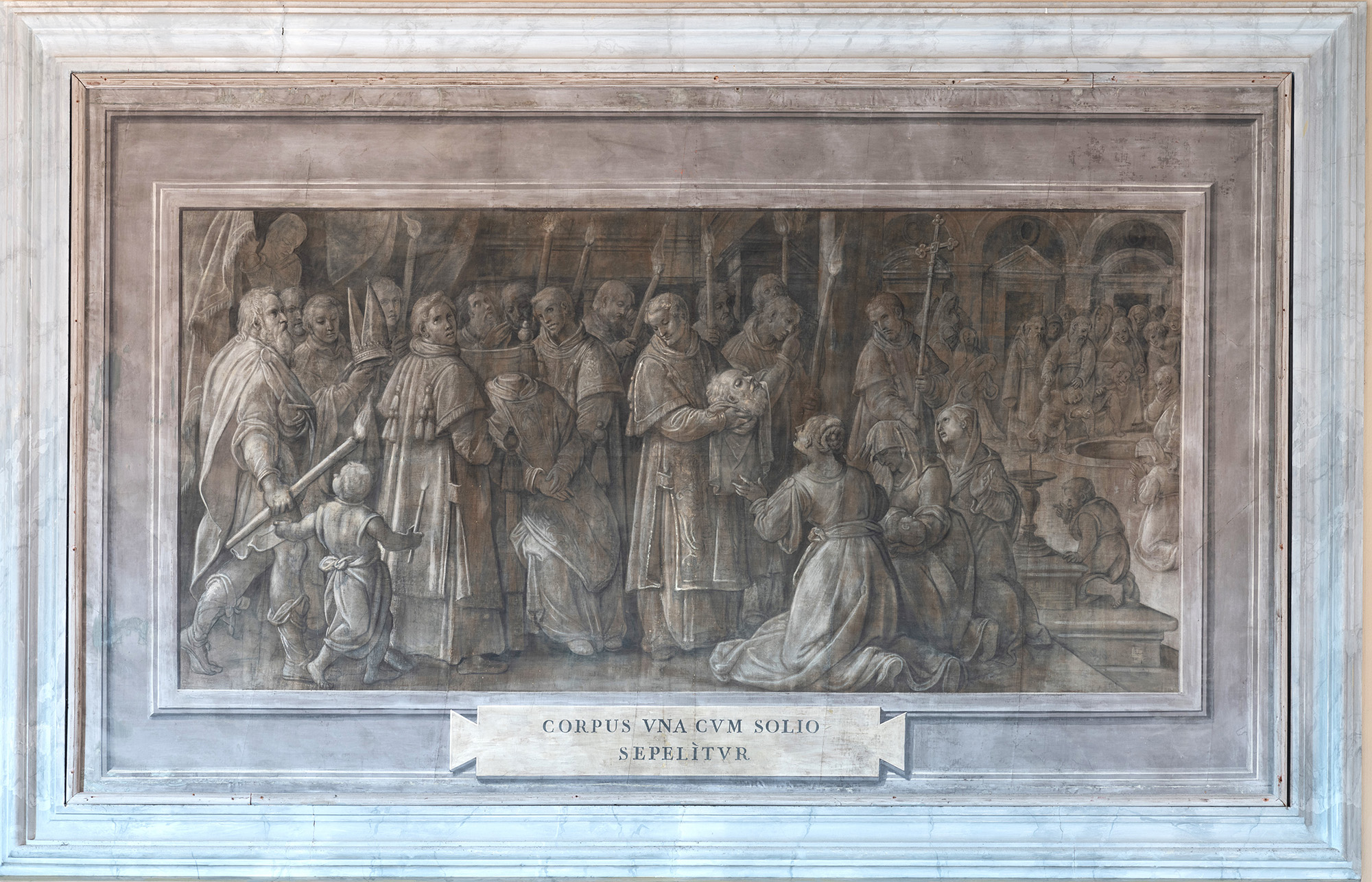
On 31 March 1588, Pisa erupted in celebration for the ceremonial entry of its new Grand Duke, Ferdinando I de' Medici. Cheering crowds and prominent local figures lined the streets as he processed through the city centre, where temporary decorations and monumental triumphal arches transformed the urban landscape. After the procession, Ferdinando and his retinue withdrew to Palazzo Medici along the Arno River. The following day, he visited the Knights of Santo Stefano, who welcomed their Grand Duke – and Grand Master – with a deferential ceremony in their conventual church, where they swore him unconditional obedience.
Having departed from Florence several days earlier and stopping at Villa dell’Ambrogiana, Cardinal Ferdinando I de’ Medici – who had become the new Grand Duke of Tuscany just months before – reached Pisa on the morning of 31 March 1588. Following tradition, he made his triumphal entry to ‘come to review and give orders to reform his noble city’ [‘venire a rivedere e a dar’ ordine di riformare la sua nobile città’]. Despite the city’s economic hardships at the time, Pisa’s community rallied to prepare for this prestigious arrival. They decorated every corner of the town and created sumptuous festive displays along the Grand Duke’s planned processional route through the centre. A precious and detailed account of the event is preserved in the description written by Giovanni Cervoni, a literary scholar and legal advisor to the Medici court. His meticulous documentation covers every aspect of the ceremony – from initial preparations through to the final execution – and provides detailed descriptions of all installations and decorative elements.
At Cascina, where Ferdinando was welcomed by the Pisan militia and high-ranking city officials, he alighted from his carriage, mounted a chinéa (ceremonial white horse), and continued his journey toward the city with a large entourage in attendance. The procession began at Porta San Marco, where a monumental triumphal arch had been erected to celebrate the Grand Duke’s good governance. Passing through throngs of cheering crowds along Via di San Martino, the procession reached the Church of the Holy Sepulchre, where the Florentine community in Pisa had erected a second arch extolling the sovereign’s moral virtues.
Next came the displays mounted by the Ufficio dei Fiumi e Fossi (Office of Rivers and Ditches), celebrating their successful land reclamation projects and those of the Customs Office. Ferdinando encountered more triumphal arches after crossing the Ponte Vecchio (known today as Ponte di Mezzo). At what is now Piazza Garibaldi stood the first, adorned with canvases illustrating scenes from his life and career. Further along the Arno riverbank, on the approach to Palazzo Medici (now Palazzo Reale), stood another arch commissioned by the Studio Pisano, celebrating the Grand Duke’s intellectual achievements. The procession continued beneath an arch where musicians performed from a special platform – ‘under the arch and platform arranged for the Music […], which was performed during his passage’ [‘sotto l’arco e palco ordinato per la Musica […], la qual si fece nel suo passare’] . At the naval arsenal, the final arch was crowned with allegorical statues of Justice and Peace.
After spending the night at the family palace, the next day the Grand Duke wished to pay homage to the Knights of the Order of Saint Stephen, of which he was the Grand Master. They received him with solemn celebrations in a festively decorated Piazza dei Cavalieri. Ottavio Piazza and Ridolfo Sirigatti coordinated and supervised the implementation of the festive arrangements. Escorted beneath a canopy, Ferdinando was led to the entrance of the Church of Santo Stefano, whose façade – then incomplete and therefore lacking the marble cladding still visible today – had been covered for the occasion with wooden scaffolding designed to support temporary structures used to make its appearance more majestic. A grand portal with an architrave was erected before the building’s entrance, its fluted pilasters adorned with festoons and inscriptions. Painted canvases were set between these, depicting allegorical figures of Beatitude, Victory, Active and Contemplative Life, Fidelity, and Obedience alongside the Grand Duke’s heraldic insignia. The church interior, as bare and undecorated as the facade, had been entirely covered with festoons, fabric hangings, flags, and a cycle of five monochrome canvases (still in situ) depicting Episodes from the Life of Pope Stephen I, Martyr, following an iconographic program once again designed by Sirigatti and executed by a group of more and less well-known painters, including Alessandro Pieroni dell’Impruneta, Jan van der Straet, known as Stradanus, and Giovanni Balducci, known as il Cosci. Ferdinando was received by the Prior of the Order, who offered him holy water and then led him to the high altar, where the knights, who had all gathered in the church for the occasion, paid him homage offering their obedience, while musicians intoned the Te Deum in the background.
Media gallery
1609
The Reception of the Bona Victors by Grand Duke Cosimo II in Pisa
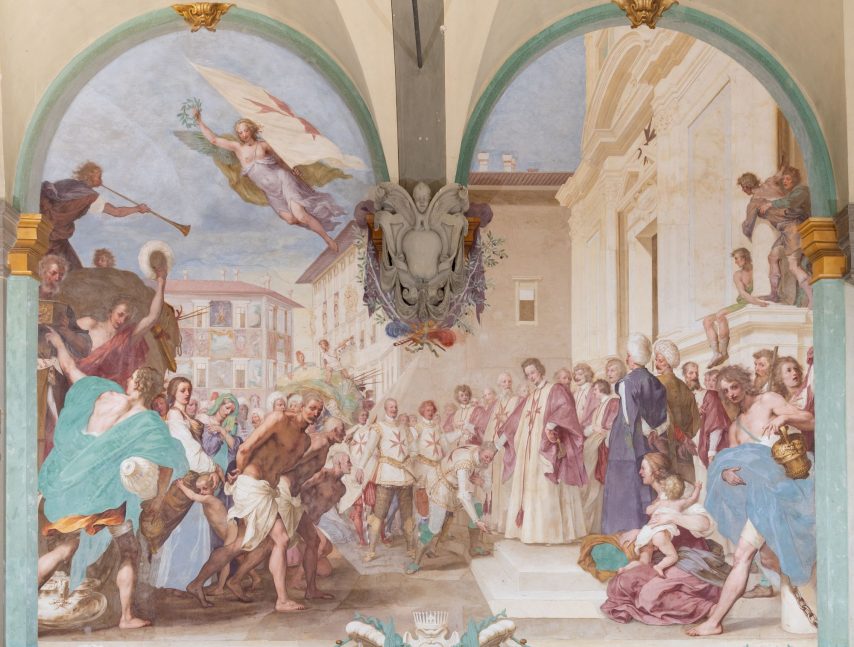
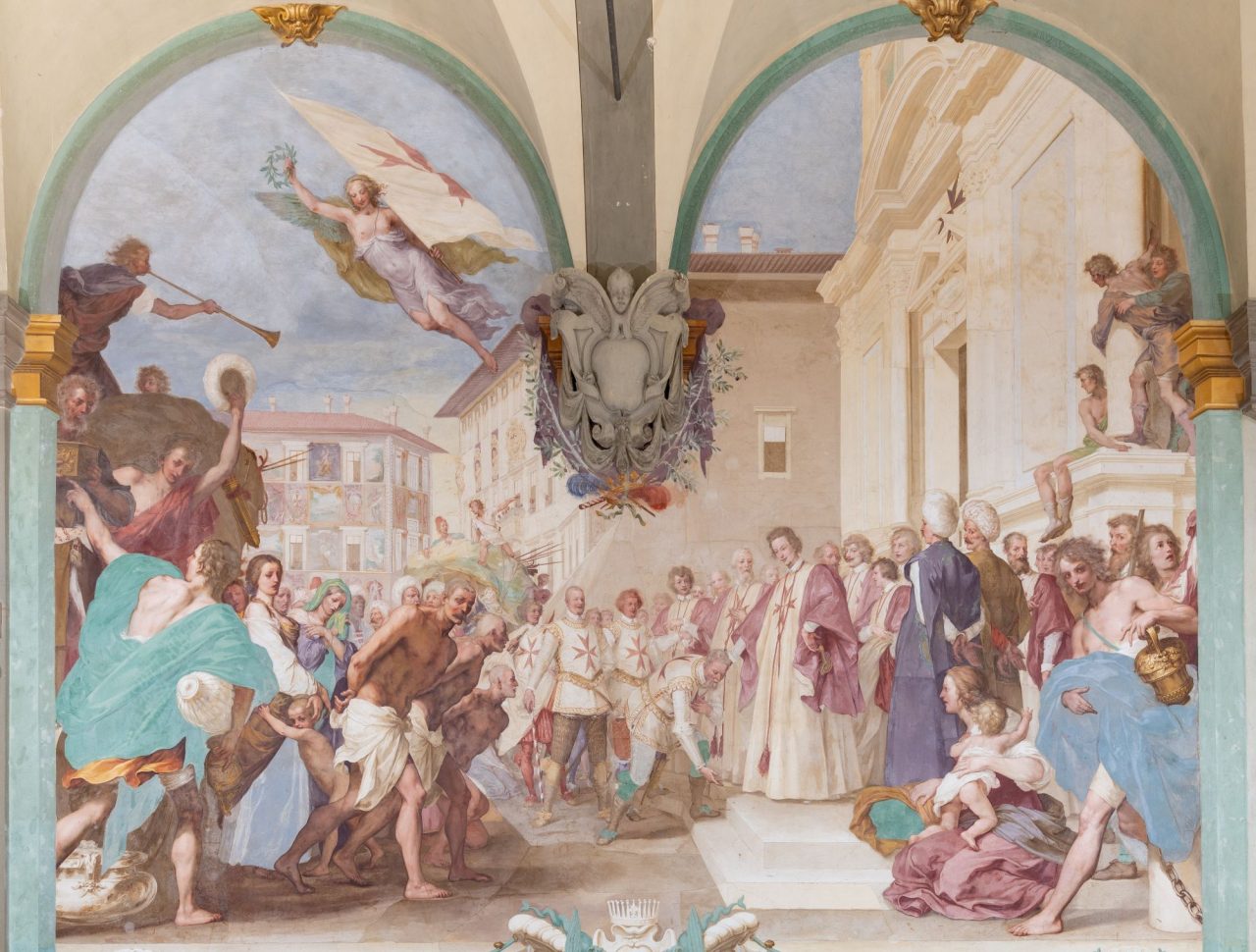
Perched on the Algerian coast, the city of Bona (modern-day Annaba) served as a strategic Turkish stronghold, whose forces had become particularly notorious for their brutal torture of Christian soldiers, captured after a shipwreck shortly before the Order of Saint Stephen launched its mission. On 16 September 1607, not without difficulty, the Medicean army succeeded in conquering the enemy fortress. In April 1609, the victory - among the most important ever achieved by the Order - was finally celebrated in Pisa with a solemn ceremony in Piazza dei Cavalieri. The young Grand Duke Cosimo II, who had recently succeeded his father Ferdinando I, played a central role in the celebrations.
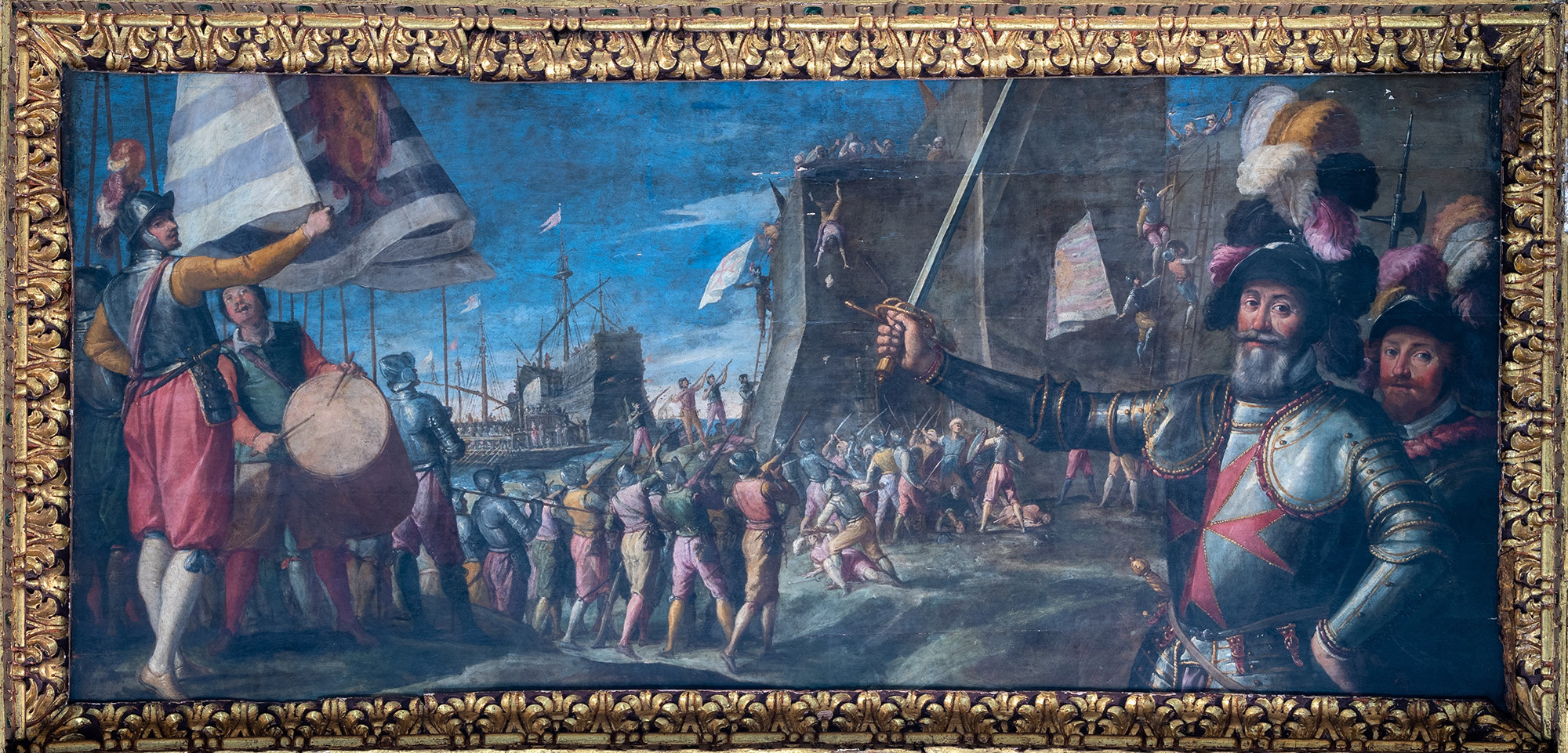
The capture of the city of Bona (modern-day Annaba, on the northeastern coast of Algeria) was the outcome of a major military operation conducted on land and sea and by the Knights of Saint Stephen in service to the Grand Duke of Tuscany, Ferdinando I de’ Medici. Admiral Iacopo Inghirami commanded the mission alongside Silvio Piccolomini, Grand Constable of the Stephanian Order and tutor to the young Grand Prince Cosimo II, in whose name the expedition was launched. The motivation for the plan likely stemmed from a recent pirate attack against several ships of the Order that had been wrecked off the Maghreb coast. The soldiers from these vessels were taken prisoner and subjected to horrific torture, culminating in the display of their severed heads atop the walls of Bona. As one of the most strategically significant Ottoman strongholds in the Mediterranean, Bona’s capture would offer Ferdinando’s government not only vengeance but also increased prestige and enhanced regional influence. Beyond these strategic advantages, the victory carried symbolic importance as a response to Ottoman aggression, particularly following the Turkish siege and capture of Famagusta in Cyprus during the summer of 1607.
223 x 301 mm
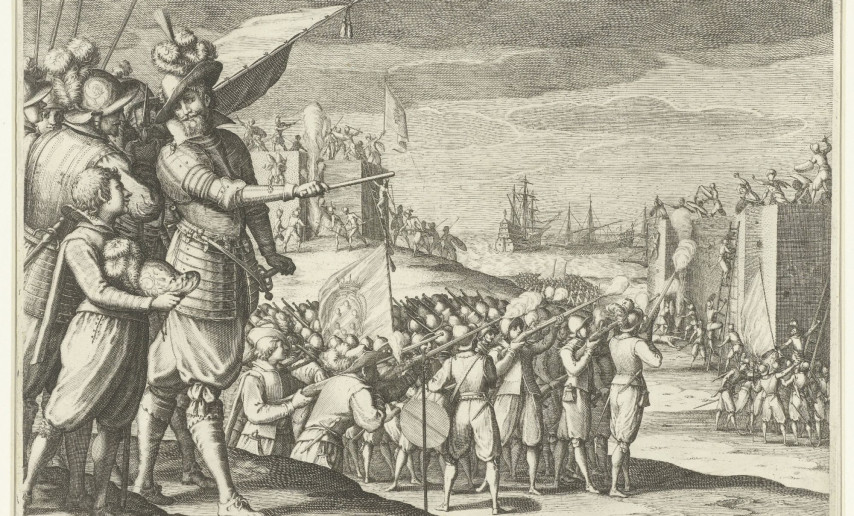
The Stephanian fleet consisted of nine galleys, three galleons and two bertons (three-masted ships), accompanied by smaller vessels and an army of over two thousand men, including knights and mercenary soldiers. The mission was planned and programmed down to the smallest detail. Still, several unexpected events during the approach to the coast caused a dangerous delay and threatened to jeopardise the entire outcome. Nevertheless, on 16 September 1607, Piccolomini decided to proceed with the landing and, despite the difficulty of the enterprise, managed to lead his troops to victory. After the battle, Bona was sacked and torched while the army immediately prepared to depart for Livorno.
As paradigms of the Ecclesia triumphans, victories over the Turks were celebrated by the Order with great pomp, following strictly codified ceremonial procedures. The Bona enterprise was thus celebrated in Pisa on 1 April 1609, with a procession in Piazza dei Cavalieri and a solemn mass in the church of Santo Stefano. According to contemporary chronicles and documents, for this momentous event, Grand Duke Cosimo II – who had recently succeeded his deceased father – arrived in the city on 26 March with his wife Maria Maddalena of Austria, several days ahead of the celebration.
On 1 April, dressed in his robes as Grand Master of the Order, Cosimo received the processional cortege in the church. The procession was led by the Knights of Tau – formerly the ancient Order of San Giacomo of Altopascio, which had been absorbed by the Stephanian Order in the late sixteenth century – accompanied by trumpet players. Following them came Grand Constable Piccolomini bearing the standard of Religion, thirteen prisoners in ceremonial dress carrying insignia, and finally, the other knights. Kneeling before the altar, the Grand Duke gathered in prayer, after which the Turkish banners captured at Bona were presented to the officiating monsignor, who blessed them, formally sanctioning their definitive consignment to the Order. The meticulous planning of the event, of which written record is preserved in the Archivio di Stato di Pisa, added that after the celebrations, ‘His Most Serene Highness will retire to the sacristy to remove his robes, and at the same time all the lord knights will remove their robes. His Most Serene Highness will then return to hear low mass’ [‘Sua Altezza Serenissima si ritirerà in sagrestia a spogliarsi l’abito, et nel istesso tempo tutti i signori cavalieri si caveranno l’abito. Sua Altezza Serenissima poi tornerà a sentir messa piana’]
In 1613, the Knights commissioned one of the painted panels on the ceiling of the church of Santo Stefano to commemorate the Battle of Bona. Bernardino Poccetti and his assistants had already depicted this theme in a cycle of paintings on the piano nobile of Palazzo Pitti in Florence (1607-1609). The 1609 celebrations were later depicted in a fresco by Baldassarre Franceschini (known as il Volterrano) as part of a larger decorative scheme commemorating Medici triumphs in the external loggia of Villa della Petraia, a Medicicean country house located near Florence (1636-1646). Finally, in 1694, the success of the Stephanian fleets became the subject of a heroic-encomiastic poem dedicated to Cosimo III de’ Medici by Count Vincenzo Piazza, a Knight of the Order, titled Bona espugnata (Bona Conquered)
Media gallery
223 x 301 mm
1683
Translation of the Relics of Saint Stephen
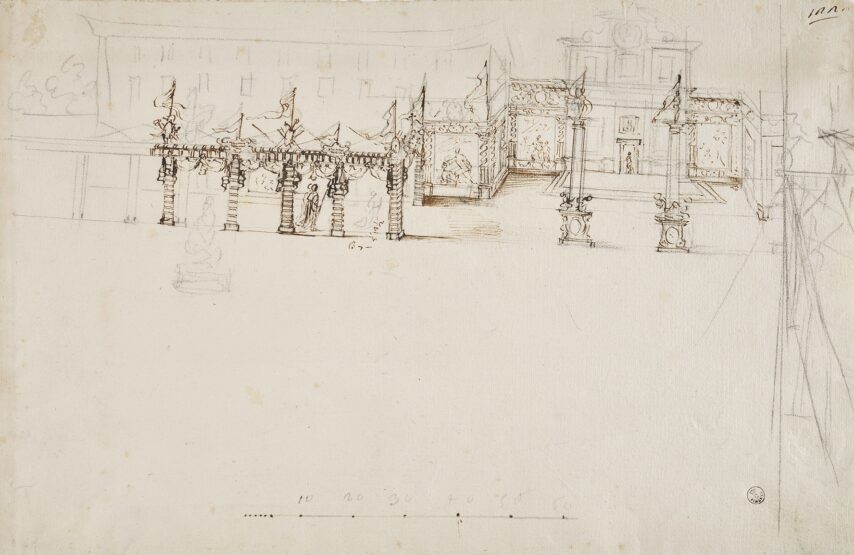
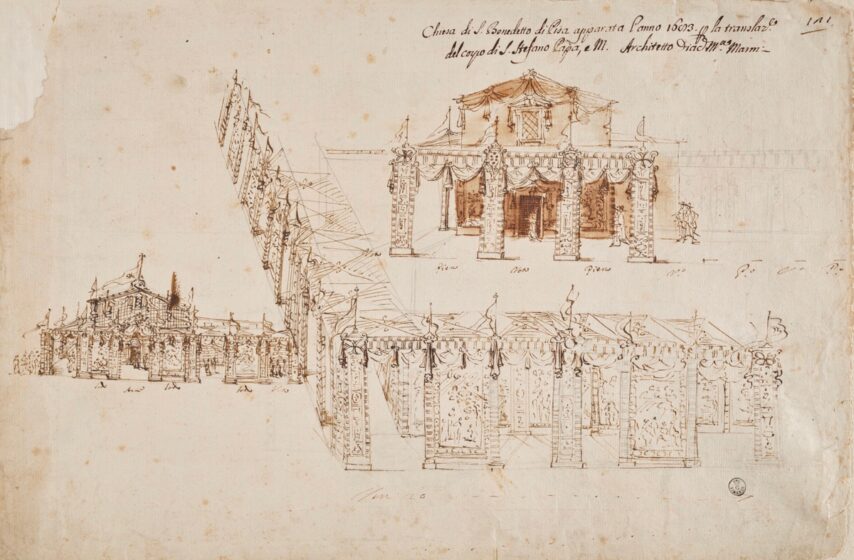
On 25 April 1683, Pisa hosted the solemn ceremonial transfer of the relics of Saint Stephen, pope and martyr, from the church of San Benedetto to Santo Stefano dei Cavalieri. The event was orchestrated by the grand-ducal guardarobiere Diacinto Maria Marmi, who designed its sumptuous ephemeral decorations, and was attended by many members of the Medici family in Piazza dei Cavalieri. The ceremony culminated in Santo Stefano, where Giovan Battista Foggini had created a gigantic wood-and-stucco model for the occasion, showing the Saint between Religion and Faith - a work still preserved in the church today.
The Order of the Knights of Saint Stephen had coveted the saint’s remains since 1571, when Giorgio Vasari was tasked with securing their acquisition. The relics, however, once preserved in various locations within Rome, had already been dispersed further afield. In 1611, small fragments of the body and some vials of the saint’s blood were discovered in the monastery of the Observant Friars of Santa Maria della Colonna in Trani, which Grand Duke Ferdinando II de’ Medici unsuccessfully attempted to obtain.
The relics were finally granted to the Order in 1682, during the reign of Cosimo III de’ Medici. This came after lengthy negotiations with the authorities of Trani – where the saint was already established as protector- and a papal brief from Pope Innocent XI. After their arrival – by land to Naples and then by sea – the sacred remains were initially preserved in the lower church of San Benedetto, under the Knights’ jurisdiction. The Knights organised the transfer ceremony for the following year’s Divine Mercy Sunday, 25 April 1683, to coincide with the Order’s General Chapter meeting, during which positions would be renewed for three years.
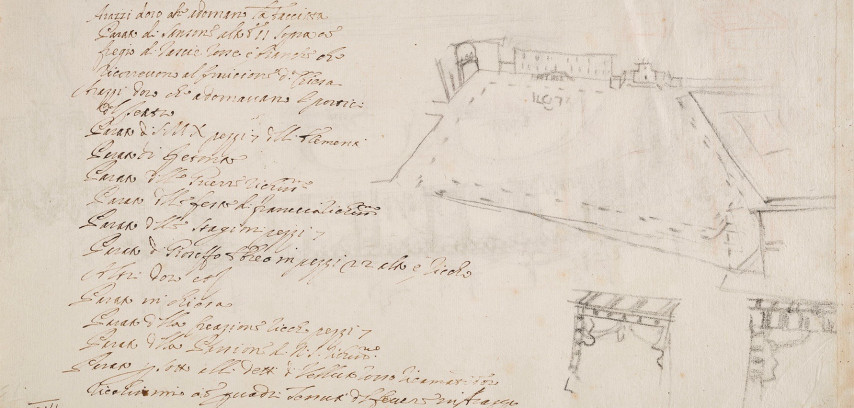
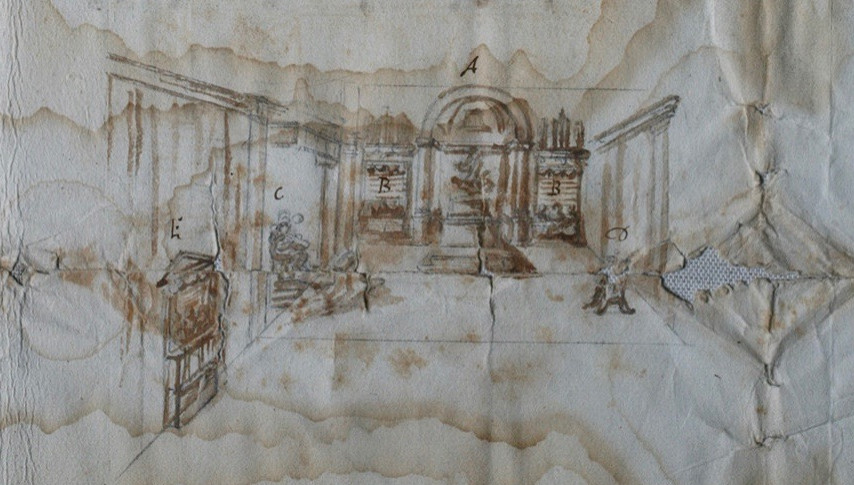
The ceremony, which culminated in Piazza dei Cavalieri, and the rich decorations adorning the route between the two churches are documented in several sources, both manuscript and printed. The event is also recorded in a letter by Diacinto (or Giacinto) Maria Marmi, the grand-ducal guardarobiere (wardrobe keeper) who designed the temporary decorations for the event. The lavish ceremony can be reconstructed through payments to numerous artists and craftsmen preserved in the Archivio di Stato in Pisa, a substantial group of drawings found in Florence, Pisa, and New York, and an engraving depicting the piazza’s decorations. Some of these drawings were intended to produce an illustrated printed account, which has not been found and may indeed never have been published. Nine views of the celebration were commissioned from Domenico Tempesti and Bastiano Tromba for the planned publication.
Six drawings by Marmi have been identified in the Gabinetto dei Disegni e delle Stampe degli Uffizi, interpreted as sketches made after the ceremony and then provided to the two artists. The three drawings in the Archivio di Stato in Pisa appear to belong to an earlier, more operational phase during the development of the actual installation, and, in my opinion, their attribution to Marmi remains uncertain. Although Tempesti and Tromba completed the drawings for print – confirmed by a payment of 40 scudi – only one of the nine views has been found: the interior of Santo Stefano, now at the Morgan Library in New York.
During the celebration, meticulously reconstructed by Barbara Riederer-Grohs and particularly by Franco Paliaga, the reliquary was removed from the lower church of San Benedetto and displayed among candles and silverwork on the altar of the upper church, which had been decorated for the occasion with tapestries depicting sacred scenes. San Benedetto’s facade was adorned with pillared scaffolding draped in white and turquoise checkered cotton cloth. Above this rose an enriched frieze and cornice decorated with flags. A tapestry depicting the deeds of Cosimo I de’ Medici (not readily identifiable in the Uffizi drawing) hung between the allegories of Piety and Justice.

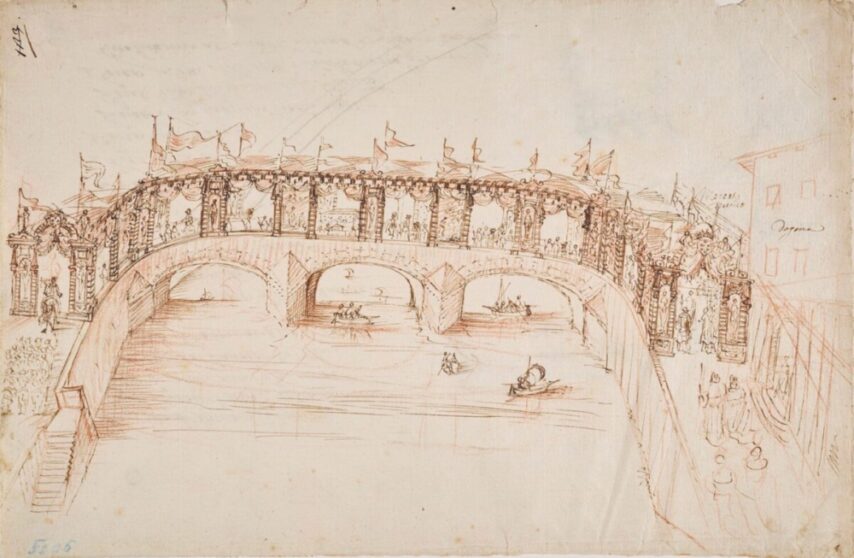
The reliquary was placed under a canopy and carried in procession by the Grand Duke, Cosimo III, dressed in his grand master’s robes and accompanied by a retinue of four hundred knights and clergy. The procession moved along the Lungarno to the Ponte di Mezzo, another highlight of the route. Here, the passage was marked by mortar fire and sumptuous decorations. The bridge was framed by two triumphal arches and covered with naval awnings, friezes, and coloured drapes. Tapestries depicting Faith, Hope, Joy, and Sorrow were placed at each end of the bridge, while additional tapestries with allegorical figures were installed between the pillars.
Along the Via del Borgo, a series of tapestries were displayed showing the Storie dei Medici (depicting Cosimo the Elder, Lorenzo the Magnificent, Clement VII, and Cosimo I), the so-called Parato della Vigilanza (Vigilance Tapestry), the cycle of ‘Florentine festivals,’ and other series dedicated to mythological figures.
Another triumphal arch, on which a chiaroscuro episode from the Life of Saint Stephen had been placed, led into the piazza, which was entirely surrounded by a wooden arcaded loggia supporting various series of tapestries: among these were the Stories of Saint Joseph, The Stories of Phaethon, the ‘Elements’ series, the Marriage of Henry IV and Maria de’ Medici, and individual pieces depicting sacred stories. In the piazza, waiting for the procession, were various members of the Medici family: Grand Duchess Vittoria della Rovere, the Princesses Ferdinando and Gian Gastone, and Cardinal Francesco Maria, the Grand Duke’s brother.
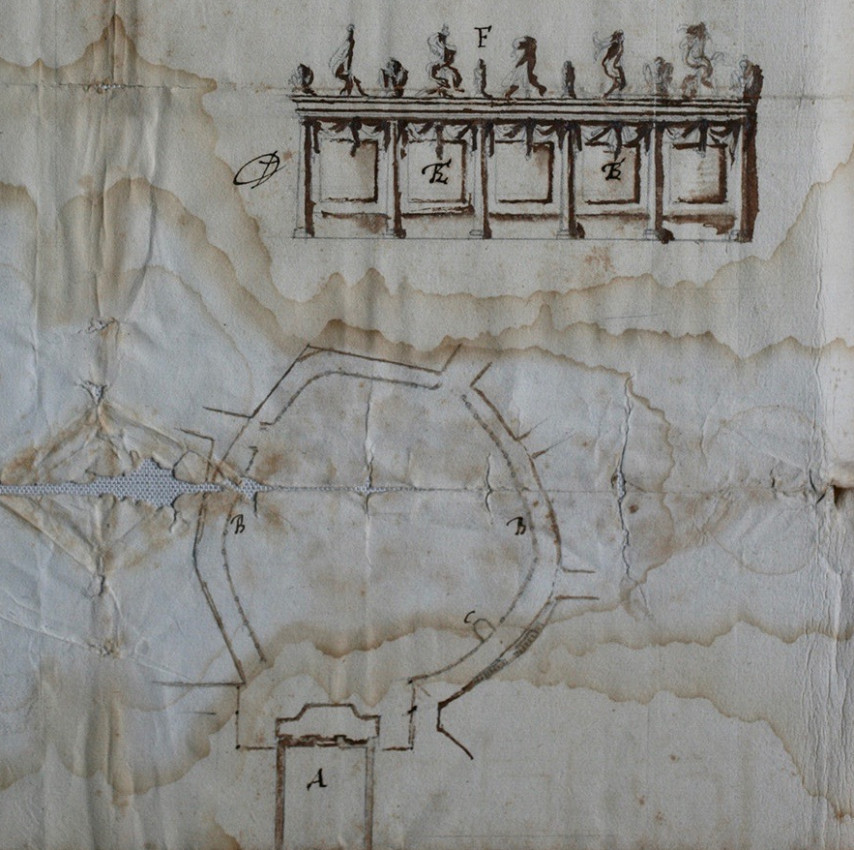
Once the procession had disbanded, the procession entered the church. In front of the church stood two columns, each crowned with an allegorical figure: Religion, bearing a standard emblazoned with the Knights’ coat of arms and with enemy spoils at her feet, and Victory, holding both a standard and a crown, similarly displaying captured enemy trophies at her base. Chained to the column pedestals were four captive figures, while the church facade was dominated by Grand Duke Cosimo III’s portrait, a work by Pietro Dandini created in collaboration with gilders and weavers.
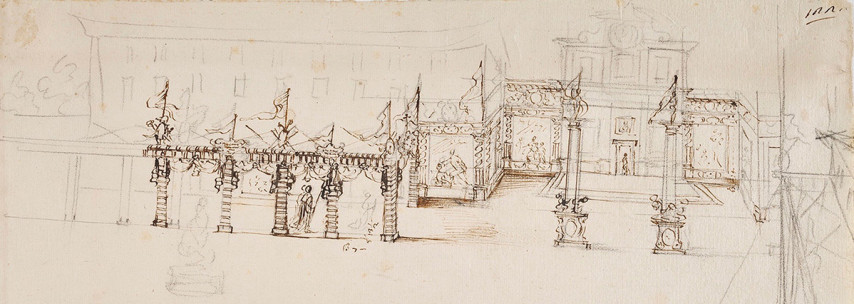
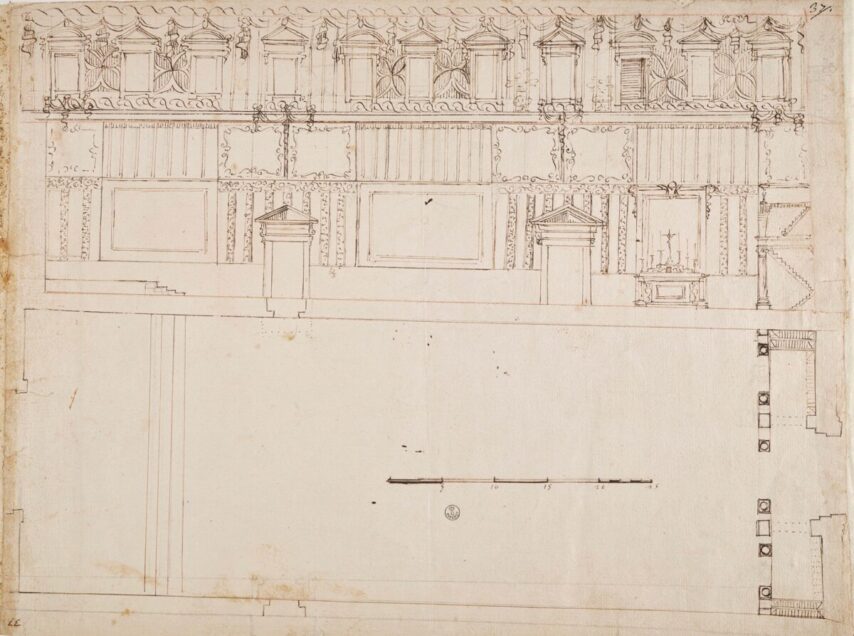
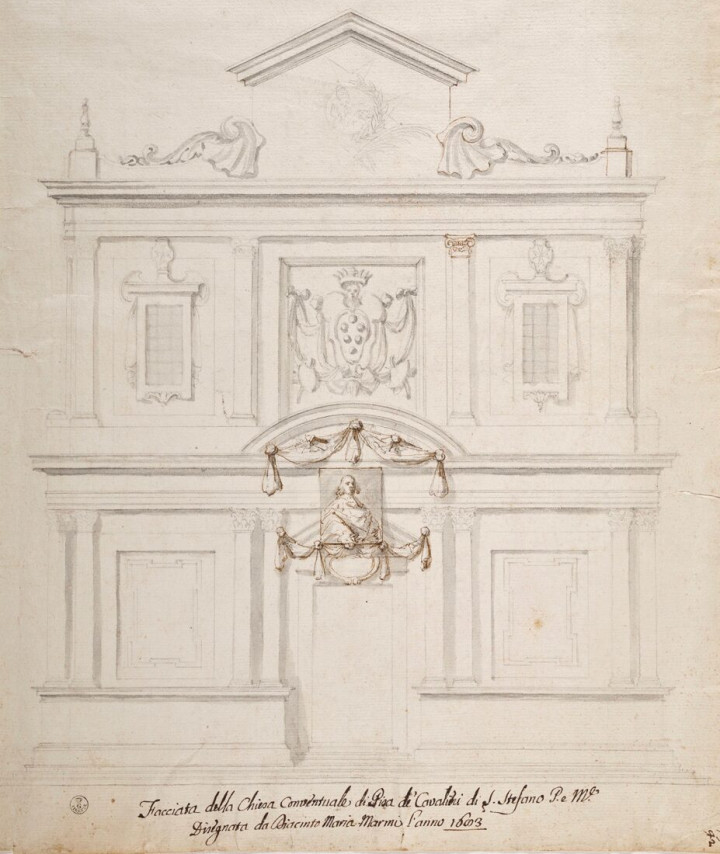
The church interior had been fitted with a musicians’ gallery, thrones for the Grand Duke and Prior Felice Marchetti, and ‘gabinetti’ [loges] to accommodate the guests and court: among these, besides the Order’s authorities, were the Archbishop of Pisa Francesco Pannocchieschi d’Elci, and Monsignor Giacomo De Angelis, the Vicar General of the Diocese of Rome. The church was adorned with various tapestry cycles: the Grotesque series, the Life of Samson, and the Creation of Adam. From the ceiling hung a standard depicting the saint with an angel and, at its base, the kneeling figure of Religion. On the high altar, designed for the occasion by Pier Francesco Silvani, stood the plaster and wood figures created by Giovan Battista Foggini, depicting Saint Stephen between Religion and Faith, now preserved in a chamber to the right of the presbytery.
This was an event without precedent. Diacinto Maria Marmi resided in Pisa for forty-three days, directing a veritable team in a transformation that touched every aspect of the celebration. The extensive preparations ranged from comprehensive work on the church interior – including gilding, cleaning, and the complex movement of materials – to the meticulous preparation of every street along the processional route. Improvement works were carried out on the facades and roofs of the buildings. The streets were covered with sand, and the piazza was cleaned and paved with cobblestones in some areas.
Franco Paliaga emphasises the distinctive nature of the ceremony, which proceeded from one site under the Order’s jurisdiction to another – marked respectively by the portraits of Cosimo I and Cosimo III – traversing the city’s most important thoroughfares (the Lungarni and Borgo) via a system of covered galleries.
Marmi’s ephemeral decorations served both economic and symbolic purposes: many tapestries came from the Medici Guardaroba (wardrobe); curtains and other textiles were borrowed from Santa Maria Novella and numerous Florentine, Pisan, and Livornese institutions; other objects came from private loans. The vast sacred and secular repertoire inspired wonder and admiration, primarily emphasising decorative aspects, although some tapestries demonstrated the connection between the Medici dynasty and the Order, stressing the necessity of fighting against invasion at a particular historical moment: the Turkish advance at the gates of Vienna.
Media gallery
1765
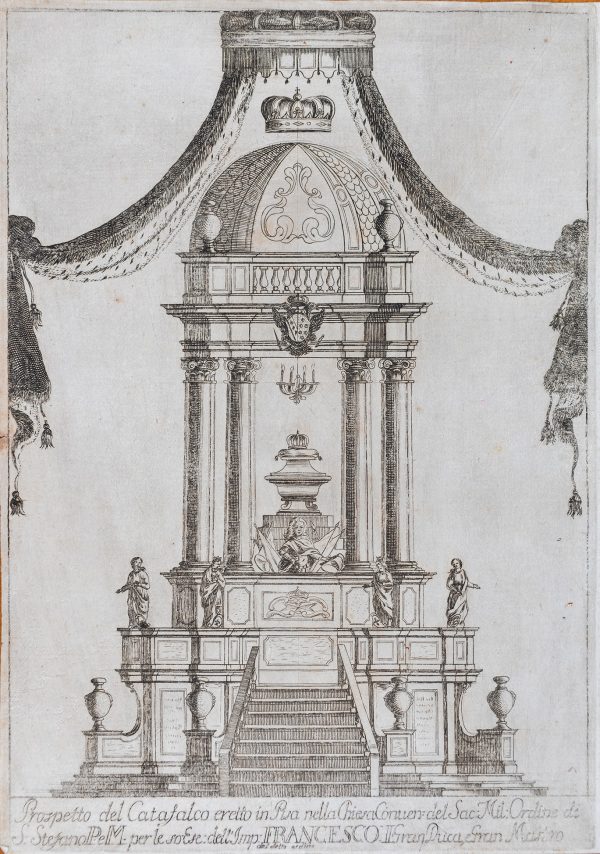
Funeral ceremonies for Francis I of Lorraine
On December 19, 1765, Pisa began elaborate funeral celebrations in memory of Emperor Francis I of Lorraine, who had died suddenly that summer, leaving his sons Joseph and Leopold as heirs. The event was organised by the Order of Saint Stephen (of which Francis was Grand Master in his role as Grand Duke of Tuscany). The Order oversaw every aspect of the ceremony, carefully planning both the rituals and the elaborate decorations that adorned the interior and exterior of their conventual church.
Holy Roman Emperor Francis I of Lorraine (1708-1765), who ruled as Grand Duke Francis III of Tuscany, died suddenly in Innsbruck on the evening of August 18, 1765. He suffered a stroke while travelling by carriage with his son Joseph, leaving his subjects and his beloved wife, Maria Theresa of Austria, shocked by his unexpected death. Joseph, already chosen as heir to the imperial throne, succeeded his father as Emperor. His younger brother Leopold, who had married the Spanish Infanta Maria Luisa of Spain just days before his father’s death, assumed control of the Grand Duchy of Tuscany. The main cities of the Grand Duchy immediately began organising elaborate ceremonies to honour the deceased ruler.
In Pisa, the Order of the Knights of Saint Stephen took direct responsibility for organising the public funeral ceremonies in his memory. They appointed the lawyer Francesco Taddei to provide a detailed written account of all the arrangements and to chronicle each stage of the celebrations. This document remains our key source for understanding how these events unfolded. The Council of Twelve (the Dodici) appointed three officials to oversee the work: Anton Maria Boni, commissioner of the Stephanian convent; Quintilio Galeotti, consul of the sea; and Camillo Ruschi, superintendent general. The Pisan architect Nicola Stasi was commissioned to design and construct the catafalque in the church of Santo Stefano.
The Pisan funeral ceremonies for Francis I commenced on the morning of 19 December 1765. The church portal was framed with yellow and black festoons, honouring the imperial colours and topped by a long commemorative inscription by Father Odoardo Corsini, Professor of Letters at the city’s university. Similar decorations dominated the church interior, appearing in the apse and on the triumphal arch, crowned at its centre by the imperial coat of arms. The long walls of the nave ‘were adorned with painted colonnades and Doric architectural arches with pillars and counterpilasters of white Carrara marble, inlaid with Seravezza marble, as was all the remaining decoration’ [‘furono adornati a pittura con intercolunnj, ed arcate di architettura dorica con pilastri, e contrapilastri di marmo bianco di Carrara, formellati di mischio di Seravezza, come era tutto il restante dell’ornato’ ]. The architectural sequence began with intercolumns, each containing two oval paintings in chiaroscuro against a black background, depicting personifications of Justice and Prudence. The seating for the new Grand Duke and Grand Master Pietro Leopoldo was installed in cornu evangelii (on the gospel side, meaning to the left of the apse when facing away from the entrance), and that of the Order’s Prior in cornu epistolae (on the epistle side). Along both sides were more arches with black backgrounds and yellow decorations, featuring additional oval chiaroscuro paintings suspended from above with personifications of virtues, while altars were arranged in the spaces below. The counter-facade housed the musicians’ gallery, and the entire space was decorated with the customary flags and military trophies arranged between the windows.
As shown in a print included in Taddei’s Descrizione of the event, the catafalque was placed at the centre of the church, raised on a stepped base of porphyry with marble pedestals supporting vases of the prized marble known as verde antico. At the top of the steps, the central section consisted of a balustrade crowned with female statues, each representing a Tuscan city. Rising over these stood ‘the royal urn of the deceased monarch’ [‘l’urna regale dell’estinto monarca’], protected by a large canopy lined with ermine.
The ceremony began as ‘frequent sacrifices were offered to the Most High on all the temple’s altars, and numerous faithful worshippers continuously offered fervent prayers for the eternal rest of that august soul’ [ ‘sopra gli altari tutti del tempio si offerirono all’Altissimo frequenti sacrifizj, e dai moltissimi fedeli adoratori continuamente si porsero ferventi preghiere in suffragio, e riposo eterno di quell’anima augusta’] The Religious Knights then arrived ‘in magnificent procession and in church vestments’ [‘con magnifico treno, e con abito da chiesa’], positioning themselves around the catafalque; behind them were the Commissioner, the Consuls of the sea, and the Priors of the city of Pisa, all in magisterial robes, [‘‘il sig. Commissario, i signori Consoli del mare, ed i signori Priori della città di Pisa, tutti in abito di magistratura’] At precisely 10 o’clock, the solemn mass began, sung by the priest and knight Anton Maria Boni of Cortona, substituting for the elderly church prior Gasparo Cerati, and accompanied by musical compositions by the Neapolitan Francesco Durante.
After the service, the officiating priest, followed by the clergy, pronounced, ‘the Absolutions, circling the urn on the base’s railing’ [‘le Assoluzioni, girando intorno all’urna sulla ringhiera dell’imbasamento’], while Flaminio dal Borgo – knight, jurisconsult, professor at the University of Pisa and Grand Treasurer of the Order – delivered the funeral oration, praising with noble eloquence the ‘illustrious and magnanimous deeds of the deceased lord’ [‘encomiando con nobile facondia le luminose et magnanime gesta dell’estinto signore’]. For the following three days, the church and the entire ceremonial display remained open to the public, who came in great numbers to pay their respects to the deceased sovereign.
Media gallery
print, 240 x 177 mm.
Inscription, lower centre: ‘Prospetto del Catafalco eretto in Pisa nella Chiesa Conven: del Sac: Mil: Ordine di / S: Stefano P. e M. per le so. Ese: dell’Imp: Francesco: II [sic] Granduca e Gran Maestro / del detto ordine’
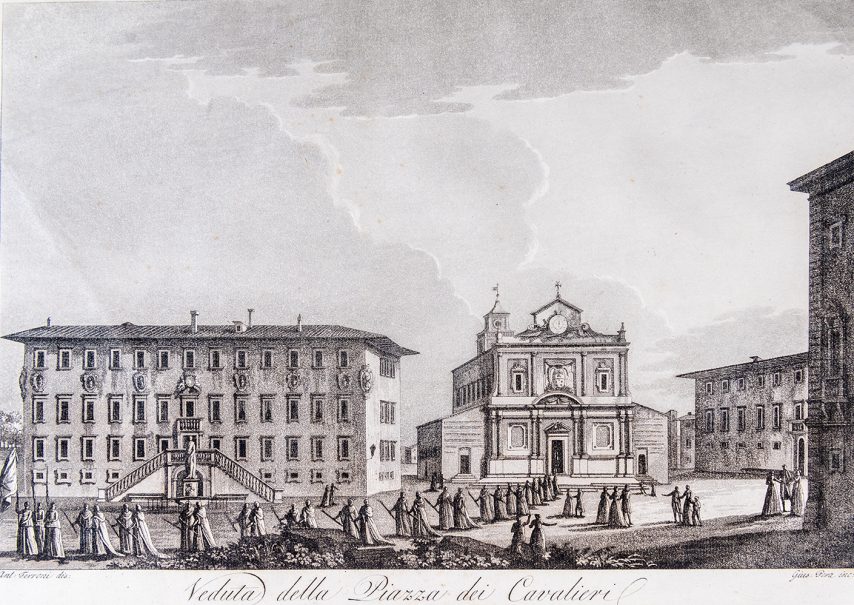
1799
Celebrations for the Liberation From French Rule
After the temporary expulsion of the French in the summer of 1799, the people of Pisa tore down the liberty tree that the invaders had erected in Piazza dei Cavalieri and organised ceremonies to celebrate their regained freedom, in which the knights of the Order of Santo Stefano also played an active role.
In the summer of 1796, Napoleonic troops gradually occupied the Grand Duchy of Tuscany, initially allowing Ferdinando III of Habsburg-Lorraine to retain his throne—though only nominally. By the spring of 1799, however, the French had officially entered Florence, forcing Ferdinando into exile in Vienna. With Tuscany’s neutrality ended, liberty trees—symbols of the French Revolution—were erected in every city square across the region. Yet the fragile French conquest was soon undermined by the second anti-French coalition. Within a few months, in the summer of that same year, Austrian and Russian forces entered Florence, aided by internal uprisings against the French Republic—most notably from Aretine insurgents who, crying ‘Viva Maria’, had joined the Sanfedist reactionary movement. The liberation from French rule sparked widespread celebrations throughout Tuscany.
Our knowledge of events in Pisa comes from a 1799 report by the lawyer Francesco Gaeta, which captures the jubilation of those Pisans who, loyal to religious and monarchical ideals, had suffered deeply under French secularisation policies—particularly the abolition of religious orders and corporations. The principal target of the invaders in Pisa had been the Knights of the Order of Saint Stephen. Their past triumphs, symbolised by Turkish banners displayed in their conventual church, remained a source of pride for many Pisans and a powerful emblem of the historical victories of faith. It was therefore no surprise that the Knights featured prominently in the anti-French celebrations.
Piazza dei Cavalieri—once dominated by a religious-military order but reinterpreted by the French through the most conspicuous symbol of the Revolution—became the setting for one of the first spontaneous acts of celebration by the people of Pisa, inspired by the ‘Viva Maria’ uprisings: the toppling of the liberty tree. Gaeta describes the scene: ‘allorché accorso il popolo in folla sulla Piazza detta dei Cavalieri, rovesciò e distrusse il simbolo della desolazione, che vi era stato eretto, unitamente a tutti gli altri emblemi repubblicani. Fatto in pezzi l’infame albero, fu bruciato in diversi luoghi della città’ [When the crowd gathered in Piazza dei Cavalieri, they tore down and destroyed the symbol of desolation that had been erected there, along with all other republican emblems. The infamous tree, smashed to pieces, was burned in various parts of the city].
Following the French occupation, Pisa’s disrupted religious traditions were gradually revived through a series of public celebrations in which Piazza dei Cavalieri and the Knights of the Order of Santo Stefano played a visible part. They joined the procession in honour of the Maria Vergine di sotto gli organi—a highly revered icon of the Madonna and Child, considered one of Pisa’s most important religious artworks—which passed through Piazza dei Cavalieri, continued with ceremonies in the Cathedral’s Chapel of San Ranieri, and culminated in festivities organised by the Knights at Santo Stefano.
Due to the interruption caused by the occupation, the annual celebration of Corpus Domini could not be held on its usual date and was exceptionally observed on 30 July. The square was blessed, and the Knights, wearing the cappa magna (full ceremonial cape), made their way to the conventual church for Mass. After the service, a well-attended procession wound through the streets of Pisa to the singing of the Te Deum. Throughout the day, the consecrated host was exposed for public adoration, and at six in the evening, the knight-chaplain Pietro Matani delivered an oration. The festivities concluded after Vespers with the Eucharistic blessing.
Despite Pisa’s brief restoration of pre-revolutionary traditions, the revival lasted only a few months. The Treaty of Lunéville, signed in February 1801, forced Ferdinando III to abdicate and led to the creation of the Kingdom of Etruria—a French-controlled state governed by the House of Bourbon—bringing an end to the city’s traditional structures.
Media gallery
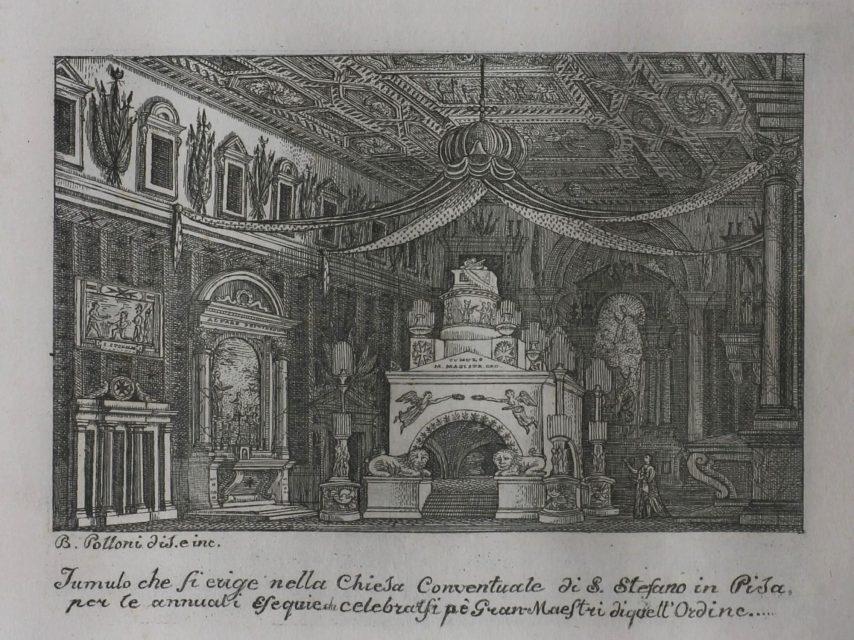
1824-1859
THE FUNERAL RITES OF FERDINAND III OF TUSCANY AND OTHER MEMBERS OF THE GRAND DUCAL FAMILY
Throughout much of the nineteenth century, Santo Stefano dei Cavalieri continued to serve as the setting for the funeral rites of the Lorraine grand dukes. Among these, the ceremonies held for Ferdinand III of Tuscany in 1824 were particularly notable for their exceptional splendour. In response to this ceremonial context, the Pisan architect Alessandro Gherardesca designed the so-called 'Catafalque of the Knights' in 1833—a temporary structure intended for reuse on similar occasions.
Even after the transition to Lorraine rule, the Stephanian Order continued to hold sovereigns’ funeral ceremonies in its conventual church—rituals whose scale and organisation subtly reflected the degree of favour accorded to different members of the grand ducal family.
While the funeral rites of Emperor Francis I in 1765 prompted the swift organisation of an elaborate ceremonial apparatus, the death of his successor, Leopold, in 1792 was met with markedly less enthusiasm. This shift in tone reflected not only the political distance created when Leopold relinquished the government of Tuscany—and with it the role of grand master—to his son Ferdinand III two years earlier, but also the enduring resentment provoked by his radical and poorly received curtailment of Stephanian authority. During the brief period of Bourbon rule over Pisa, Louis I, King of Etruria— and thus Head of the Order — from 1801 to 1803, had also received a solemn funerary rites. By contrast, the unexpected death of Ferdinand—restored to power in 1814—elicited far greater attention from the Order, which he had reinstated in 1817, eight years after its suppression by Napoleon.
Following the death of Ferdinand III in Florence on 18 June 1824, the Knights took part in commemorations held throughout the cities of Tuscany. During the month of preparations, the church of Santo Stefano was closed; services were conducted, as noted, ‘in the chapel of the Holy Sepulchre, for the convenience of the people, a movable altar was erected in the room used as the robing chamber of the Most Holy Knights’ [‘nella Cappella, detta del Santissimo Sepolcro, e per comodo del popolo fu eretto un altare amovibile nella stanza che serve di spogliatoio dei santissimi Cavalieri’].
On 16 September, the day of the ceremony—attended by the Council of the Order and leading members of the Pisan nobility—an imposing mausoleum was erected inside the church. It featured four pillars bearing candelabra in imitation bronze, each topped with numerous lit candles. At its centre stood a sepulchral urn, against which leaned an elegant, and slightly larger-than-life statue, depicting the personification of the Order di Santo Stefano in an an ‘attitude of profound melancholy, a statue of elegant form and slightly larger than life, representing the Order of Santo Stefano, inconsolable for the loss of its august grand master’ [‘atteggiamento di profonda mestizia una statua di eleganti forme, e di grandezza un poco più che naturale, rappresentante la Religione di Santo Stefano, inconsolabile per la perdita dell’augusto suo gran maestro’], gazing upon the grand duke’s portrait—undoubtedly a relief medallion.
The sculptor was Tommaso Masi, a pupil of Canova who had long confined himself to restoration and minor commissions. Latin inscriptions by Giuseppe Dini, master of belles-lettres for the clerics, adorned the walls and the doorframe.
After the requiem—sung by Prior Giuseppe Cosi del Voglia, with music composed by chapel master Stefano Romani and performed by a choir of professors—the funeral oration was delivered by Beniamino Sproni, the university’s provveditore generale (chief administrator). Interweaving classical imagery with religious exaltation, Sproni depicted the Grand Duke’s return to the government of Tuscany as a moment of supreme restoration of peace and praised him as a tolerant yet resolute legislator—even citing his reintroduction of the death penalty.
Professo Baccio dal Borgo had composed one of his canzoni which, through a free alternation of hendecasyllables and heptasyllables, depicted the weeping of two women, companions in mourning: Alfea, ‘once mother of feared heroes’ [‘già madre di temuti eroi’] and a Warrior, ‘from whose breast hangs a purple cross’ [‘cui purpurea croce pende dal petto’]—representing Pisa and the Order of Saint Stephen, respectively, both saved from ‘a hateful exile’ [‘un odioso esiglio’] by Ferdinand’s intervention.
On 24 March 1832, Maria Anna Carolina of Saxony, first wife of Leopold II, died in Pisa. Long afflicted with tuberculosis, she had settled in the city, renowned for its salubrious air. Her body lay in state at Palazzo Reale for three days before being transported to Florence, accompanied by a procession as far as Porta Fiorentina.
On 10 April, the Knights took part in the commemorations by reusing ‘the grand structure previously used for Grand Duke Ferdinand III, with the exception of the medallion, which was created by the young Vallint and depicted a lifelike portrait of the august deceased, encircled by the motto “Lex Dei in corde ipsius”’ [ ‘la macchina grandiosa, che era stata in opera pel gran-duca Ferdinando III, meno del medaglione, che è stato fatto dal giovane Vallint, rappresentante al naturale il ritratto della augusta defonta col motto all’intorno “Lex Dei in corde ipsius”’] as a temporary funerary display.
The artist in question was Enrico van Lint (1808–1884), a figlio d’arte and son of Michele, who—following in the footsteps of Masi—had practised in Pisa a conservative sculptural style firmly rooted in the work of Antonio Canova. After his father’s death in 1828, Enrico took over the family’s sculpture workshop, later distinguishing himself as a pioneer in the emerging field of photography.
After the Missa Cantata, Baccio dal Borgo delivered a florid oration marked by heightened pathos, opening with a hyperbolic evocation of the commemorative display in Santo Stefano: ‘Here, where a sacred apparatus of mourning looms large in solemn rite […]; here, where the songs and prayers of priests rise from the perfumed altar; here, where a most mournful bier, draped in royal insignia, declares that all the pomp of human greatness vanishes in the final honour of a tomb’ [‘Qui dove grandeggia in rito solenne un sacro apparato di lutto […]; qui dove i canti e i prieghi de’ sacerdoti sul profumato altare s’innalzano; qui dove un feretro funestissimo di regali insegne coperto, addita che ogni fasto di umana grandezza si perde nell’ultimo onore di una tomba…’].
The grand duchess was praised as a gentle sovereign and an exemplar of Christian mercy. With regard to Pisa, the oration recalled her role in reviving the Conservatory of Sant’Anna, following her earlier foundation of the female college of the Santissima Annunziata in Florence in 1823. Appended to the printed oration, the Pisan publisher Nistri also included the temporary epigraph composed by Giuseppe Cantini for the funeral in Santo Stefano.
The following year, the renowned Pisan architect Alessandro Gherardesca designed a catafalque for the ‘annual funeral rites to be celebrated for the grand masters’ [‘annuali esequie da celebrarsi pe’ gran maestri’] in the Church of Santo Stefano. Executed in Pentelic marble and grey and red granite, it featured an elaborate decorative scheme, including a figured bas-relief, candelabra, metal bowls in the Corinthian style, lions, and other ornamental elements.
The original design for the ‘Catafalque of the Knights’ still survives. In 1838, Bartolomeo Polloni both described the structure and included it in a view of the church interior. Gherardesca’s composition reworked motifs he had used elsewhere and bore notable affinities with the triumphal arch erected in Piazza Santa Caterina in June 1833 for the inauguration of the Monument to Leopold. However, the differing dimensions of the two structures—as evidenced by surviving drawings—make it unlikely that the earlier ceremonial arch was directly repurposed for the catafalque, as initially hypothesised.
Aside from the notably subdued ceremony held on 4 March 1859—attended by only nineteen knights—for the death of Anna Maria of Saxony, consort of Ferdinand, son of Leopold II, the annual commemorations in memory of deceased grand masters marked the final funeral rites celebrated in the church for the grand ducal family. Ferdinand himself would be named grand duke in absentia that July, serving only nominally and for a few short months as Tuscany’s last sovereign. But by then, the requiem was also beginning to toll for the Order itself, which was formally abolished by the provisional government on 16 November.
Media gallery
1860
Plebiscite for Annexation to the Kingdom of Italy
In March 1860, the citizens of Tuscany voted for annexation to the Kingdom of Italy through a system of universal male suffrage. The first of the five polling stations in the province of Pisa was established inside the Palazzo della Carovana, which has been the home of the Scuola Normale Superiore since 1846. A letter from the historian Pasquale Villari to the English poet Elizabeth Barrett Browning offers a valuable account of this historic event.
On 11 and 12 March 1860, the citizens of Tuscany voted in a plebiscite organised by the provisional government of Bettino Ricasoli, choosing between ‘Union with the constitutional monarchy of King Victor Emmanuel’ and a ‘separate kingdom’ [‘Unione alla monarchia costituzionale del re Vittorio Emanuele ovvero Regno separato’]. Several months earlier, Grand Duke Leopold II had left Tuscany and taken refuge in Vienna, creating a favourable moment for a popular vote—by universal male suffrage—on the annexation of the former Grand Duchy of Lorraine to the Crown of Savoy.
In Pisa, the Order of Saint Stephen had recently been abolished, and the first of five polling stations was established in the Palazzo della Carovana, which had been home to the Scuola Normale Superiore since 1846—a choice likely motivated by both its symbolic significance and central location. The electoral college of the first section met there, comprising the gonfaloniere Francesco Ruschi, Cavalier Giuliano Prini, Antonio Giorgi, Lelio Gallizioli, and Gaetano Fantoni, a canon and professor of Philology and Oriental Letters at the University of Pisa. The electoral records, preserved in the State Archive, document the proceedings across the two days, with the gonfaloniere noting the time ‘according to the municipal clock in Piazza dei Cavalieri’ (that is, looking towards Palazzo dell’Orologio). The registers preserve the names, ages, and professions of those entitled to vote—among them many peasants, labourers, engineers, stonemasons, shopkeepers, and landowners from the parishes assigned to the station, as well as several university lecturers. In the brief register of the conventual church of Santo Stefano, the names of Ranieri Sbragia, director of the Normale (1846–1862) and a liberal theologian, Emilio Villari, then a student and later a distinguished physicist in Bologna and Naples (1836–1904), and his brother Pasquale stand out. Each bears a small mark confirming that they cast their vote.
On 12 March 1860, Pasquale Villari (1827–1917)—a distinguished Neapolitan historian, a politically significant yet unconventional figure in unified Italy, and future director of the Scuola Normale Superiore—wrote a moving letter to his friend, the poet Elizabeth Barrett, who had lived in Pisa with her husband during the winter of 1846–1847. The window of his residence—‘in Pisa, in the Tower of Famine of Count Ugolino, now Casa Finocchietti in Piazza dei Cavalieri’—had proved a privileged vantage point from which to record the event, the scholar wrote that: ‘At eight in the morning, the great square filled with the people of Pisa, arriving in near-military order, tricolour flags unfurled, in a solemn and almost reverent silence. One by one, they entered a building marked “Universal Suffrage – First Section” and emerged through a side door. Today, that building houses the Scuola Normale; once, it was the home of those illustrious Pisan knights who captured so many flags from the Barbary pirates. The act of voting, too, was conducted with dignity and a true sense of freedom’ [Alle 8 del mattino questa gran piazza fu inondata di tutto il popolo pisano che venne con ordine quasi militare, bandiere tricolori spiegate e con un silenzio solenne, con una gravità quasi religiosa]
During the voting procedures, observed up close at the time of the ballot, Villari recorded the central role of ‘Professor and canon Fantoni, created a knight by the former grand duke, (who) held the alphabetical list of all those entitled to vote. He asked each for their name, so that no one underage or from outside the area could vote. After that, a member of the National Guard opened the ballot box, which was closed as soon as the secret vote had been cast. Then the canon would mark the name of the person who had voted, so that no one could present themselves a second time’ [‘professore e canonico Fantoni, creato cavaliere dall’ex granduca, [che] aveva in mano la nota alfabetica di tutti coloro che avevano diritto a votare. Chiedeva a ciascuno il nome, acciò niuno che fosse di età minore o forestiero potesse votare, dopo ciò una guardia nazionale apriva l’urna che veniva chiusa non appena il voto segreto era deposto. Allora il canonico faceva un segno al nome di colui che aveva votato, acciò non si potesse presentare una seconda volta’].
But what most fascinated the scholar were above all the ‘nobility’, ‘gravity’, ‘order’, and ‘silence’ with which the ‘people of Pisa ‘fulfilled their duty’, and in particular ‘a poor man who spent an hour climbing and descending the stairs, helped by two other companions, and endured pain that made him turn pale but not cry out. He looked like a soldier of Garibaldi; a severe and recent wound had made one leg unusable, and even the other was still painful to move’.[un povero uomo impiegare un’ora a salire e scendere la scala, aiutato da due altri compagni, e sopportare dolori che lo facevano impallidire ma non gridare. Sembrava un soldato di Garibaldi; una grave e recente ferita gli aveva reso impossibile l’uso d’una gamba, quello dell’altra riusciva ancora doloroso].
Even within the intimate and informal style of a private letter, Pasquale Villari’s description draws on the same narrative and rhetorical conventions found in official journalism. Similarly, in Florence, as reported by La Nazione on 13 March, the plebiscite unfolded with ‘No songs, no shouts, no tumultuous movements, no disorderly bustle, but silence, solemn calm, and an almost religious composure (…) Were it not for the dense flags adorning every house and every street, no one would have noticed anything’. [‘Non canti, non grida, non moti tumultuarii, non affaccendarsi incomposto, ma silenzio, calma solenne, e quasi religioso raccoglimento […] Se non erano le folte bandiere che adornavano ogni casa ed ogni contrada, niuno sarebbesi accorto’]
While Villari in Pisa was struck by the gravitas of a voter with injured legs, in Vicopisano, the delegate Alfani was moved by the sight of ‘three poor elderly men in their eighties, unable to drag their feeble limbs (…) and, having reached the municipal palace, helped down again by some people who guided them to the ballot box’ [‘tre poveri vecchi ottuagenari impotenti a trascinare il debole fianco (…) e giunti al palazzo municipale discenderne sorretti da alcune persone che li hanno guidati all’urna’].
The data and contemporary accounts confirm a scene of orderly participation in the Tuscan plebiscite, marked by moments of enthusiasm and little significant dissent. The process, however, was effectively orchestrated by the moderate wing of the Risorgimento movement and, in Pisa—as Danilo Barsanti has shown—involved a citizenry often organised and directly guided to the polls by political representatives, landowners, and sympathetic members of the clergy. Only a portion of the population appears to have been emotionally engaged in the event.
In Pisa, student-led campaigning helped bring more than ninety per cent of eligible voters to the polls—a notably high turnout compared to the rest of Tuscany, where votes nonetheless overwhelmingly favoured union. On 17 March, Ricasoli formally declared Tuscany’s annexation to the Kingdom of Italy. At the polling station in the Palazzo della Carovana, of the 2,622 registered voters, 2,451 voted for union, 59 for separation, and 32 ballots were either null or blank.
Pasquale Villari’s letter concludes with a historically verified detail, to be read against the backdrop of widespread indignation towards Archbishop Corsi, who was in sharp conflict with the provisional government:
‘I forgot to tell you that all the houses had tricolour flags. Only one very large palace had all its windows shut—the archbishop’s—but on its walls was written: “Long live Victor Emmanuel II”, a thousand times by the people’.[‘dimenticavo di dirle che tutte le case avevano bandiere tricolori. Un solo grandissimo palazzo era con tutte le finestre chiuse – quello dell’arcivescovo – sulle mura però v’era: Viva V[ittorio]. E[manuele] II. scritto dal popolo 1000 volte’]
This same image is echoed by the journalist Carlo Pisani in a fierce anti-Mazzinian article from 1861:
‘The foolishness of the Mazzinian attempt has outraged everyone here. (…) All of Tuscany has written at every turn: ‘Long live our King Victor Emmanuel’. In Pisa, they literally covered the Archbishop’s palace with it. (…) Just imagine the bile that spurts from the souls of those virgin intellects crystallised in the Word! – That must surely feel to them like walking on a volcanic crust’
[‘La balordaggine del tentativo mazziniano qui ha indignato tutti. […] Tutta la Toscana ha scritto ad ogni passo – Viva il nostro Re Vittorio Emanuele. – A Pisa ne han coperto letteralmente il palazzo dell’Arcivescovo. […] Figuratevi il fele che sprizza dalle anime dei vergini intelletti concretizzati nel verbo! – Questo sì che deve loro far l’effetto di passeggiare sopra una crosta vulcanica’.]
The text makes ironic use of Giuseppe Mazzini’s well-known metaphor of the ‘volcanic crust’ [crosta vulcanica] poised to rupture under the pressure of the Risorgimento—a phrase first used in his Proclama of 6 February 1853: ‘The surface of Europe, from Spain to us, from Greece to holy Poland, is a volcanic crust: beneath it, lava sleeps’ [La superficie dell’Europa, dalla Spagna a noi, dalla Grecia alla santa Polonia, è crosta vulcanica: dorme al disotto una lava]. Mazzini had already employed the same imagery in his 1831 letter to Carlo Alberto: ‘Sire! Do not let yourself be deceived by courtiers (…), you walk above a volcano’ [Sire! non vi lasciate illudere da’ cortigiani (…) voi passeggiate sopra un vulcano].
Pasquale Villari himself echoes the metaphor in his letter to Elizabeth Barrett: ‘I leave it to you to imagine with what spirit I reflect on the past—when the lava of the Volcano broke open at our feet’ [‘io lascio a lei pensare con che animo io mi occupi del passato – quando ruppe tutto ai nostri piedi la lava del Vulcano’].
Barrett, a fervent supporter of the Risorgimento, frequently—and often critically—engaged with Mazzini’s views in her correspondence, debating the ideas of the founder of Giovine Italia and the Società degli amici d’Italia.
Having cast his vote as a citizen, the Neapolitan scholar and newly appointed professor at the University of Pisa, Pasquale Villari, returned ‘to the Tower of Hunger to prepare my lectures’ [nella Torre della Fame ad apparecchiare le mie lezioni]. His first course—ranging from universal history to the philosophy of history—was well attended; yet, as his letters reveal, it caused him considerable anxiety, as he struggled to find the right words for such a varied audience.
All the more, a mind like his could not fail to perceive the ‘inextinguishable irony’ [ironia inestinguibile] of watching history unfold from his window: the Palazzo della Carovana, for three centuries the pride of the Knights of St Stephen, had become the stage for an epochal transformation, hosting the convergence of those passionate, unruly, and often opposing forces that made up the Risorgimento.
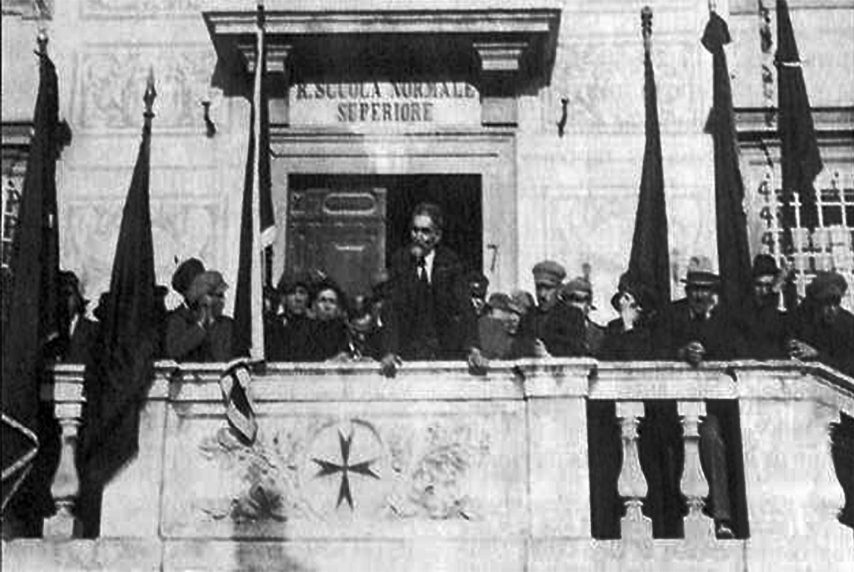
1920
Errico Malatesta’s Rally
Errico Malatesta, a prominent figure in the workers’ movement and the international anarchist scene, delivered a speech on 31 January 1920 from the steps of the Palazzo della Carovana to a Piazza filled with workers and banners.
The First World War ended in 1918, leaving a legacy of social and political fractures, loss of life, and economic crisis. Social unrest, already evident during the war, was exacerbated by unemployment, the return of veterans from the front, the emergence of new forms of poverty, the dismantling of wartime systems of subsidies and price controls, and even an epidemic caused by the Spanish flu. The war sharpened social contradictions and introduced a significant new factor: the sudden emergence of the masses onto the public stage. During what is commonly referred to as the Biennio Rosso (Red Biennium) of 1919–1920—though it in fact encompassed a variety of political forces and tendencies—Italy was shaken by intense conflicts that erupted into peasant struggles, workers’ strikes, food riots, and protests against the rising cost of living. These public demonstrations found crucial support in trade union and socialist organisations, while the response of the liberal state oscillated between an initial, moderate reformist approach and a harsh, repressive counteroffensive.
It was in this context that Errico Malatesta, described in the memoranda of the Public Security authorities as a nota persona (known figure), returned to Italy from London at the end of 1919. He had taken refuge there in 1914 after an arrest warrant was issued for his role as an agitator in the Settimana Rossa (Red Week) uprisings. Both a distinguished political theorist of international anarchism and a formidable agitator, Malatesta returned to Italy, where he embarked on a tour of lectures, rallies, and meetings. Despite being over sixty years old, he travelled tirelessly across Italy, greeted everywhere by piazzas overflowing with crowds. A testament to his moral stature is the letter entitled Grazie, ma basta (‘Thank you, but enough’), published in the weekly Il Libertario. In it, he expressed his gratitude to his comrades but urged them to curb the personal adulation, warning that ‘it is politically dangerous and morally unhealthy for both the exalted and those who exalt them.’ Malatesta’s aim was revolution, conceived as an insurrectionary and violent break with the political and economic order of the bourgeois state, in pursuit of the emancipation of workers and the liberation of all humanity.
Among the ‘grand revolutionary receptions for Errico Malatesta’, the one in Pisa, which took place the day after a national strike by railway, postal, telephone and telegraph workers, was particularly notable. The atmosphere in the city in late January was highly charged, as the night of 20–21 January had seen violent actions and arrests carried out by groups of armed civilians. The city responded swiftly and spontaneously by declaring a general strike until the detainees were released. Despite the short notice of his visit, Malatesta arrived at the train station on 31 January to be greeted by an enthusiastic crowd. According to the local anarchist press, ‘a thunderous applause, springing from the pure and rebellious soul of our people, welcomed the man of a hundred battles, and the cry of “Viva Malatesta”, the leader of the Italian Revolution, echoed through the air. Preceded by numerous banners, a procession immediately formed and, singing rebellious hymns, moved towards Piazza dei Cavalieri’, where a rally was improvised on the entrance staircase of Palazzo della Carovana. Malatesta spoke after the anarchists, representatives of the Chamber of Labour, socialists, and railway workers. His speech was clear and direct: ‘The revolution must be made by the people’, through the convergence and unity of all subversive left-wing forces. It could not be carried out ‘with folded arms, […] by abandoning machines or factories’, but rather ‘must be fought by confronting arms with arms’, while not neglecting ‘the study of the question of food supply in the aftermath of the destruction of the bourgeois state’.
In the days that followed, as Malatesta resumed his campaigning tour, he was arrested in Tombolo, between Pisa and Livorno, but was swiftly released after a wave of protests and a general strike in Tuscany. True to the ideals he had upheld throughout his life, he continued in the months and years that followed to promote social revolution, though he never saw it realised.
Media gallery
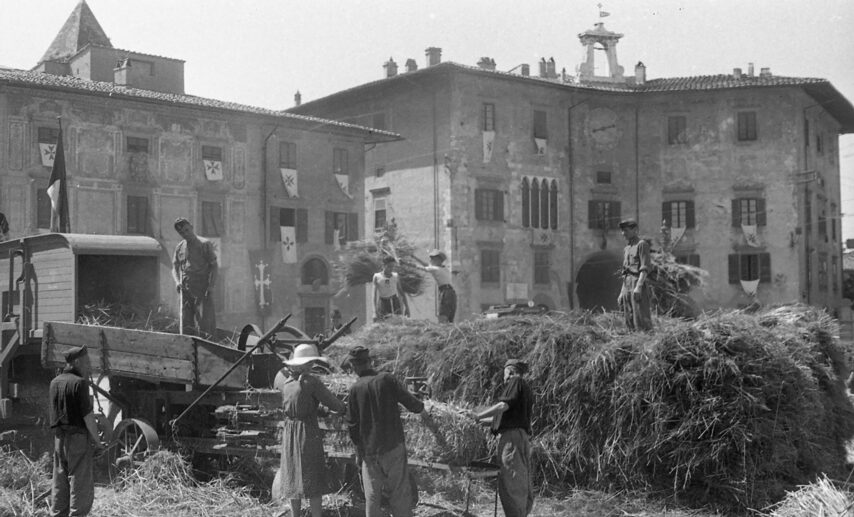
1925-1943
The ‘Battaglia del Grano’
During the Fascist regime, Piazza dei Cavalieri was home to ‘la festa del grano’, a strictly controlled mass mobilisation festival that formed part of Mussolini's 'Battaglia del grano' [Battle for Grain]. Launched in 1925, this campaign aimed to boost national cereal production. In the urban space, sheaves of grain were threshed using modern agricultural machinery, celebrating rural work and technological progress.
Like all totalitarian regimes, Fascism advocated a determined policy of mass regimentation. This was pursued (among other means) through an overwhelming and carefully planned series of gatherings: assemblies, ‘patriotic ceremonies,’ demonstrations, and speeches, promoted either by the national regime or by myriads of associations through which social life was organised at the time. Public space, particularly the piazza, assumed special importance within this strategy (which was not free from coercion).
Along with other locations in the city (Piazza del Duomo, which hosted a famous visit by Mussolini in 1926, and Piazza Santa Caterina, which welcomed the royal family in 1925), the Piazza dei Cavalieri held a privileged role. Among the many events here, one of the most distinctive was undoubtedly connected to promoting the famous ‘Battaglia del grano’. Announced by Benito Mussolini in a statement on 11 June 1925, and reinvigorated in 1935 in response to international sanctions, the campaign aimed to increase national cereal production. The campaign’s economic goals (food self-sufficiency, balanced books, and support for Italian producers) were flanked by political ambitions. As campaign architect Francesco Todaro noted, the Fascist regime credited grain with ensuring ‘national independence in peace and victory in war’ [‘l’indipendenza nazionale in pace e la vittoria in Guerra’]. However, beyond these practical aims laid deeper ideological purposes. Under the slogan ‘Italy must be ruralised’ [‘bisogna ruralizzare l’Italia’] , the regime contradictorily mixed its traditionalist and reactionary component – rooted in myths: the return to the land, the virility and morality of country life, ultra-local traditions (strapaese), and bucolic idylls – with its modernist aspect, fascinated by technological advancement and industrialisation.
The ‘Battaglia del grano’ consisted of multiple events and meetings branching out, as always, between the centre (Rome) and the periphery. In Rome, at the Teatro Argentina, winners of the ‘National Competition for the Victory of Grain’ [‘Concorso nazionale per la vittoria del grano’] were proclaimed between October and December. Mussolini himself called these winners veliti (light infantry). In July 1934, the competition was renamed to the ‘National Competition of Grain and Agricultural Business’ [‘Concorso nazionale del grano e dell’azienda agraria’], awarding the most productive farms in the presence of the head of government himself. Meanwhile, individual provinces held their own local celebrations. For example, Pisa ‘boasted’ many mentions in the third edition of the award (1927). The regime, working through local Fascist organisations, established the so-called ‘travelling agricultural lectures’ [‘cattedre agricole ambulanti’], which were mobile demonstration workshops that taught farmers the latest production techniques. At the same time, additional activities included scientific conferences, exhibitions, and film screenings.
As in other Italian cities, Pisa celebrated the grain festival between June and July (coinciding with the final phases of harvest). Sheaves were placed in the piazza and then threshed. This operation was performed by automated machinery and was used for demonstration and advertising purposes. One of the accompanying photographs shows a model from the S.A. Balduzzi e Rovida company in a piazza crowded with city banners. In this urban masterpiece of Italian Mannerism, before the pride and joy of the national academy, the Scuola Normale, Fascism merged ancestral tradition (the harvest festival) with technological innovation and business promotion. This was one of the many forms in which the regime’s often reckless eclecticism expressed itself during its power in Italy between 1922 and 1943.
In one of the accompanying photographs, set in a square festooned with civic banners, a thresher from the S.A. Balduzzi e Rovida company is visible. Within this urban masterpiece of Italian Mannerism, in the presence of the nation’s academic crown jewel, the Scuola Normale, Fascism combined an ancestral tradition (the harvest festival) with technological innovation and corporate promotion. This represents one of the many forms in which the regime’s eclecticism expressed itself—in many cases reckless or unprincipled—during its hold on power in Italy between 1922 and 1943.
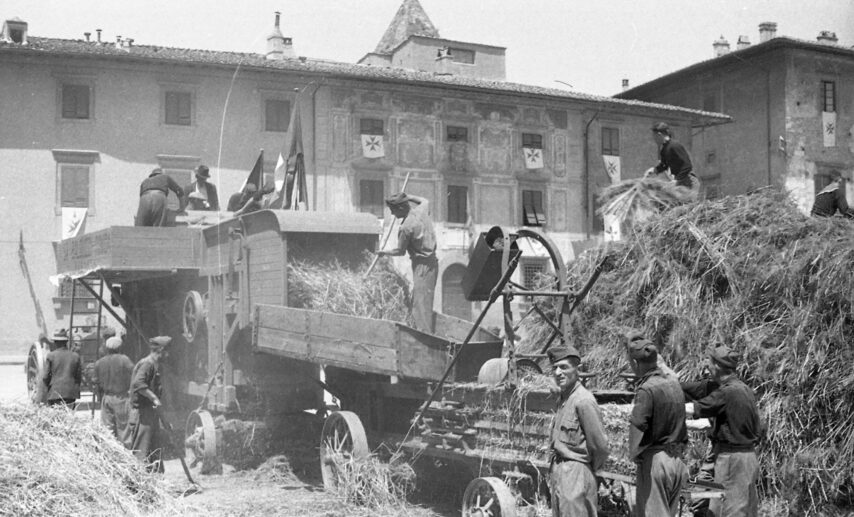
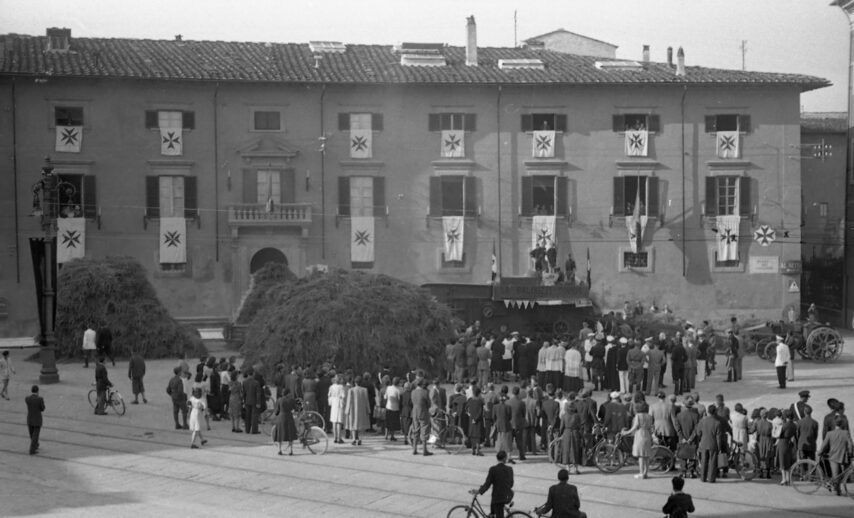
Media gallery
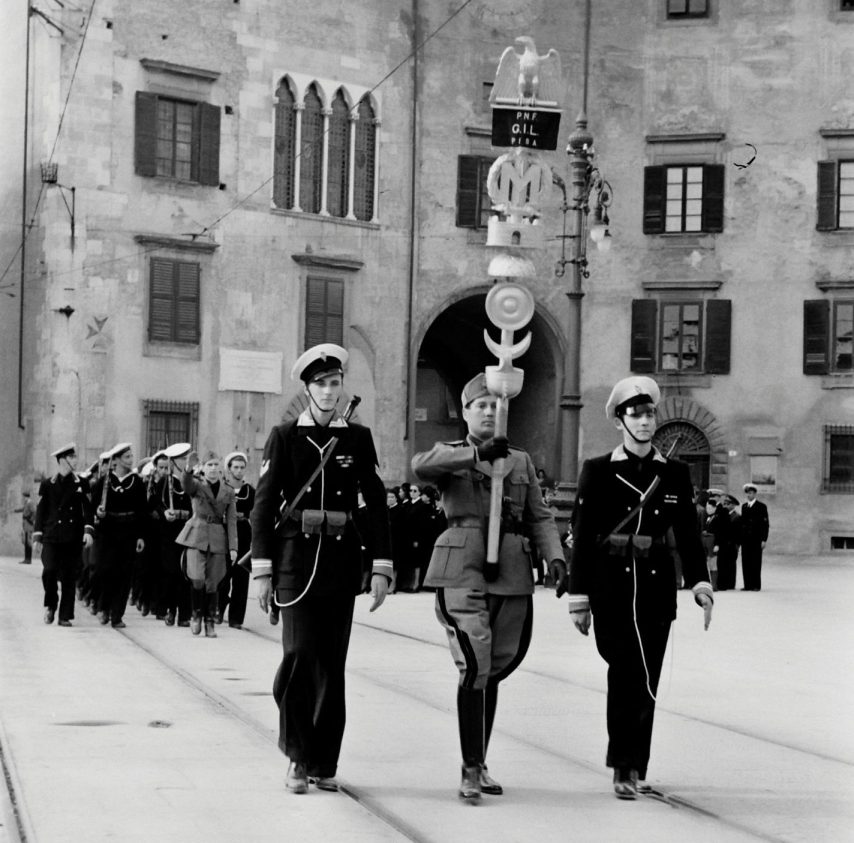
1935-1940
Parades of Fascist Youth Organisations
Under Fascism, Piazza dei Cavalieri became a focal point of the regime’s ritual life, hosting gatherings and parades that were widely attended by the population during the 1930s. Particularly significant were the events involving youth, who marched in groups divided by age and gender, in line with the Fascist regime’s framework for disciplining society.
Like many other Italian cities, Pisa experienced a period of profound upheaval and mounting social and political tensions after the First World War. In this climate of growing instability, the first founding assembly of the Fascist movement was held in Borgo Stretto on 28 April 1920. Initially composed of young veterans, including former Arditi (veterans of Italy’s First World War assault troops), students, members of the small and medium agrarian bourgeoisie, the unemployed, and the disaffected, the Pisan Fascio (local branch of the Fascist movement) adopted an increasingly violent stance during the 1920s. Nevertheless, it retained the support of both the local establishment and the military authorities, while its membership grew exponentially, reaching around 34,000 by 1939. This expansion reflected not only the consolidation of Fascist power in Italy but also its ability to embed itself deeply in Pisan society, through a combination of violence and propaganda, reinforced by the backing of local elites.
One of the key figures of local Fascism was Guido Buffarini Guidi, who, after serving as podestà (mayor under Fascism) from 1926 to 1933, became Undersecretary of the Interior, a position he held until the fall of the dictatorship. His leadership helped to consolidate Fascist power in the city, with Piazza dei Cavalieri becoming its natural stage. The imposing Vasarian staircase of Palazzo della Carovana was turned into a platform from which speeches were delivered by microphone to the assembled crowd. Events celebrating the so-called ‘battaglia del grano’ or commemorating the March on Rome—such as those documented in photographs of 28 October 1935, showing an immense gathering—were regularly held in this urban space. During the ventennio—the twenty years of Fascist rule—Piazza dei Cavalieri also underwent major architectural interventions, the first in over two centuries, including the renovation of the two side wings of the church of Santo Stefano and the enlargement of the Palazzo della Carovana under the commissionership of the philosopher Giovanni Gentile (1928–1933).
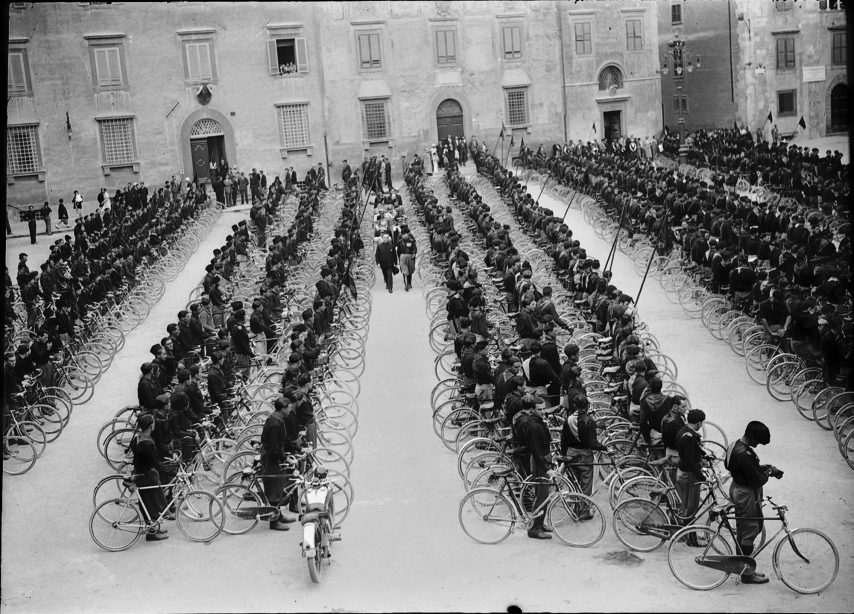
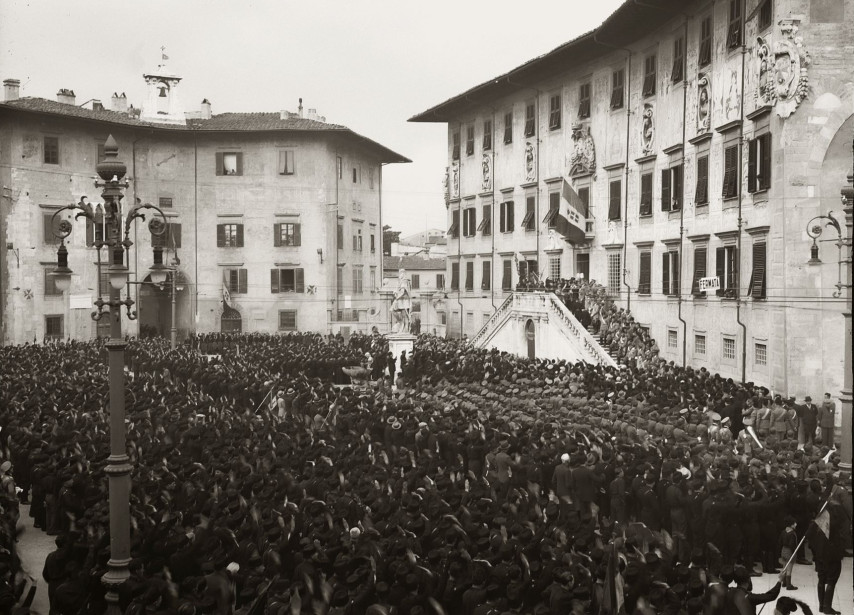
Among the various events held in Piazza dei Cavalieri, parades—both military and civic—were particularly prominent. These occasions functioned as moments of collective participation and rites of passage, mobilising broad sections of the population, and found one of their most visible expressions in the marches of the different youth organisations.
The Fascist disciplining of society—structured by gender, age, and occupation—found one of its most effective expressions in the comprehensive organisation of youth through the creation, in 1926, of the Opera Nazionale Balilla. This autonomous body was entrusted, as the sole legitimate authority across the entire national territory, with the education and assistance of children and adolescents up to the age of eighteen. At that point, they entered the Fasci Giovanili di Combattimento (Youth Combat Fasci), renamed Gioventù Italiana del Littorio (Italian Youth of the Lictor) in 1937 as Giovani Fascisti (Young Fascists). A decree of 1934 refined the structure, defining three distinct categories for boys: Figli della Lupa (Sons of the She-Wolf, six to eight years), Balilla Moschettieri (Balilla Musketeers, eight to fourteen), and Avanguardisti (Vanguardists, fourteen to eighteen). The regime kept boys’ and girls’ organisations separate, assigning them distinct educational and formative goals. A parallel structure was created for girls: Figlie della Lupa (Daughters of the She-Wolf); Piccole Italiane (Little Italian Girls) from eight to fourteen; then Giovani Italiane (Young Italian Girls); and, from seventeen, Giovani Fasciste (Young Fascists). Upon reaching the age of twenty, young women could enter the Fasci Femminili (Women’s Fasci). In Pisa in 1940, 23 percent of girls between 15 and 17 years old were enrolled in the Gioventù Italiana del Littorio.
Numerous photographs from the period show Piazza dei Cavalieri crowded with people watching militaristic and authoritarian parades, in which various groups, including youth organisations, marched in strict divisions by age, gender, and uniform. On these occasions, the Figlie della Lupa wore a long-sleeved white piqué blouse, a black skirt, white stockings, and a woollen beret. The Giovani Fasciste wore a black suit, white blouse, and flesh-coloured stockings. TheBalilla Moschettieri paraded in black wool fezzes, black cotton shirts, shorts, and grey-green knee socks. Finally, the Giovani Fascisti wore a grey-green military-style cap, a black shirt, knickerbocker-style trousers, and long white gaiters. During the parade, each transition between youth organisations represented a symbolic act of continuity. Through a ritual gesture, such as an embrace, representatives of each organisation marked the passage from one stage to the next, thereby reinforcing the Fascist indoctrination of successive generations.
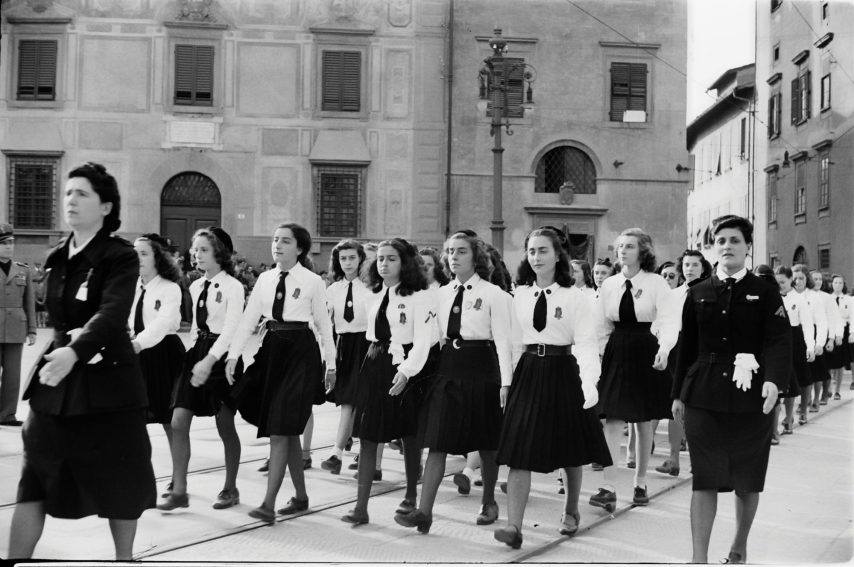
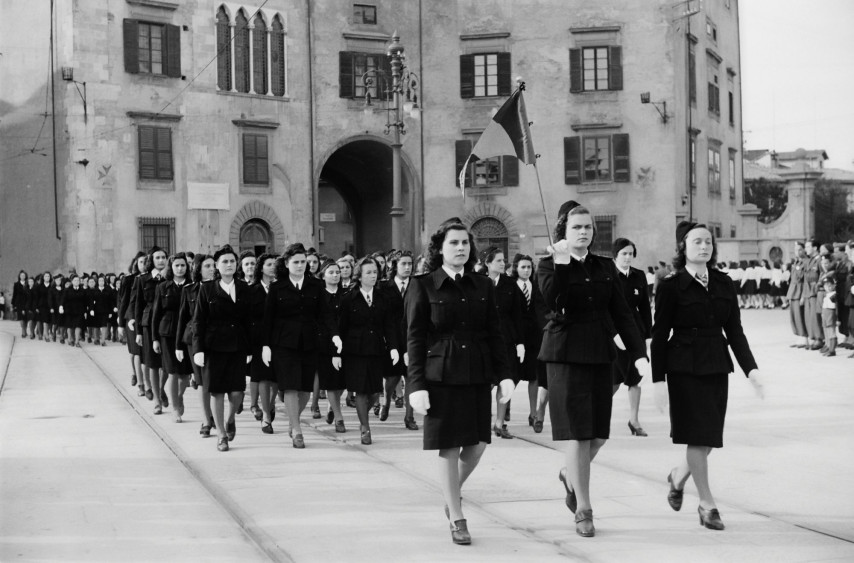
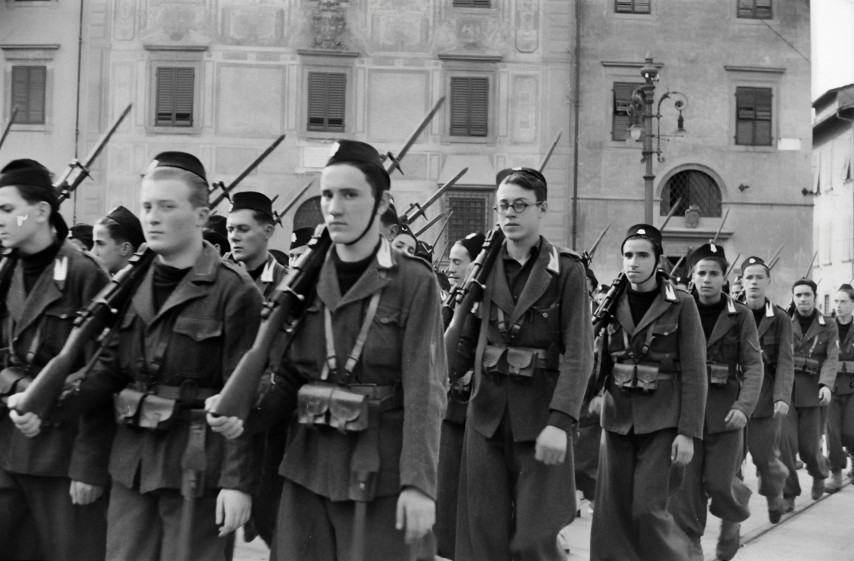
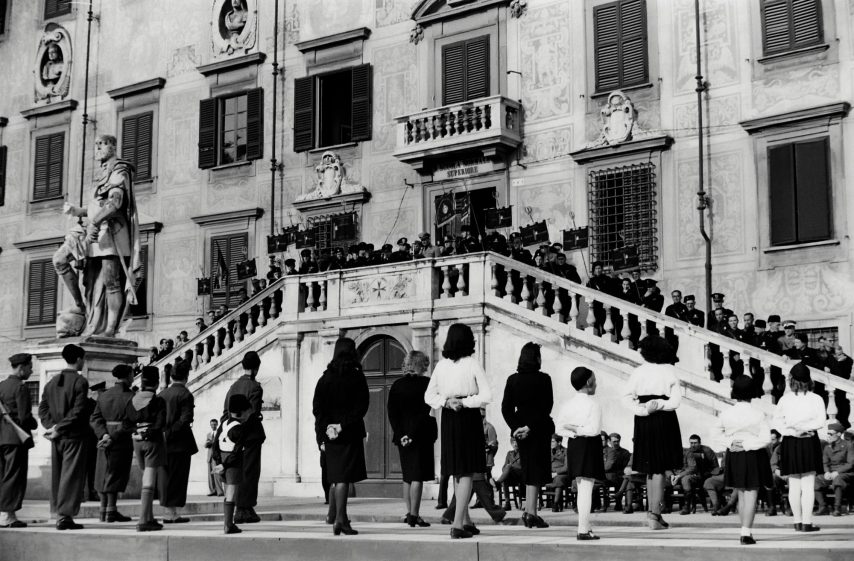
In Pisa, as elsewhere in Italy, the Party and its numerous organisations sought to permeate civic life, occupying a significant place in everyday life. The Fascist project, conceived and idealised by Mussolini and his supporters, implied a biopolitical vision of the nation, aimed at framing society both spiritually and materially. During the ventennio, the ceremonies held in Piazza dei Cavalieri—emblematic of the ritualisation of Fascist politics—served to reinforce the integration of Pisa’s population into a hierarchical structure intended to perpetuate the regime’s ideology. In the 1930s, these events brought citizen mobilisation to unprecedented levels, transforming the urban space from the civic heart of the city into a stage of collective participation: a sacred and symbolic place where a rigidly organised and disciplined “liturgical mass” periodically celebrated the rites of the fatherland in what amounted to a civil religion of the nation.
Media gallery
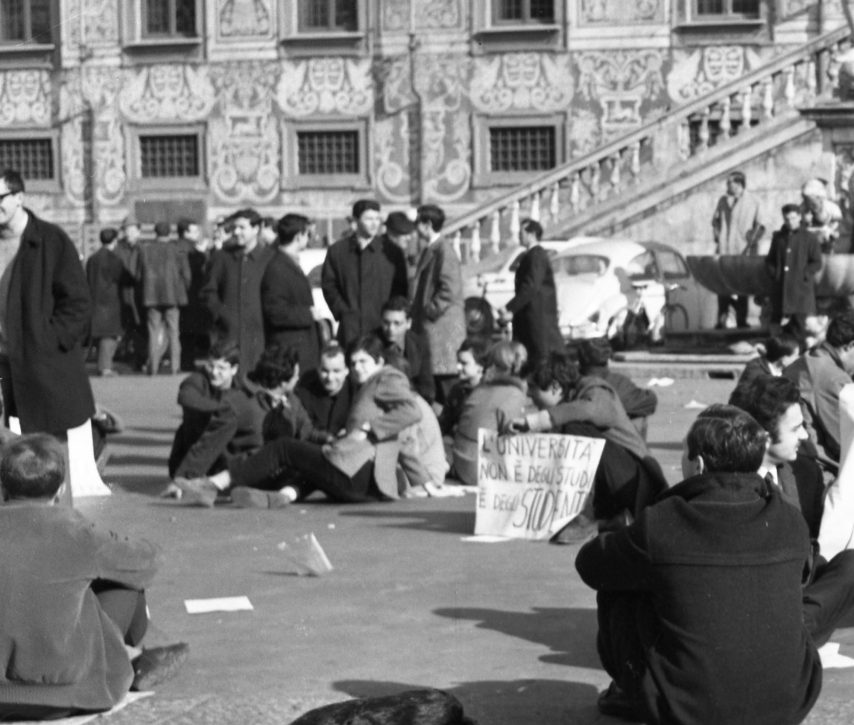
1967-1968
Student Protests
In February 1967, students began to challenge a model of university and society that they found unsatisfactory, bringing their demands directly into Piazza dei Cavalieri and inaugurating its role as a site of protest, which it would continue to play over the next two years.
On the occasion of the rectors’ conference scheduled for 11 February 1967 in Pisa, students decided to occupy the Palazzo della Sapienza and protest against the so-called ‘Gui Plan’. The government-backed proposal envisaged a structural reorganisation of the university system, including differentiated study paths based on professional prospects. On the left, however, it was widely seen as falling short of the demands for a democratic transformation of the academic world.
Beginning on 7 February, the occupying students launched a series of discussions on the university system and its forms of representation, which led to the collective drafting of the so-called Progetto di Tesi del sindacato studentesco (Tesi della Sapienza), a document that affirmed the need for students to have a decision-making role in their own education and called for new methods of democratising the university system through assemblies.
At its core was the theoretical claim that students should be regarded as workers: ‘the student is a worker and, as such, if they produce, they are entitled to a wage; if not, they have no right to remain at university.’ The Tesi demanded a right to education as a democratic instrument to guarantee access by removing class barriers, and as a contestation of the capitalist model. What distinguished it from earlier student mobilisations was precisely its connection with trade-union and workers’ struggles, a convergence further encouraged by the ongoing process of factory dismantling and deindustrialisation.
The occupation of the Palazzo della Sapienza in Pisa assumed a national scope and received unprecedented media attention, amid considerable tensions. These arose partly from clashes with the academic authorities under contestation and partly from the opposition of the conservative faction of the student body. This faction, which included elements from the neo-fascist Fronte Universitario d’Azione Nazionale, rejected both the protest and the resulting suspension of classes.
On the night of 11 February, only hours before the institutional conference was due to begin, police moved in to clear the occupation. In response, students flooded into Piazza dei Cavalieri, where they staged one of the earliest sit-ins in the history of protest in Italy.
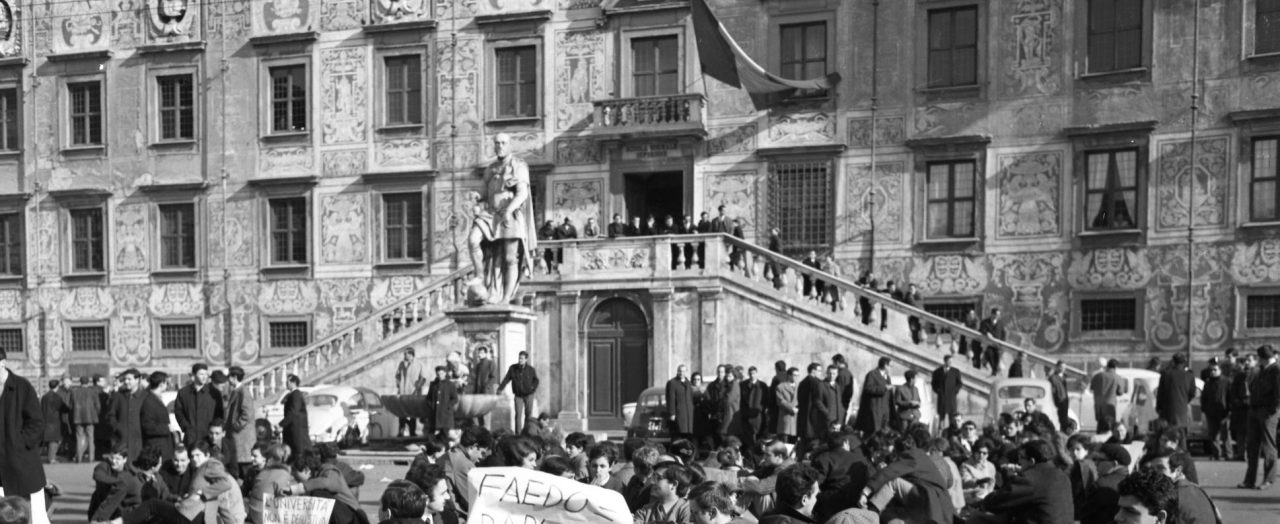
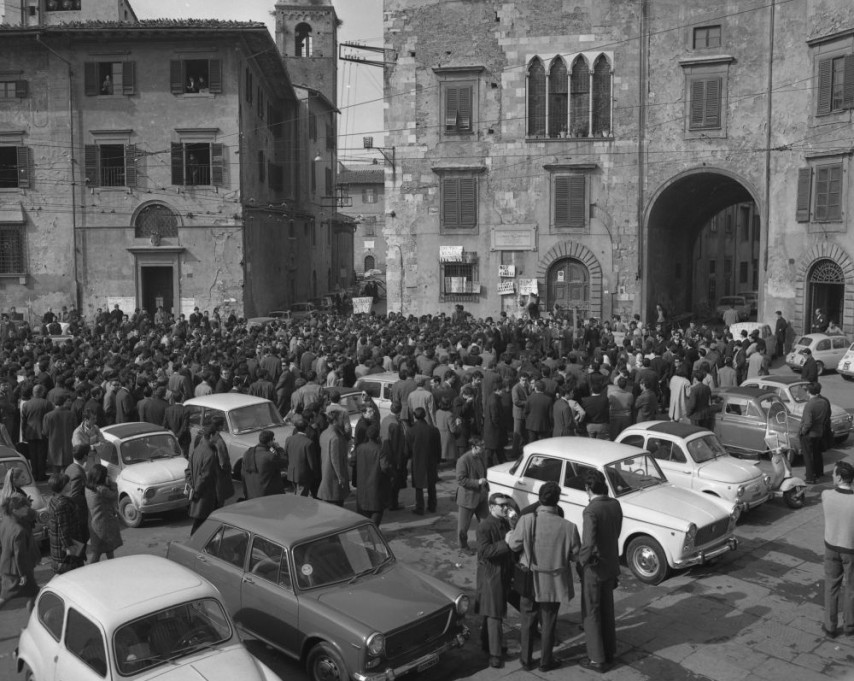
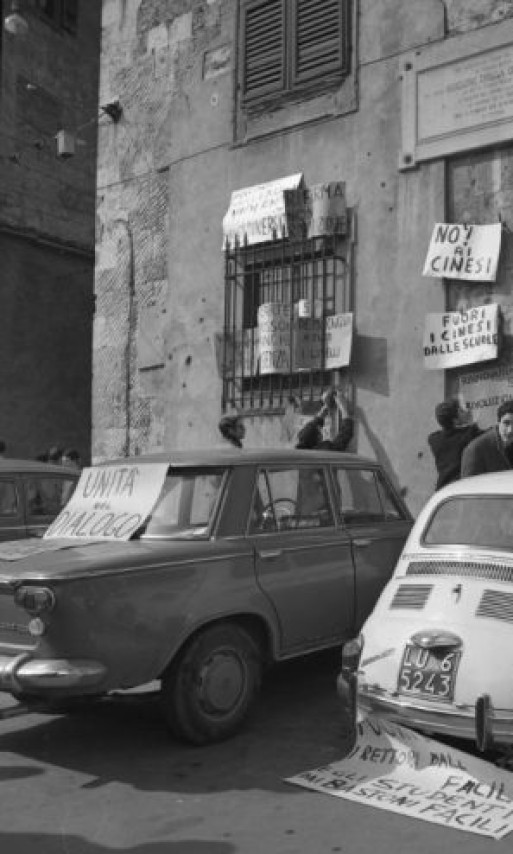
The period later known as ‘the long ’68’ marked the beginning of a comprehensive drive for societal renewal that extended into the 1970s, involving feminist movements, high school students, trade unions, and workers. In Italy, its main protagonists were the twenty-year-olds of the first generation born after the end of World War II. Entering university amid worldwide upheavals, they became part of a wave of political and cultural youth revolt that spread from American campuses to Europe. It was fuelled by mass opposition to the Vietnam War and to racial segregation in the United States, and drew inspiration from revolutionary figures such as Ernesto ‘Che’ Guevara, as well as from Mao’s Little Red Book and the Chinese Cultural Revolution, and was marked by concern over the colonels’ coup in Greece and the Soviet tanks in Prague. For this generation, 1968 was a formative moment—socially, culturally, and politically—and ultimately a crucible for the country’s future political leadership.
These global and national dynamics also left their mark on Pisa, where Piazza dei Cavalieri became a key setting for protest, serving as a gathering point, a passage along march routes, or the destination at the end of the day’s demonstrations. Such was the case on 24 November 1968, during a city-wide march against the Vietnam War promoted by the Italian Communist Party and the Italian Socialist Party of Proletarian Unity. A political propaganda poster from that event is still preserved in the Biblioteca Franco Serantini, along with other documentation that highlights the key issues of the period, from support for striking workers at Saint Gobain and Marzotto in the autumn to solidarity with employees of the Upim department stores in December. Flyers of this kind were likely distributed in the piazza as well, where counter-protests also took place. Photographs from the time show placards reading ‘No to the Chinese’ [‘No ai Cinesi’], a pejorative slogan signalling opposition to the student movement, which was regarded as radical and associated with the Chinese Cultural Revolution.
The significance of Piazza dei Cavalieri during this turbulent two-year period lay not only in its central location within the city, but above all in its role as a hub linking Pisa’s main university sites, only steps away from where students both studied and lived. Alongside the historic student residences already in the square—the Palazzo della Carovana and the Collegio Puteano—the Palazzo dell’Università had, in the post-war years, been converted into accommodation under the name Collegio Pacinotti. In addition, the Casa dello Studente ‘Aldo Fascetti’, recently built adjacent to the piazza, was at that time used as a venue for assemblies and thematic lecture cycles.
Media gallery
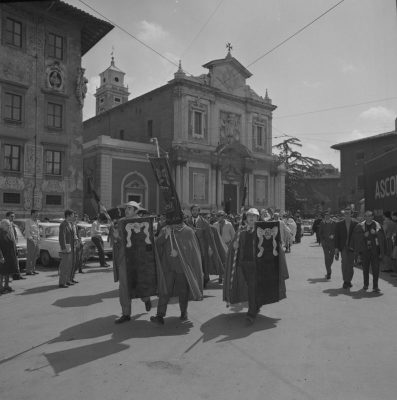
1968-1969
The University Students’ ‘Festissima’
Like other parts of the city, Piazza dei Cavalieri hosted the passage of the Festissima delle Matricole, the annual festive event in which students of the University of Pisa prepared floats and masquerades, drawing in the local community. This was also the case in 1968–1969.
The very name, ‘Festissima delle Matricole’, evoked the playful and ironic spirit of the event, which in late 1960s Pisa remained a highly anticipated and important annual occasion. At the start of the academic year, students from the University of Pisa organised this occasion of collective amusement, conceived as a kind of improvised carnival that enlivened the whole city. Promoted by students from different faculties, recognisable by the colours of their feluca (a cap of medieval origin) worn by the young participants, the procession wound its way along the riverbanks to reach Piazza Garibaldi, where pranks and banter ensued. The festivities continued from Borgo through Piazza dei Cavalieri and on to the stadium, enlivened by games and competitions of every kind, from sack races to the ‘palio dei ciuchi’ (donkey race). Large numbers of Pisans filled the streets and squares, following the ingenious and imposing allegorical floats on which the ‘goliardi’ (members of Italy’s student carnival tradition) paraded in ironic disguises and period costumes. Dressed in absurd costumes or made to hold placards with improbable Latin phrases in place of its staff of command, even the statue of Cosimo I de’ Medici could be irreverently drawn into the revelry.
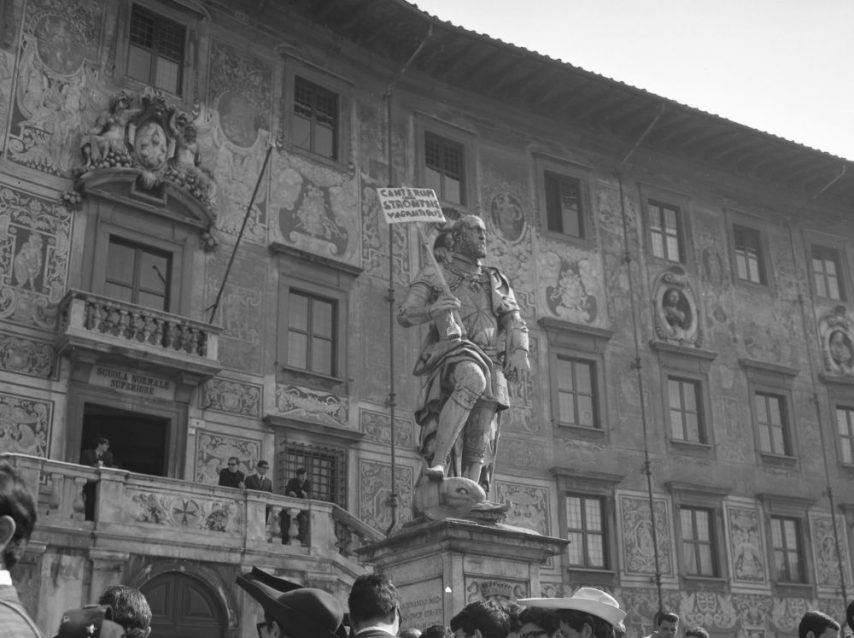
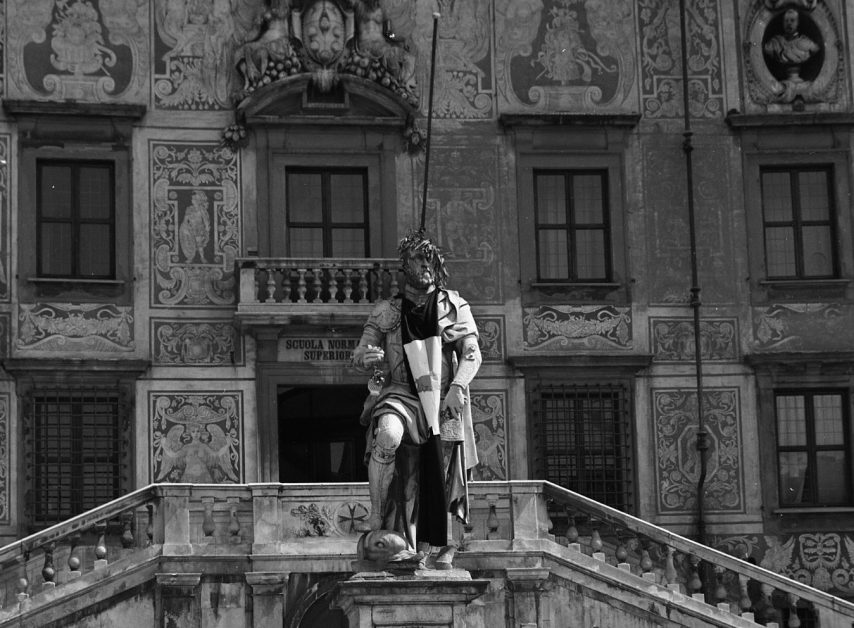
For centuries goliardia (student carnival culture) was the intellectual prerogative of those privileged enough to pursue advanced study, and it traditionally expressed itself through poetry, song, prose, theatre, and drawing. In Pisa—a city profoundly shaped since the Middle Ages by the presence of its University and academic colleges—goliardic festivities became over time a defining feature of local culture, particularly with the nineteenth-century expansion of the University. In the early twentieth century, the organisers of Pisa’s goliardic life conceived the idea of establishing an annual occasion to stage playful events that would also engage the wider community. Thus was born the Festissima delle Matricole, characterised by a parade of allegorical floats from the various faculties, inspired by the late-nineteenth-century Viareggio Carnival, together with performances of operettas (the most famous being Addio giovinezza!) and a publication bearing the same title as the event. The return of students to the University after the First World War marked a revival of goliardic activities, particularly through the efforts of the Crocchio Goliardi Spensierati (Circle of Carefree Students). The rise of Fascism—with the formation of the Fascio Pisano in 1920, the establishment the following year of the Fascist University Groups (GUF), and the March on Rome in October 1922—brought repression and the dismantling of both antifascist and apolitical student organisations, significantly curtailing goliardic activities, which became increasingly rare. It was only after the arrival of the Allies in Pisa that, on 6 December 1944, at the Palazzo della Sapienza, a group of young students re-established an association to revitalise university life: the Unione Goliardica Pisana (UGP). As the first Italian student organisation of the post-war period, the UGP played a pivotal role in supporting the University’s renewal after the devastation of war.
In the second half of the 1950s, profound changes that affected the University and, more broadly, the social and cultural fabric of Pisa helped to reshape the aspirations of the student body, increasingly oriented towards political debate, civic engagement, and criticism of traditional academic models. Pisa’s goliardic tradition was deeply affected by these transformations, gradually losing the central role it had once held in university life. In the turbulent years of 1968–1969, the Festissima delle Matricole was still held, continuing to serve as a moment of welcome for new students, though without the participation of the historic goliardic organisations. Photographs from those years clearly show that contemporary public issues—such as the condemnation of fascism and opposition to war—were also expressed in the procession, albeit in a tone of light-hearted irony, markedly different from the serious register that was, at the same time, shaping the student protests of 1968.
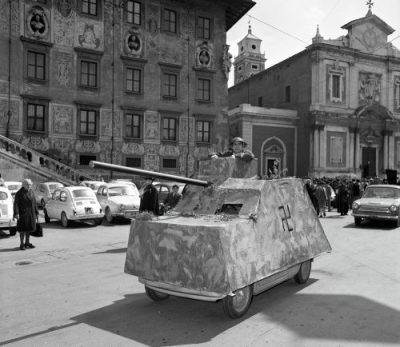
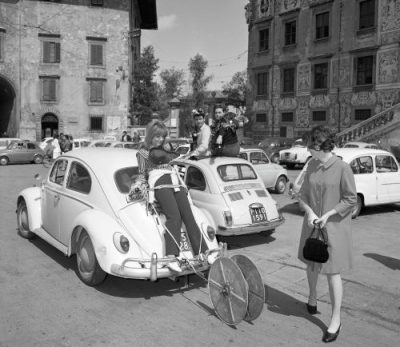
Media gallery
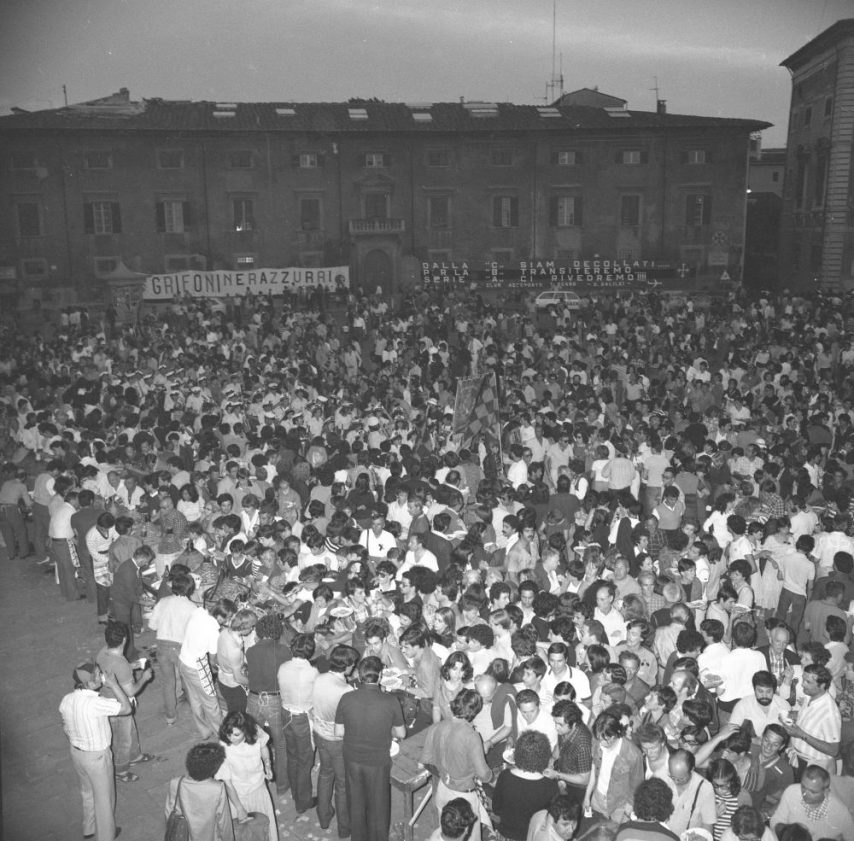
1979
Celebrations for Pisa’s Promotion to Serie B Football
In June 1979, Romeo Anconetani, less than a year into his presidency of Pisa Sporting Club, guided the city’s team to promotion to Serie B football (the Italian second division). This first success of his presidency sparked great enthusiasm in the city, and to mark the milestone, Piazza dei Cavalieri was chosen as the gathering place for supporters, where a long table was set and ‘soup and wine’ were served to all.
The history of Pisa Sporting Club is notable for both its longevity and historical significance. Founded in 1909 and distinguished by its black-and-blue colours, the club soon established itself as the city’s leading football representative. After winning the Tuscan championship in 1914–1915, it rose to prominence in the immediate post-war years, reaching the final of the Italian championship held in Turin in July 1921. Meanwhile, in 1919, the Arena Garibaldi stadium—still in use today—was inaugurated just outside Porta a Lucca After a period of decline, culminating in relegation to the Third Division at the end of the 1920s, the club experienced mixed fortunes in the post-war era: another relegation to the fourth tier in the early 1950s, promotion to Serie A in the 1967–1968 season, and then a return to the lower leagues, which prompted a major change in leadership. This came in the summer of 1978, when Romeo Anconetani, born in Trieste in 1922, took over the club, remaining president for sixteen years until 1994. Under the leadership of the presidentissimo, the club achieved prestigious successes, including promotion to Serie A in 1982 and victory in the Mitropa Cup in 1988, reviving its fortunes within just a few years.
From the outset of his career in the 1950s, Romeo Anconetani distinguished himself as a multifaceted and innovative figure in Italian football, with a particular focus on the needs of supporters. His initiatives included introducing ‘special trains’ for fans and advance ticket sales at box offices several days before matches. This attentiveness to the fan base and the local community was also evident after Pisa Sporting Club’s promotion to Serie B, achieved after eight seasons of failed attempts. The long-awaited victory over Paganese Calcio (the team from Pagani, Campania) on 9 June 1979 unleashed a wave of enthusiasm in the city of Pisa, with spontaneous celebrations in which ‘parades of cars and scooters with black-and-blue flags’ filled the city’s squares and streets in ‘a deafening celebration that went on until morning,’ as reported in the local press. A few days later, on 14 June, upon the team’s return, Anconetani honoured a promise made months earlier on Radio Pisa International by organising a collective celebration through the city’s streets, culminating in Piazza dei Cavalieri.
The urban area was not only enlivened by a profusion of flags and banners hung across its main buildings, but also witnessed a parade of allegorical effigies dressed in black-and-blue football jerseys, accompanied by a large crowd of all ages. As often happened during spontaneous celebrations in Pisa, the statue of Cosimo I de’ Medici was irreverently drawn into the festivities, transformed into a monumental supporter with a scarf draped over its marble armour and a team flag fluttering above. Most strikingly, however, the square became the stage for an unusual banquet: taking an active role in the event, the president himself—joined by former directors and coach Pier Luigi Meciani—donned a kitchen apron and served nearly three thousand people a portion of soup and a glass of wine.
The local press reported the event with great enthusiasm in the days that followed, describing ‘three thousand people participating in the black-and-blue apotheosis last night in Piazza dei Cavalieri’, thus conveying the image of a city united in celebrating its team. The rhythm of the evening was further marked by a symbolic slogan that echoed through the square, adorned with posters and banners: ‘From Serie C we’ve taken off, through Serie B we’ll pass, we’ll soon be in Serie A again.’
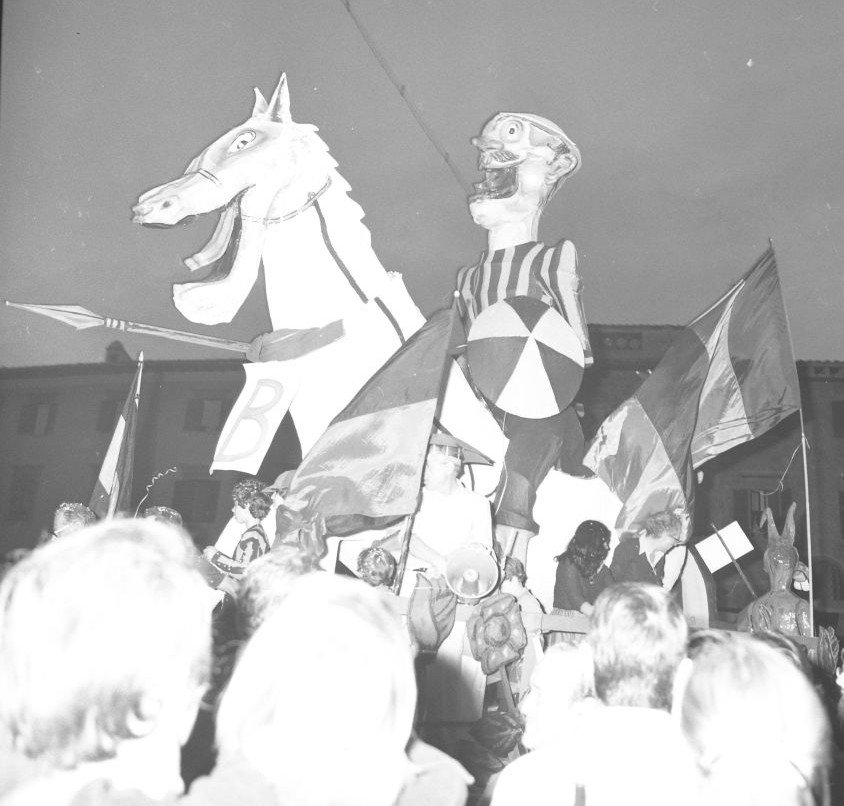
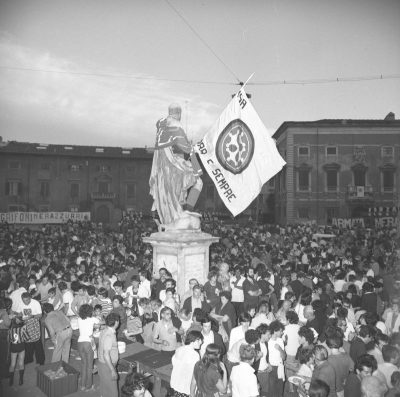
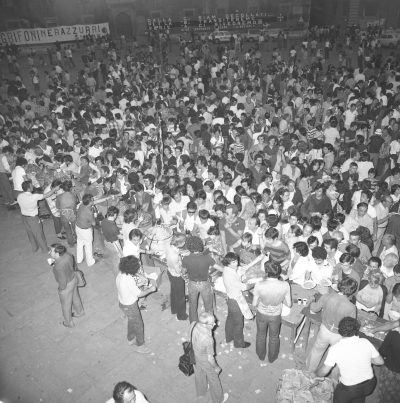
Media gallery
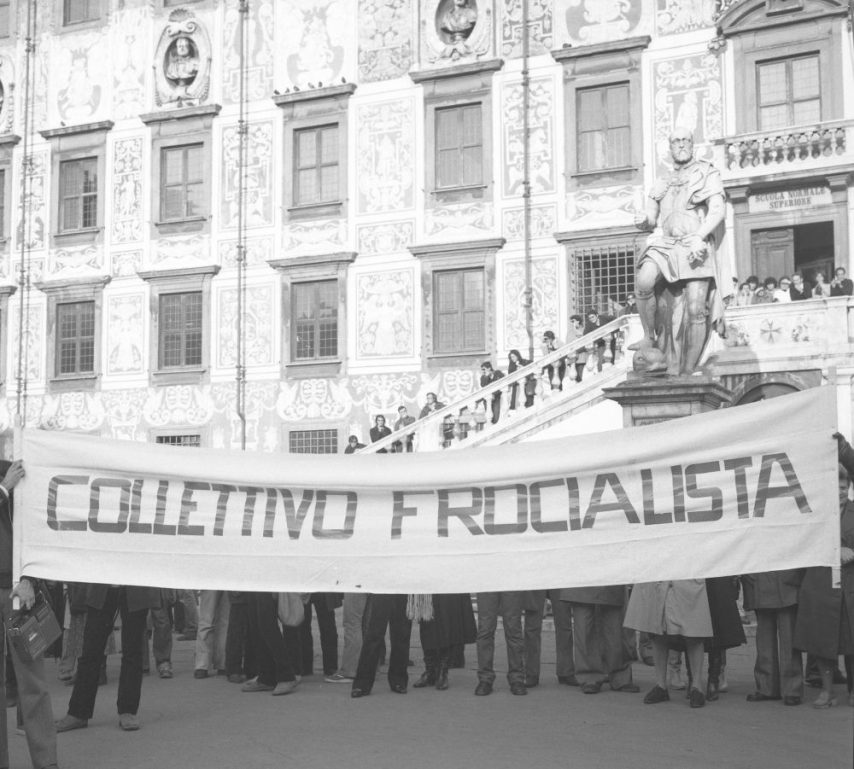
1979
The First Gay Pride Demonstration in Italy
On 24 November 1979, the National Demonstration against Violence towards Homosexual Men and Women set out from Piazza dei Cavalieri, proceeding through the city’s streets, squares, and riverbanks. Organised by the Collettivo Omosessuale Orfeo di Pisa, the event is regarded as the first gay pride march in Italy.
In June 1969, the Stonewall Inn, a gay bar and key meeting place for the gay and trans communities of Greenwich Village, became the scene of violent clashes between its patrons and the New York police. The so-called ‘Stonewall Riots’ came to symbolise the birth of contemporary LGBT+ movements, prompting the emergence of gay groups in Italy to confront the growing wave of homophobic violence collectively. In the spring of 1971, the Fronte Unitario Omosessuale Rivoluzionario Italiano (Italian Revolutionary Homosexual United Front, F.U.O.R.I.) was founded in Turin, later bringing together other gay and lesbian groups from across the country. Among its initiatives, F.U.O.R.I. rallied activists from all over Italy to Sanremo in 1972 to protest against the first International Congress held there from 5 to 8 April by the Centro Italiano di Sessuologia, whose programme included sessions on psychological and psychiatric ‘therapies’ aimed at eradicating homosexuality. The demonstration also drew gay and lesbian activists from England, France, and Belgium, attesting to the international reach of the Turin-based organisation.
This ‘little Italian Stonewall’ [‘piccola Stonewall nostrana’] marked a pivotal moment for the visibility of the gay movement in the country. In its aftermath, the 1970s saw the spread across Italy of numerous organisations committed to sexual rights and liberation. The Collettivo Omosessuale Orfeo, an autonomous group composed mainly of university students from northern Tuscany (from Versilia to Livorno), was founded shortly afterwards in a climate of mounting hostility, culminating in the brutal shooting of a gay resident of Santa Croce sull’Arno at the end of May 1979. The incident dominated the front pages of the local press for some time, arousing widespread outrage and drawing public attention.
In response, the Orfeo Collective organised a demonstration against violence and homophobia, which also affirmed the presence of gay and trans people through the visibility of a public street event. The march, regarded as the first true Italian gay pride demonstration, was also the first at national level to be authorised by the police and sponsored by a municipality. Video records confirm this—often including the voices of those who took part—together with photographs and testimonies circulated online for the thirtieth-anniversary commemoration held in Pisa.
The demonstration, known as ‘Pisa79’, was held on 24 November. Before the march began—conducted entirely peacefully, with songs and slogans, and involving several hundred participants—the meeting point was Piazza dei Cavalieri, where demonstrators assembled with banners and leaflets. They were determined to assert and normalise their presence in this urban space, transforming it from a site of political representation and power into one of visibility, self-determination, and collective liberation. As documented in photographs now preserved in the Frassi Collection at Palazzo Blu, participants in the march came from a range of gay groups, movements, and collectives across Italy, including Taranto (Collettivo Magna Frocia), Rome (Narciso. Collettivo omosessuale romano), and Bologna (Collettivo Frocialista).
‘Pisa79’ is regarded as Italy’s first Gay Pride and one of the earliest acts of visibility for the LGBT+ community. Another march of comparable significance would not take place until 1994, with Rome Pride.
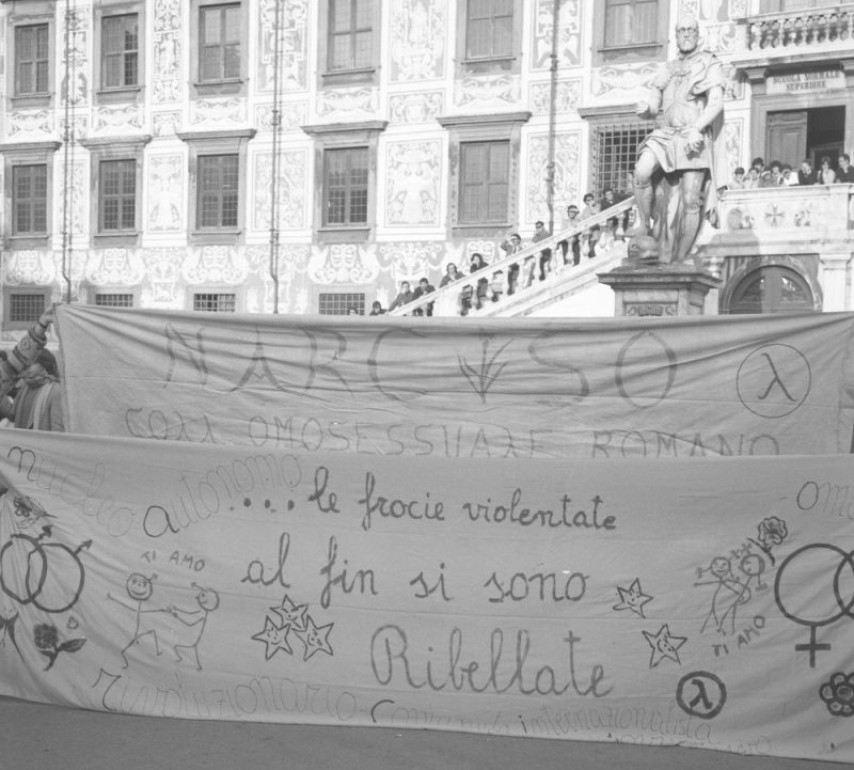
Media gallery
1990-1991
The ‘Pantera’ Movement and Demonstrations Against the Gulf War
In the early months of 1990 and again in January 1991, Piazza dei Cavalieri was the site of several protest demonstrations: first, the student movement known as the Pantera (Panther), opposing the proposed Ruberti Law, and then the mobilisation against the war in Iraq, which, in Pisa, too, drew in many sectors of civil society.
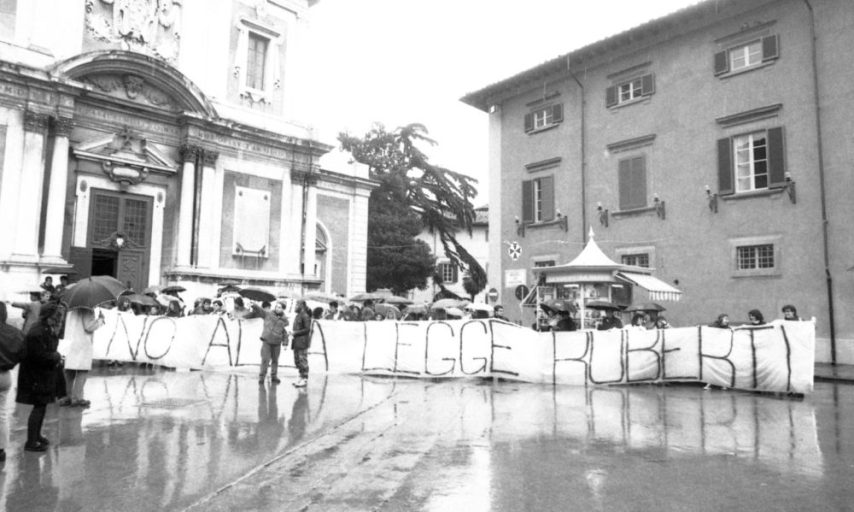
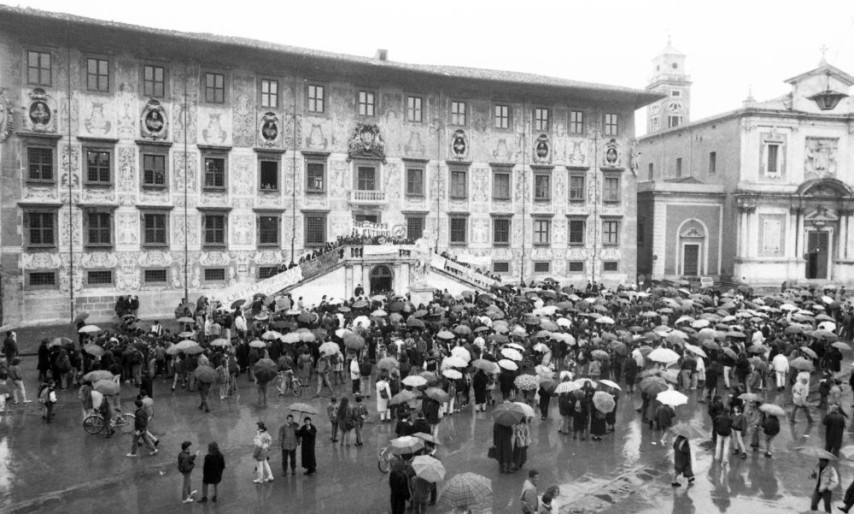
At the end of 1989, a major student protest erupted in Palermo, marking the beginning of what became known as the Pantera movement. University students, gathered in permanent assembly, voted to occupy the Faculty of Arts and Philosophy indefinitely in opposition to a reform promoted by the Socialist minister Antonio Ruberti. The reform introduced financial autonomy for Italian universities, requiring them to seek funding and partnerships from external bodies. Many students feared this would open the door to private interests in public higher education, jeopardising its accessibility and autonomy. The Palermo occupation thus became the catalyst for a broader national mobilisation.
The movement adopted the slogan ‘la pantera siamo noi’ (‘we are the panther’), coined by two activist advertisers. The image of the panther recalled the American Black Panthers as a symbol of resistance, while also recalling a story then circulating—almost mythic in tone—of a panther that had escaped from a private zoo and was roaming the Roman countryside. By January 1990, the protest had spread across Italy, gaining momentum as students in other cities joined. The Pantera soon distinguished itself for its innovative organisation, notably through the use of fax machines by a dedicated press office. This allowed both the rapid circulation of information to counter the mainstream press and real-time communication among student collectives nationwide.
A further distinctive feature of the Pantera was its use of creativity and irony as tools of inclusion. Flyers, cartoons, posters, and videos conveyed the movement’s message in ways that were accessible, inventive, and often humorous. These creative outputs not only widened participation but also reached the mass media, amplifying the movement’s visibility and marking a clear departure from the more conventional tactics of earlier student protests.
Within this wider wave of dissent, the wind of protest fanned the flames of struggle, and it soon reached Pisa. Here, the movement first took hold in the Faculty of Arts and Philosophy on 22 January 1990, when students voted to blockade the faculty, before spreading to the rest of the university. Thanks above all to Pisa’s computer science students, the movement was able for the first time to establish an email network called ‘Okkupanet’. This technological innovation, even more effective than the fax, enabled faster communication among the few universities that could access it. Okkupanet, however, never replaced traditional protest methods such as occupations and demonstrations, which remained central to the movement’s grassroots momentum.
On 30 January, secondary-school and university students marched through the streets of Pisa in a city-wide demonstration, chanting the slogan ‘No to the Ruberti Law’. The culmination of the protest was Piazza dei Cavalieri,where, as in the demonstrations of 1968, the entrance staircase of the Palazzo della Carovana was used to display posters and to recap with a megaphone the main points of the protest and its demands.
Within a few months, the Patera movement came to an end, partly because normal university activities had to resume and partly due to internal divisions, which were exacerbated by the government’s decision in the Ruberti bis law to incorporate some of the movement’s demands.
The significance of Piazza dei Cavalieri as a stage for dissent, however, remained unchanged. On 15 January 1991, more than 5,000 people again marched through the city for different reasons, halting once more in the square.
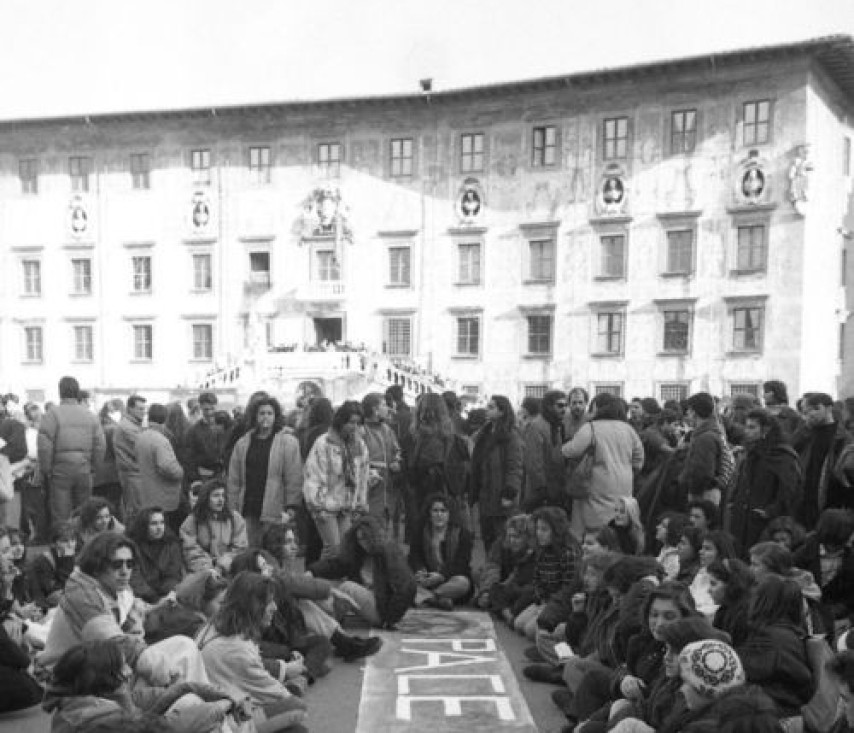
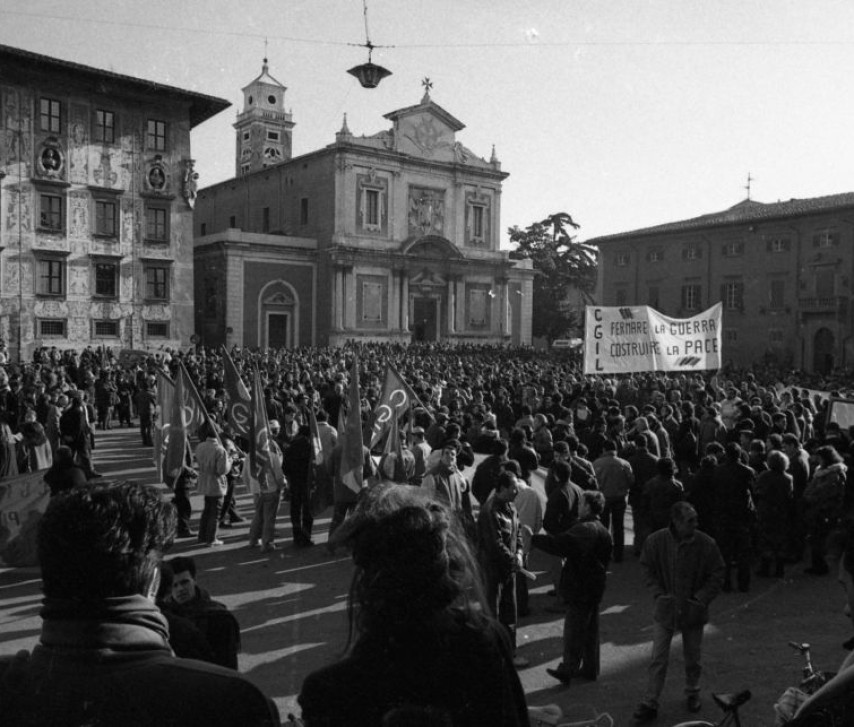
The demonstration took place on the very day that marked the United Nations’ deadline for Iraq, imposed in response to its occupation of Kuwait on 2 August 1990. That ultimatum demanded Iraq’s unconditional acceptance of UN resolutions, after a series of progressively harsher measures—from economic sanctions to a full embargo—had been introduced to force a withdrawal of troops and the resumption of peace negotiations. After 15 January, the international coalition would be authorised to intervene in support of Kuwait.
Meanwhile Italian civil society was mobilising. On 7 October 1990, the Perugia–Assisi peace march drew a large turnout, and anti-war demonstrations were organised across the country with slogans such as ‘no blood for oil’ and ‘take war out of history’, invoking respect for Article 11 of the Italian Constitution. In Pisa, a city-wide anti-war coordination group was set up, alongside assemblies and strikes. On 13 January, just days before the UN deadline, secondary-school students issued a statement: ‘We, the young people of Pisa, feel it is our duty to voice our dissent about the events now unfolding. Unable to do anything more, we want to publicly show our support for those who are desperately trying to resolve this international crisis. We cannot fully understand the reasons that drive Saddam to seek war, but we are certain of one thing: the situation that has arisen will above all harm ordinary people like us.’
The atmosphere in Pisa quickly grew tense, as reported in the local press, which described the city as a ‘hot zone’, both because of ‘the presence of the Camp Darby military base in Tirrenia, the paratroopers’ barracks, the military and civilian airport, [and] an important railway station’, and above all because of ‘the University, with its foreign visitors, young and old, including some from the Middle East’. All these elements, the papers noted, required the attention of the police, ‘who must keep the situation under control with discretion but also with vigilance’.
The demonstration of 15 January saw broad participation. Many groups marched through Piazza dei Cavalieri, including local associations, political parties, trade unions, university students, and secondary-school students, all united in a resounding cry of ‘No!’ to the war. Among the demands of the city’s anti-war committee, the call for an immediate ceasefire was linked to other key slogans of the peace movement, from the self-determination of Middle Eastern peoples to the demilitarisation of the territory.
Events in the Middle East unfolded against a new international phase marked by the end of the Cold War and the dissolution of the USSR, alongside an Italian context undergoing significant social and political transformations. Among these, the long-standing coalition government of the so-called Pentapartito (comprising the Christian Democrats, Socialists, Social Democrats, Republicans, and Liberals) was nearing its end, while the Communist Party had initiated the ‘Bolognina turn’, a process that led to its dissolution on 3 February 1991. These changes reverberated even in the peripheral context of Pisa.
In Pisa, the focus on international upheavals was partly overshadowed by local efforts to stabilise the Leaning Tower through research and engineering works aimed at reducing its tilt. The local press captured this juxtaposition in a January 1991 article titled: ‘Desolazione sotto la Torre. E la guerra uccide il turismo’ (‘Desolation under the Tower. And the war kills tourism’).
Media gallery
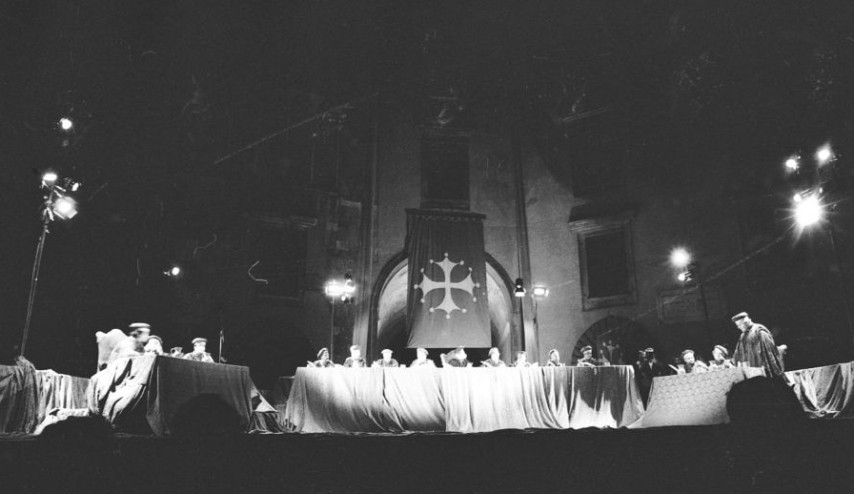
1993
Trial of Ugolino
In 1993, a symbolic trial of Count Ugolino della Gherardesca was staged in Piazza dei Cavalieri to reconsider—beyond Dante’s literary portrayal—the historical figure’s responsibility to the city of Pisa. Organised by the Municipality, the event invited the public to reflect on the divergences between historical memory, legal truth, and literature, encouraging a critical re-evaluation of the city’s past.
On 4 June 1993, Piazza dei Cavalieri was transformed into the evocative stage for this symbolic trial of Ugolino della Gherardesca, who in 1289 had been condemned to die of starvation with two sons and two grandsons in the Tower of Famine. Nearly seven centuries later, Pisa offered the medieval count, figuratively seated in the dock, the chance to plead his innocence before the Palazzo dell’Orologio—in full view of the place of his death.
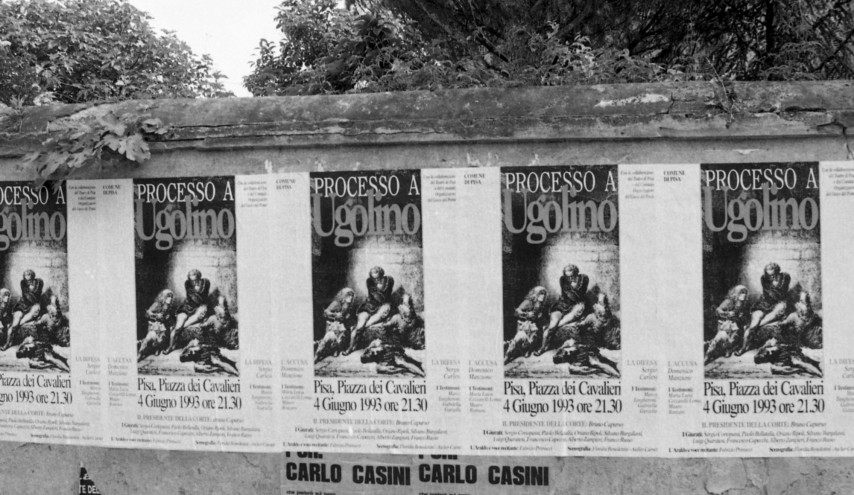
The event, organised by the Municipality in collaboration with the Teatro Verdi and the Gioco del Ponte Committee, and advertised across the city with posters, was staged as a genuine trial, conducted under the procedures of the Penal Code then in force. A court made up of historians, jurists, magistrates, and intellectuals in period costume presided, while a large audience filled Piazza dei Cavalieri to witness a detailed reconstruction of the events that led to Count Ugolino’s imprisonment. The performance lasted more than two and a half hours. The organisers aimed to provide the public with tools for a critical reappraisal, particularly of Ugolino’s literary image as shaped by Dante in The Divine Comedy—a portrayal that was at odds with the historical reality of events and, above all, left unexplained the grounds for his eternal condemnation as a traitor to his homeland.
The trial, introduced in its prologue by the narrating voice of the Herald—played by actor and director Fabrizio Primucci—set out to ‘examine the political conduct of the accused over at least two decades, with the sole aim of establishing the truth of the facts’. The prosecution, led by magistrate Domenico Manzione, brought four charges against the count, arguing that his actions formed not isolated incidents but part of a coherent, deliberate political strategy to consolidate his personal power at the expense of the city of Pisa. With the defence entrusted to journalist Sergio Carlesi, the proceedings focused on four pivotal episodes in Ugolino’s political career, considered emblematic of his conduct. Testifying for the prosecution were Maria Luisa Ceccarelli Lemut and Mauro Ronzani; for the defence, Gabriella Garzella and Marco Tangheroni—all medievalists and professors at the University of Pisa.
Of the four charges brought against Count Ugolino—including the accusation of having sought to safeguard his territories in Sardinia at the expense of the Commune’s interests (c. 1270–1276), abandoning the Battle of Meloria and thereby condemning Pisa to defeat (1284), and ceding the castles of Pontedera, Ripafratta, and Viareggio to the Lucchese Guelphs (1285)—only the fourth led to conviction. According to the court, presided over by Bruno Capurso, then a magistrate of the Court of Cassation, Ugolino’s true betrayal lay in his alleged treachery against his nephew Nino Visconti—excluding him from the diarchy and securing sole rule over Pisa. This was judged to be Ugolino’s true act of treachery: the culmination of his political manoeuvres to satisfy personal ambition at the expense of the city’s good. Despite a partial acquittal, the verdict tempered the traditional image of the count, though it did not entirely dispel its shadows.
The speeches delivered during the hearing, including those of both prosecution and defence, were later published in Processo a Ugolino, edited by the Municipality of Pisa. The volume documents in detail the argumentative frameworks advanced by each side, capturing the historical, political, and symbolic complexity attributed to Count Ugolino in contemporary debate.
Media gallery
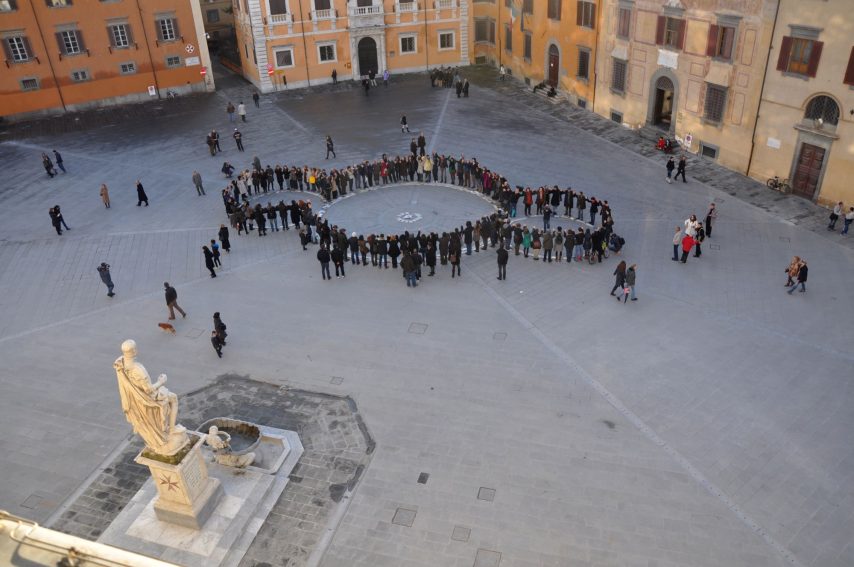
2012
Michelangelo Pistoletto, ‘Il Terzo Paradiso’
On the afternoon of 16 December 2012, Michelangelo Pistoletto's 'Il Terzo Paradiso' was created in the centre of Piazza dei Cavalieri, with the participation of Pisa's citizens and the student community of the Scuola Normale.
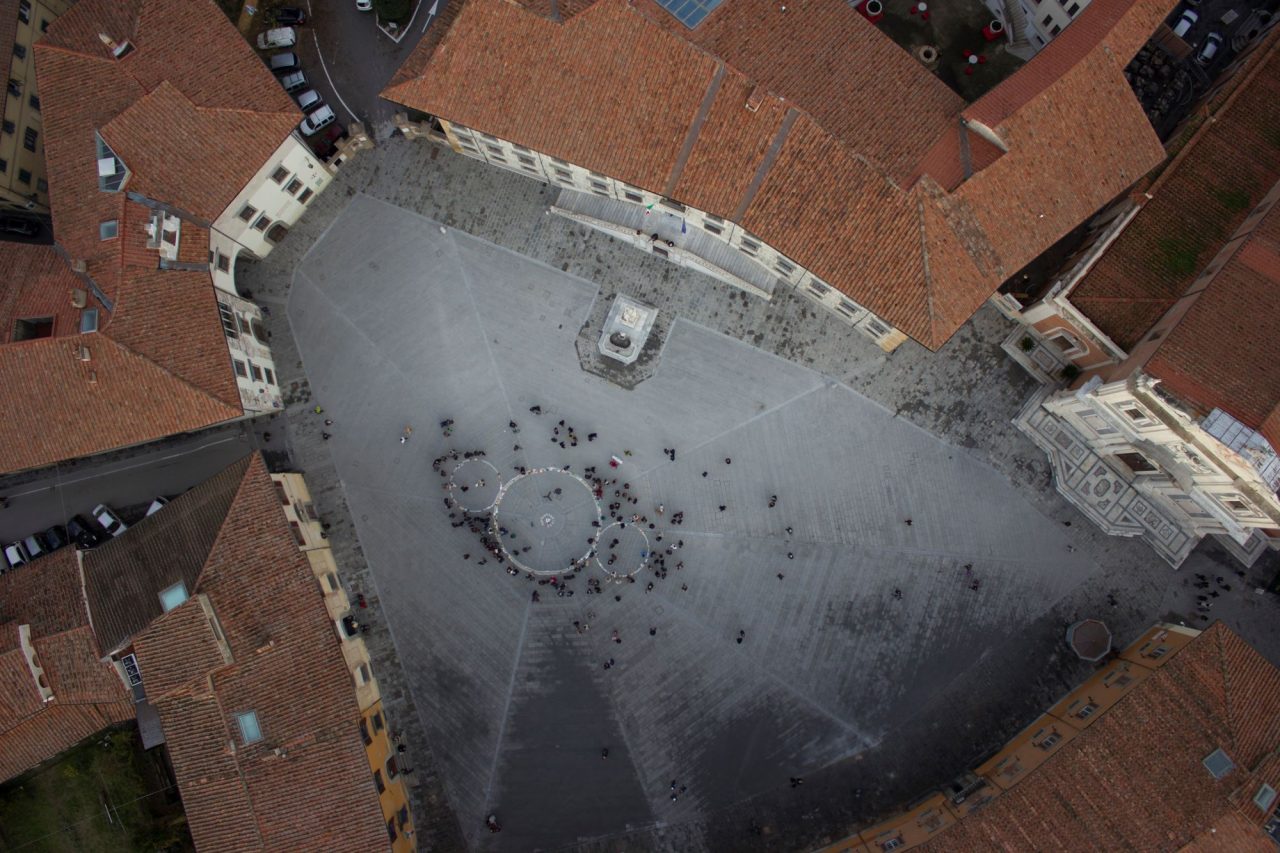
The event was part of a series of initiatives organised for the reopening of Piazza dei Cavalieri after the months of work needed to instal a new sandstone paving. Celebrating the Piazza’s revival as a centre of civic and student life, this initiative also marked the beginning of the Normale’s renewed engagement with contemporary art. The project brought together the Municipality of Pisa, Scuola Normale, and the Centro Pecci of Prato in collaboration with Castello di Rivoli – Museo d’Arte Contemporanea and Cittadellarte, Pistoletto’s research centre established in Biella in 1998. This collaboration continued in subsequent years, with the Centro Pecci regularly installing artworks in Palazzo della Carovana.
Il Terzo Paradiso, conceived by Pistoletto in the early 2000s, serves as a symbol of a possible new equilibrium between humanity and the Earth. It consists of three interconnected circles that evoke the mathematical symbol of infinity, with the addition of a more prominent central element. The two lateral circles represent, on one side, the primordial state of nature (the Primo Paradiso) and, on the other, the world of science, technology, and artifice (the Secondo Paradiso), which has elevated contemporary living standards dramatically while exhausting our ecosystem’s resources. The central circle symbolises the Terzo Paradiso: the hope for an era where these two seemingly opposing worlds might finally coexist through a balanced connection between nature and technology, founded on collective responsibility toward sustainable progress.
‘Terzo Paradiso means the passage to an unprecedented stage of planetary civilisation, essential for ensuring humankind’s survival’, wrote Pistoletto in his manifesto ‘What is Il Terzo Paradiso?’ (2003), ‘It is the interpenetration between opposing circles representing the generative womb of new humanity’.
After the publication of this work, Il Terzo Paradiso would remain at the heart of Pistoletto’s artistic practice for many years. The three-circle symbol evolved into an icon of harmony between progress and sustainability, a reflection on the relationship between nature, technology and society. While the work appeared in various prestigious locations – the Terme di Caracalla in Rome, the Piazza della Signoria in Florence, and the Woods of St. Francis in Assisi – each installation maintained its uniqueness through active community participation. As Pistoletto himself emphasised during a meeting organised in the Palazzo della Carovana on the eve of his Pisan installation, this process of collective participation within a public space was the truly determining factor for his ‘oper-azione’ [artwork-in-action] to become a vehicle for genuinely shared reflection.
For the Piazza dei Cavalieri version, Il Terzo Paradiso was created by arranging hundreds of books that students and citizens had been invited to bring to the square. The choice carried profound symbolic meaning: it highlighted both the intimate bond between university life and urban space and the central role ‘study’ plays in fostering the critical thinking needed for a better, more equitable and sustainable society. The installation also embodied the dialogue between scientific and humanistic knowledge, presenting interdisciplinary exchange as crucial for addressing the complex challenges of our time.
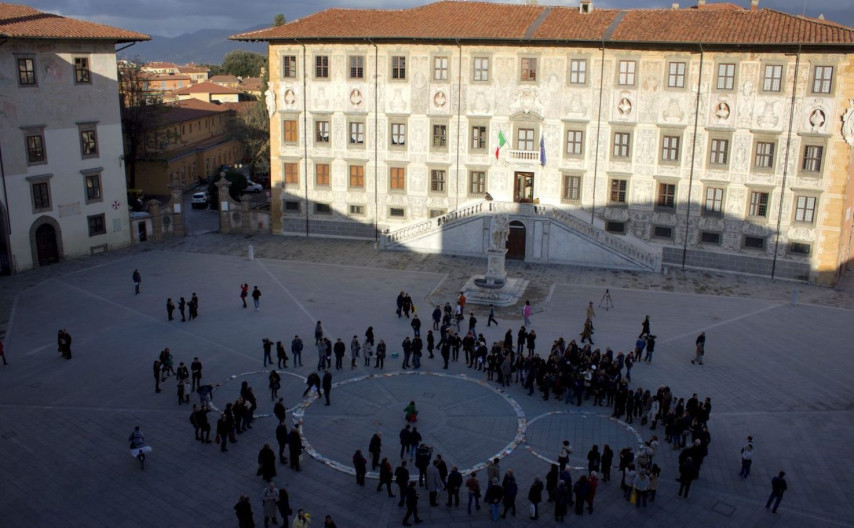
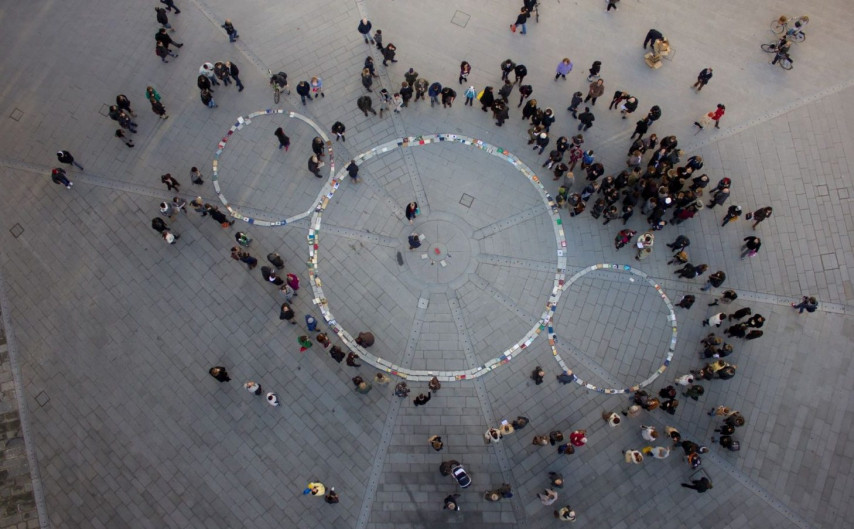
A few days later, on 21 December 2012, Pistoletto launched the first Rebirth-day: a kind of ‘worldwide celebration of rebirth’, deliberately scheduled to coincide with the date that, according to early 2000s popular and film culture, should have marked the end of the world as predicted by ancient Maya calendars. On this day, Pistoletto and his team orchestrated a global celebration comprising hundreds of events – from performances and concerts to flash mobs and installations – all expressing hope for a profound transformation in human relationships. Rich documentation of this extensive collective work would later be presented by Pistoletto in his solo exhibition: Année 1. Le paradis sur terre, inaugurated the following spring at the Musée du Louvre in Paris.
Media gallery
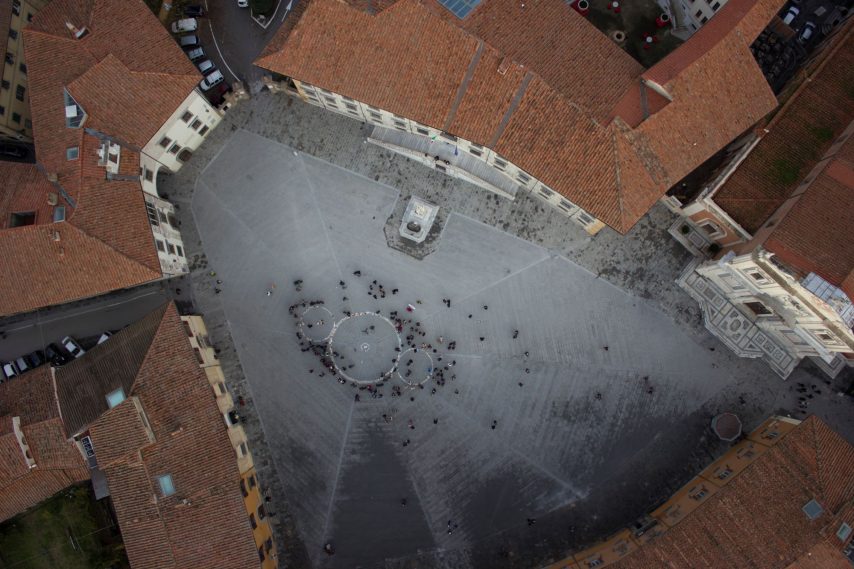
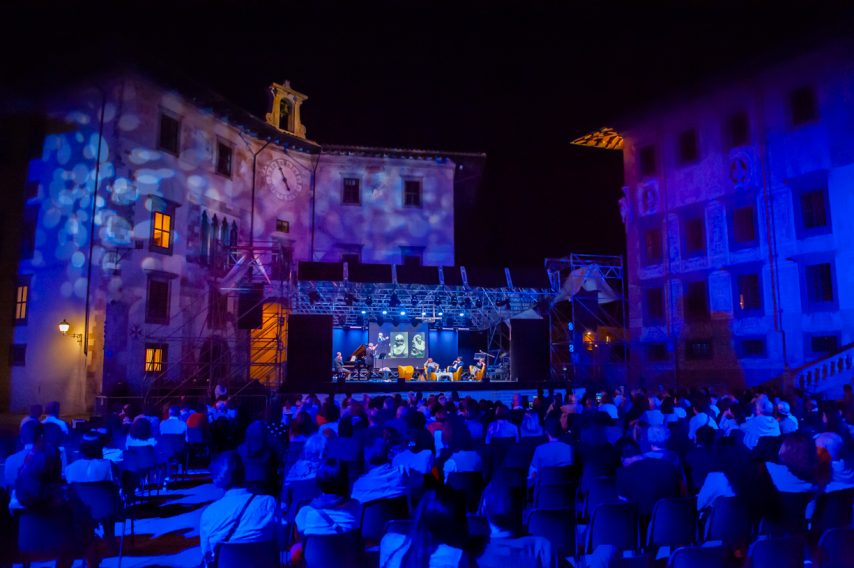
2015-2025
Cultural Events in the Piazza
In recent years Piazza dei Cavalieri has become a focal point for spontaneous youth gatherings and cultural life in Pisa. Grassroots initiatives, ticketed performances, and free events of scientific popularisation have all competed for the ‘possession’ of this urban space, which, by drawing in a socially diverse audience, has reaffirmed its central role in the civic and university life of the city.
Situated in Pisa’s historic centre, on the axis connecting the city’s three universities, Piazza dei Cavalieri has developed into a popular open-air space for the student population in the evenings and after dark, particularly over the past decade. It served as a place of spontaneous gathering for groups and individuals, where people of diverse backgrounds and cultures mingled, fostering a ‘grassroots culture’ through street music with guitars, drums, tambourines, and games.
For all its alternative and spontaneous character, this use of the piazza was not without difficulties, including public order concerns and disturbances of the peace. The challenge of reconciling such activity with the residential function of the surrounding area, as well as with the conservation restrictions imposed on the historic site, fuelled a recurring public debate that repeatedly resurfaced in the local press, where this use of the square was condemned as ‘malamovida’ (disruptive nightlife).
In response to this phenomenon, the Municipality of Pisa progressively intensified surveillance of Piazza dei Cavalieri while also promoting a series of more institutional cultural initiatives. These included major events such as the Summer Knights festival, held every September since 2019, featuring high-quality live music. On these occasions, the square was closed off and accessible only by paid admission.
The provision of cultural initiatives in the piazza, however, is not a recent development. As early as 1997 Andrea Bocelli chose the Piazza, remodelled by Giorgio Vasari as an urban stage, as the setting for his internationally successful concert A Night in Tuscany, which presented a blend of genres—from opera to pop music—through a series of duets.
In the following decade, other renowned artists also performed there, including Lou Reed and Franco Battiato in the summer of 2003. Such large-scale concerts, however, provoked debate between the Municipality, the Superintendency, and one of the organisers, Metarock, over the use of a historic site for events of this kind, particularly in relation to noise impact.
The Scuola Normale has recently joined the contest over Piazza dei Cavalieri, promoting a variety of cultural activities, all offered free of charge. Since 2017 it has organised the series Arte e scienza si incontrano in piazza (Art and Science Meet in the Piazza), designed as evening lectures on cultural themes accompanied by music and readings. The programme has involved academics as well as public figures from the worlds of scientific communication and the arts, including the composer Nicola Piovani in one of the first year’s events.
In addition, a summer film festival has been held, with screenings arranged in thematic programmes, each introduced by presentations and followed by discussions, in collaboration with the Cineclub Arsenale. The Festival of Academic Theatre, created by the Normale’s theatre group in partnership with other university companies, has likewise enriched the piazza’s cultural life.
Media gallery
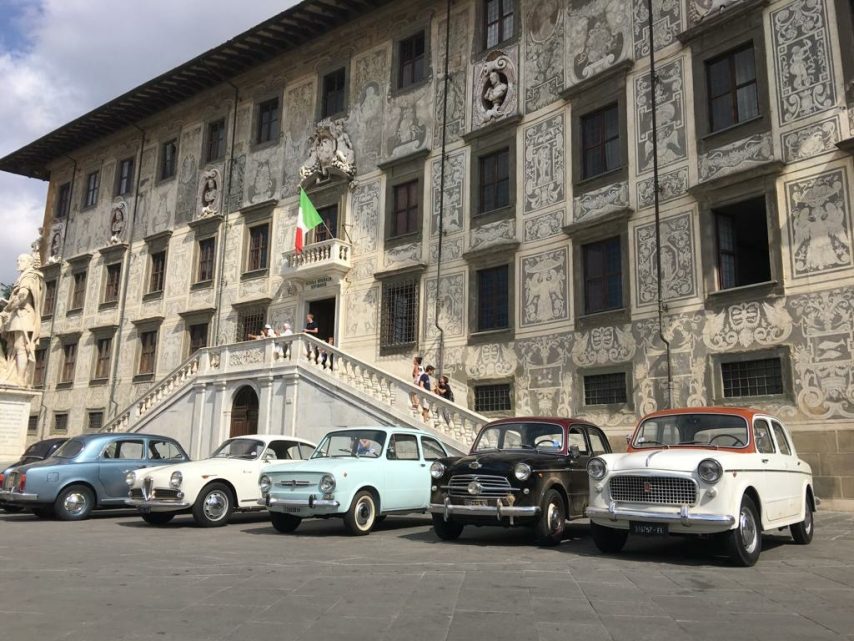
2019
TV Series Filming for ‘My Brilliant Friend’
In autumn 2019, several scenes for the television series 'L’amica geniale' ('My Brilliant Friend'), based on Elena Ferrante’s novel of the same name, were filmed in Pisa. For the production, both Piazza dei Cavalieri and Palazzo della Carovana were meticulously adapted to evoke the atmosphere of the 1960s, ensuring historical authenticity in the series’ setting.
In September and October 2019, scenes for the second series of the television programme My Brilliant Friend were filmed in Pisa. Based on The Story of a New Name (Storia del nuovo cognome, 2012), the second novel in Elena Ferrante’s Neapolitan Novels series, the screenplay was written by Francesco Piccolo, Laura Paolucci, and Saverio Costanzo, under Ferrante’s supervision.
Produced by Wildside, Fandango, and The Apartment, in collaboration with HBO and Rai Fiction, the series had already achieved widespread popularity and international acclaim with its first season. Saverio Costanzo directed the majority of the second season, with the exception of two episodes— The Kiss (Il bacio) and The Betrayal (Il tradimento)—both directed by Alice Rohrwacher.
In Storia del nuovo cognome, the development of one of the two protagonists, Elena (Lenù), reaches a pivotal moment. In the summer of 1965, she is admitted to Scuola Normale Superiore and moves to Pisa to attend university. This transition marks a transformative step, offering her the opportunity to leave the Luzzatti district of Naples and immerse herself in the academic and intellectual life of the Tuscan city. Pisa becomes the backdrop for her university years, her ambitions, and her early romantic experiences—but above all, for her first time living apart from her lifelong friend, Lila.
One of the most compelling aspects of the Pisan shoot was the work of set designer Gianfranco Basili and his team, who were tasked with transforming parts of the city—and several interiors of the Palazzo della Carovana—to evoke the atmosphere of the 1960s. While the Luzzatti district had to be almost entirely reconstructed on set, with substantial digital enhancements used to recreate the streets and buildings where Lila and Lenù grew up, in Pisa, Basili worked directly with the city’s existing locations. His interventions were more limited in scope, each carefully designed to restore the setting’s appearance to how it would have looked some sixty years earlier.
The collaboration with the Scuola Normale proved crucial in this regard. Access to period documents and photographs allowed Basili and his team to gather valuable insights for their reconstruction work, capturing with remarkable accuracy the atmosphere of university life in Pisa during the era depicted in the novel. This documentary research provided a vital foundation for decisions relating to set design and costumes, with particular attention given to furnishings, student clothing, and the everyday environments of academic life—elements that take centre stage in the season’s final two episodes: I fantasmi (The Ghosts) and La fata blu (The Blue Fairy).
Several spaces within the Palazzo della Carovana were adapted to meet the narrative needs of the production. A third-floor room, now used as staff offices, was temporarily restored to its original function as a college bedroom—the setting for the scene in which Elena spends her final night with Franco Mari, a fellow student and romantic partner during her early years in Pisa. Likewise, the first-floor corridors, the grand staircase leading to the third floor, and the Aula Pasquali were reconfigured; the latter was prepared for the scene in which Franco, following an Italian literature exam, formally withdraws from the Normale—and with it, his scholarship. Finally, the Sala del Ballatoio, now home to the School’s archive, was partially refitted to serve once again as a library and study room.
Since it was not always possible to film in the exact locations described by Ferrante, the spaces of Collegio Timpano—where Elena lives during her university years—were recreated by Basili inside the Royal Victoria Hotel on Lungarno Pacinotti, just a few hundred metres from the actual college. Although Collegio Timpano still houses students of the Scuola Normale today, extensive renovations have significantly altered its original appearance. The hotel’s proximity to the real site nonetheless allowed for a strong visual and conceptual continuity with the settings described in the novel.
An even more challenging task involved the transformation of outdoor spaces: alleys, shopfronts, café tables along the streets, and the riverbanks, where a large procession of workers appears at the beginning of the seventh episode. Piazza dei Cavalieri—closed to traffic for decades—was brought back to the vibrant life of the 1960s with vintage scooters, period cars parked in front of the Palazzo della Carovana, and dozens of extras. All were essential to recreating the dynamic atmosphere of a square that—then as now—has long been the beating heart of university life in Pisa.
During the weeks of filming, actress Margherita Mazzucco—who played Elena—was closely supported by several students of the Scuola Normale, who helped her gain a deeper understanding of the daily realities of university life. They also organised private lessons to ensure that the then seventeen-year-old could keep up with her own studies. The Pisan phase of My Brilliant Friend: The Story of a New Name thus became a notable example of fruitful collaboration between an academic institution and a television production, between historical research and scenographic creativity. Thanks to the Scuola Normale’s openness and Basili’s meticulous design work, the city of Pisa itself emerged as a silent protagonist of the series, actively contributing to the visual storytelling of Elena Ferrante and Saverio Costanzo.
Media gallery
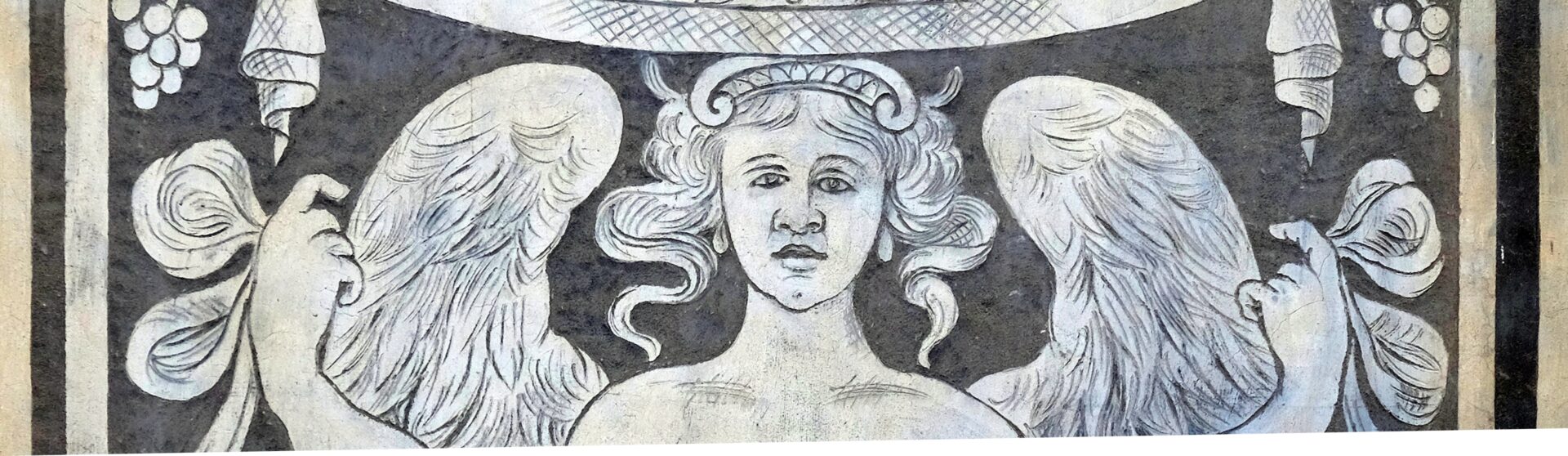
Newsletter
Stay in Touch
Sign up for the Piazza dei Cavalieri newsletter
to receive updates on project progress and news.