
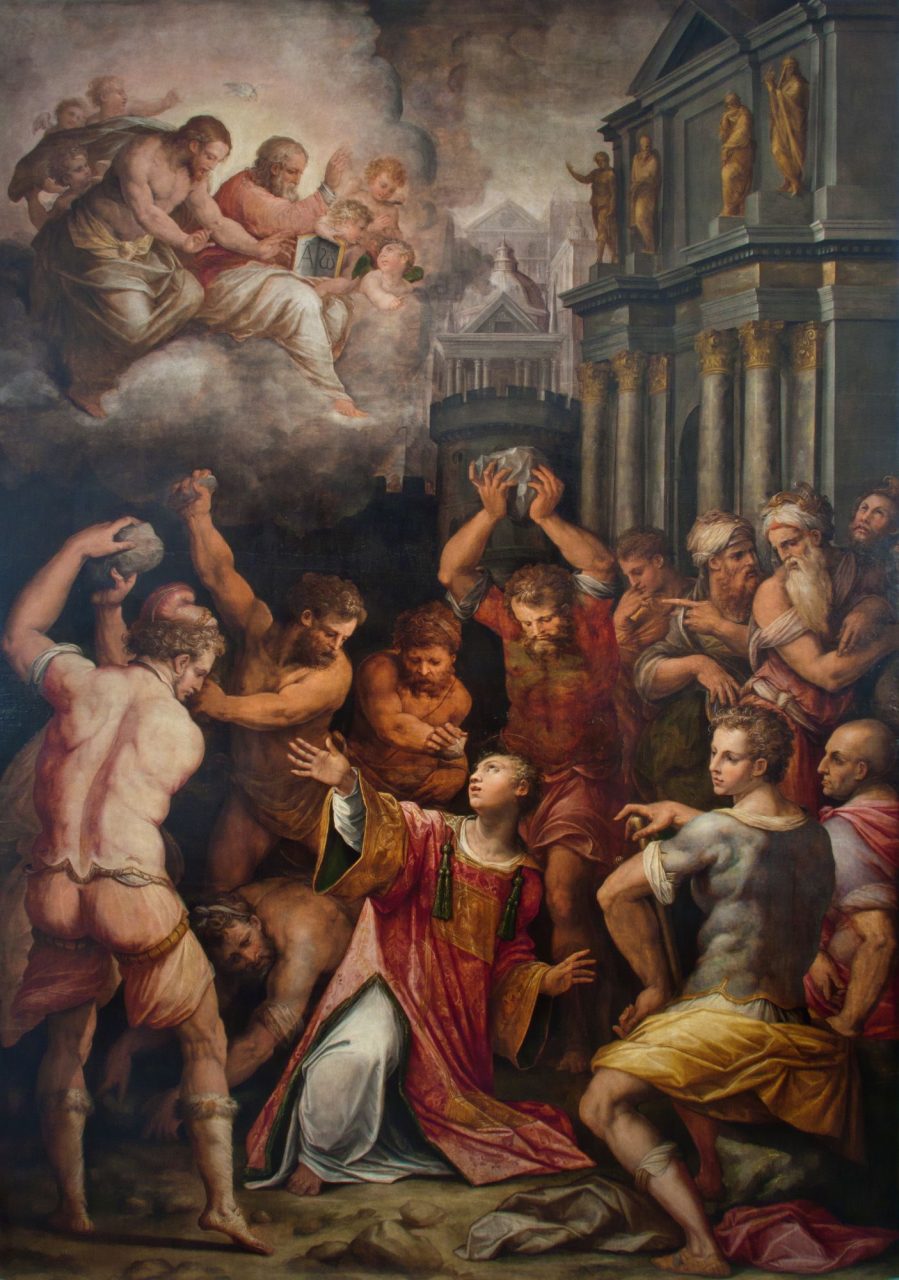
Giorgio Vasari
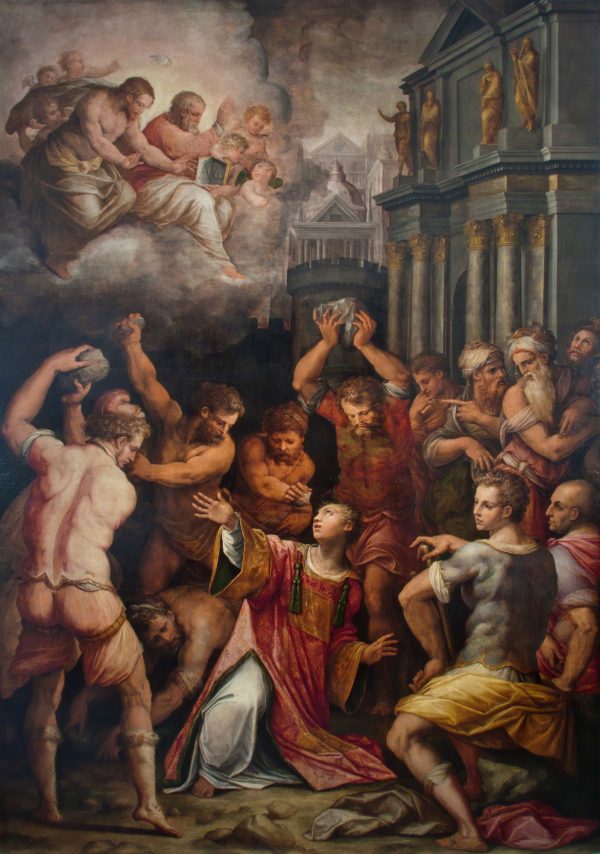
Stoning of Saint Stephen the Protomartyr
In response to the needs of the Council of the Order of Saint Stephen concerning the arrangement of the apse area in the church of the Knights, Cosimo I de’ Medici commissioned the panel from Giorgio Vasari in 1569. Initially, Bronzino’s Nativity had been intended for the high altar, but during the works it was decided instead to replace it with a bronze ciborium flanked by statues. Since Bronzino’s altarpiece had already been completed, two facing aedicules were constructed on the side walls of the church. One of these required a second painting to form a pendant, which was accordingly entrusted to Vasari, while Nigi della Neghittosa made the corresponding wooden frames.
The subject was proposed directly by Cosimo I de’ Medici, who chose to dedicate the painting not to the titular saint of the church—Pope Stephen I, martyred by beheading on 2 August 257 AD—but to the deacon Stephen, the first Christian martyr, stoned to death around 34 AD. This decision aligned with the simultaneous dedication of the ground-level chapel in the complex of three superimposed oratories commissioned by Pope Pius V in the Vatican, where Vasari was also actively involved at the time. Cosimo’s choice led the Council of the Order of Saint Stephen to seek clarification from Vasari, reminding him that ‘as in said church there is neither image nor any memorial of Saint Stephen, pope and martyr, to whom the church of the Order is dedicated, and apart from these two altars nothing remains to us but the high altar, where the Most Holy Sacrament is placed’ [come in detta chiesa non ci è inmagine (sic), né memoria alcuna di santo Stefano papa e martire, al quale è intitolata essa chiesa della Religione, e fuori di questi dua altari e non ci resta se non l’altare maggiore dove sta collocato il santissimo sacramento]. In response, Vasari reassured the Council regarding the grand duke’s intentions, explaining that ‘[the main chapel [which] is to be painted [on] the walls with his [Pope Stephen’s] story, or else two marble statues to be placed on either side of the ciborium on the altar—one of Saint Stephen, pope and martyr, and the other of Saint Cosimo’ [la capella maggiore [che] abbia a esser dipinta [nel]le facciate con la storia sua [di Stefano papa], overo duo statue di marmo che metteranno in mezzo il ciborio in sullo altare abbino a essere santo Stephano papa e martire e l’altra san Cosimo].
The numerous concurrent projects in Florence, Pisa, Rome, and Bosco Marengo inevitably prolonged the execution of the painting, which began with preparatory drawings in early 1570. Two sheets related to the composition—identified by Florian Härb—are now held in a private collection. The work was completed and delivered on 26 December 1571, the feast day of Saint Stephen the Protomartyr. The work was completed and delivered on 26 December 1571, the feast day of Saint Stephen the Protomartyr. Vasari received 2,300 scudi as payment, corresponding to the transfer of ownership of the Passelli (or Passegli) estate in the Valdarno, which he had previously rented from the Order.
Iconographically, there is no doubt about the close compositional correlation between the Pisan and Roman paintings—executed more or less concurrently—of the same subject. However, the causal and chronological relationship between the two remains unclear. Vasari’s involvement in both, together with the diplomatic ties between the Medici and Ghislieri courts, makes mere coincidence unlikely. Pope Stephen and Stephen the Protomartyr, linked not only by name but also by hagiographic feast days, held particular significance for Cosimo I de’ Medici. The 2nd of August, the date of Pope Stephen’s martyrdom, coincided with key Medici victories at Montemurlo (1537) and Scannagallo (1554), which tradition holds to have influenced the choice of this saint as patron of the religious-military Order that bore his name. The 3rd of August, commemorating the discovery of the Protomartyr’s relics, also corresponded to the Battle of Gavignana in 1530—another major Medici victory over their adversaries.
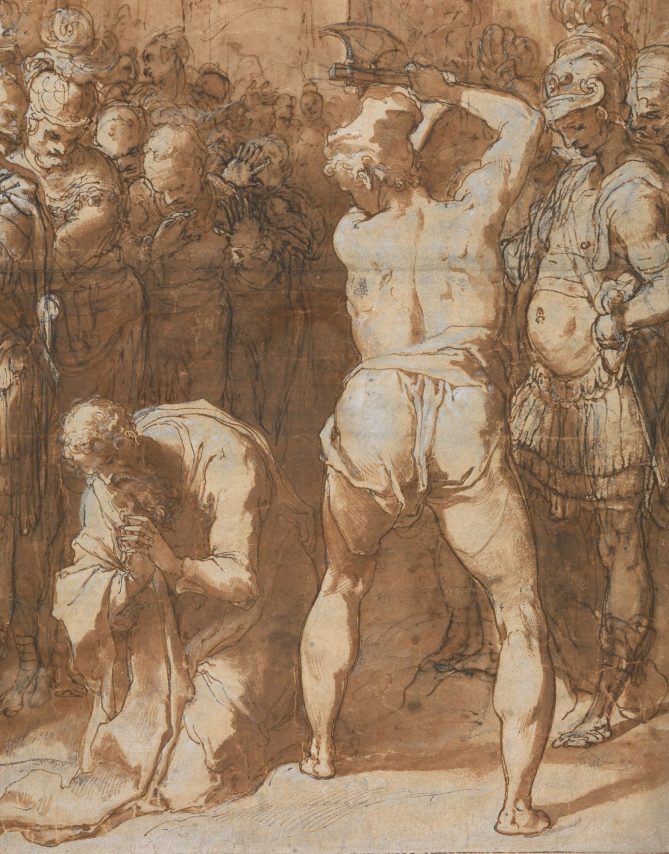
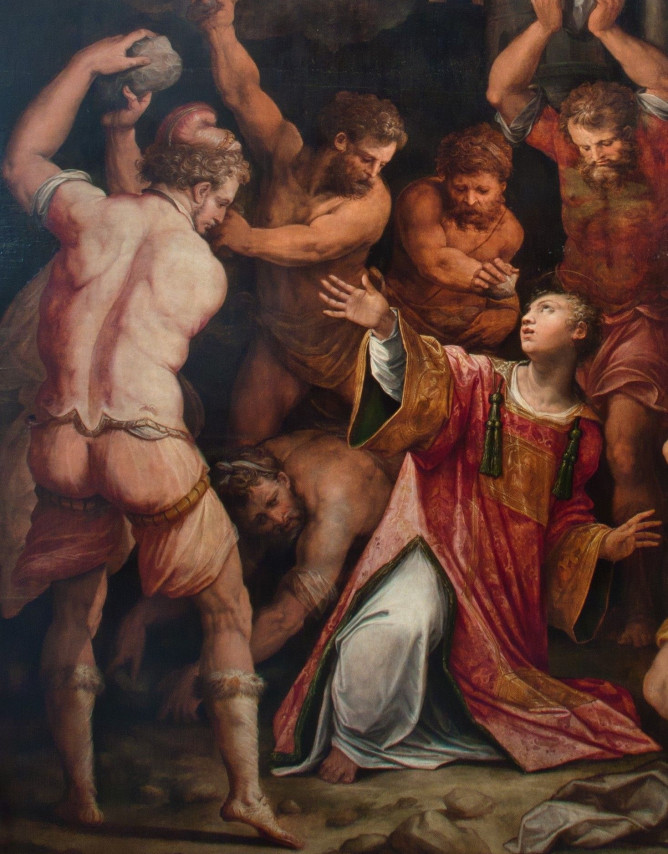
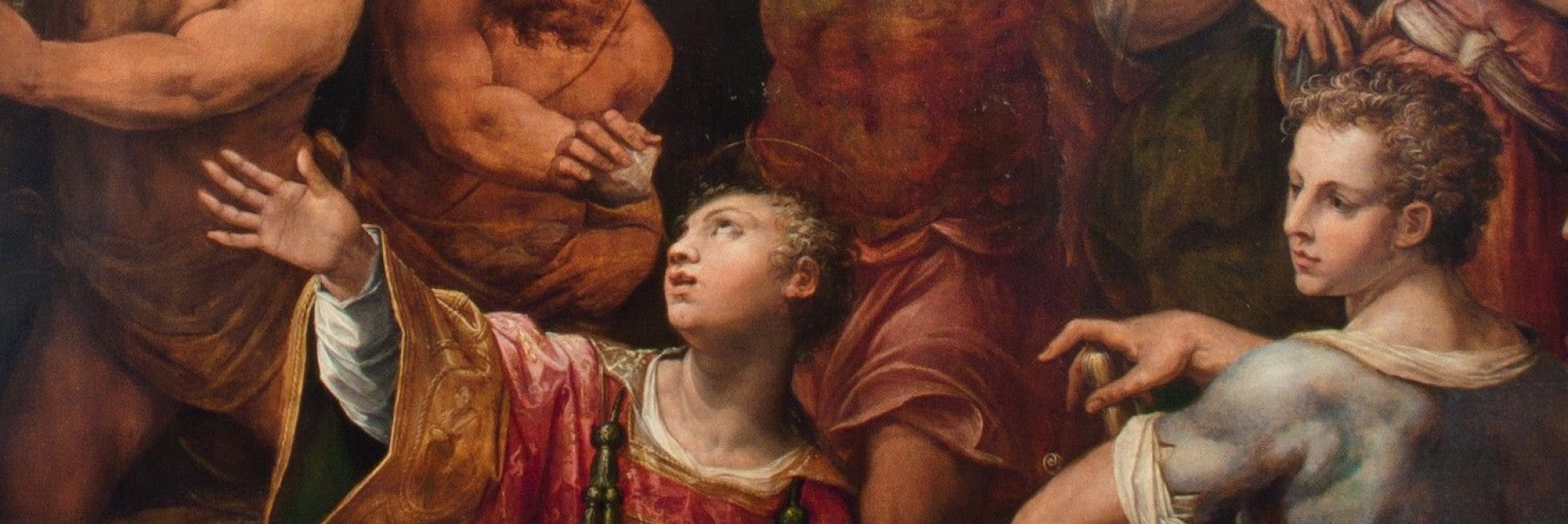
The scene in the Pisan painting is mainly concentrated in the foreground, where Stephen, dressed in a modern deacon’s dalmatic—possibly the very one used by officiants in the church of the Knights—extends his arms to shield himself from the stones his executioners are about to hurl at him. On the left, a figure seen from behind echoes—reversed—a similar character painted by Taddeo Zuccaro in the Decapitation of Saint Paul on the vault of the Frangipani Chapel in San Marcello al Corso, Rome (c. 1558–1566; preparatory drawing at the Metropolitan Museum, New York, inv. 1975.1.553). On the right, the young Saul is depicted seated, receiving at his feet—as recounted in the Acts of the Apostles—the garments of the executioners and several bystanders. His pose is reinterpreted, in reverse, after Michelangelo’s Lorenzo de’ Medici in the Medici Chapels. In the sky, in close adherence to the biblical text, Christ is shown seated at the right hand of God the Father. In the background, a Romanised Jerusalem appears, with Christ and God the Father among clouds and putti. At right, in foreshortening, stands a pedimented building with statues, resembling the structure depicted in Vasari’s nearly contemporary fresco, The Return of Gregory XI from Avignon, in the Sala Regia of the Vatican. It is therefore not, as has sometimes been claimed, the façade of Santo Stefano dei Cavalieri, which never took that form and was still in the design stage at the time. The composition of the Pisan painting clearly recalls Giulio Romano’s Stoning of Saint Stephen, painted around 1521 for the Genoese abbey dedicated to the same saint. It likely served as a reference for Lorenzo Sabatini’s fresco of the same subject in the Pauline Chapel in the Vatican (1574–1576), probably based on a design by the now-deceased Vasari or a reworking of his ideas. This is supported by two related drawings, held at the Istituto Centrale per la Grafica in Rome (inv. D-FC129822) and the Museo di Capodimonte in Naples (inv. GDS_1370).
Vasari’s Pisan panel has itself undergone multiple conservation interventions over the centuries. The most recent, carried out in 2013, included extensive diagnostic investigations to map areas of deterioration and overpainting, as well as to monitor the condition of the wooden support panels. Additional extraordinary maintenance work was recorded in 2017.
Media gallery
Newsletter
Stay in Touch
Sign up for the Piazza dei Cavalieri newsletter
to receive updates on project progress and news.