
Construction Phases
In a letter sent from Florence on 3 October 1562, Giorgio Vasari asked Giovanni Caccini, his contact and provveditore (a Medici-appointed overseer) of Pisa to have Davide Fortini, who was working on his behalf in the city, send him ‘the entire space in width and length where the church is to be built’ [‘tutto il vano della larghezza et lunghezza dove s’ha a far la chiesa’]. By January 1563, in a missive addressed to Bartolomeo Gondi, secretary to the then Duke Cosimo de’ Medici, Vasari was already referring to the stretching of cords for laying out the building’s ground plan. The foundation stone, however, was laid only in April 1565, after the complete demolition of the medieval church of San Sebastiano alle Fabbriche maggiori, which occupied the same site. Construction then proceeded rapidly: by October 1566 the masonry was almost complete (as indicated by one of the two inscriptions still visible on the façade), and in August 1567 the roof was finished, covered with slate slabs laid by the Genoese Francesco Ginocchi. Shortly afterwards, the Venetian Giovanni della Fenice produced the window glazing (white glass with a small Medici coat of arms), while the stonemasons Giovanni Fancelli, called Nanni di Stocco, and Antonio Bitossi carved the pillars, cornices, and framing elements. The church floor was finally supplied and laid by a certain Papi Comparini in March 1568.
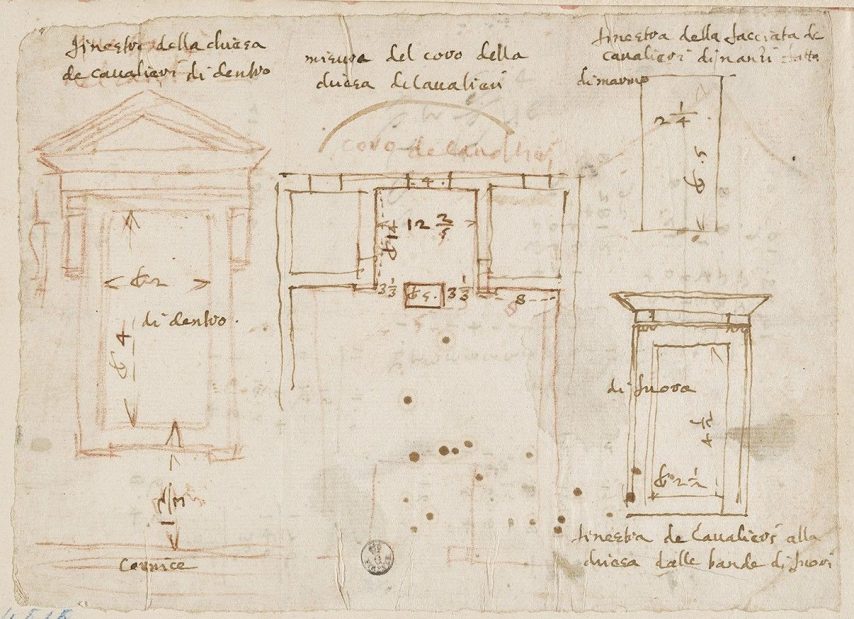
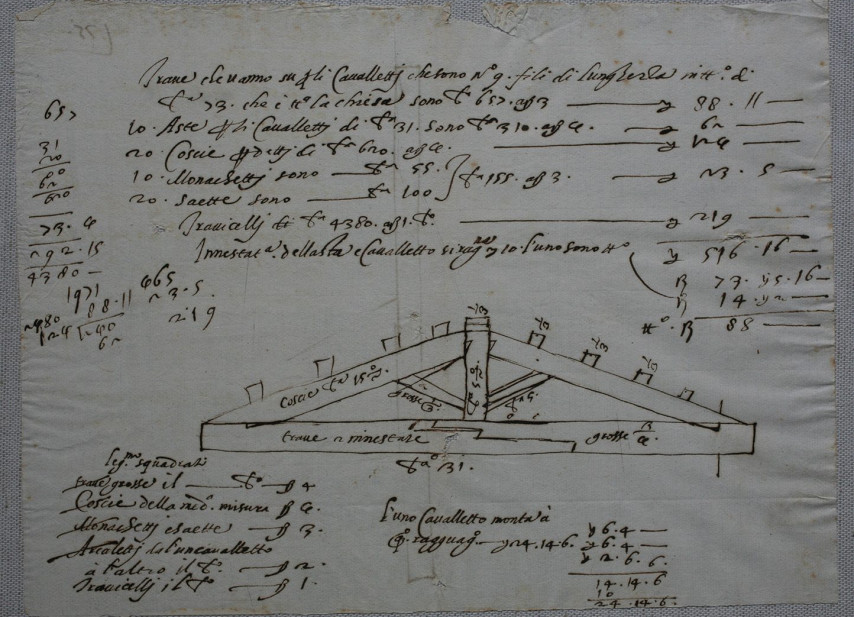
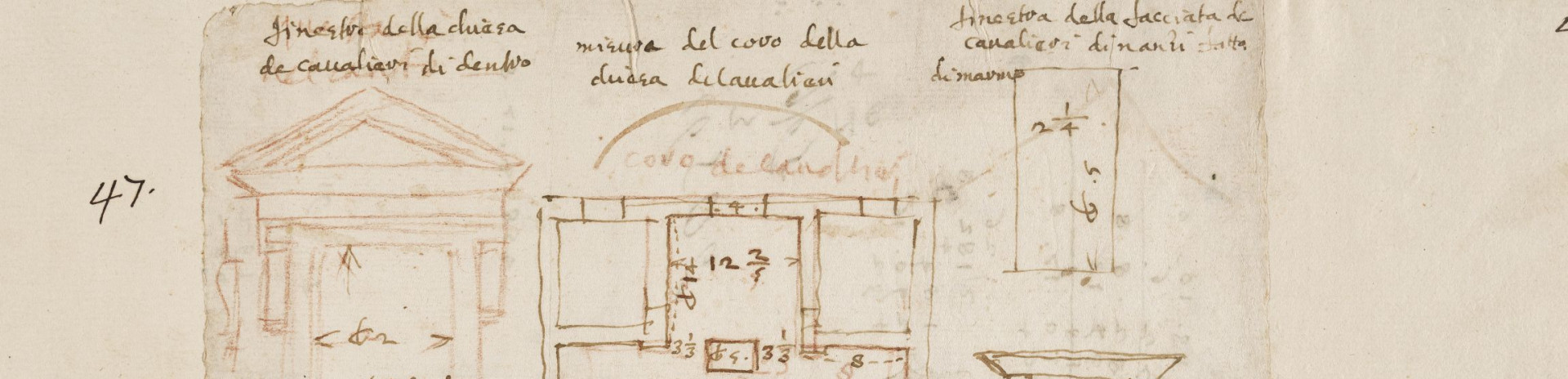
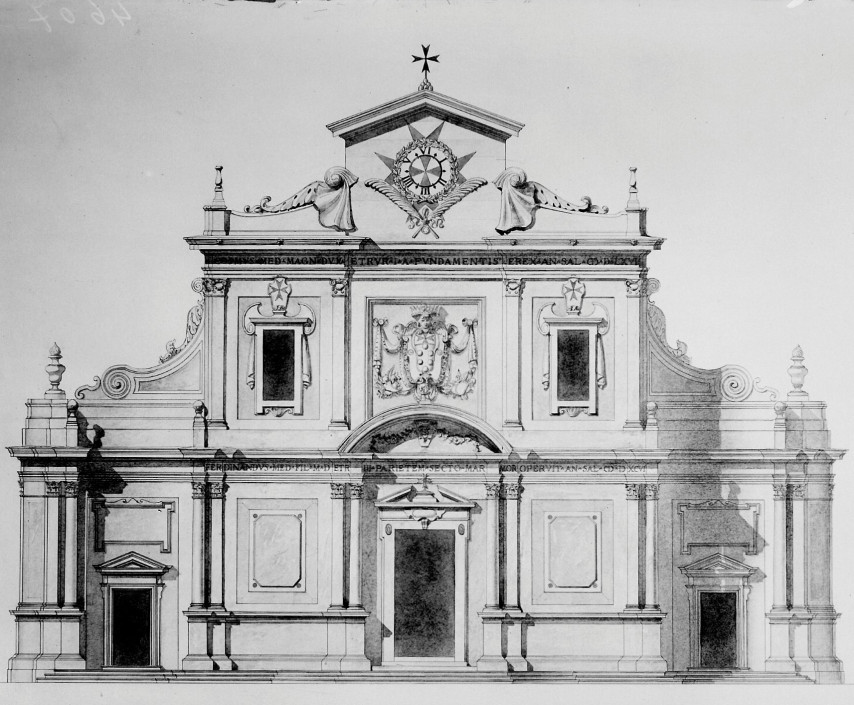
During this phase, the works were overseen by Fortini — Vasari’s right-hand man —who also served as the direct intermediary with the Council of the Order of Saint Stephen. The master mason was Domenico Celli, who was likewise active at Palazzo della Carovana and at the nearby Palazzotto del Buonomo (later Palazzo dell’Orologio).Vasari’s design consisted of a single nave articulated by a series of wooden altars, together with a rectangular chapel and two sacristies. The bell tower was designed by Vasari himself at the end of 1569 and completed in early 1572. By the end of 1569, Vasari had also produced a ‘drawing of a burial ground for the Most Illustrious Knights’ [‘disegnio d’un canposanto per gli illustrissimi cavalieri’], planned in the vicinity of the church. This is recorded in a list of ‘Drawings, plans, profiles and mouldings for models’ [‘Disegni, piante, proffili et modanature per modegli’] sent by the architect to the Order and now preserved in the Archivio di Stato di Pisa. Vasari was also responsible for designing various items of church furnishing. The church was consecrated on 21 December 1569, even though construction was not yet complete. The façade, in particular, was left unfinished at Vasari’s death in 1574. It was redesigned between 1593 and 1596 by Giovanni de’ Medici, assisted by the stonemasons Giovanni Gargiolli and Francesco Balsimelli. A wooden model corresponding to this project is now preserved at the Museo Nazionale di San Matteo, Pisa.
In the seventeenth century, the most significant intervention inside the building was the creation of the sumptuous wooden ceiling designed by Alessandro Pieroni, who also executed the entrance door and devised solutions for the ‘choir of the knights’ [‘coro dei militi’], originally envisaged by Vasari but dismantled during the nineteenth-century rearrangements of the interior. In the early years of the same century, the need for an enlargement of the structure became apparent, leading to the preparation of several projects that were never carried out, including one by Gherardo Mechini (1610) and five by Paolo Guidotti (1616). These proposals envisaged the addition of two transepts and a large choir.
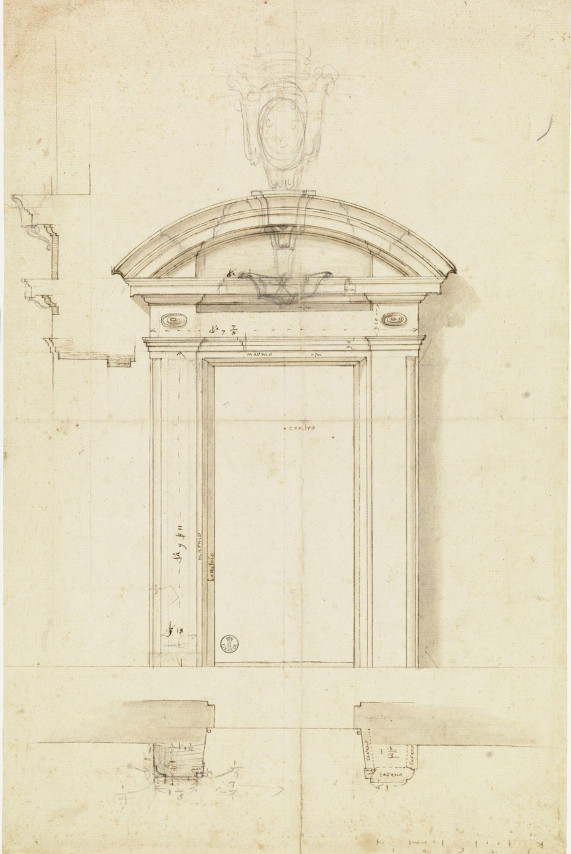
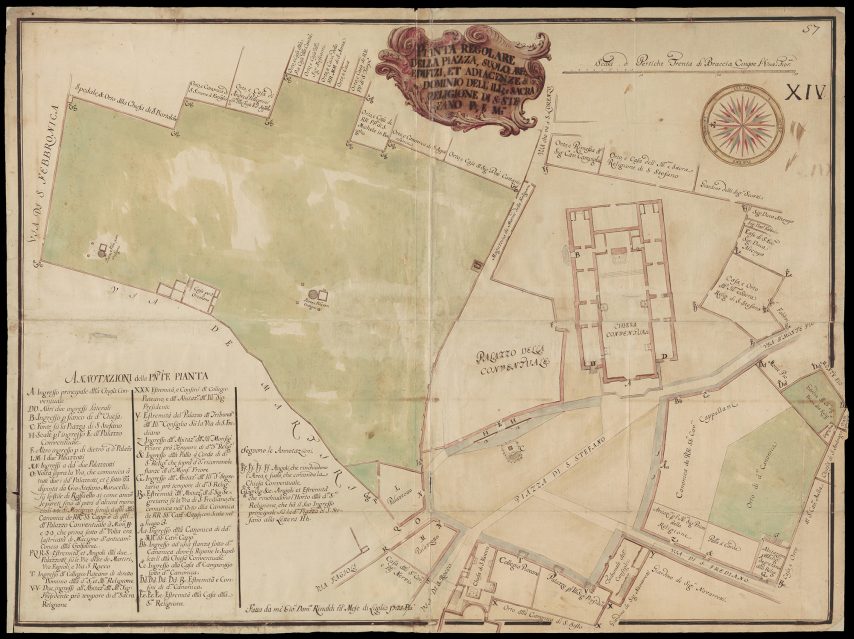
Pen, black chalk and wash on white paper, 751 x 516 mm
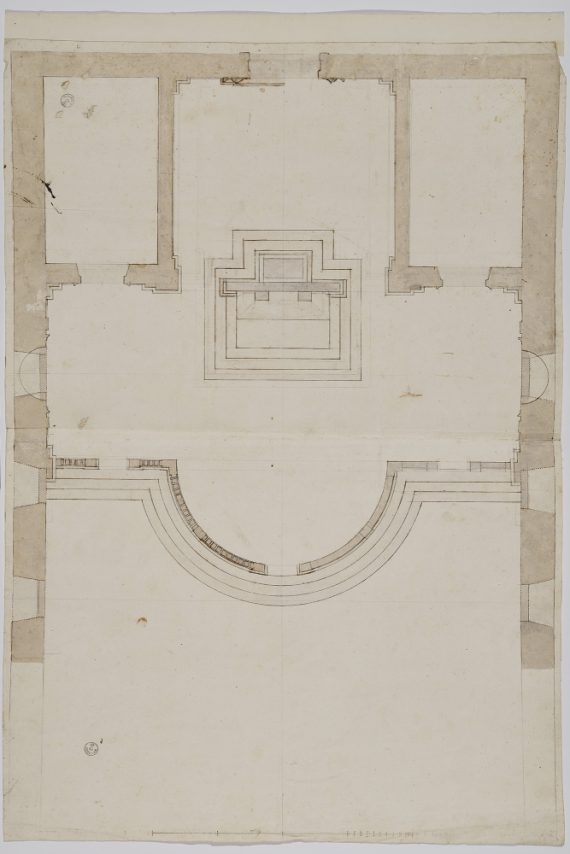

Determined to give the church of the Order a new monumental appearance, Cosimo III de’ Medici gave fresh impetus to projects for its restructuring and enlargement. He initially engaged the Roman artist Ciro Ferri, who produced two drawings still preserved at the Uffizi (Gabinetto Disegni e Stampe, inv. nos 2264A and 2266A). One proposes a redesign of the apsidal area; the other depicts a section of wall with a high dado, pilasters, and a coat of arms framed by festoons. In 1682, Pier Francesco Silvani presented an expansion proposal involving the construction of two domed lateral chapels and corresponding side wings, connected to the central body of the building by two pairs of pedimented doorways. One of the wooden models of the church still preserved at the Museo Nazionale di San Matteo bears witness to this scheme. The new annexes were completed by Giovanni Battista Foggini in 1691. He also oversaw a series of works on the bell tower, where a clock—previously incorporated into the church façade—was installed in 1682, in keeping with Vasari’s original design. Although the clock occupied this position only briefly, its presence left a lasting mark on the building. Eighteenth-century engravings and nineteenth-century photographs still show the numerical dial at the apex of the pediment. It was removed only during the architectural interventions of the Fascist period, which reinstated the Stephanian cross envisaged in the late sixteenth-century project.
The eighteenth century began with the definitive completion of the high altar, the result of a protracted design process that had, in effect, continued uninterrupted since the sixteenth century. The commission was once again entrusted to Giovanni Battista Foggini, who completed it by 1709. Other notable interventions proposed during the eighteenth century remained unrealised. Among them was an initiative of the Council of the Order to construct new cantorie, entrusting the design to Giovanni Michele Piazzini in 1757. His drawings are still preserved in the Archivio di Stato in Florence and are accompanied by a detailed survey of the organ decorations and the gallery balustrades.
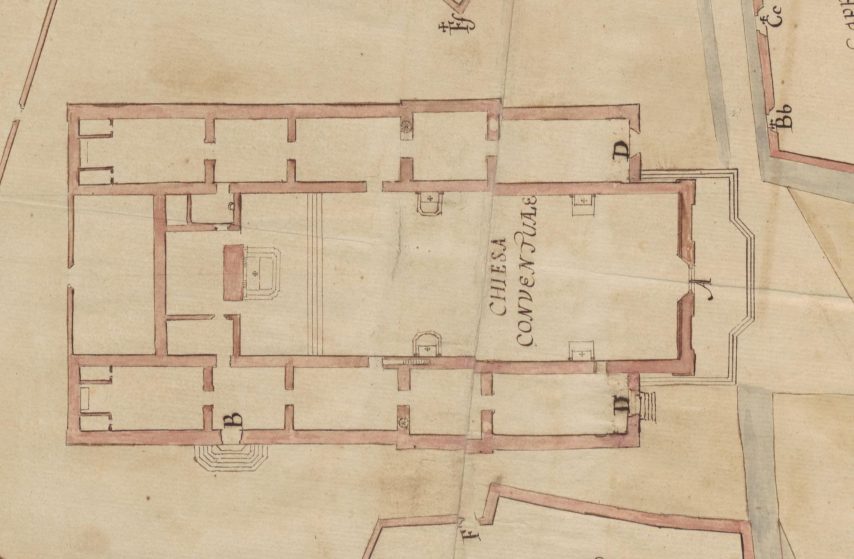
Diagram published in Lara Claudia Chisari, La chiesa dei Cavalieri di Santo Stefano a Pisa: analisi storica e della sicurezza statica, tesi di laurea magistrale, Università di Pisa, Facoltà di Ingegneria, 2017–2018
Graphic adaptation for the website by Zaki Srl
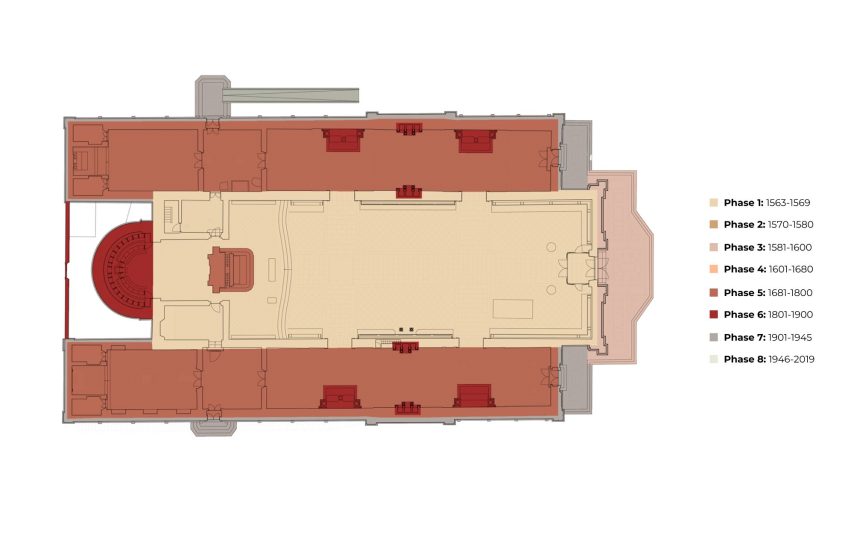
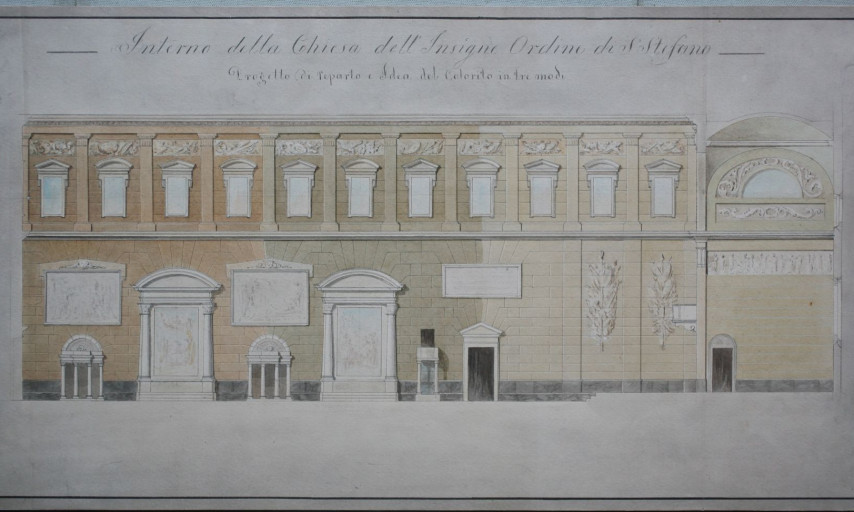
With the advent of French rule, the Order of Saint Stephen was abolished, and the church came under the ecclesiastical jurisdiction of the diocese. In 1820, following the restoration of the institution decreed by Ferdinand III of Lorraine in 1817, the Council of the Twelve resolved to erect four new confessionals, designed by the architect Giuseppe Marchelli, together with two large Carrara-marble altars to a design by Giovanni Lazzarini. These replaced the much-deteriorated sixteenth-century wooden altars. For nearly half a century thereafter, numerous proposals were put forward for alterations to the church interior and the lateral wings. In 1828, for example, Giuseppe Caluri produced a drawing for the marble cladding of the latter. In 1838, the architect Florido Galli—author of the Chapel of the Blessed Sacrament near the sacristy (1837)—advanced a reorganisation plan proposing a Greek-cross layout, the insertion of two domed chapels (fitted with Lazzarini’s altars) within the lateral wings, and the opening of two large arches cut into the walls between the central nave and the side aisles. In 1840, the Greek-cross scheme was also taken up by the engineer and architect Alessandro Gherardesca. Although his project was initially approved by the Order, it survives today in numerous graphic drawings. His proposals were later rejected by Pasquale Poccianti, Chief Architect and Consultant to the Direction of Royal Works, who in 1843 personally assumed responsibility for redefining the church’s internal spaces. Nearly a decade later—perhaps prompted by the emergence of new proposals by the Florentine Nicolò Matas—Poccianti presented a further scheme that radically altered Vasari’s original layout. It envisaged a three-aisled church, with the central aisle connected to the lateral ones by Corinthian marble colonnades, to which the altars and confessionals would be transferred. The project also included the enlargement of the choir by means of a semicircular tribune. A drawing of this scheme survives in the Archivio di Stato di Pisa, together with a un wooden model held at the Museo Nazionale di San Matteo. Although the works were approved by Leopold II and begun in 1853, they were halted in 1857 at the Grand Duke’s own instruction. They were resumed in 1867 under the engineer Gaetano Niccoli, who imparted to Santo Stefano its definitive form.
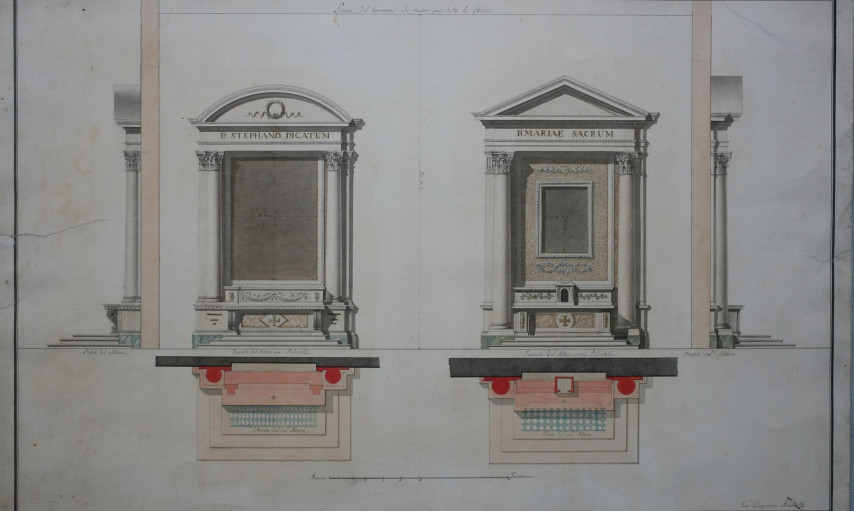
Inscription: ‘Interno della chiesa dell’Insigne Ordine di Santo Stefano. Progetto di reparto e idea del colorito in tre modi’ . Ink, traces of pencil and wash on cardboard, 315 x 588 mm, not signed or dated
Interest in completing the façades of the two lateral wings revived in the early 1910s. Two photographs by Carlo Carbone (c. 1917) reproduce an overall drawing and a detail ‘of the model for the completion of the wings of the church of the Knights of Saint Stephen, arch. Silvani’ [‘del modello per il completamento delle ali della chiesa de’ Cavalieri di S. Stefano, arch. Silvani’], which had evidently returned to the centre of attention. Only some twenty years later, however, was a definitive solution reached. The Pisan engineer Luigi Pera was commissioned to design the cladding of the two structures, determined to produce ‘a pure and simple harmonious and decorous arrangement of what constitutes an eyesore and a disfigurement’ [‘una pura e semplice sistemazione armonica e decorosa di ciò che costituisce una bruttura e un disdorno’]. His proposal was approved in 1933, allowing work to begin in the following spring. Pera’s intervention sought to harmonise the additions with the sixteenth-century façade through the use of simple marble architectural elements—such as a broken pediment and corner rustication—while concealing the pitched roofs of the annexes behind a quadrangular moulding crowned by a large cornice and a white marble attic. Brick facing continues to clad the lateral elevations of the two wings on both the north and south sides. These are framed in marble, punctuated by five windows set within marble cartouches, vertically articulated by copper downpipes for rainwater collection, and further enriched by a framed portal. The works were completed in June 1935, in time for the feast of the city’s patron saint, Saint Ranieri.
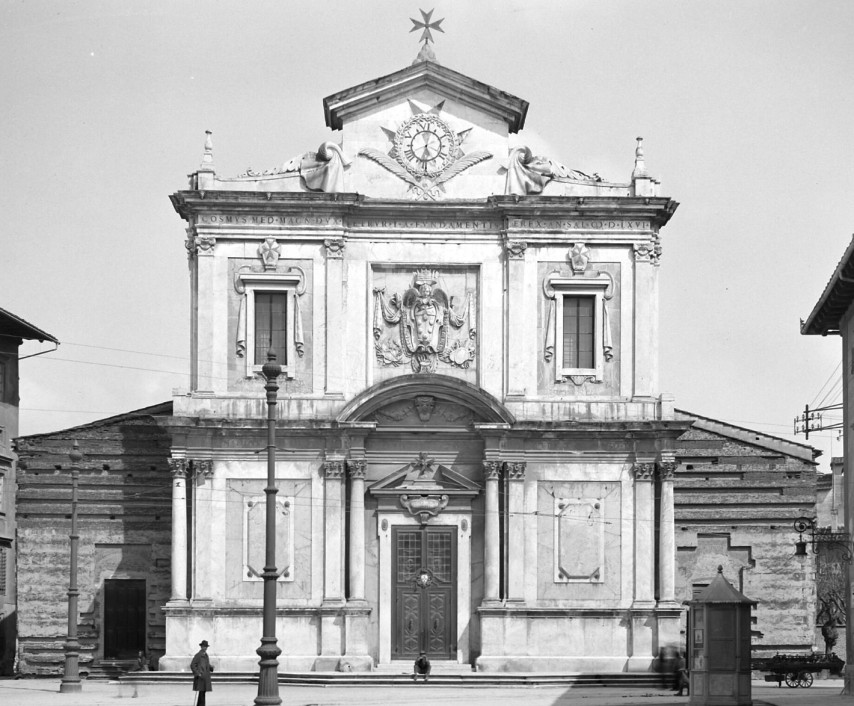
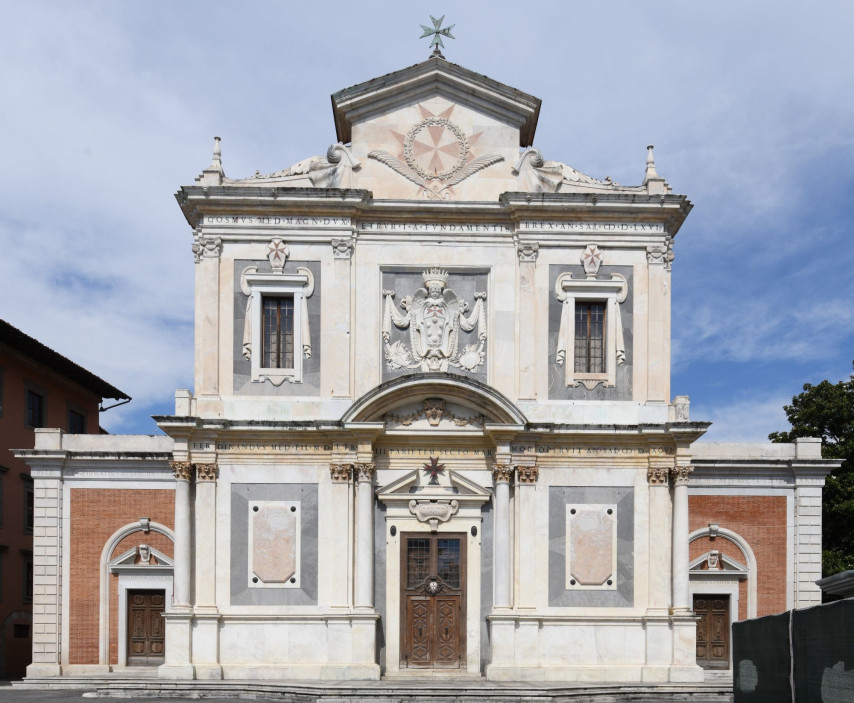
Throughout the twentieth century, the church underwent no further structural modifications. It did, however, remain the subject of ongoing interventions to counteract deterioration, stemming chiefly from problems of water infiltration. The large wooden ceiling of the nave proved particularly vulnerable. Suspended by ties and struts anchored to the Vasarian trusses, it has required consolidation and restoration on multiple occasions, with one such campaign still ongoing.
Media gallery
Pen, black chalk and wash on white paper, 751 x 516 mm
Inscription: ‘Interno della chiesa dell’Insigne Ordine di Santo Stefano. Progetto di reparto e idea del colorito in tre modi’ . Ink, traces of pencil and wash on cardboard, 315 x 588 mm, not signed or dated
Newsletter
Stay in Touch
Sign up for the Piazza dei Cavalieri newsletter
to receive updates on project progress and news.