
Stoups
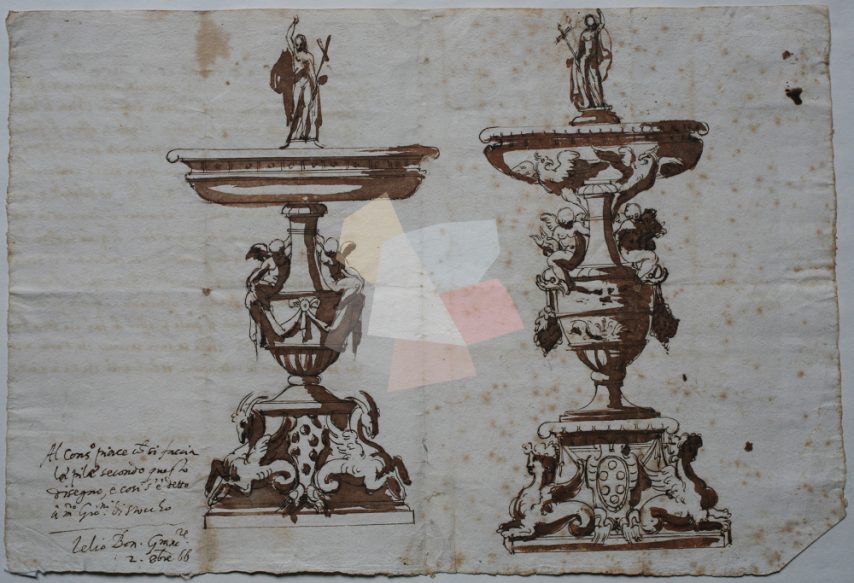
A well-known summary letter, sent by Giorgio Vasari to the Council of the Order of Saint Stephen on 30 September 1569, documents the numerous works planned and coordinated by the Aretine artist for the interior and exterior decoration of Santo Stefano dei Cavalieri. Among the various projects listed are: ‘Two designs for the holy water basins [i.e. stoups], executed in marble by Master Giovanni di Stocho’ [Dua disegni delle pile dell’aqua santa, che si feciono fare di marmo a maestro Giovanni di Stocho], along with ‘The design and mouldings for the lamps and two small holy water basins in mischio marble, commissioned to Master Giovanni Fancelli’ [Il disegnio e modani delle lanpane et di dua pilette di mischio per l’aqua santa, allogate a maestro Giovanni Fancelli]. These latter two conceptual sketches are not known today, nor do the corresponding furnishings appear to have survived (except perhaps for one of the small basins, now walled into the right-hand annexe). The design of the two larger stoups, however—still preserved within the church—can be reconstructed thanks to one of the Vasarian drawings (judged by Florian Härb not to be in the master’s hand), preserved among the documents relating to the Saint Stephen building works in the State Archives of Pisa.
Pen and brown ink on white paper.
Inscription: lower left: ‘Al Cons.o piace che si faccia le pile secondo questo disegno, e così s’è detto con m.ro Gio[van]ni di Stoccho / Lelio Bon. Granc[ancellie]re / 2 8bre 66’.
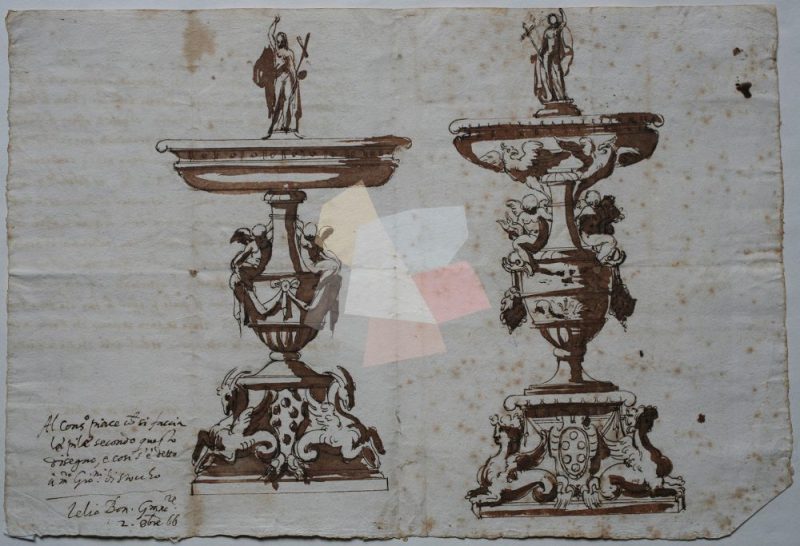
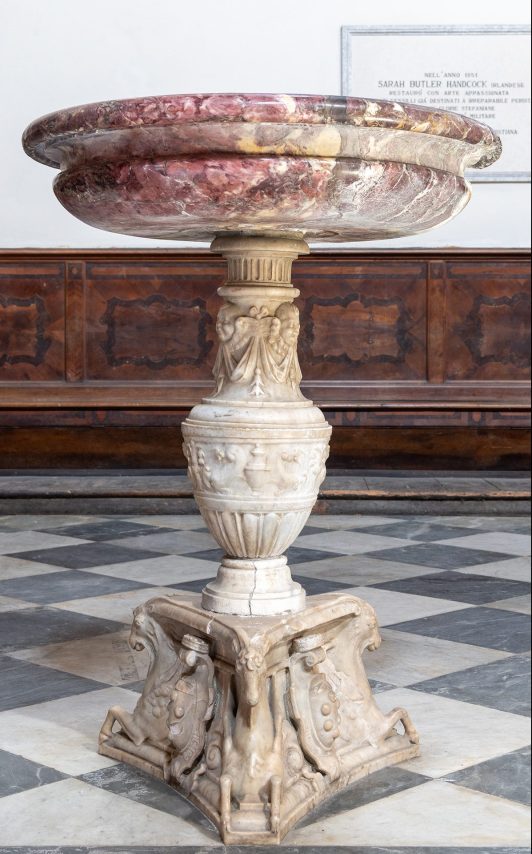
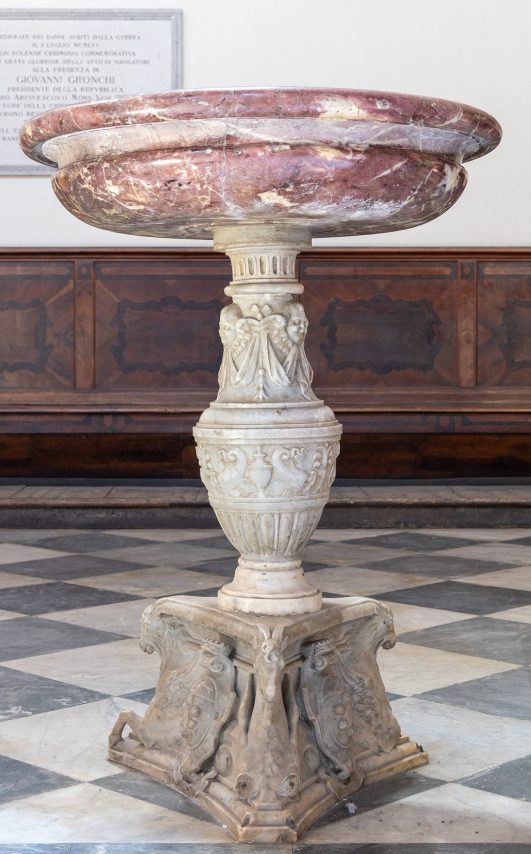
In the autumn of 1566, Giorgio Vasari submitted two distinct models to the Order of Santo Stefano for the design of the stoups. The first, which was ultimately selected for execution (as recorded at the bottom left of the sheet: ‘The Council is pleased that the basins should be crafted according to this design, and thus it has been instructed to Master Giovanni di Stoccho [Al Cons(igli)o piace che si faccia le pile secondo questo disegno, e così s’è detto a m(aestr)o Gio(van)ni di Stoccho), featured a triangular base composed of winged capricorns framing the Medicean coat of arms. Above this rose a tapered stem, amphora-like in form, flanked by putti holding ribbons and supporting a wide basin with an ovolo motif, crowned at the centre by a small sculptural figure of Saint John the Baptist. The second model, more elaborate and richly ornamented, proposed a similar base with harpies to either side of the Medicean shield and a comparable stem with putti, further enriched with two dolphins, scrollwork, and garlands of greenery. The basin above was flanked by Arabian phoenixes with outstretched wings and, like the first, surmounted by a statuette of Saint John the Baptist. The commission for the sculptural work was awarded to Giovanni di Paolo Fancelli, called Nanni di Stocco, a trusted collaborator of the Aretine master and a long-standing servant of the Medici. He had previously executed the two corner coats of arms on the façade of Palazzo della Carovana in Pisa and would continue to work alongside Vasari in the years to follow, contributing to Santo Stefano not only the stoups but also decorations for the main chapel, the balconies beneath the organs, and the bell chamber—always in line with Vasari’s designs and direction.
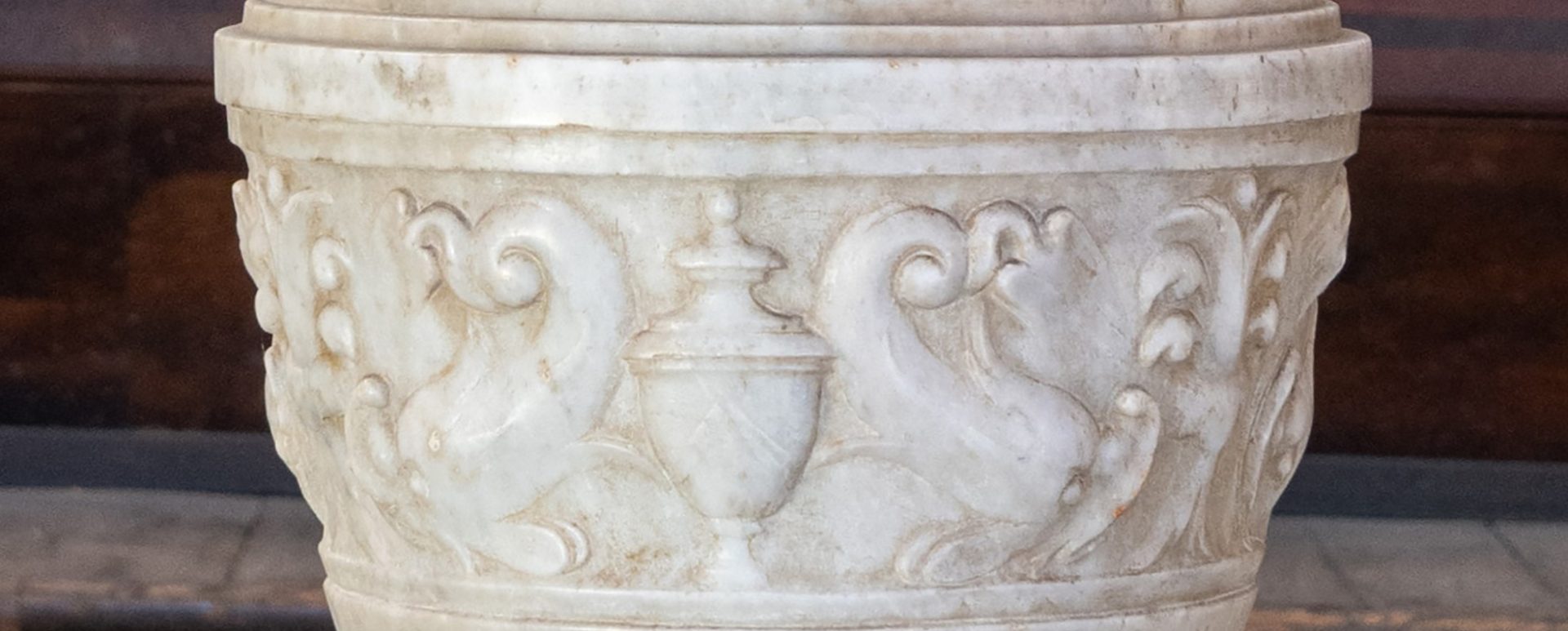
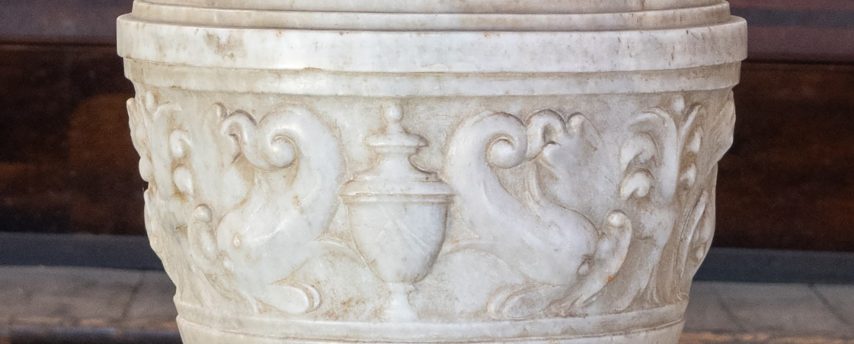
The monumental stoups of Santo Stefano, completed by February 1568, were crafted by Fancelli in white Lunense marble, with the upper basin in mixed marble from variegated Serravezza, adopting a simpler and more streamlined design than the Vasarian model approved by the Council, particularly in the central stem. The base closely follows Vasari’s sketch, featuring capricorns, a recurring symbol of power in the iconographic repertoire associated with Cosimo I de’ Medici’s patronage. Although born under the sign of Gemini, Cosimo was appointed Duke of Florence on 6 January 1537, linking this date to a symbolic second birth and his rise to power. The base includes only the addition of the Stephanian cross above the Medici coat of arms. The stem incorporates scrollwork and dolphin motifs from the rejected design, supplemented by small urns, and reinterprets the full-figure putti as cherub heads interspersed with simple festoons. The statues, likely depicting Christ and Saint John the Baptist, intended to crown the stoups, were almost certainly created, as evidenced by the anchorages within the basins; however, they are now lost.
The prominent placement of the stoups within a building of great symbolic and political significance for the city of Pisa—combined with the prestige of their distinguished designer—led to the adaptation of the Vasarian model in similar works created for other churches in the surrounding area. One such example is the stoup at San Michele Arcangelo in Orciano Pisano (1644), which replicates the structural scheme of the Santo Stefano prototype, omitting any additional figurative decoration. Another is the late sixteenth-century stoup at San Nicola in Pisa, which features a quadrangular base but follows a comparable vertical arrangement, incorporating cherub heads—here transformed into seraphim on the stem—and a basin carved from a darker, contrasting marble. Further instances include the stoup commissioned by Giulio Battaglia for the church of Santi Maria e Giovanni in Vicopisano; the polychrome-material stoup in the church of the Carmine in Pisa; and the example in San Michele in Borgo (1646). Lastly, a more simplified version executed in Campiglia marble by Bastiano Bitozzi for the Cathedral (c. 1616–1617) includes, in contrast to the others, statues of Christ and Saint John the Baptist crowning the basin.
Media gallery
Pen and brown ink on white paper.
Inscription: lower left: ‘Al Cons.o piace che si faccia le pile secondo questo disegno, e così s’è detto con m.ro Gio[van]ni di Stoccho / Lelio Bon. Granc[ancellie]re / 2 8bre 66’.
Newsletter
Stay in Touch
Sign up for the Piazza dei Cavalieri newsletter
to receive updates on project progress and news.