

Monochrome Paintings
Ferdinando I de’ Medici became Grand Duke in the autumn of 1587 and made his triumphal entry into Pisa on 31 March 1588. The local community and the Order of Saint Stephen mobilised to welcome him, appointing the knights Ottavio Piazza and Ridolfo Sirigatti to oversee the festive preparations in the streets—particularly in Piazza dei Cavalieri and in the adjacent conventual church, which at the time still lacked a façade and remained bare inside. It was there that the Grand Duke, as grand master, was to receive the oath of obedience from the assembled knights.
Sirigatti undertook the task of organising the necessary ceremonial decorations, commissioning, among other elements, five monochrome canvases illustrating episodes from the life of Pope Stephen I, the Order’s titular saint, who lived in the third century AD and was martyred by beheading under Emperor Valerian. Intended from the outset for the church, the canvases remained there after the event, ‘there being no space in the convent to store them’ [non essendo in convento stanza da poterli riporre]. They constitute the only surviving visual record of the ceremony and belong to a tradition of Florentine ceremonial decoration, exemplified also by the two monochrome tempera paintings by Benedetto Veli—now displayed in the Sala degli Stemmi of the Palazzo della Carovana—executed in commemoration of the deaths of Philip II of Spain (1598) and Henry IV of France and Navarre (1610).
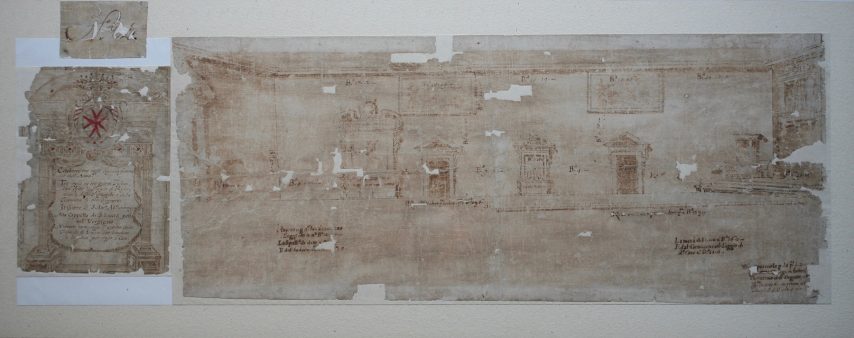
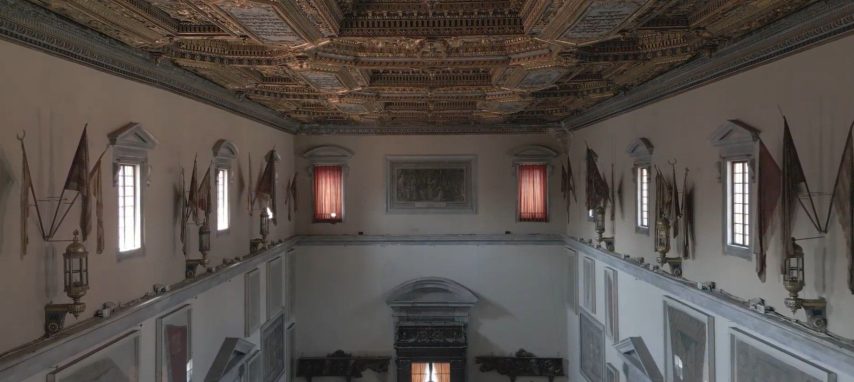
An intriguing drawing, seemingly dating from the seventeenth century and preserved in the Archivio di Stato in Pisa, depicts a partial longitudinal section of the left wall of Santo Stefano, revealing two of the canvases in their original position, just below the stringcourse cornice. During the nineteenth-century reorganisation of the church’s interior, the canvases were moved to a lower level—except for the one on the counter-façade, positioned between the windows—to make space for the display of Turkish banners and the monumental portals connecting to the lateral annexes.
Several artists, all active in the Florentine region—and some of them former collaborators of the late Giorgio Vasari—contributed to the execution of the monochrome canvas cycle. The painters involved—Alessandro Pieroni (known as Alessandro dell’Impruneta), Jan van der Straet, (known as Stradanus), Giovanni Balducci (il Cosci), Alessandro Fei (Alessandro del Barbiere), and Giovanni di Raffaello del Pallaio—are securely identified through published documentary records which, while confirming their participation and payments, do not assign specific episodes to individual hands. In 1751, Pandolfo Titi referred to ‘the five paintings executed in chiaroscuro, depicting various miracles of Saint Stephen, pope and martyr, and hanging on the walls among the banners’ [li cinque quadri fatti a chiaro oscuro, rappresentanti diversi miracoli di santo Stefano papa e martire, e che stanno appesi alle muraglie infra le bandiere] in the church, attributing them broadly to the ‘hand of Giorgio Vasari and his pupils’ [mano di Giorgio Vasari, e de’ suoi Scolari]. In 1812, Alessandro Da Morrona, citing unspecified ‘ancient papers’ [antiche carte], claimed that ‘one is by Vasari, another by Ligozzi; that the Blessed [sic] Cosimo is the work of Cristofano Allori, and that two are by [Jacopo da] Empoli’ [ch’uno è del Vasari, l’altro è del Ligozzi; che opera di Cristofano Allori è il B. (sic) Cosimo, e che due sono dell’Empoli]—likely confusing these with painters who took part in the Stories of the Stephanian Order painted on the church’s ceiling between 1604 and 1613. These works have long been the subject of attributional debate, which is undoubtedly complicated by the difficulty of examining them closely and the limited information available about some of the artists involved.Alessandro Pieroni, Stefano papa somministra la comunione ai Cristiani nelle catacombe di Lucina, 1588. Pisa, Santo Stefano dei Cavalieri
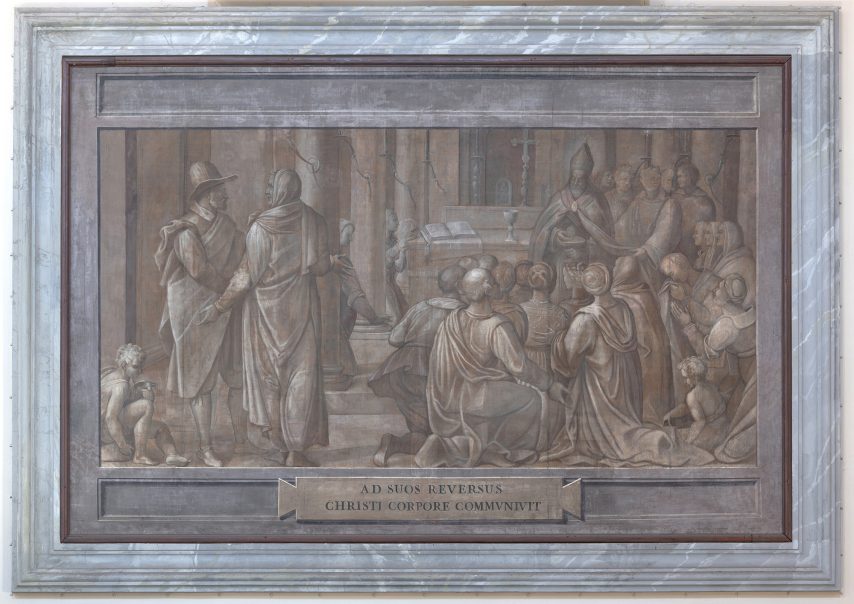

Starting from the entrance, the first panel on the right is Alessandro Pieroni, Pope Stephen Administering Communion to Christians in the Catacombs of Lucina, 1588, accompanied by the inscription ‘AD SUOS REVERSUS CHRISTI CORPORE COMMVNIVIT’.
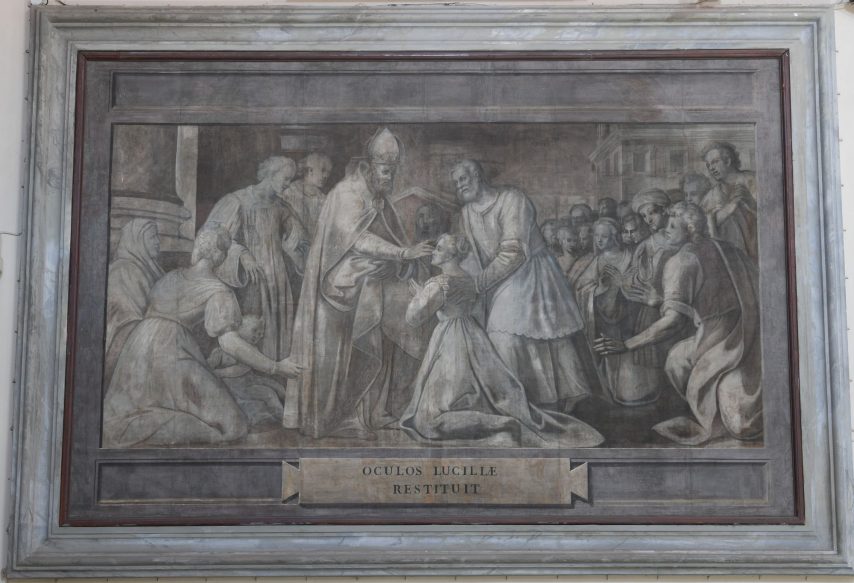
Further along is Alessandro del Barbiere, Pope Stephen Healing the Blind Lucilla, 1588, with the inscription ‘OCULOS LUCILLAE RESTITUIT’. Archival records attribute this painting to Alessandro del Barbiere as the ‘first history of Saint Stephen’ [prima historia di S. Stefano], which, in both the hagiographic account and Giovanni Cervoni’s 1588 description of the festive decorations, corresponds to the miracle of Lucilla.
The life and miracles of Pope Stephen—central to a noted controversy with the African church over the validity of baptism administered to reconciled heretics—are recounted in the Passio Sancti Stephani (sixth–seventh century AD), the principal source for this Pisan series (several manuscript versions of which are preserved in the Biblioteca Medicea Laurenziana, Florence), and later in various other accounts, notably the Acta Sanctorum, first printed in 1643.
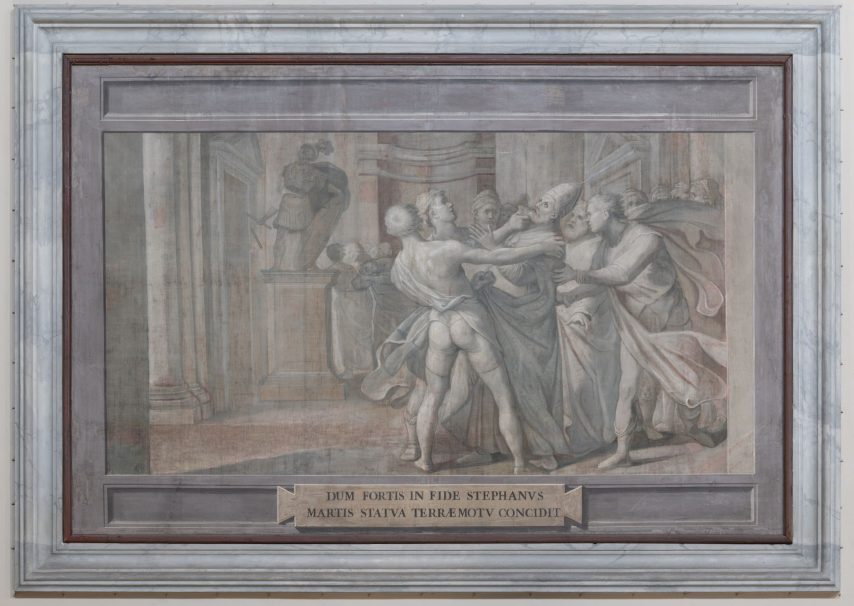
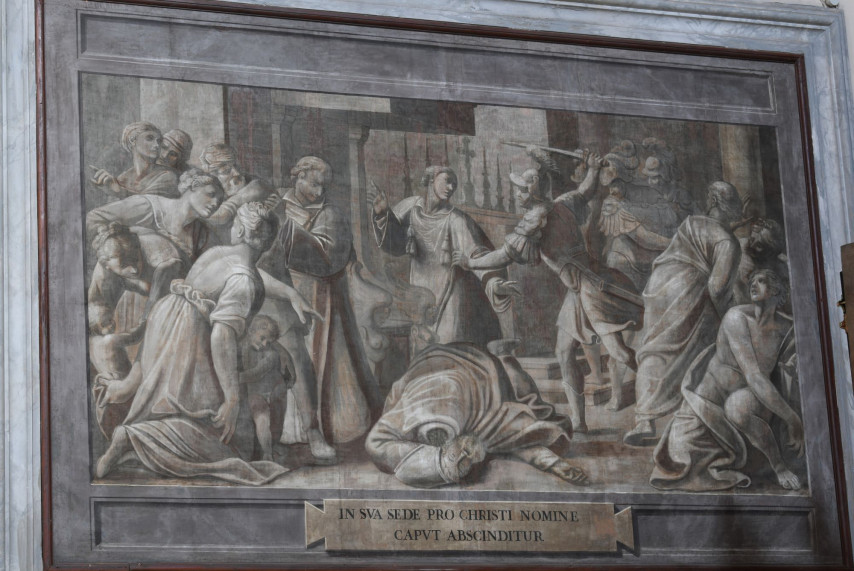
On the left wall, again proceeding from the entrance, are Giovanni del Pallaio, Capture of Pope Stephen, 1588, with the inscription ‘DUM FORTIS IN FIDE STEPHANVS MARTIS STATVA TERRAEMOTV CONCIDIT’, and Giovanni Balducci (called il Cosci), Decapitation of Pope Stephen in the Catacombs of Lucina, 1588, with the inscription ‘IN SVA SEDE PRO CHRISTI NOMINE CAPVT ABSCINDITUR’.
Finally, on the counter-façade is the Burial of Pope Stephen in the Catacombs of Callixtus, 1588, with the inscription ‘CORPUS VNA CVM SOLIO SEPELÌTVR’. Preparatory drawings for this episode, held at the Ashmolean Museum, Oxford (inv. nos. WA1943.6; WA1863.202), have been attributed to Stradanus, thereby reinforcing the attribution of the canvas to the same artist.
In 2000, the five monochrome paintings underwent significant conservation. According to the report, preserved in the Archive of the Soprintendenza in Pisa, the canvases had been restored and retouched multiple times over the years. The cartouches bearing the inscriptions—which notably alternate between the Italian capital U and the Latin V—were likely enlarged at an unspecified date.
Media gallery
Newsletter
Stay in Touch
Sign up for the Piazza dei Cavalieri newsletter
to receive updates on project progress and news.