
The Order and Slavery
The principal mission of the Knights of the Order of Saint Stephen was the defence of Christendom against the infidels, pursued primarily through privateering. This form of warfare, characterised by clashes between small fleets and the pursuit of enemy vessels, had largely replaced large-scale naval battles in the second half of the sixteenth century, particularly after the Battle of Lepanto in 1571.
The Knights of the Order excelled in privateering, earning a formidable reputation across the Mediterranean as Christian corsairs. Their activities ranged from protecting the Tuscan coasts—relentlessly pursuing Ottoman and North African Barbary galleys—to raiding enemy territories. A notable example is the conquest of Bona in 1607, a victory celebrated in Pisa in the presence of Cosimo II. This triumph became a recurring theme in the visual representation of the Order and the Medici dynasty in Tuscany, first depicted soon after the event in the painted panels on the ceiling of Santo Stefano dei Cavalieri.
The principal social consequence of privateering was slavery, an enduring reality in early modern Christian Europe. In Tuscany, enslaved people were predominantly travellers and soldiers captured by the Knights of the Order of Santo Stefano during their raids against Muslim shipping.
Many captives were sold in slave markets across the Mediterranean, such as those in Palermo and Naples, while the strongest were brought to Livorno, which between the sixteenth and seventeenth centuries served as one of the principal slaving hubs in the Mediterranean. There they were meticulously recorded in the so-called Libri delle prede (‘Books of Prizes’) and employed as galley rowers, in port maintenance, or as labourers on public works.
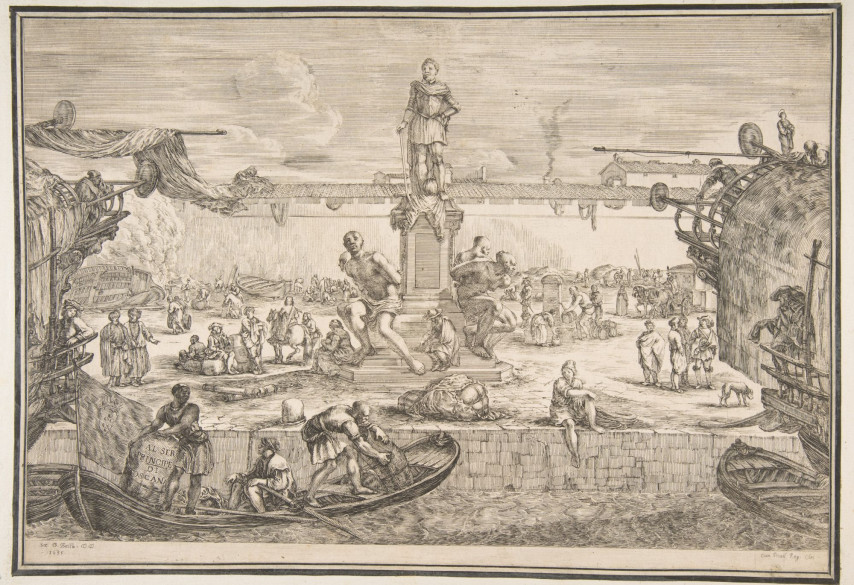
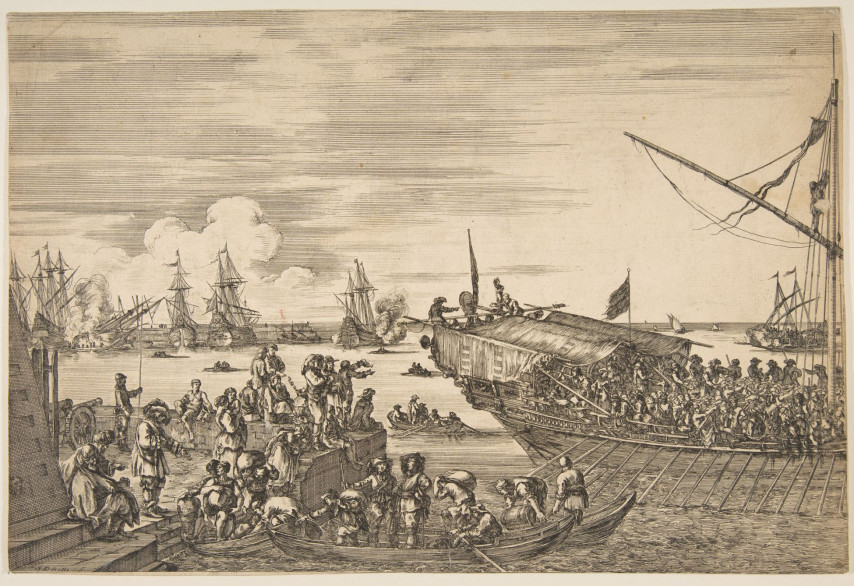
Under Ferdinando I de’ Medici, Livorno became the principal port of the Medici state and the base for all operations of the Order of Saint Stephen. Between 1598 and 1604, the Bagno was constructed in the city, a unique prison-fortress in the Christian world, comparable only to its counterpart in Malta. Visited about a decade later by Emir Fakhr ad-Dīn, Livorno’s ‘prison for prisoners of war’ [‘carcere per i prigionieri di guerra’] consisted of four long underground chambers where captives were confined at night. Openings above allowed guards, stationed at ground level, to monitor them easily. More than a fortress for holding thousands of slaves and forced labourers and sheltering them during the winter, the Bagno served as a vast reservoir of manpower for hardtack bakeries, ship and weapons construction, and public works of the Grand Duchy, functioning as a true productive complex.
In Pisa, the labour of enslaved people is documented by Vincenzo Pitti in his Relazione di Pisa (1616), recording that galleys were built not only in Livorno but also in the city’s arsenal, where ‘at least 170 slaves’ [‘almeno 170 stiavi’] worked intensively. A century later, in November 1728, Charles-Louis de Montesquieu described the ‘extremely harsh’ conditions in the ‘bagni, or prisons of the slaves’, located ‘near the shipyard’ where the Grand Duke’s fleet was built. A slightly earlier account by De Rogissart, in the sixth volume of his Délices de l’Italie, confirms that enslaved men in Pisa were employed in marble cutting and cleaning, and, according to local tradition, Turkish prisoners were even said to have worked the porphyry used for the altar of Santo Stefano.
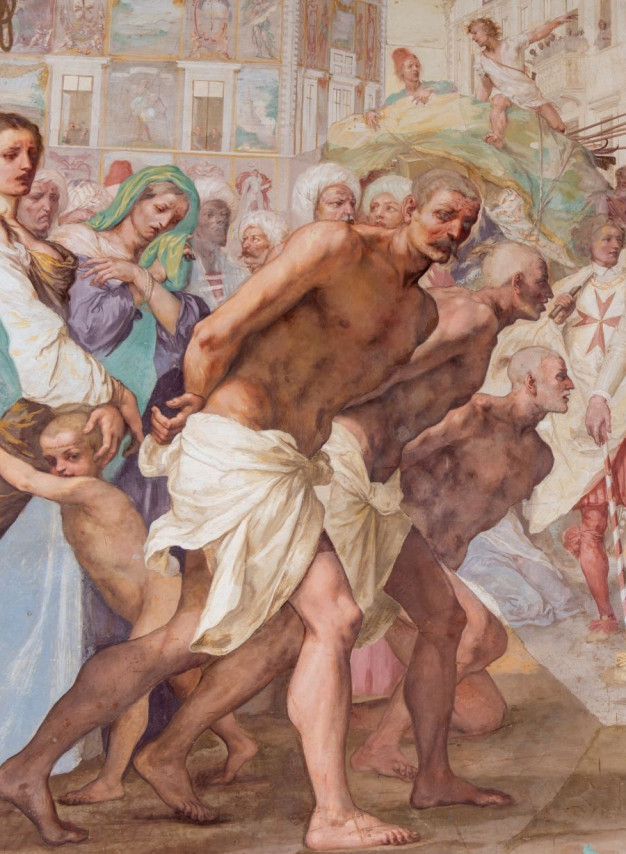
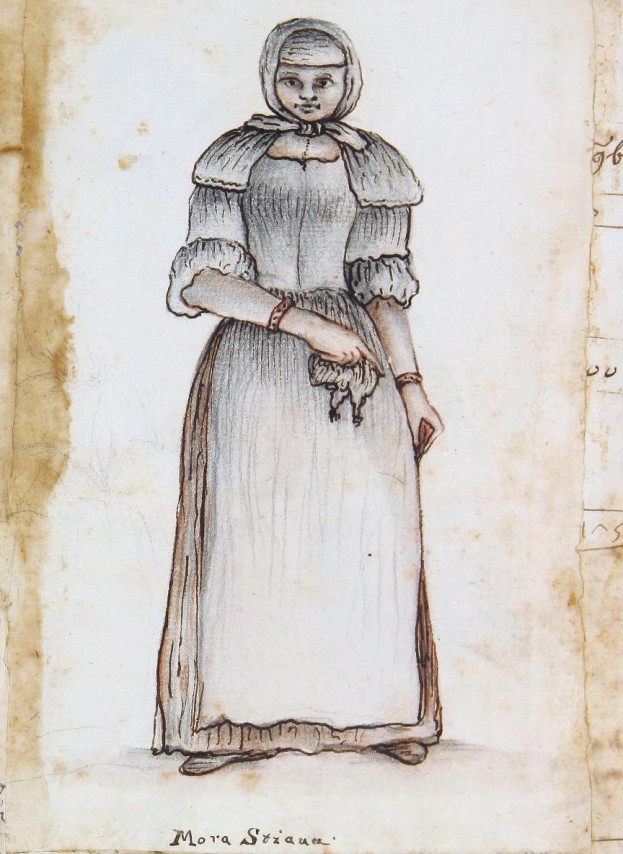
Slavery was a tangible reality in early modern Tuscany, marked by the distinctive clothing and hairstyles that distinguished those in bondage. The Grand Duke’s slaves were typically shaven headed, except for a single tuft at the crown, and wore shirts, canvas or linen trousers, red cloth jackets, and red wool caps. One of the principal sources for these details is the remarkable collection of drawings from the late seventeenth century by Cavalier Ignazio Fabroni, which also documents instances of female captivity.
‘Chevalier de l’Ordre de St. Etienne’
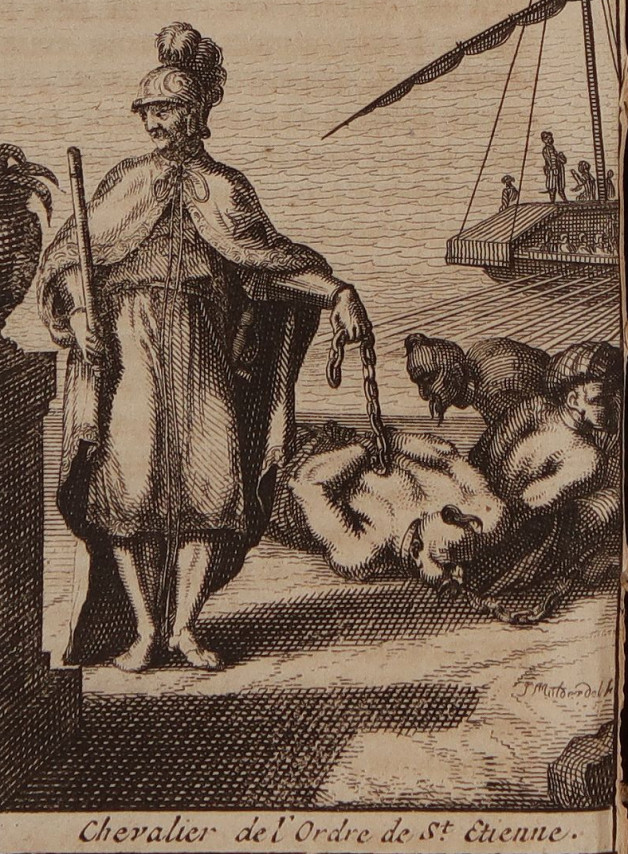
During the seventeenth century especially, enslaved individuals—mostly captives taken by the Knights of Saint Stephen during their naval campaigns—were frequently depicted in art to exalt the grandeur of the Grand Dukes and the Order they led as grand masters. The most renowned example is the Monument to Ferdinando I in Livorno, whose base features four monumental bronze statues of chained men of different ethnicities, modelled and cast by Pietro Tacca after studying live models, including one known as Morgiano. Known collectively as the Quattro Mori (Four Moors), the monument was conceived to celebrate the Medici’s mastery of the seas and their victories over the Muslim corsairs, with Ferdinando shown wearing the insignia of the Order. Bronze reproductions of enemy weapons and emblems, intended to reinforce this message of triumph, were looted and likely melted down by the French during their 1799 occupation of Livorno.
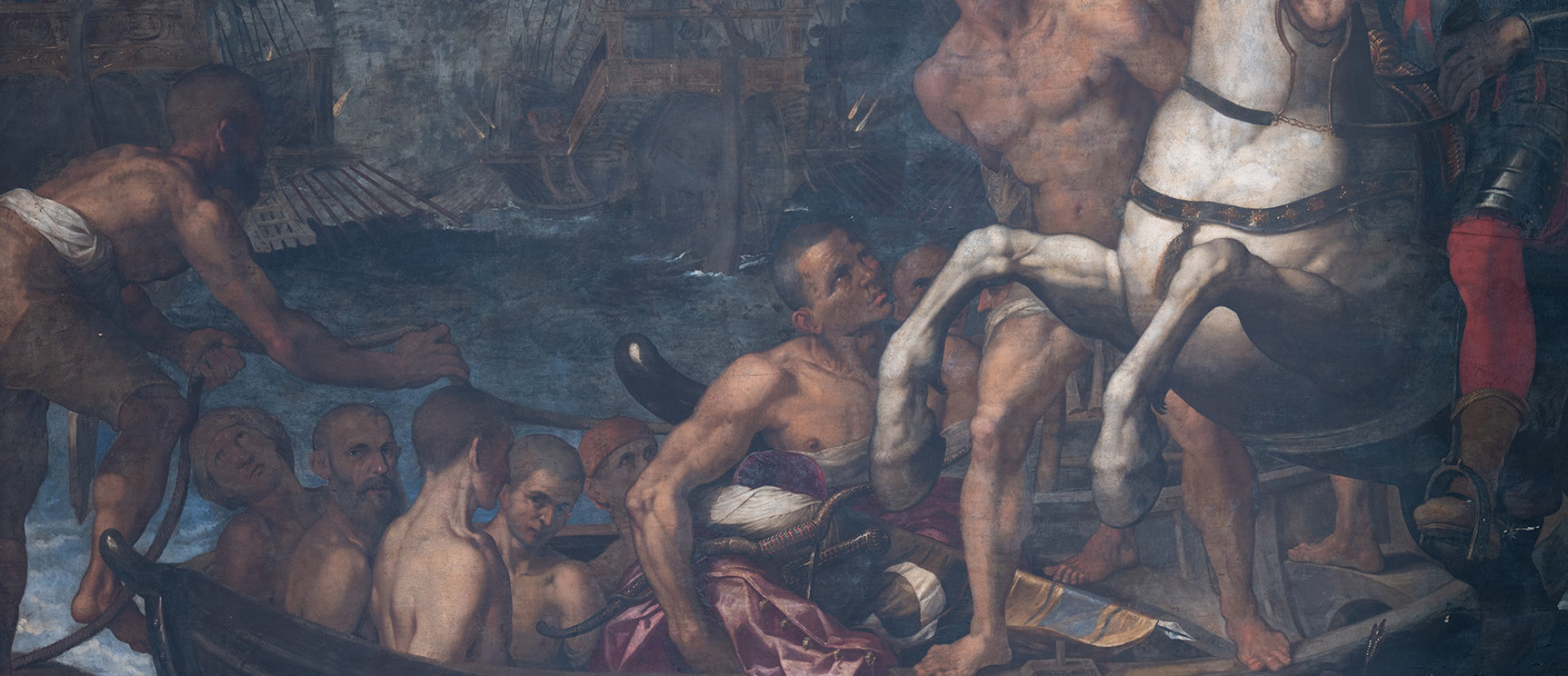
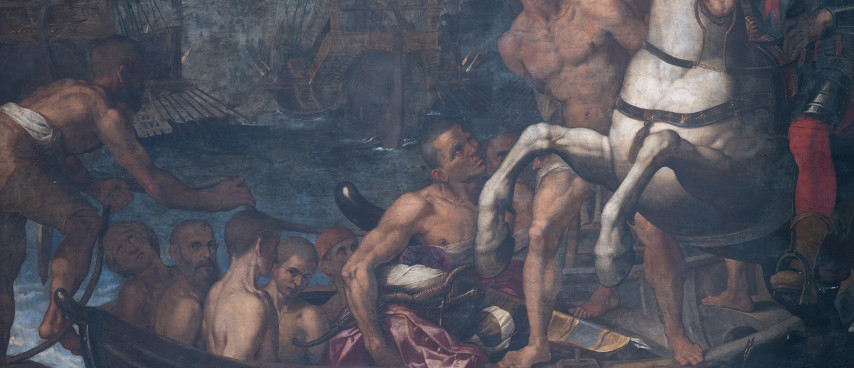
The victories of the Order of Saint Stephen over non-Christians are prominently evoked in Santo Stefano dei Cavalieri, conceived both as a ‘political’ church devoted to the glory of the Medici dynasty and as an austere garrison church where worship was bound to the commitment and memory of the struggle for the faith. Within the sacred building, it became customary to display trophies seized by the Knights from enemy ships—such as lanterns and flags—which tangibly recalled the exploits depicted in the painted ceiling cycle, executed between 1604 and 1614. Of particular note is the scene Return of the Stephanian Fleet from the Battle of Lepanto, a work that departs from the traditional iconography focused on the clash itself to portray instead the Order’s ships returning to Livorno, laden with glory but above all with enslaved people—the true spoils of the Christian corsairs’ raids.
Also of great interest are the wooden fragments carved in the late seventeenth century and displayed in the church of Santo Stefano dei Cavalieri only from the mid-nineteenth century, thus not part of the original decorative programme. Depicting Turkish and North African prisoners, including women and a child, they recall the statues of Pietro Tacca and offer a poignant example of how the glorification of the Order of Saint Stephen and the Medici dynasty was also expressed through the degradation of the defeated enemy. The ‘infidel Muslim’ is shown not only in chains but with a ferocity rendered in almost grotesque and even bestial terms.
Media gallery
‘Chevalier de l’Ordre de St. Etienne’
Newsletter
Stay in Touch
Sign up for the Piazza dei Cavalieri newsletter
to receive updates on project progress and news.