
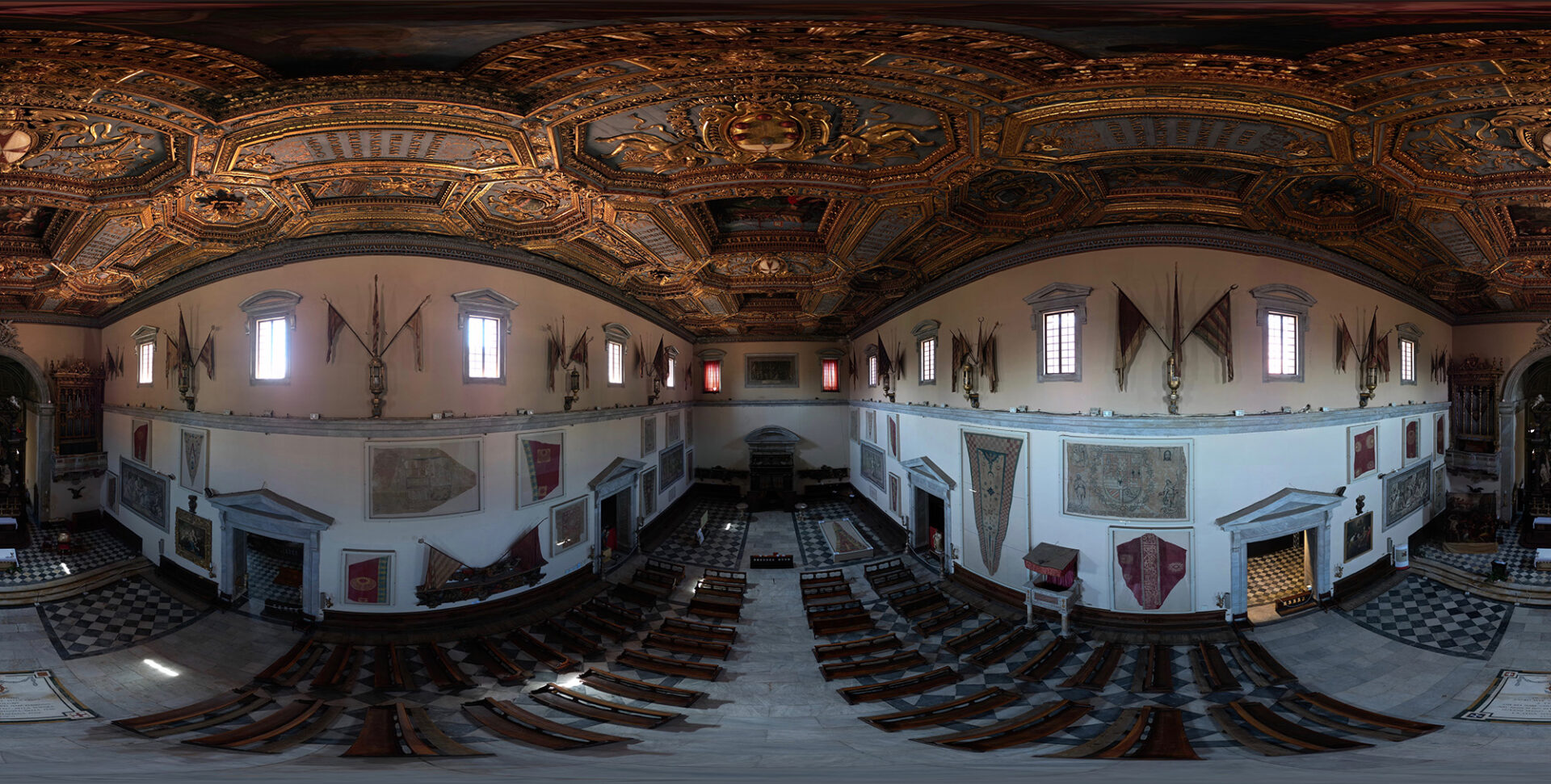
Interior
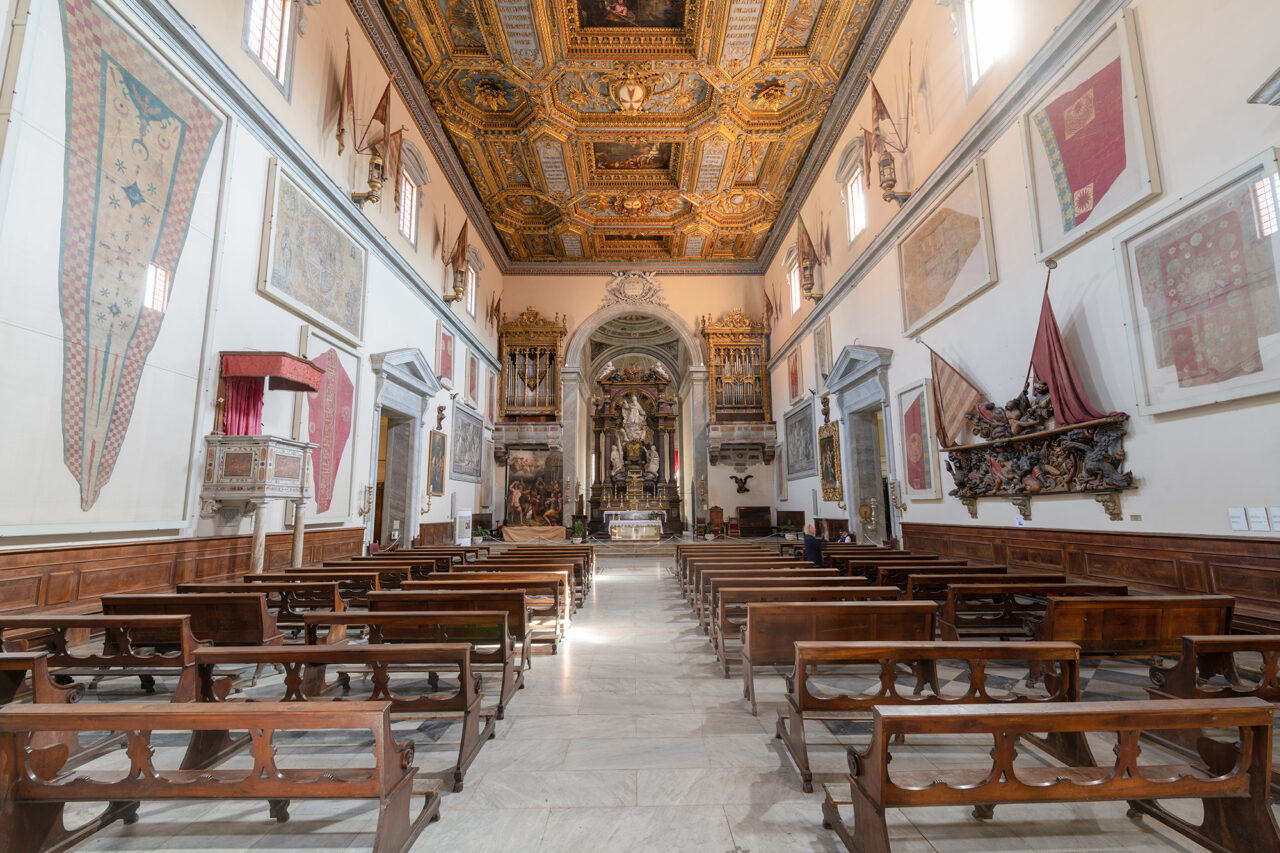
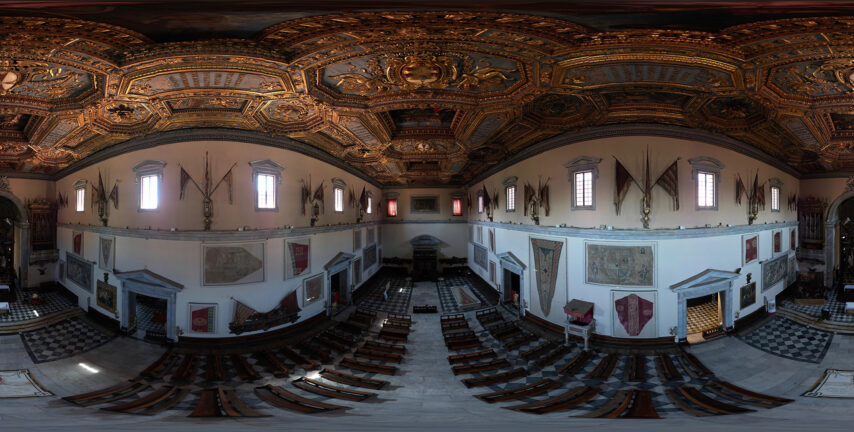
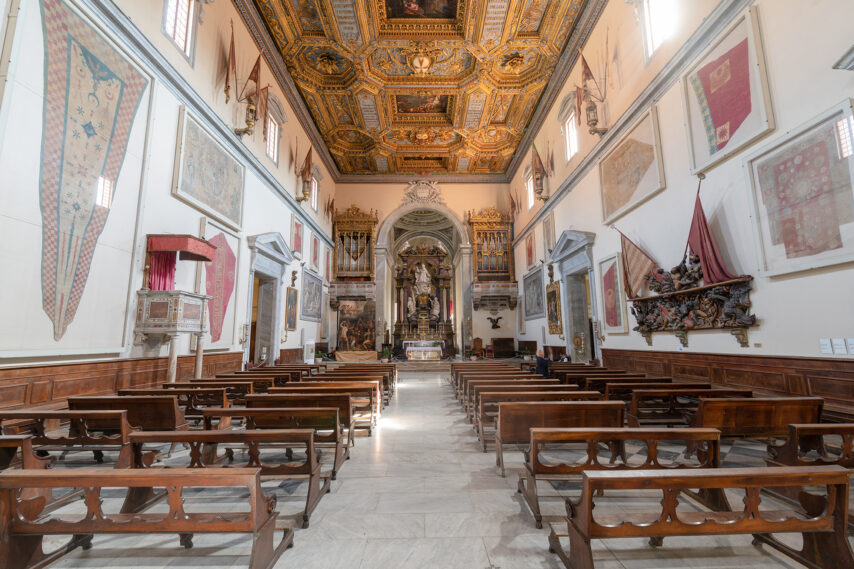
The church of Santo Stefano dei Cavalieri has a single nave flanked by two side aisles, which are accessed from the central space through four gabled openings, two on each side.
The presbytery houses the high altar, dominated by Giovanni Battista Foggini’s monumental ensemble, executed with workshop assistance between 1702 and 1709. At its centre rises the figure of Saint Stephen in Glory above the bronze cathedra, whose backrest bears a relief of the saint’s decapitation. Lower down, two angelic figures – one holding a banner and the other a sword and shield – are seated upon a jasper sarcophagus. The front of the altar carries the inscription ‘NOMINI MEO ADSCRIBATVR VICTORIA’. The work marked the culmination of a long and complex genesis.
The side walls are horizontally divided by a string course, above which rise five windows on each side. The painted architectural framing and the window pediments, alternately curved or straight, are executed in the grey Golfolina stone specified by Giorgio Vasari; the same tone was adopted in 1867–1868 for the frames of the openings towards the side wings. Vasari’s original design underwent profound alteration between the seventeenth and nineteenth centuries. The principal changes, in chronological order, were as follows: the replacement of the open-truss ceiling with a coffered ceiling (1603–1604), a modification attributed to Alessandro Pieroni; the addition of lateral wings serving as storerooms and vestries by Pier Francesco Silvani and Giovanni Battista Foggini (1685); the erection of Foggini’s sumptuous high altar (1702–1709); and the substitution of the wooden side altars with marble ones executed by Giovanni Lazzarini (1820), which were later relocated to the wings by Gaetano Niccoli (1867–1868). Two elements that do survive from the original furnishings are the stoups near the counter-façade, carved by Giovanni Fancelli, called Nanni di Stocco to Vasari’s design between 1566 and 1568. Vasari also designed the galleries now positioned beneath the organs flanking the high altar. The one on the right was executed by Onofrio Zeffirini in 1569 and fitted with elaborate carved woodwork following Vasari’s scheme; the gallery on the left was conceived by Azzolino della Ciaia in 1734. These decorative features represent only a faint echo of the comprehensive interior scheme Vasari devised for the church, down to the smallest detail. Many of those elements have since been lost, though they remain known through the architect’s surviving drawings.
Vasari originally planned two large altarpieces for the wooden side altars. One was to depict the Martyrdom of Saint Stephen the Protomartyr; Vasari painted it himself in 1571, and it now hangs to the left of the high altar. The other was to represent the Nativity, executed by Agnolo Bronzino in 1564–1565 and now placed in a marble altar in the left wing.
The church houses the banners captured by the knights from the Ottoman fleet, displayed on the walls or in purpose-made frames arranged along the nave. The collection is varied in material, shape, and decoration. Since the second half of the nineteenth century, the nave walls have also displayed late-Baroque carved wooden fragments from galleys. These include figures of chained prisoners – both men and women – together with eagles and trophies rendered in high relief and in the round. Such imagery, characterised by a violent and discriminatory visual language, reflects the hegemonic ambitions of the Medici dynasty.
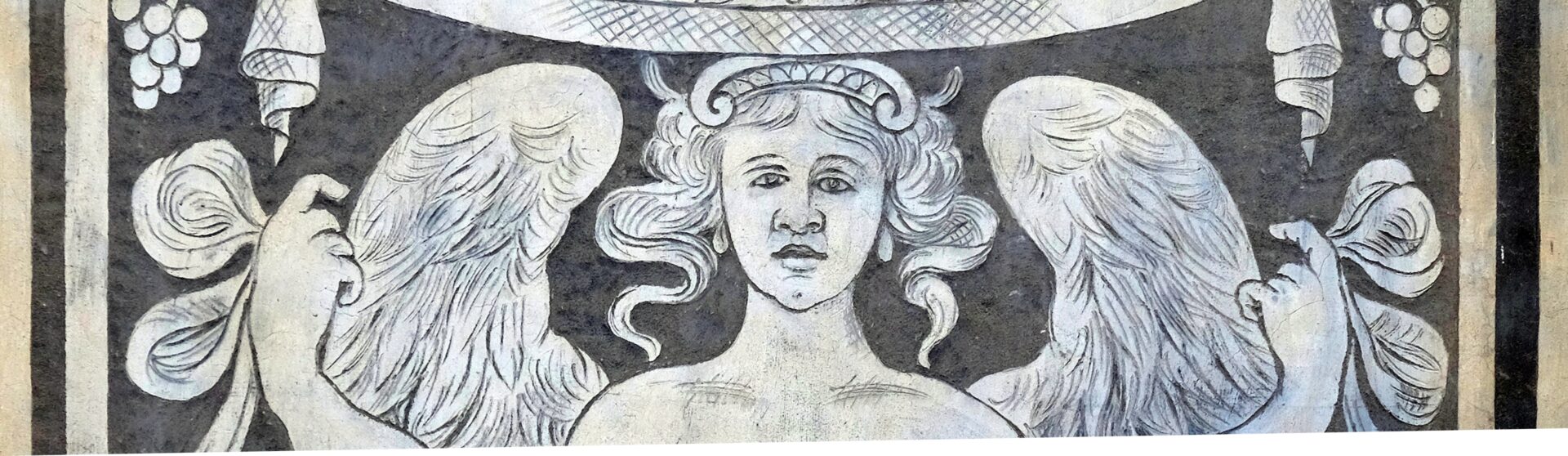
The walls also display a monochrome painting cycle depicting the Stories of St Stephen. These were painted in 1588 on the occasion of Ferdinando I de’ Medici’s ceremonial entry into Pisa, an event orchestrated by the versatile artist Ridolfo Sirigatti.
The paintings are not hung in narrative sequence. Above the entrance door is the Burial of Pope Stephen in the Catacombs of Callixtus. On the right wall, moving towards the presbytery, are Pope Stephen Administering Communion to Christians in the Catacombs of Lucina and Pope Stephen Healing the Blind Lucilla. On the left wall, proceeding in the opposite direction, are the Beheading of Pope Stephen in the Catacombs of Lucina and the Capture of Pope Stephen.
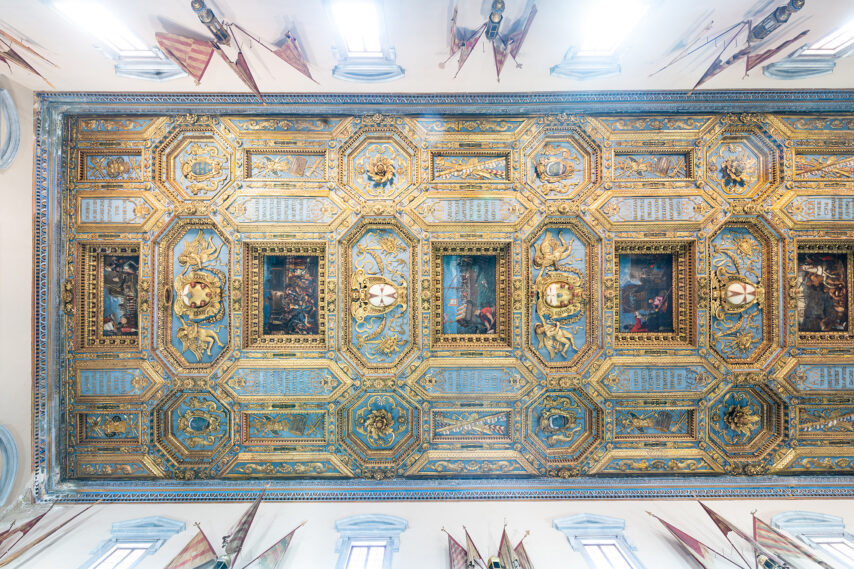
The much-admired coffered ceiling – designed by Alessandro Pieroni and executed by Filippo Paladini between 1603 and 1604 – encloses six large panels illustrating episodes from the history of the Order, painted between 1604 and 1613. .Starting at the presbytery, these depict: The Investiture of Cosimo I as Grand Master of the Order by Ludovico Cardi, called Il Cigoli; The Return of the Fleet from the Battle of Lepanto by Jacopo Ligozzi; The Embarkation of Marie de’ Medici by Cristofano Allori; The Victory in the Greek Archipelago by Jacopo Chimenti, called Jacopo da Empoli; The Capture of the City of Preveza by Ligozzi; and The Capture of Bona by Jacopo da Empoli. The ceiling is also studded with the emblems of the Grand Dukes: the boat with its mast and the motto ‘FESTINA LENTE’, referring to the wisdom and prudence of Cosimo I; the boat bearing the cross of Santo Stefano and the motto ‘IN HOC SIGNO VINCES’, taken from Constantine’s dream; the emblems of Francesco I – the weasel with a rue leaf (‘AMAT VICTORIA CURAM’), alluding to the Grand Duke’s prudence, and the badger bristling with thorns (‘LAEDENTEM LAEDO’), denoting the severity of his justice; and finally the emblem of Ferdinando I, the bee protected by its swarm (‘MAJESTATE TANTUM’).
Over the years, the conventual church has assembled a varied collection of works, some transferred from other buildings belonging to the Order. These include the canvas The Holy Family with St Stephen, painted by Aurelio Lomi in 1593 for the Council Chamber of the Knights (then housed in Palazzo della Carovana), and the polychrome marble pulpit by Chiarissimo Fancelli (1627), which was moved from Pisa Cathedral to the church of Santo Stefano in 1929.
Finally, the plaster and wood modello depicting St Stephen between Religion and Faith– executed by Giovanni Battista Foggini to a design by Pier Francesco Silvani for the temporary decoration of the high altar during the translation of the saint’s relics in 1683 – remains still kept in a room to the right of the presbytery, opposite the Chapel of the Blessed Sacrament built by Florido Galli in 1836–1837.
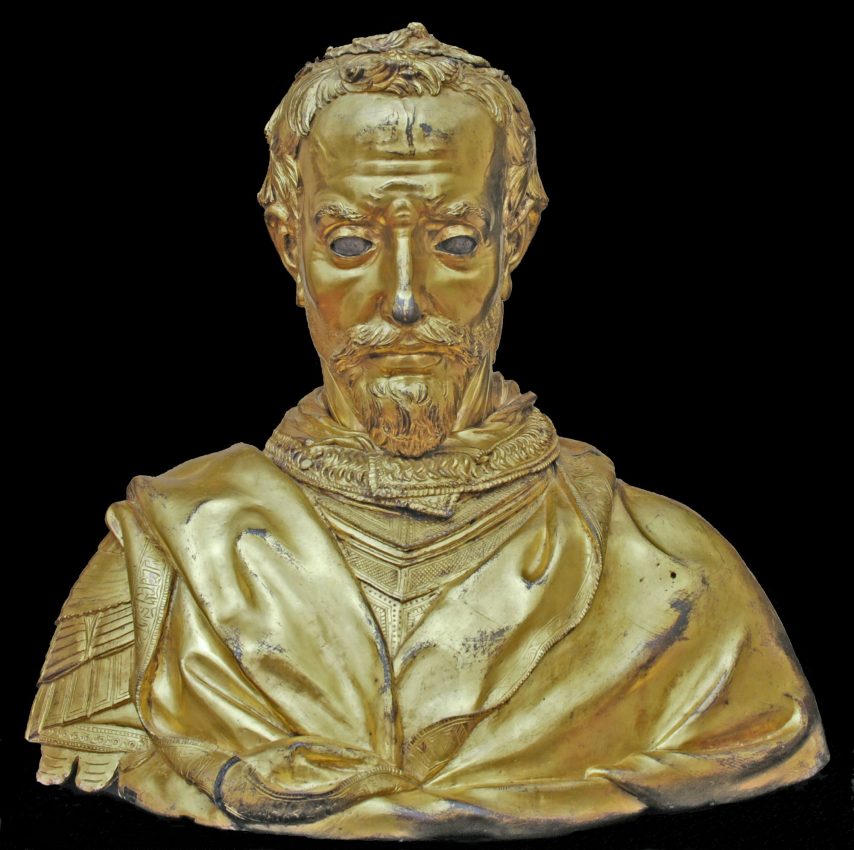
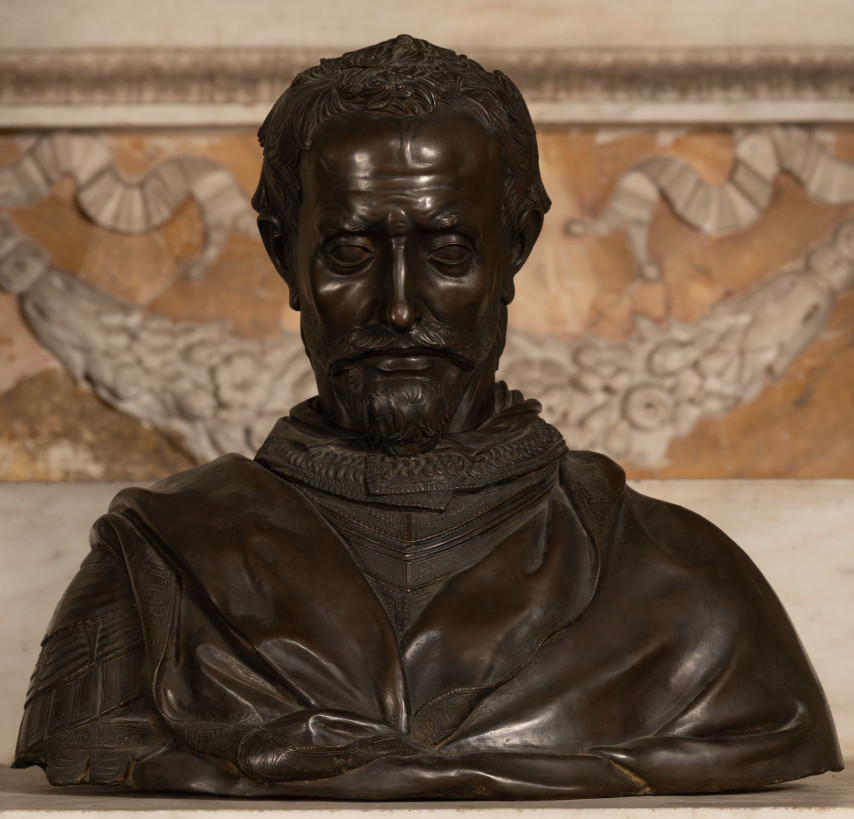
Among the goldsmiths’ works that entered the church during the fifteenth century, particular mention must be made of Donatello’s reliquary bust of Saint Luxorius (also known as San Rossore), datable to around 1422–1425. The original is now housed in the Museo Nazionale di San Matteo; it was replaced in the church by a copy after its high-profile theft – and subsequent recovery – in 1976.
Gilded and silvered bronze, cast, 55 x 58 x 42 cm
Media gallery
Newsletter
Stay in Touch
Sign up for the Piazza dei Cavalieri newsletter
to receive updates on project progress and news.