

Bell Tower
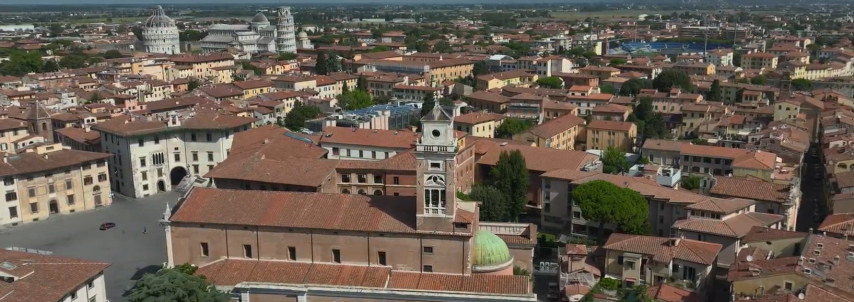
Like every other component of Santo Stefano dei Cavalieri, the bell tower as it appears today—adapted in form over the centuries—was originally designed by Giorgio Vasari, who sought to ensure that its formal appearance harmonised with the façade he had conceived. Several drawings preserved in the Archivio di Stato in Florence document both its configuration and the stages of development of this important architectural component. They show the tower rising from a balustrade surmounted by slender Ionic columns (reused from the choir of Santa Maria del Fiore in Florence) and a twin arched pediment (similar to the one Vasari had already used for the main entrance portal on the façade). The whole structure is framed by corner pilasters and crowned at the top by the bell chamber with its pitched roof, featuring four circular openings—one on each side—designed to accommodate clock faces ‘visible from all four sides of the tower for the greater convenience of the city, as they could be seen from everywhere’ [‘le mostre de l’ore visibili da tutte quattro le parti del campanile per maggior comodità della città potendosi vedere da per tutto’].The use of different materials, already suggested in one of the sheets preserved in Florence, further accentuated the chromatic contrast—still partly discernible today—between the load-bearing structures and the carved marble elements alternating with the grey Golfolina sandstone.

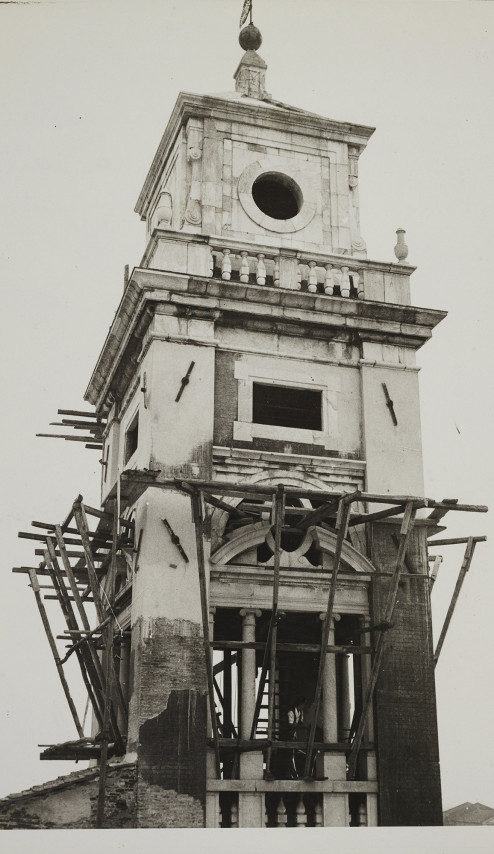
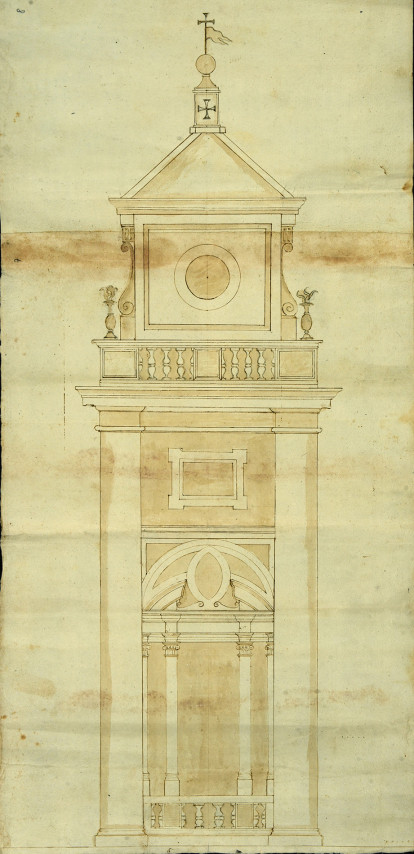
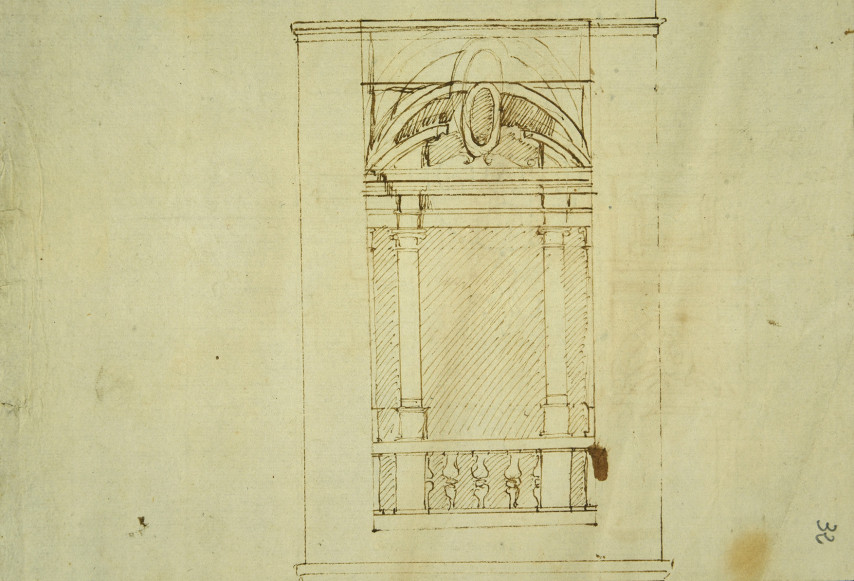
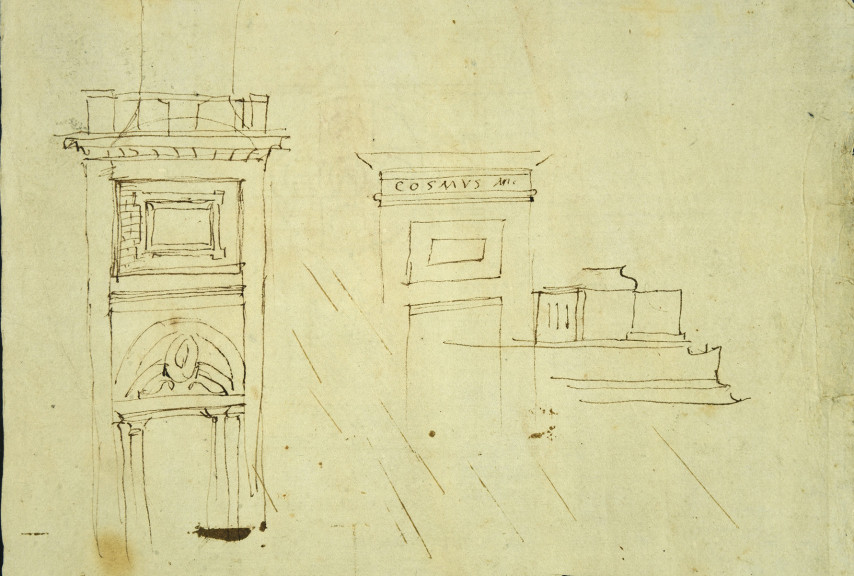
Set on the right-hand side of the main church building, the bell tower was still under full construction when the church was consecrated and inaugurated with a solemn ceremony on 21 December 1569, to the point that Vasari ordered that ‘for the moment the bell tower be covered roughly, for its completion and full height will be settled later, as the bells have not yet been made’ [‘il canpanile per ora si cuopra alla salvatica, che il suo finimento sua altezza se ne risolverà, non c’essendo canpane fatte’].
In 1570, acting in agreement with his local representative Davide Fortini, Vasari finally entrusted the finishing of the exterior surfaces to Giovanni Fancelli, called Nanni di Stocco, who undertook to complete them within ten months for the risible sum of only 400 scudi and in accordance with the drawings—repeatedly altered during the work—supplied by Vasari.
This exceptionally low estimate, which had enabled the stonecutter to secure the commission, soon led to an inevitable dispute with the Council of the Order. After the signing of the agreements and the continual design changes, Fancelli requested a revision of the costs, which, following a technical appraisal specifically commissioned for the purpose, proved to be three times higher than the contractual estimate. The agreement was eventually settled with a reluctant payment of a further 200 scudi by the Order, compelled by the fear that the work would otherwise remain unfinished, and the project was concluded in 1572 (without the clock faces originally envisaged).
Meanwhile, in November 1571, Vasari was summoned to answer for the matter, accused of having failed to supervise the drafting of the agreements appropriately. Faced with the dissatisfaction expressed by the Stephanian Council, however, the architect defended himself by claiming that the 400 scudi mentioned in the private deed signed by Fancelli were to be understood as a payment ‘on account, for everyone knew that the work was worth far more’ [‘a buon conto, perché ognuno conosceva che ci è lavoro per molto di più’].
The Vasarian project returned to prominence at the end of the seventeenth century. Around 1678 the piazza’s clock had been installed at the top of the church façade, but fears that the continual candlelit operations required for its functioning might cause fires led to renewed interest in Vasari’s original proposal, who ‘had intended to place a clock on top of the bell tower of the church and, for that purpose, several openings had been built, in which the face of the said clock was to be seen’ [‘haveva destinato di porre un oriolo sopra il campanile di essa et a tale effetto vi sono fabbricati alcuni occhi, ne quali deve vedersi la mostra di detto oriolo’]. As reported by Benedetto Baldinotti, knight and commissioner of the Stephanian convent, in 1682 the auditor Ferrante Capponi stated in a letter that he believed: ‘it would therefore be advisable to remove the said clock from the said façade and place it on top of the said bell tower’ [‘stimerei che fusse perciò bene levare detto oriolo da detta facciata e collocarlo sopra detto campanile’]. The same year, with a simultaneous reduction from four to two of the sixteenth-century clock faces, his view was accepted, and the mechanism was moved into the Vasarian tower, where it remained until 1696, before being permanently installed in Palazzo dell’Orologio.
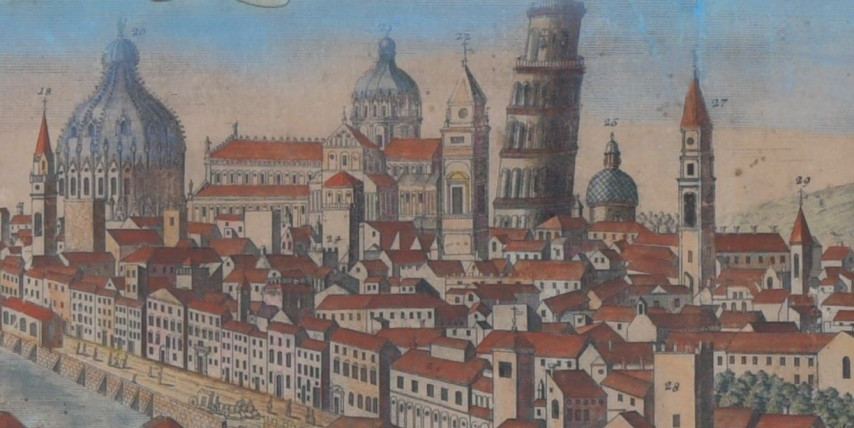
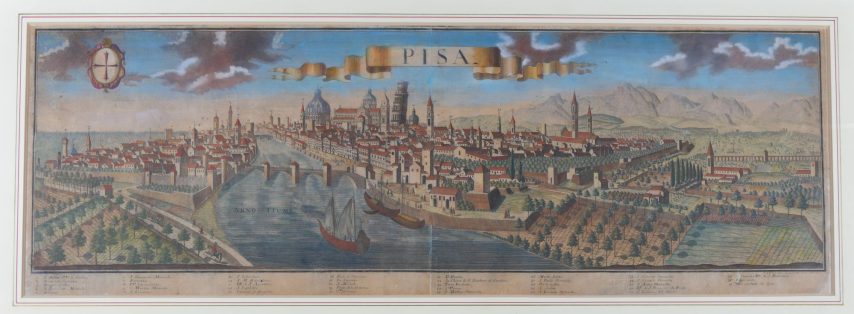
In 1691, a new campaign of restoration on the Vasarian tower engaged the services of Giovanni Battista Foggini. By 1693, he had replaced the balustrades and other decorative elements and carried out static reinforcement of the walls. The precarious condition of the masonry required further consolidation work and the replacement of several components in the centuries that followed. These included the tie-rods, the Golfolina stone balustrade, the window frames and the cornice. A large-scale intervention, planned by the engineers Giuseppe Caluri and Stefano and Ferdinando Piazzini, affected the entire structure between 1826 and 1828. It noticeably altered the building’s earlier colour scheme, which remains documented in an etching datable to the first half of the eighteenth century.

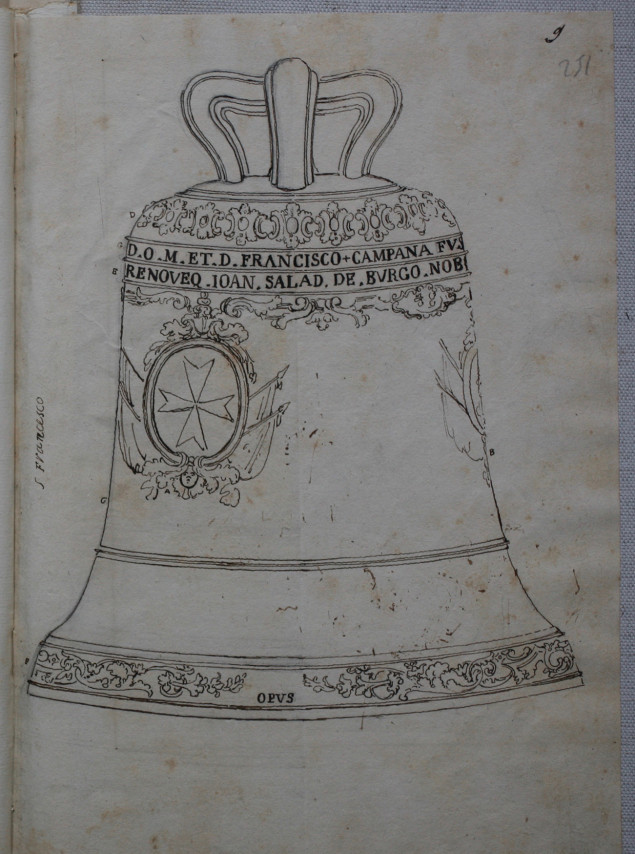
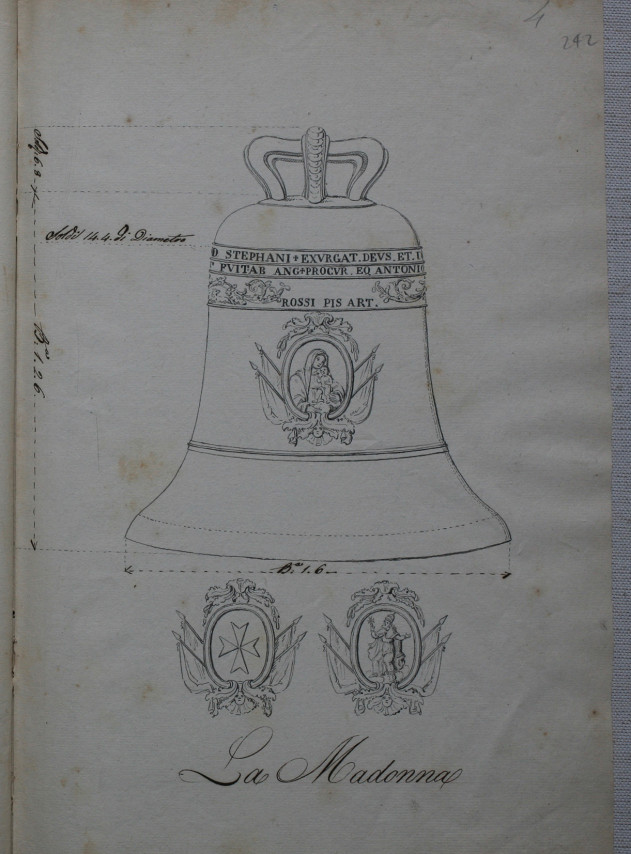
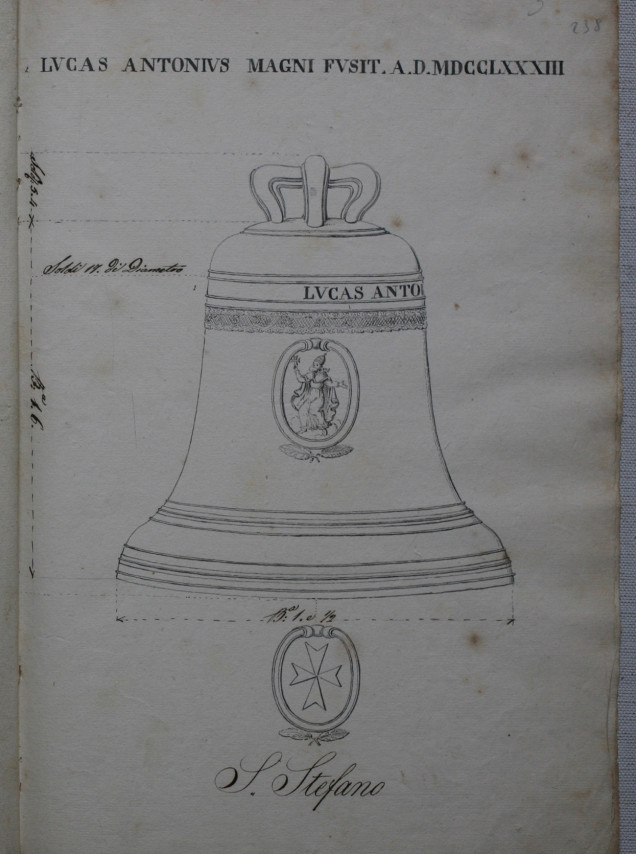
In 1827, four bells were also recast and placed again in the tower, made by the founder Sante Gualandi and associated with a fifth, the largest, dedicated to Saint Francis and still in situ, cast by Angelo Rossi in 1751 after the earlier one had broken, which a document refers to as being ‘cast by a certain Vincenzo Possanti of Pisa in the year 1576’ [‘fusa da un certo Vincenzo Possanti pisano nell’anno 1576’]. The surviving documents show that the other eighteenth-century bells, cast by Gualandi but reproduced in a series of drawings preserved in the Archivio di Stato in Pisa, were instead those ‘of the Holy Apostles Peter and Paul, […] cast by Angiolo Simone Rossi in the year 1750’ [‘dei Santi Apostoli Pietro e Paolo, […] fusa da Angiolo Simone Rossi nell’anno 1750’], bearing decorations with flags and with the figures of the Virgin and the Crucifix; ‘of Saint Stephen’ [‘di santo Stefano’], ‘cast by Luca Antonio Magni in 1783’ [‘fusa da Luca Antonio Magni nel 1783’]; ‘of the Madonna’ [‘della Madonna’], ‘cast by Rossi of Pisa in 1765’ [‘fusa dal Rossi pisano nel 1765’]; and finally ‘the small bell’ [‘la campanella’], described as lacking ‘inventions, ornaments, emblems, figures, coats of arms, or dates’ [‘invenzioni, né ornati, né emblemi, né figure, né stemmi, né epoche’].
Twentieth-century documents held in the archives of the Soprintendenza of Pisa and Livorno likewise record periodic maintenance on the bell tower, particularly after the partial damage sustained during the bombing raids of July 1944. The raids caused the collapse of the spire, and remedial work was carried out over the following two years. Further restoration of the roof and the bell tower is documented for 1976–1977, when several deteriorated parts had to be repaired after being struck by lightning in 1975. Conservation activities have continued without interruption in more recent decades, at least until 2005.
Media gallery
Newsletter
Stay in Touch
Sign up for the Piazza dei Cavalieri newsletter
to receive updates on project progress and news.