
Florentine Rule
When the last lord of Pisa, Iacopo d’Appiano, ceded the city—through his son Gherardo—to Gian Galeazzo Visconti, lord of Milan, the era of autonomy of the ancient republic may be said to have drawn to a close. This occurred in 1399.With Visconti’s death in 1402, a brief interlude of independence reopened, lasting no more than a year, before being swiftly brought to an end by Florentine intervention.
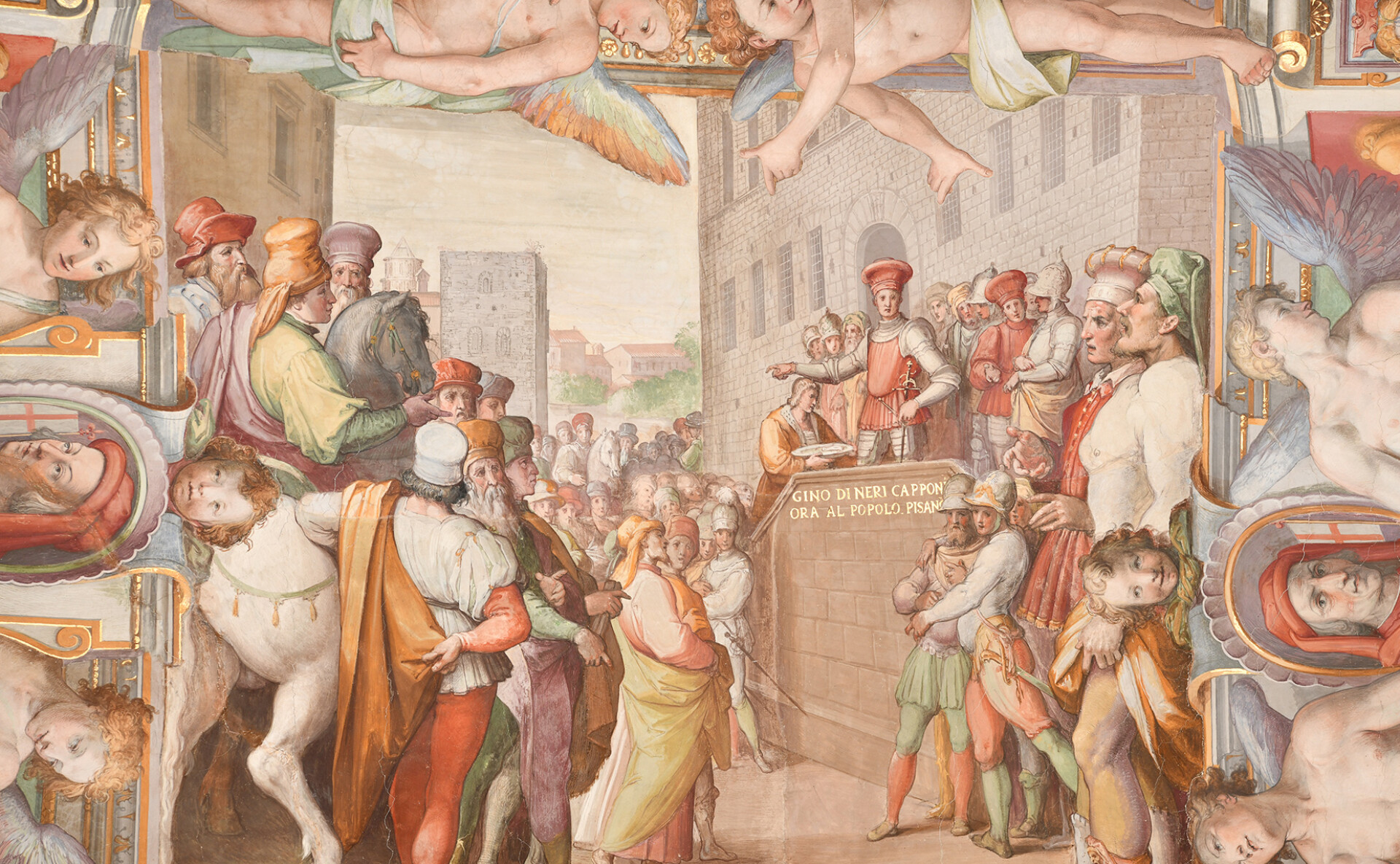
Following a complex operation that required the assent of several powers (from Genoa to France), Florence was able to proceed with the military annexation of the new territories, which met with determined Pisan resistance. The campaign ran from 31 August 1405 to 6 August of the following year, when—after a secret agreement between Giovanni Gambacorti and the Florentines (in which Gino Capponi played a leading role)—the besieging troops were admitted to the city through Porta San Marco. Capponi, commanding the army, succeeded in securing an orderly occupation by his men, preventing looting and pillage.
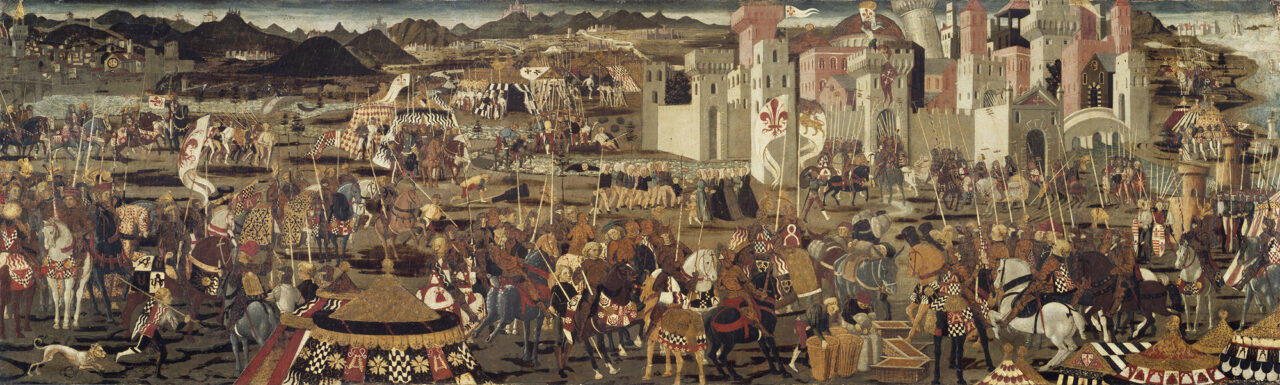
Of extraordinary historical and artistic value, the front panel of a cassone—probably produced in the mid-fifteenth century and now held at the National Gallery of Ireland in Dublin—depicts in rich detail several key episodes of the siege. Equally worthy of mention is Giovanni di Ser Piero’s Capitoli dell’acquisto che fe’ il Comune di Firenze, di Pisa, in which the events of 1406 are recounted in Dantesque terza rima.
Front panel of a cassone, 61 x 205 cm
The conquest of Pisa marked a turning point for Florence. The city, endowed with immense capital, nevertheless lacked a logistical system capable of providing direct access to the northern Tyrrhenian Sea: it was Pisa itself, in 1399—precisely during the Visconti lordship—that had barred its port to Florentine trade. For the Tuscan city, securing a reliable outlet to the sea thus became essential. The conquest of Pisa, together with the subsequent acquisition of Livorno (1421), ensured Florence a broad maritime projection, effectively displacing Pisa as the leading commercial actor in the Mediterranean. This territorial expansion also gave Florence clear predominance over the whole of Tuscany, raising it to the status of an undisputed regional power.
For Pisa, by contrast, Florentine domination coincided with the onset of a profound crisis. As Giuseppe Petralia reports, the new lords granted the city no negotiating space or autonomy, while the ancient communal institutions lost all effective power. The most important magistracy of the Republic, the Anziani del Popolo, was replaced by a priorate. Political control of Pisa passed into the hands of a captain and a podestà appointed by the Florentine oligarchy, while the contado was incorporated de iure into Florentine territorial possessions. Fiscal revenues ultimately flowed into the coffers of the new rulers. In this transformation, Piazza del Popolo was repurposed to meet the institutional needs of the new rulers: the southern wing of the present Palazzo dell’Orologio became the seat of the capitano di custodia e di balìa, while Palazzo degli Anziani first housed the Priori before being converted into the seat of the Pisan commissioner.In general, the city’s structures underwent a phase of profound decline, as exemplified by the Tower of Famine, which was left in a state of complete abandonment.
Such rigid control—previously unadopted in Florence’s earlier policies—was imposed because the old Pisan oligarchy offered no internal base of support. The combined effect of this harshness was the expulsion and voluntary exile of large sections of the urban nobility, as well as the merchant and artisan classes. This initiated a phase of severe depopulation, as documented by numerous contemporary and later sources from the fifteenth century onwards. A dramatic diaspora followed, directed towards the major centres of the Peninsula—particularly Palermo, Naples, Milan, Genoa, and Venice—as well as southern France. Recent studies have calculated that, in little more than half a century (around the 1460s), Pisa’s population declined by more than 50 per cent.
The Medici sought to revive the fortunes of a city in deep decline. In 1472, Lorenzo the Magnificent reformed the Studio Pisano (the city’s university) and introduced a tailored fiscal policy to attract new migratory flows. However, even the subsequent reforms of the grand-ducal period proved insufficient to halt a crisis that appeared irreversible. The desolation in which the city remained at least until the nineteenth century is attested by numerous accounts, including the late sixteenth-century testimony of Giovanni Botero. This perception, shared by many visitors who stayed in Pisa during the early modern period, was intensified by the sheer extent of the ancient urban centre, enclosed within the vast circuit of walls dating from the mid-twelfth century. By way of illustration alone—since the testimony lacks reliable documentary foundations and relies merely on an estimate drawn from a travel account by Benjamin of Tudela—Ranieri Tempesti, in an academic discourse delivered at the Istituto Letterario di Pisa in 1784 and now preserved in the Archivio di Stato di Pisa, estimated that between 1160 and 1170 the Tuscan city had a population of around 200,000, effectively making it in effect one of the most populous in Europe.
Media gallery
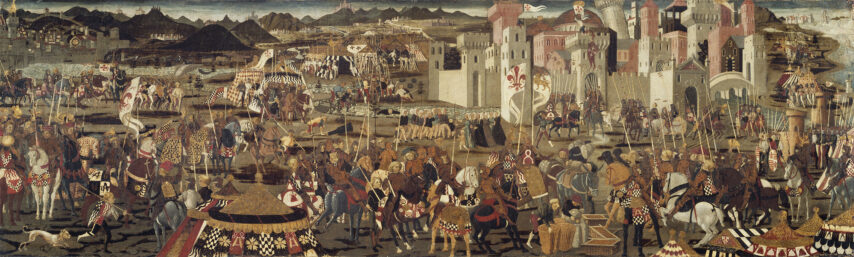
Front panel of a cassone, 61 x 205 cm
Newsletter
Stay in Touch
Sign up for the Piazza dei Cavalieri newsletter
to receive updates on project progress and news.