
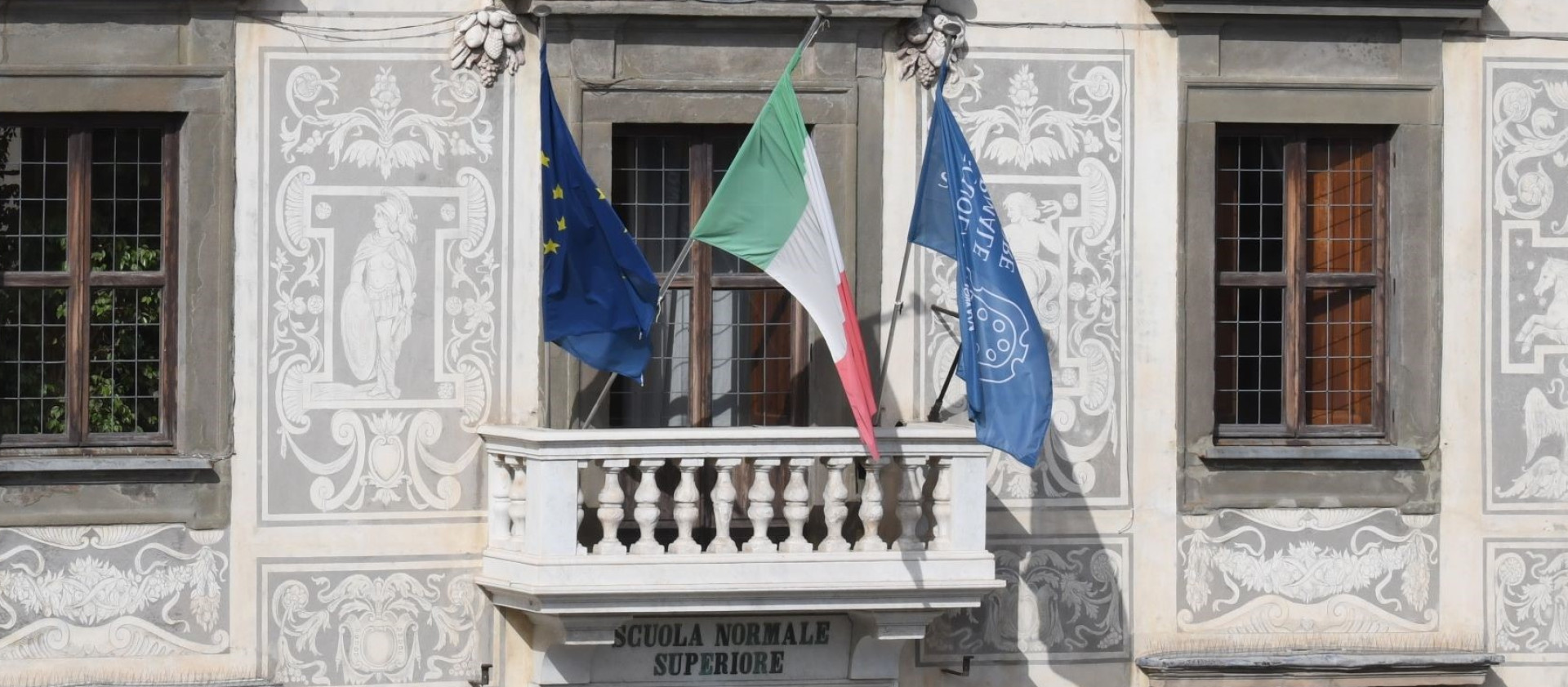
Scuola Normale Superiore
[19th century-present]
The founding of the Scuola Normale Superiore formed part of the complex reorganisation of public and private education undertaken by Napoleon from the period of the Consulate onwards and pursued with greater intensity during the Empire, when he established the system of the Imperial Universities in 1806. Tuscany, annexed to France by the Treaty of Fontainebleau (27 October 1807), was required to conform to the Napoleonic code in this sphere as well. By imperial decree of 18 October 1810, the establishment of an Academy of the Imperial University was ordered within the district comprising the three administrative departments into which Tuscany was divided (Arno, Ombrone, and Mediterranean), with Pisa designated as its seat. The decree also provided for the creation of a Pensionato Accademico, intended to replace the Collegio della Sapienza maintained by the grand dukes, for twenty-five university students, modelled on the École normale in Paris; the chosen location was initially the convent of San Silvestro, situated at some distance from the city centre. Following a demanding entrance examination—consisting of tests in Latin, Greek, algebra, and geometry for candidates in all fields of study—the first twenty-five students were admitted, thus inaugurating the School’s activities in November 1813. The institution was governed by a director, a ‘sub-director’, an economo, and an inspector responsible for supervision; additional supervisory duties were assigned to a chaplain appointed by the archbishop and to the so-called ripetitori, who were also entrusted with teaching responsibilities.
Daily life was governed by a rigid, almost martial discipline: ‘Students rise at six in summer and at seven in winter, and are given a quarter of an hour to dress. They then go to the chapel for prayers, which must last no less than twenty and no more than thirty minutes. Breakfast follows, and lessons run from half past eight in the morning until half past two in the afternoon. After lunch, half an hour of recreation is allowed, and the remaining hours of the afternoon—from four until nine in winter and until ten in summer—are devoted to study. This is followed by supper, half an hour of recreation, and prayers in the chapel, which must last no less than eight and no more than twelve minutes. At ten in winter and at a quarter to eleven in summer the students must be in their rooms, for the lights are extinguished at eleven’ [‘Gli alunni si alzano alle sei nell’estate e alle sette nell’inverno e hanno un quarto d’ora per vestirsi, dopo di che vanno in cappella per le orazioni che devono durare non meno di venti e non più di trenta minuti. Quindi la colazione e le lezioni dalle otto e mezzo della mattina alle due e trenta pomeridiane. Dopo il pranzo è concessa mezz’ora di ricreazione e allo studio sono dedicate le restanti ore del pomeriggio, dalle quattro alle nove d’inverno e alle dieci d’estate. Infine la cena, mezz’ora di ricreazione e le preghiere in cappella, che non devono durare meno di otto né più di dodici minuti. Alle dieci nell’inverno e alle dieci e quarantacinque nell’estate gli studenti devono essere in camera poiché alle undici le luci vengono spente’]. Nor were complaints from the students lacking: ‘we are more confined than the Capuchins’ [‘siamo più rinchiusi dei cappuccini’], one of them wrote in a letter home.
The dramatic end of the Napoleonic era also affected the fortunes of the Scuola Normale. On 9 November 1814, Grand Duke Ferdinand III of Lorraine approved a reform of university regulations that restored the former disciplinary and teaching frameworks. The climate of full Restoration influenced both the curriculum—which now took as its foundation ‘the Catholic Religion and the purity of its morals, obedience to the Sovereign, respect for Public Authorities, and attachment to the literary glory of Tuscany’ [‘per base la Religione Cattolica e la purità della sua morale, l’obbedienza al Sovrano, il rispetto delle Pubbliche Autorità, l’attaccamento alla gloria letteraria della Toscana’]—and collegiate life. The Scuola Normale, Napoleon’s quintessential institutional creation, was closed. In 1817, the Order of Saint Stephen was reinstated, albeit deprived of its military component, in order to fulfil purely educational functions through the establishment of a boarding school for young Tuscan nobles. It was not until the general reform of studies promoted by Leopold II in the early 1840s that the Scuola Normale—now under granducal patronage—was reopened. This took place, as recorded in the Report of 5 June 1846 and subsequently in the granducal motu proprio of 28 November, in the Stephanian Palazzo della Carovana, with twelve students maintained at the Order’s expense, together with a further six on a fee-paying basis.
The inauguration, marked by the entry of the first students, took place on 15 November 1847. The programme for the normalisti (students of the Scuola Normale)—now housed in the building restored by Giorgio Vasari—was designed to last three years. Admission required completion of the first two-year cycle of university studies, while the final year—the third normalistico year—was undertaken after the university degree and focused on advanced didactic and pedagogical training, including a teaching placement in a Pisan ginnasio-liceo.
In addition to attending lectures in their respective university faculties, the normalisti were required to follow an internal curriculum. This was characterised by a substantial core of shared courses in Catholic morals and religion, moral and rational philosophy, and pedagogy, alongside subjects specific to each disciplinary area.
In the pre- and post-1848 climate, the Scuola Normale adopted a firm policy of restraint towards liberal and nationalist tendencies. During the transitional phase from the Grand Duchy to the Kingdom of Italy—passing through the provisional government of 1859—the institution nonetheless continued its activities in its new premises in Piazza dei Cavalieri. With Italian Unification, however, a series of reforms became necessary to align the Scuola with the changed national context and the new educational needs of the nation. Through the royal decree issued by Minister Carlo Matteucci on 17 August 1862, the institution thus shifted from a granducal Scuola Normale, strongly tied to a religious dimension, to an Italian one marked by a clear reduction in confessional elements.
The first director entrusted with implementing these reforms and revitalising the institution was the historian Pasquale Villari, who served from 1862 to 1865. He secured parity between the corso normalistico and the university programme by extending the former to four years and strengthening internal teaching methods, notably by promoting the adoption of the seminar method. From this point onwards, the seminar would become a cornerstone of normalistico instruction, contributing in practice to a broadening of the Scuola’s role: no longer limited to the qualification of secondary-school teachers, but increasingly oriented towards the cultivation of advanced literary and scientific culture.
Equally significant, towards the end of the nineteenth century, was the opening of the Normale to female students. This followed the royal decree of 3 October 1875, which granted women access to university education. The first woman admitted to the Scuola was Erminia Pittalunga, from Naples, who entered the competitive examination in Letters in 1889.
During the First World War, the Scuola Normale faced considerable material difficulties: its premises were requisitioned for civilian uses, many students had departed for the front, and budgetary constraints were severe. Research activities were correspondingly weakened. Paradoxically, it was under the Fascist regime that the institution entered a new period of prominence. On the one hand, its intellectual vocation was severely curtailed by the imposition of repressive measures; on the other, thanks to the efforts of the normalista Giovanni Gentile—director of the Scuola from 1932 to 1943—the Normale increasingly established itself as a centre of national cultural life. Between 1929 and 1932, the facilities were expanded through the acquisition of the Collegio Puteano and the small palazzo built by Domenico Timpano on the Lungarno (now Lungarno Pacinotti). The Vasarian Palazzo della Carovana was also enlarged with the addition of three new wings to its rear.
The Gentile-era Normale was inaugurated on 10 December 1932. Now able to accommodate around one hundred students, enriched by the establishment of the Collegio Medico-Giuridico, and equipped with its own Statute approved in 1932, the Scuola became a legally autonomous institution, though still closely linked to the University of Pisa. This phase of expansion coincided with the arrival in Pisa of several professors invited to deliver internal courses and seminars. These included Leonida Tonelli (mathematics), Giorgio Pasquali (classical philology), Augusto Mancini (Greek), Guido Calogero (philosophy), Luigi Russo (Italian literature), and Delio Cantimori (history), as well as Paul Oskar Kristeller, lecturer in German from 1935 until his dismissal under the racial laws in 1938.
Thanks to the efforts and sacrifices of many students, as well as of members of the teaching staff and even the administration, the Scuola Normale could count on a substantial contingent of opponents to the regime. Among the many figures involved, Aldo Capitini, Guido Calogero, Walter Binni, Antonio Russi, and Alessandro Natta may be singled out. During the Second World War, the institution was initially affected by a climate of severe ideological and material restriction. Subsequently, with the advance of the Allied forces, Palazzo della Carovana was occupied by Anglo-American troops between 1944 and September 1945.
With the advent of the Italian Republic, the Scuola Normale entered a new phase, though not without significant tensions. The overwhelming victory of the Christian Democrats on 18 April 1948 sparked a confrontation that involved the institution—along with the national education system more broadly—which were perceived as centres of anticlericalism. In the following decade, however, a concerted effort by various political forces supported a process of renewal. This led to a gradual increase in budgetary resources, the readmission of female students (with the opening of a women’s college in May 1952, after their exclusion under the Gentile regulations of 1929), and improvements in teaching quality. In 1967, the Scuola also incorporated the so-called ‘Palazzone’ in Cortona and inaugurated the tradition of the Concerti della Normale.
The years leading up to and marking the onset of the student movements of 1968 saw the Scuola Normale at the forefront. On the one hand, it became an institutional venue of national significance: the meeting of Italian university rectors was held there on 11 and 12 February 1967. At the same time, it witnessed internal conflicts between the administration and the student body over reform of the statutes. On the other hand, the Scuola positioned itself as a centre of intellectual formation capable of promoting and guiding broader student protests at both local and national levels. Normalisti made a fundamental contribution to the drafting of the well-known Tesi della Sapienza.
In recent years, two significant developments have marked the evolution of the Scuola Normale. On the one hand, the establishment of the Scuola Superiore Sant’Anna in 1987 created a ‘twin’ institution, originating from the Collegio Medico-Giuridico, which had separated from the Normale in 1967. On the other hand, a third disciplinary class within the Scuola—that of Political and Social Sciences—was introduced through the merger with the Istituto Italiano di Scienze Umane, based in Florence, beginning in the 2014–2015 academic year.
Since the post-war period, the Scuola Normale in the republican era has trained not only generations of scholars of the highest scientific calibre, but has also produced men and women who have served at the highest levels of the State: Presidents of the Republic, Prime Ministers, ministers, and judges of the Constitutional Court.
Media gallery
Newsletter
Stay in Touch
Sign up for the Piazza dei Cavalieri newsletter
to receive updates on project progress and news.