
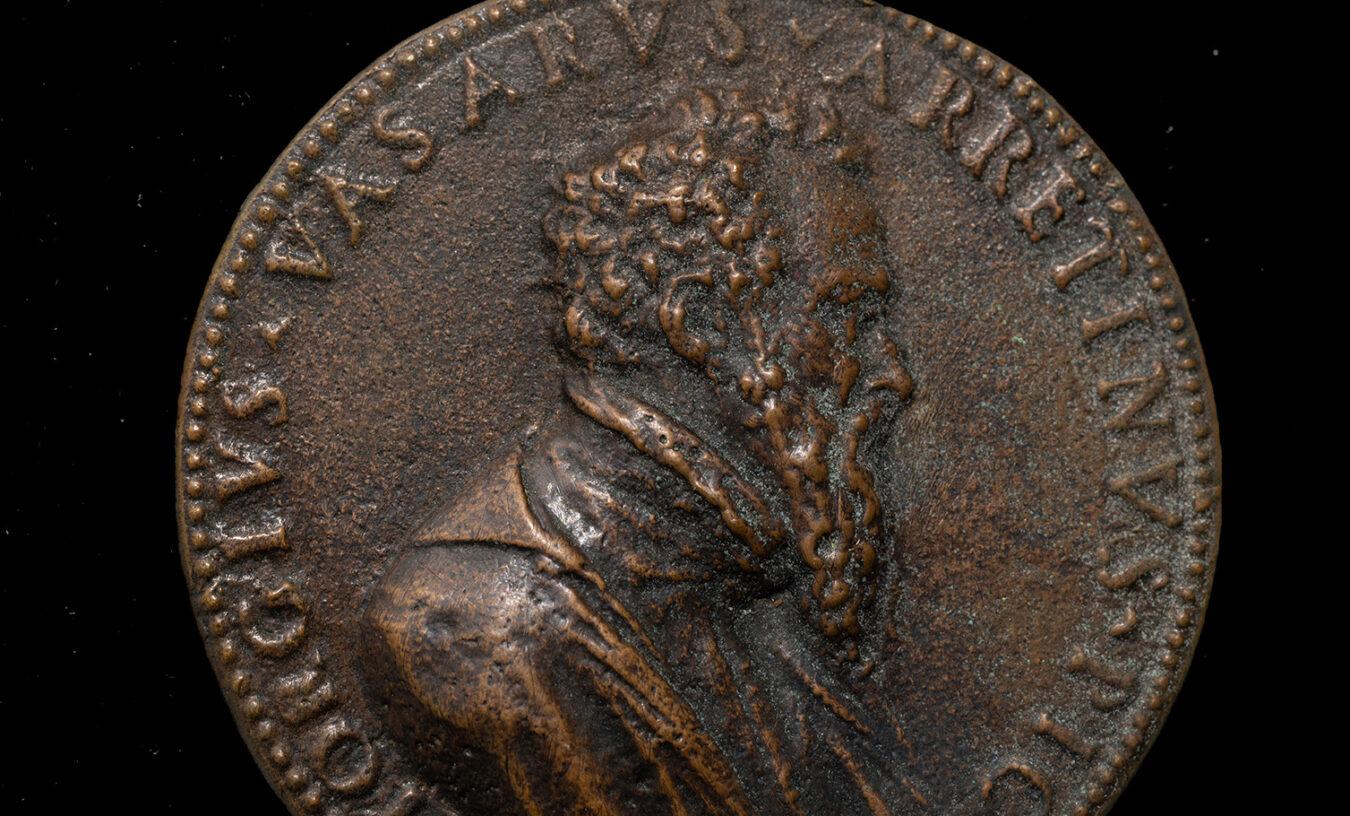
Giorgio Vasari
[1511-1574]
Giorgio Vasari was the architect responsible for the initial transformation of Piazza dei Cavalieri, converting it from a medieval civic space into a Mannerist setting in the service of Medici glory.
Born in 1511 in Arezzo to a textile merchant, Giorgio Vasari received a dual education in literature and art. His artistic training began in his native city under Guillaume de Marcillat, then from 1524 in Florence under Andrea del Sarto and Raffaello del Brescianino.
Vasari distinguished himself as a versatile artist who excelled as a painter, architect and goldsmith. Though he spent time in Baccio Bandinelli’s Florentine workshop, historians remain uncertain about the extent of his sculptural practice. He cultivated relationships with leading intellectuals of his day, including Pietro Aretino, Vincenzio Borghini, Paolo Giovio and Annibal Caro. At the same time, his artistic career took him to numerous Italian cities such as Arezzo, Siena, Florence, Rome, Bologna, Venice and Naples. His artistic legacy is defined by several monumental decorative schemes, most notably the Sala dei Cento Giorni in Rome’s Palazzo della Cancelleria (1546), his extensive work at Florence’s Palazzo Vecchio (1559–1571), and his contributions to the Torre Pia and the Sala Regia within the Vatican’s Apostolic Palace (1570–1572).
During his travels, he gathered the necessary information for writing the Vite de’ più eccellenti pittori, scultori, e architettori [Lives of the Most Excellent Painters, Sculptors, and Architects], first published in Florence in 1550 (known to scholarship as the Torrentiniana after its publisher, Lorenzo Torrentino) and a second revised and expanded version in 1568 (for the same reasons known as the Giuntina after the Giunti family of publishers). This was the first ‘manual’ of Italian art history, composed of biographies of artists grouped into three progressive ages.
Vasari’s relationship with Pisa can be reconstructed through his Ricordanze (personal memoirs and records), his correspondence, and the autobiography contained in the second edition of the Vite, in the form of a description of his works. Before his Piazza dei Cavalieri commission, Pisa played only a peripheral role in the life of the Aretine artist. He sought refuge there during the winter of 1529, escaping the ultimately unsuccessful siege of Florence by Emperor Charles V’s troops. During this stay, Vasari recounts: ‘I painted in fresco the arch above the door of the old Florentine Company’ [‘dipinsi a fresco l’arco che è sopra la porta della Compagnia vecchia de’ Fiorentini’], a now-lost depiction of St William of Aquitaine. This period also allowed him to establish valuable connections, notably with Miniato Pitti, a Benedictine monk of the Olivetan Congregation, who later helped secure several commissions for the artist. Only in 1541 did Vasari return to Pisa, where he met Domenico Beccafumi, who was engaged in painting an altarpiece for the Cathedral. He too secured a commission for an altarpiece depicting a Madonna and saints, which he completed in Florence the following year. In 1547, he was commissioned to create a Deposition, which was also executed in Florence. Unfortunately, both works were destroyed by the flames that broke out in the Pisan Cathedral at the end of the century, but they are known from surviving sketches.
The coveted position in Cosimo de’ Medici‘s service—which Vasari had so eagerly desired—remained elusive for some time. After assuming control of Florence in 1537 following Alessandro de’ Medici’s assassination, Cosimo viewed Vasari with considerable suspicion, given the artist’s long-standing patronage relationships with both Alessandro and his brother Cardinal Ippolito. Only in 1554, when his reputation had already been bolstered by the success of the first edition of the Vite and prestigious commissions from the Farnese family, Bindo Altoviti, and Pope Julius III, did Cosimo summon him from Rome to Florence, entrusting him with the internal transformation of Palazzo Vecchio into a modern royal palace (1554-1571). This was followed by the design of the Uffizi (1559-1580), intended to house the city’s principal magistracies and many other commissions.
In 1562, while work was still underway in the Florentine workshops, Cosimo commissioned Vasari to redesign Pisa’s pre-modern Piazza del Popolo, which would become headquarters for the newly established Order of Knights of Saint Stephen with the Duke himself as Grand Master. The project allowed the Aretine to engage once again with medieval architecture and aimed at the radical transformation of the piazza. Vasari frequently travelled to Pisa, using the left wing of the future Palazzo dell’Orologio as his logistical base. This is where architects and engineers in his service resided and where he completed the project for the Palazzo della Carovana. Upon returning to Florence, Vasari collaborated with architect Davide Fortini, who effectively directed the works. He also worked with Giovanni Caccini, then the superintendent of Pisa, providing him with instructions for various elements, including the iconographic programme of the sgraffito decoration of the Palazzo della Carovana.
Vasari’s original design for the interior of the church of Santo Stefano was later radically altered, though he did complete the altarpiece depicting the Stoning of Saint Stephen in 1571. That same year, Pope Pius V—who had also commissioned Vasari for work in the Vatican—honoured the artist by appointing him a Knight of the Golden Spur. Three years later, in June 1574, Vasari died in Florence but was buried in Arezzo, a city to which he had remained attached throughout his life.
Key Figures
Main EntryMedia gallery
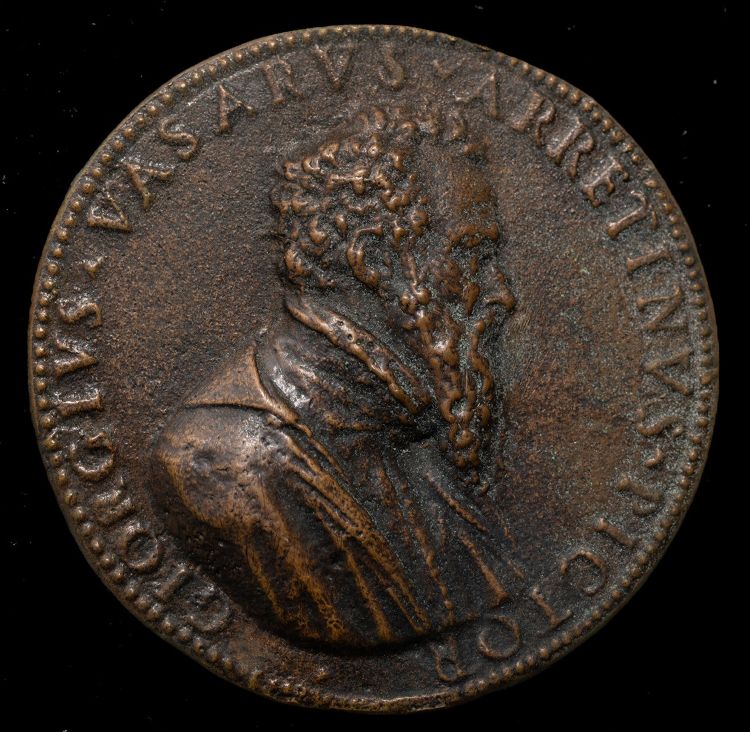
Cast copper alloy, 57,20 mm
Newsletter
Stay in Touch
Sign up for the Piazza dei Cavalieri newsletter
to receive updates on project progress and news.