
Agnolo Bronzino
Nativity
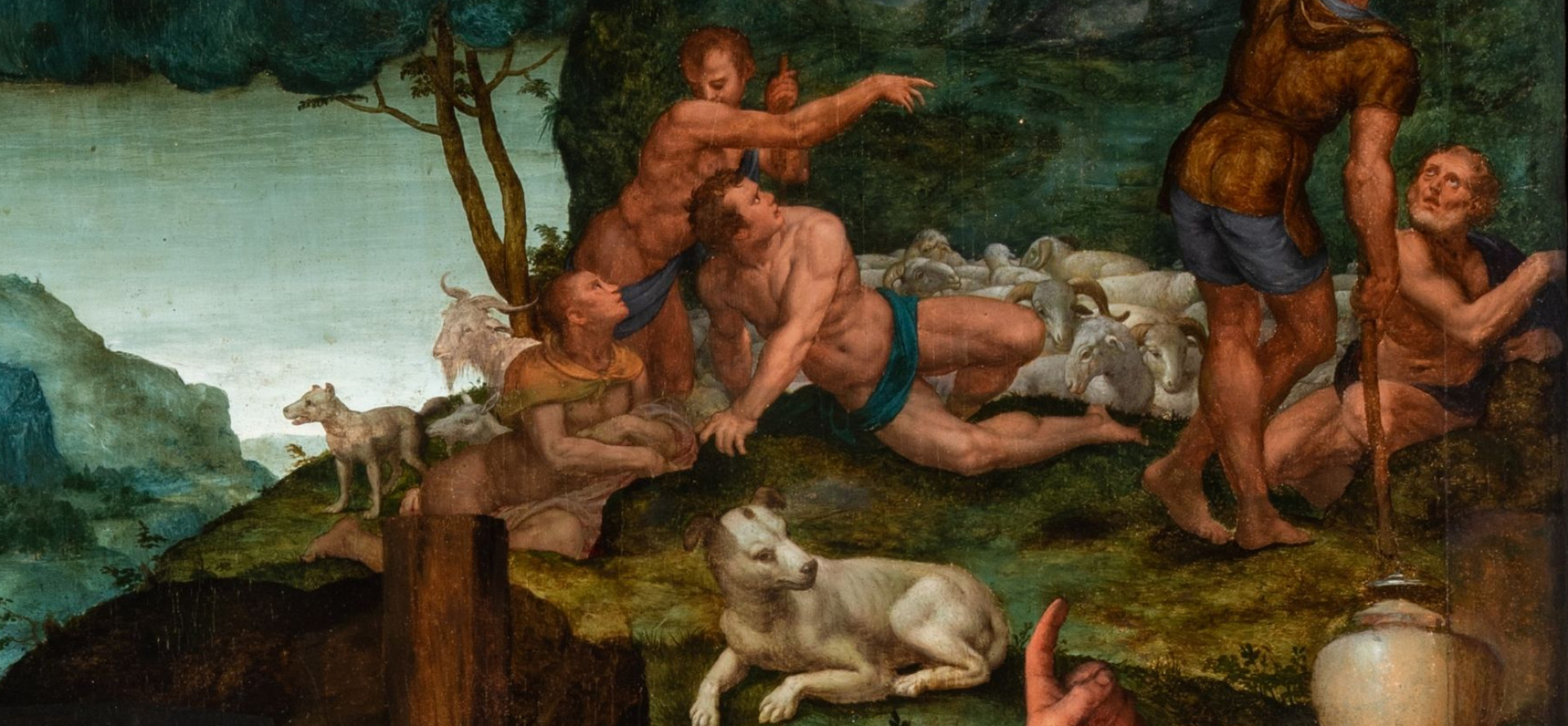
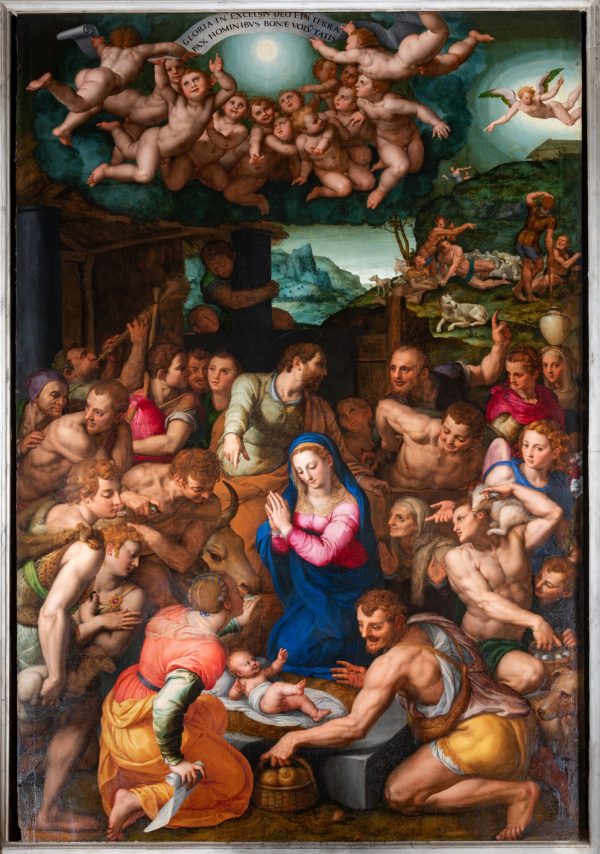
Depicting a Nativity, the oil-on-panel painting was commissioned in 1564 by Duke Cosimo de’ Medici from Agnolo Bronzino for the Church of Santo Stefano dei Cavalieri, still under construction at the time. In the biography of the artist in the Lives (1568), Giorgio Vasari praised his senior colleague’s work, describing it as painted ‘with such art, diligence, design, invention, and exquisite beauty of colouring that nothing more could be done’ [con tanta arte, diligenzia, disegno, invenzione e somma vaghezza di colorito, che non si può far più]. He went on to observe—not without a hint of self-congratulation—that ‘no less was fitting for a church founded by so great a prince, who had also established and endowed the said Order of the Knights’ [certo non si doveva meno in una chiesa edificata da un tanto principe, che ha fondata e dotata la detta Religione de’ Cavalieri].
Painted in Florence and brought by river to Pisa in April 1565, the panel was initially displayed in the nearby church of San Sisto—used by the Knights while their conventual church was still being built—as it had been intended to decorate the high altar there. However, installation plans soon changed. In 1569, the Council of the Order judged the painting too large for the apsidal area, opting instead for a bronze ciborium surrounded by statues, and relocated it to a smaller aedicula on the left lateral wall, opposite a similar structure on the right, which was soon occupied by Giorgio Vasari’s Stoning of Saint Stephen the Protomartyr.
Bronzino’s altarpiece, a work from the painter’s late period, was widely regarded by sources up to the nineteenth century as one of his finest achievements, though it has attracted relatively little attention in modern scholarship. Its commission closely followed that of the monumental Deposition of Christ for the church of the Observant Franciscan friars in Portoferraio (now in the Galleria dell’Accademia, Florence, inv. 1890 no. 3491), which was requested in 1561 by Dukes Cosimo de’ Medici and Eleonora di Toledo and likewise delivered in 1565, at the same time as the Nativity in Pisa. Both works, intended for prominent settings, exemplify the lasting favour Bronzino continued to enjoy at the Medici court in his sixties, at a time when his position remained secure despite the rise of Vasari as the leading figure in Cosimo’s urban planning and dynastic self-fashioning.
The painting is densely populated with figures and infused with a mannerist aesthetic that spans the vivid colour modulations of the early Florentine ‘eccentrics’—including Bronzino’s teacher, Jacopo Pontormo—to the Michelangelesque repertoire and the polished intellectualism typical of official Medicean painting. It reads almost as an artistic testament by Bronzino, who inscribed his signature in capital letters on the cornerstone beneath the Christ Child’s bed: ‘A DIO SIA GLORIA OPERA DI AGNOLO DET[TO] IL BRONZINO FIORENTINO MD.LXIIII’ [GLORY BE TO GOD, WORK BY THE FLORENTINE AGNOLO, CALLED BRONZINO MD.LXIIII]
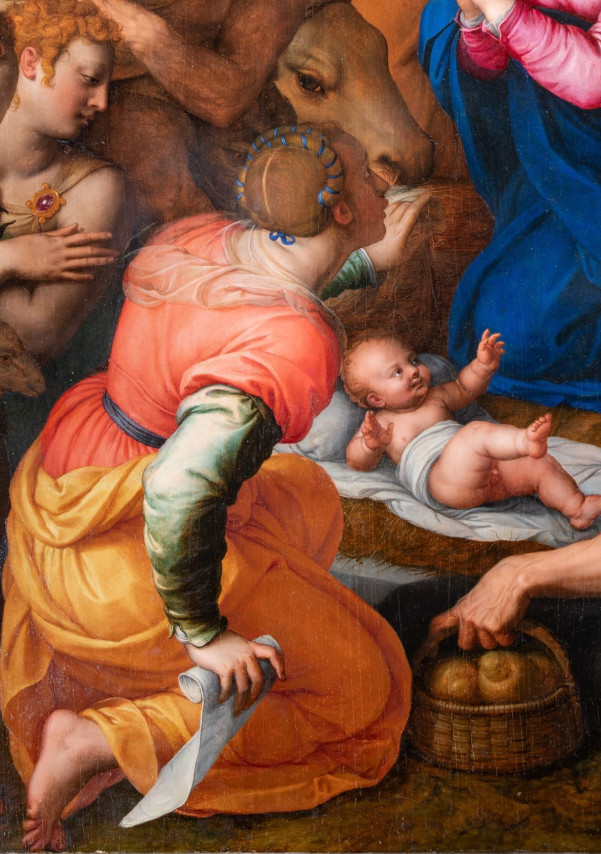
A particularly striking iconographic detail is the female figure in the left foreground, depicted from behind and holding a parchment scroll, clearly identifiable as a sibyl. Such an inclusion—unusual in Nativity scenes—recalls the traditional association of sibyls as pagan seers with the prophecy of Christ’s coming. The motif was most likely brought to renewed prominence through Michelangelo’s celebrated use of sibyls alongside prophets on the Sistine Chapel ceiling. Among the most notable precedents for its appearance in a comparable context is Pellegrino Tibaldi’s Adoration of the Child (1549), now in the Galleria Borghese, Rome (inv. 415), a work closely indebted to Michelangelo’s example.
Compared to Bronzino’s uninhibited use of twisting and serpentine forms, Vasari adopted a seemingly more restrained formal language in his painting—one which, as has been observed, transforms ‘the horror vacui and heightened emotional tension (of Bronzino’s work) into a detached examination of virtuous sentiments’ [l’horror vacui … e l’esacerbata sospensione emotiva in un asettico scrutinio di buoni sentimenti]. Set in ornate wooden frames carved by Nigi della Neghittosa, both panels nonetheless disrupted the decorative austerity that had previously defined the Chiesa dei Cavalieri—an aesthetic deliberately cultivated by Cosimo, who believed that the severity of the sacred space better reflected the moral rigour of the Stephanian Order.
The Nativity was not Bronzino’s only work in Pisa. In 1555, he completed an altarpiece of Christ Carrying the Cross Surrounded by Saints for the altar of Our Lady of Graces in the Duomo. Only two fragments of the painting survive today, both housed in the Accademia Nazionale di San Luca in Rome (Saint Bartholomew, inv. 423, and Saint Andrew, inv. 424). Bronzino’s artistic activity in the city was strongly supported by Duchess Eleonora, who, after commissioning works from him in Florence in 1550, summoned him to Pisa as a portraitist for the ducal family. The features of Eleonora—who died of malaria in 1562 at the age of forty, together with her sons Giovanni and Garzia—appear to echo in the face of the angel positioned at the right edge of the Nativity panel for Saint Stephen, shown gazing outward and holding a lily: a symbol of purity, but also a heraldic emblem of both Florence and the Medici dynasty (see, for comparison, her celebrated likeness in the National Gallery in Prague, inv. O 11971).As seen in the chapel commissioned by Eleonora in Palazzo Vecchio (1540–1545) and in the Descent of Christ into Limbo for Santa Croce (1552), the inclusion of contemporary likenesses in sacred compositions was a recurring feature in Bronzino’s practice. The female figure above the angel, with a turban and amphora on her head and likewise looking directly at the viewer, may also reflect this approach—though she could equally be a stock figure drawn from the painter’s repertoire.
Regarding the conservation history of the painting, the archive of the Soprintendenza in Pisa holds documentation related to two modern restoration campaigns: one dating back to 1945 and the other, more recent, from 1996.
Media gallery
Newsletter
Stay in Touch
Sign up for the Piazza dei Cavalieri newsletter
to receive updates on project progress and news.