
Vasari as Designer
Giorgio Vasari’s wide-ranging and assiduous engagement extended beyond the design of the renewed architectural structures facing Piazza dei Cavalieri. He also devised furnishings and ornaments of various kinds to complete and enhance them, and particularly those of the church of Santo Stefano. This multifaceted contribution is encapsulated in a letter that Vasari himself addressed to the Council of the Order in September 1569.
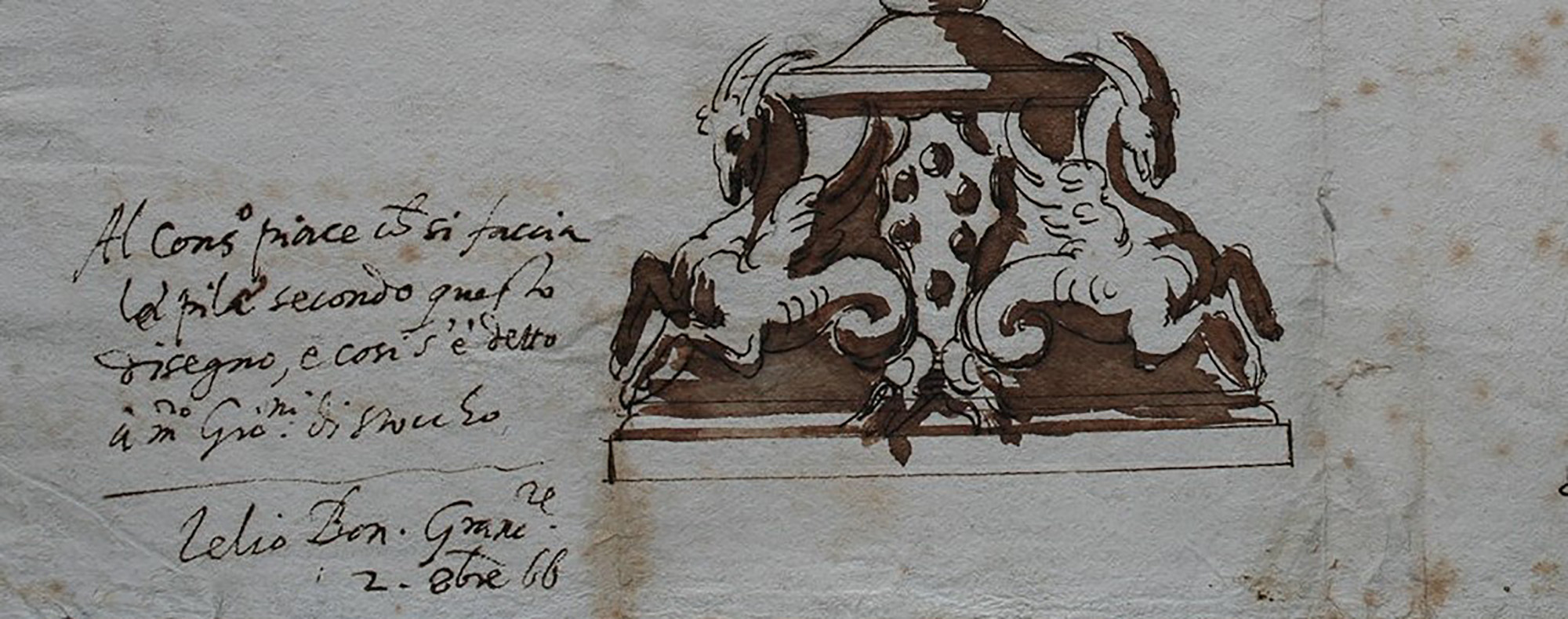
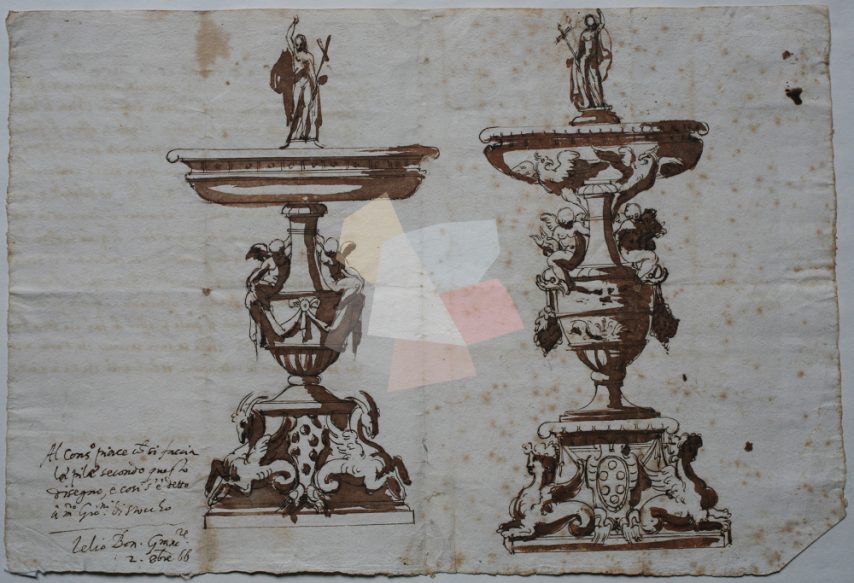
The original document, preserved at the Archivio di Stato di Pisa, bears the heading ‘Disegni, piante, proffili et modanature per modegli da condurre il palazzo e la chiesa della illustrissima Religione de cavalieri di Santo Stefano in Pisa fatti da Giorgio Vasari’It records the ‘labours carried out and those still to be undertaken’ [‘fatiche fatte e da farsi’] coordinated by the Aretine master, mentioning plans and drawings that in many cases are still recognisable today. If one excludes ‘the drawing and plan of the church’ [‘il disegnio e pianta della chiesa’], designed and erected from the foundations, ‘the drawing of the frontal façade’ [‘il disegnio della facciata dinanzi’] (referring to an initial design concept for it, later realised after his death), and ‘all the mouldings of the stonework, cornices, pilasters, windows, and small doors of the main chapel’ [‘tutte le modanature delle pietre, cornicioni, pilastri, finestre et porticelle della capella maggiore’], Vasari’s design activity within the sacred building concerned chiefly liturgical objects and furnishings and, in accordance with established practice, relied on the contribution of various collaborators. Among these, the most active was the sculptor Giovanni di Paolo Fancelli, called Nanni di Stocco. Working from Vasari’s designs, Fancelli produced the two sumptuous stoups in white marble and Seravezza mischio (1566–1568), which remain in situ and are sketched in duplicate versions on a surviving sheet among the papers of the Archivio di Stato in Pisa. He also made two further smaller holy-water basins (pilette), one of which may be identifiable with an example now set into the right-hand nave. Fancelli also undertook, following the Aretine’s graphic indications, the execution of ‘the mischio balconies, one for the organ and the other for the singers’ [‘i poggioli di mischio dove va l’organo uno, et l’altro dove canteranno li musici’], corresponding to those still visible in the presbyterial area (1570), beneath the two organs arranged on either side of the high altar.
One of the hallmarks of Vasari’s designs was their abundant decoration, embodying a pronounced Mannerist preference for ornamentation. In some instances, however—most notably the stoups and the altar—Cosimo de’ Medici called for simplification, seeking to align every element of the church with the formal and moral rigour he wished to associate with the Order of Saint Stpehen. By contrast, the original design for the earlier of the two organs—now placed to the right of the presbytery (with one’s back to the entrance)—remained substantially unaltered. A finely executed drawing by the Aretine artist preserves its details: the sheet clearly shows the ornamental motifs of the gilded wooden case, with volutes interspersed with small caryatids. This case was crafted by the master woodworker Nigi della Neghittosa.
Similar elements can also be found in the designs for the Grand Master’s throne, the most linear of which is preserved with the others in the Archivio di Stato di Pisa, while a second sheet, depicting the element from the front and in profile, is part of the Ottoboniano Latino 3110 manuscript in the Biblioteca Apostolica Vaticana, together with various other studies for Santo Stefano. In this graphic study, we see the throne supported by harpies and flanked by large volutes with winged female caryatids supporting the crosses of the Order at the top; others are found on the sides and armrests, while above the backrest there is a shield with the St Stephen’s cross and at the top of the structure two reclining angels support the grand ducal crown. Florian Härb, confirming what Frey had already stated, attributed these sketches to Vasari’s workshop, recognising none of them as the master’s own work.
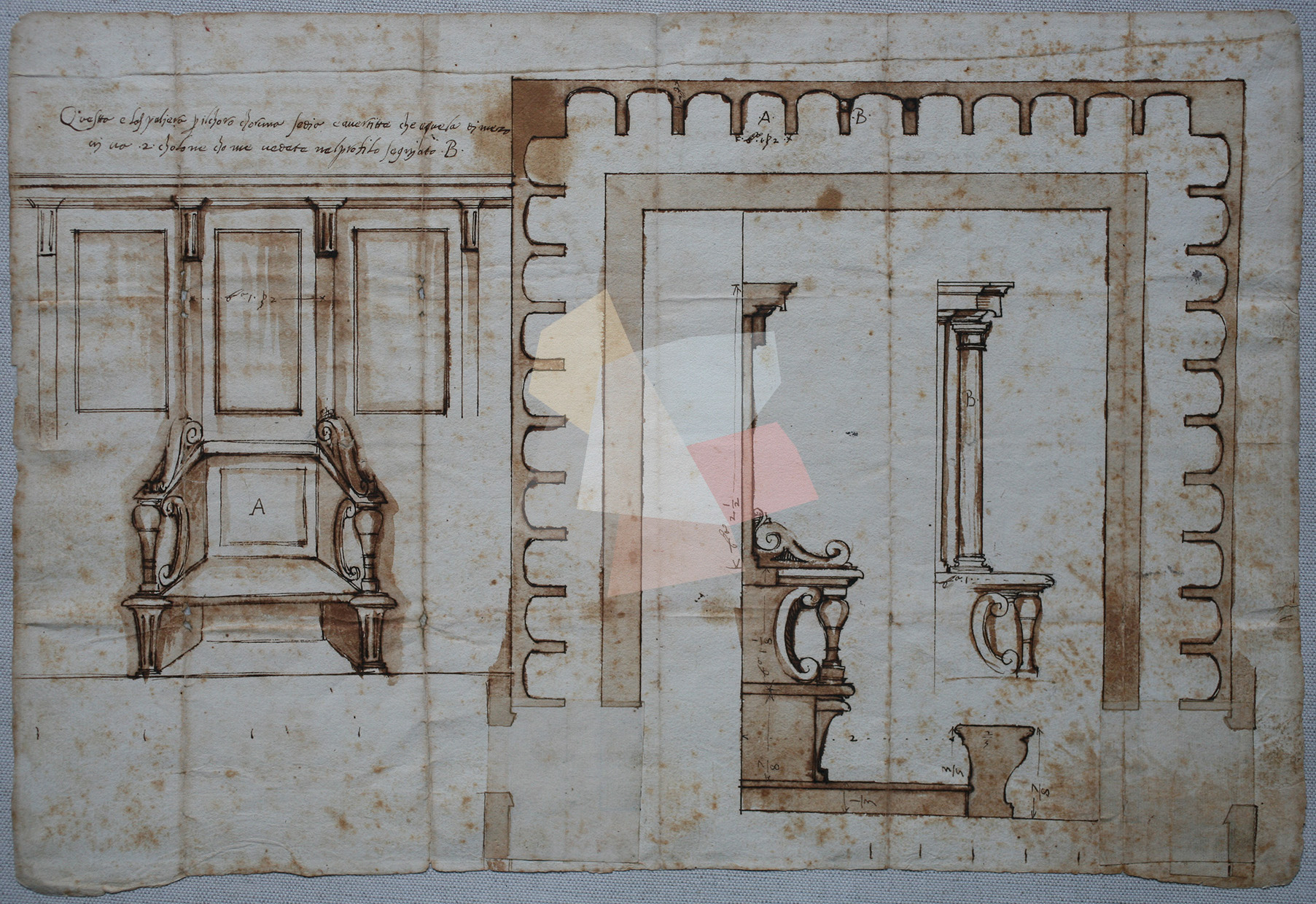
Pen and wash on white paper.
Top left, inscription: ‘Questa e la spaliera p[er] il choro choruna [sic] sedia e avertitta che a quale di nuovo ci va 2 cholone che una vedete nel profilo segniato B’.
Pen and brown ink, and brown wash on white paper
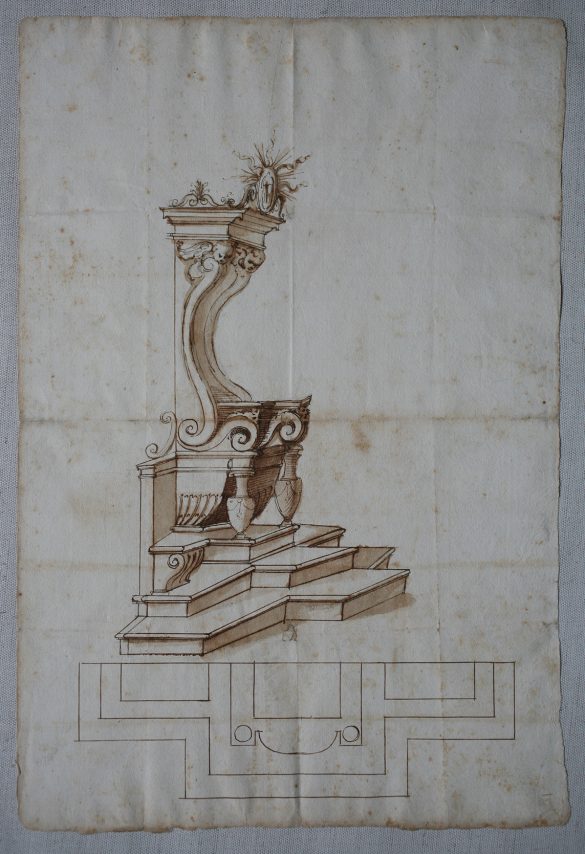
Pen and brown ink on white paper
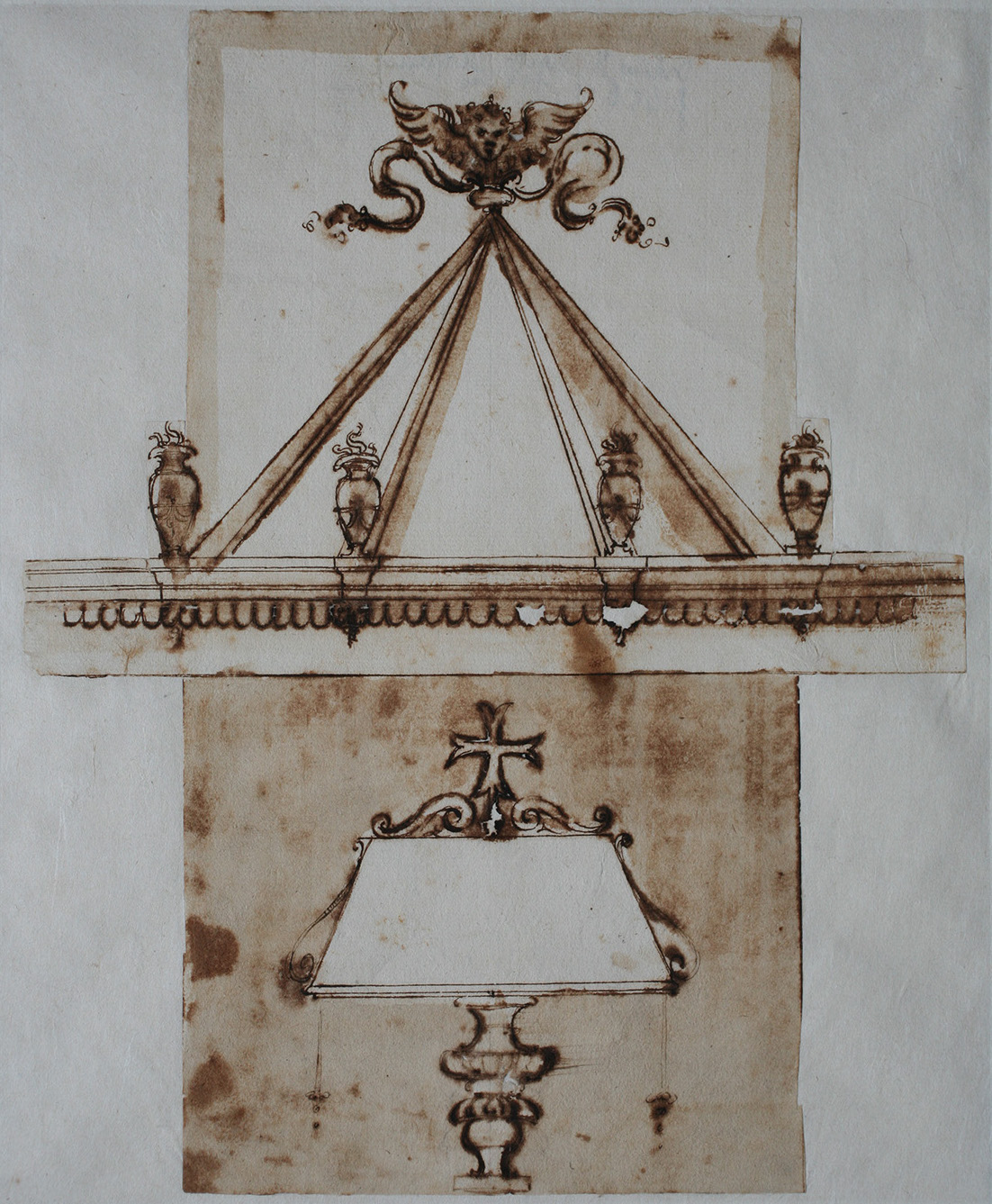
Pen and brown ink, and brown wash on white paper.
Inscription: upper left: ‘Questo è l’armadio de la sagrestia;.
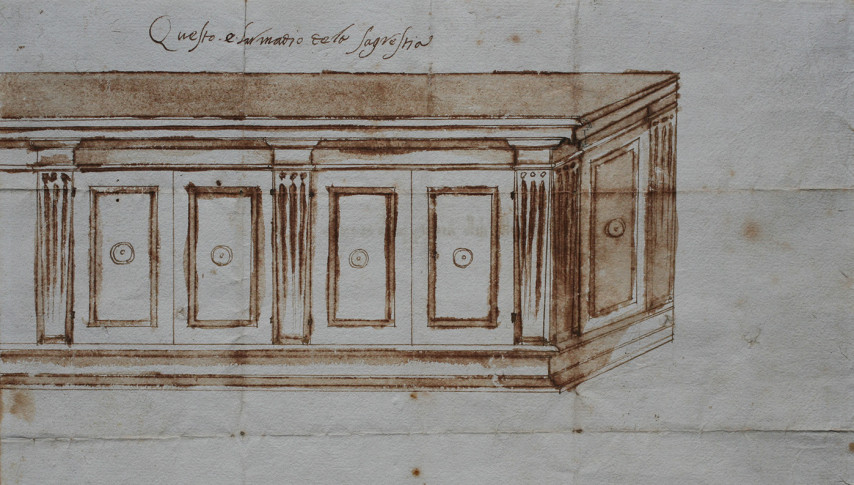
Vasari also designed ‘the choir of the main chapel and the seats for the priests’ [‘il disegnio del coro della capella maggiore, delle sedie per i preti’]. Their appearance is known from graphic reworkings by Cosimo d’Arrigo, who ultimately carried out the work; the wooden stalls are now in the church of San Frediano. He likewise provided ‘the design of the cupboards for the sacristy and their mouldings’ [‘il disegnio degli armarii per la sagrestia et modani loro’], preserved in a sheet by Pasquino da Bibola; ‘the design and mouldings of the lamps’ [‘il disegnio e modani delle lanpane’]; ‘the arrangement of the staircases and the choir for the Knights’ [‘l’ordine delle scale et coro per i Signori cavalieri’]; and ‘two designs of mischio ornaments to frame the panels intended for the two altars on the façades and walls of the church’ [‘dua disegni degli ornamenti di mischio per cigniere le dua tavole che vanno a’ dua altari nelle faccie e pariete della chiesa’]. The high altar warrants separate consideration. Although it survives today in its Baroque form, dating to the early eighteenth century, its long and problematic development originated with Vasari’s own studies. The 1569 inventory indeed records ‘a design of the altar and ciborium of the Sacrament, to be made of marble and bronze’ [‘disegnio dello altare e ciborio del sagramento da farsi di marmo et di bronzo’]. This may correspond to a project for a monumental altar with ciborium and dome included in the manuscript Ottoboniano Latino 3110, already mentioned, and partly reworked in a second drawing from the same Vatican collection. These proposals, however, were only partially realised. As noted above, Cosimo initially judged Vasari’s scheme excessively sumptuous; moreover, the prolonged execution led to the works being carried out by Fancelli and d’Arrigo—also revised in their choice of materials—in 1571.
By convention, the rapid sketches for a lectern and for the musicians’ canopy are also attributed to Giorgio Vasari, and are likewise included among the Stephanian bundles of the Archivio di Stato di Pisa.
Media gallery
Pen and wash on white paper.
Top left, inscription: ‘Questa e la spaliera p[er] il choro choruna [sic] sedia e avertitta che a quale di nuovo ci va 2 cholone che una vedete nel profilo segniato B’.
Pen and brown ink, and brown wash on white paper
Pen and brown ink on white paper
Pen and brown ink, and brown wash on white paper.
Inscription: upper left: ‘Questo è l’armadio de la sagrestia;.
Pen and brown ink on white paper.
Inscription: lower left: ‘Al Cons.o piace che si faccia le pile secondo questo disegno, e così s’è detto con m.ro Gio[van]ni di Stoccho / Lelio Bon. Granc[ancellie]re / 2 8bre 66’.
Newsletter
Stay in Touch
Sign up for the Piazza dei Cavalieri newsletter
to receive updates on project progress and news.