
Façade
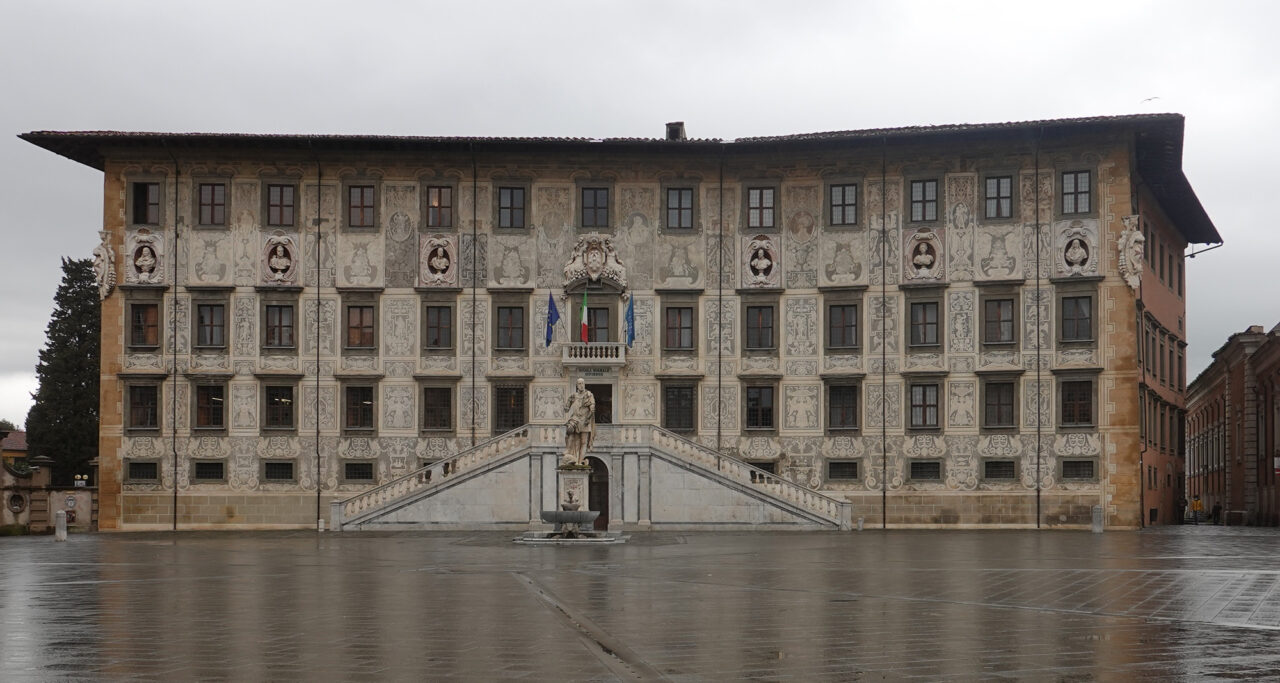
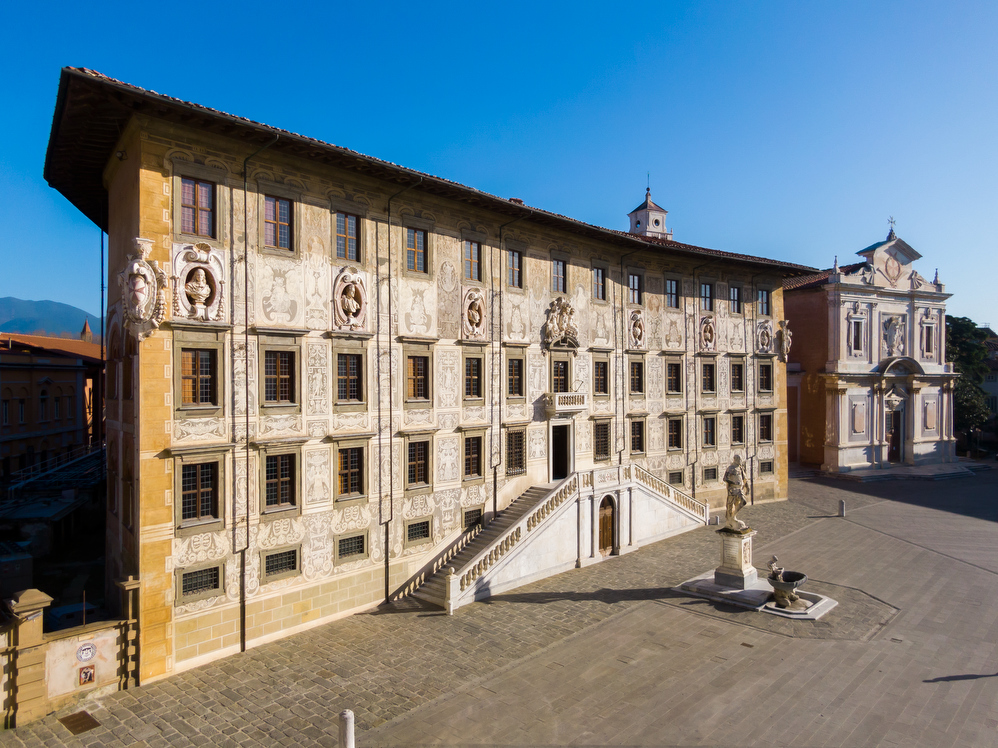
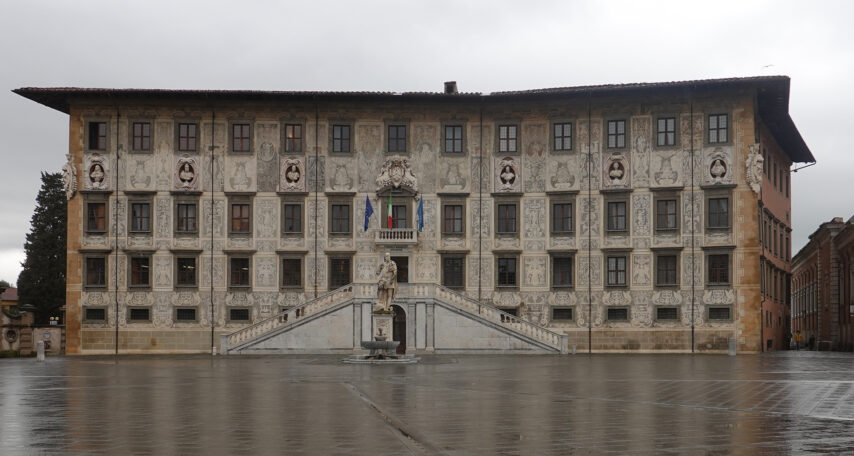
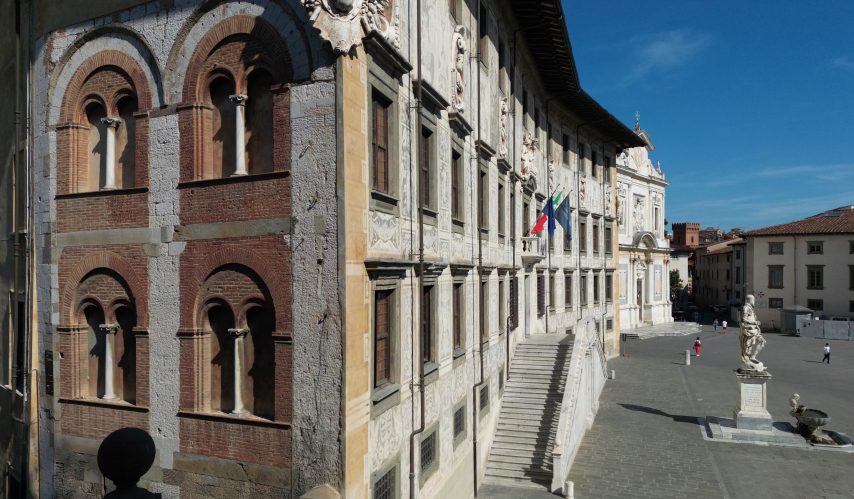
Palazzo della Carovana, seen from Piazza dei Cavalieri, appears as a long building extending over four storeys, each with thirteen windows. Those on the ground floor are smaller. All openings are framed in grey-green Golfolina stone, the same originally used (1564–1567) for the balcony, the main doorway frame, and the grand Vasarian staircase, subsequently replaced by marble: the balcony (now adjacent to the Sala del Gran Priore) by Giovanni Michele Piazzini in the middle of the eighteenth century, and the staircase between 1821 and 1838 to a design by Giuseppe Marchelli. Together these elements define the building’s central axis, marked by the Medici-Stephanian coat of arms with allegorical figures of Religion and Justice, executed by Stoldo Lorenzi after a design by Giorgio Vasari (1562–1563), reinforcing the Palazzo’s formal symmetry and symbolic weight.
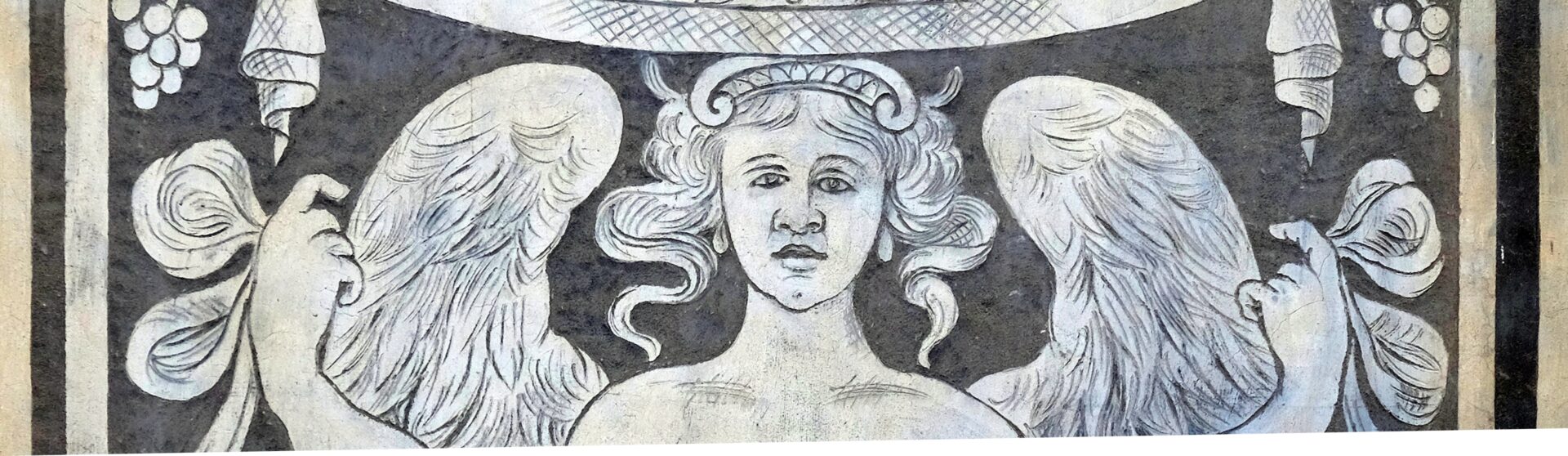
The grey-green tone of Golfolina stone and the restrained modelling of the relief used for the window frames harmonise with the two-tone sgraffito decoration (now no longer original owing to the many restorations it has undergone). First executed between 1564 and 1566 from Vasari’s drawings and cartoons, the scheme still presents a complex iconography focused both on the civil, military, and religious virtues of the Knights of Saint Stephen and on the deeds of Cosimo de’ Medici, patron of the renovation, in his dual role as duke and grand master of the Order. The decoration fills all the available space between the openings, except for the panels beneath the windows in the band between the second and third storeys. In this section, marble busts of the grand dukes and grand masters are set within niches, forming part of a celebratory scheme attributed to Ferdinando I. Over the span of a century and a half, the Medici portraits were gradually added—first to the left, then to the right of the Medici-Stephanian coat of arms—in accordance with a carefully structured sequence.
| Grand Duke | Ferdinando II | Ferdinando I | Cosimo I | Francesco I | Cosimo II | Cosimo III |
|---|---|---|---|---|---|---|
| Reign | 1621-1670 | 1587-1609 | 1569-1574 | 1574-1587 | 1609-1621 | 1670-1723 |
| Artist | Giovanni Battista Foggini | Rodolfo Sirigatti | Rodolfo Sirigatti | Rodolfo Sirigatti | Pietro Tacca | Giovanni Battista Foggini |
| Date of execution | 1675-1681 | 1595-1596 | 1588-1590 | 1591-1593 | 1633 | 1724-1725 |
Summary diagram of the bust commissions
The band between the second and third storeys features, at either end, the coats of arms of the Knights of Saint Stephen, flanked by capricorn heads and garlands. These were executed by Nanni di Stocco between 1562 and 1564, following designs by Vasari once again. The corners on which they are set are finished in rusticated stonework, a treatment repeated below in the graffito decoration.
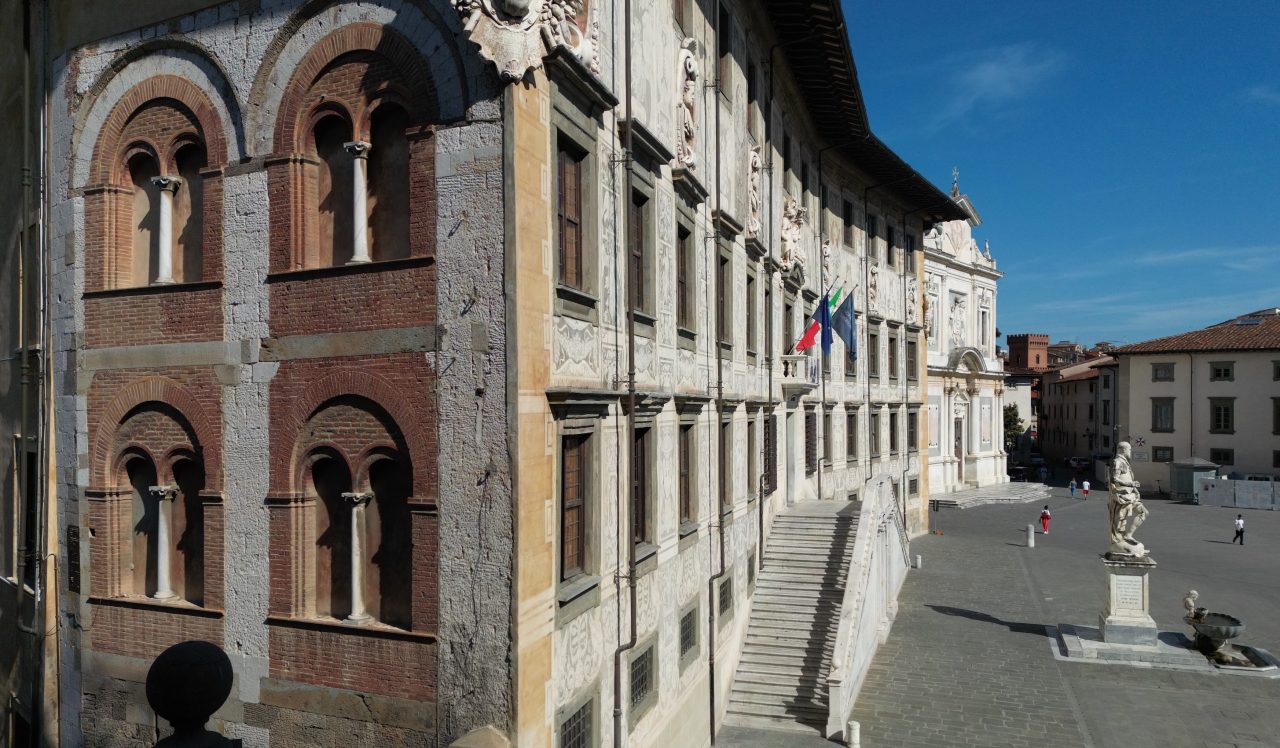
Traces of its medieval past remain visible on the exterior. On the right-hand side, along Via Consoli del Mare, are the remains of a tower-like structure with a pointed arch; on the left, traces of a domus show elegant pairs of bifores set within round arches. These two cores formed the nucleus from which Palazzo degli Anziani developed from the second half of the thirteenth century.
Palazzo della Carovana
Main Entry- Preesistenze medievali
- Fasi costruttive
- Functions
- Façade
- Interior
- Varisco, Quadri comunicanti – Jarred
- Aula Bianchi
- La collezione dei calchi epigrafici
- Le opere del Centro Pecci
- Sala della Mensa
- The Coats of Arms of the Knights
- Sala Azzurra
- Sala del Ballatoio
- Sale della Direzione
- Scalone
- Gastini, «… e finire è cominciare»
- Maruscelli (attr.), Figura virile
- Sala degli Stemmi
- Sala della Colonna
- Cortile
Media gallery
Newsletter
Stay in Touch
Sign up for the Piazza dei Cavalieri newsletter
to receive updates on project progress and news.