
Anziani del Popolo
[13th–15th centuries]
Following the triumph of the Popolo over the Nobility in the mid-thirteenth century (1254–1256), the entire system of Pisan magistracies—the political and administrative bodies charged with governing the Republic—underwent a profound reconfiguration. From that point onward, the magistracy of the Anziani del Popolo became the political centre of the city.
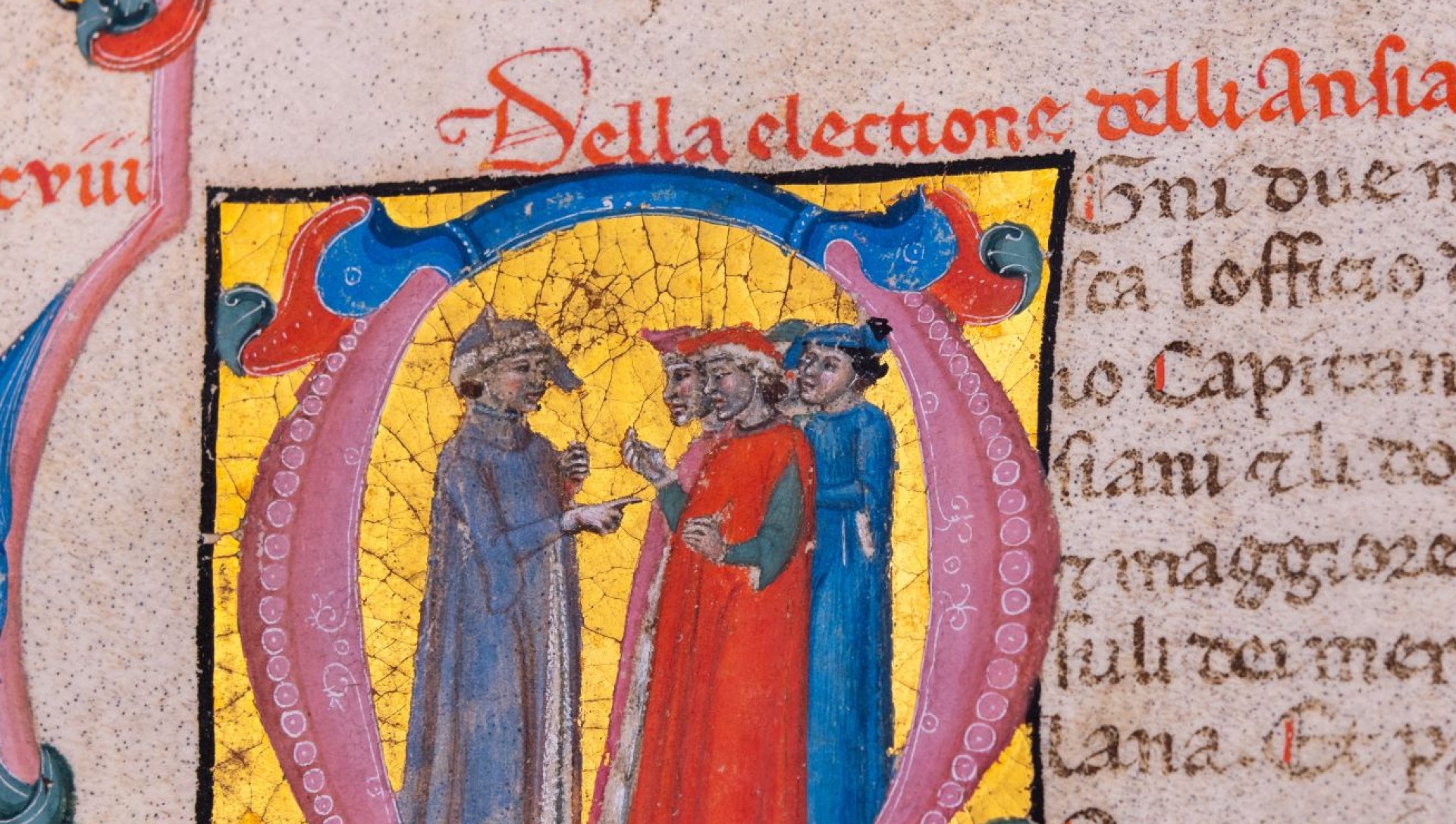
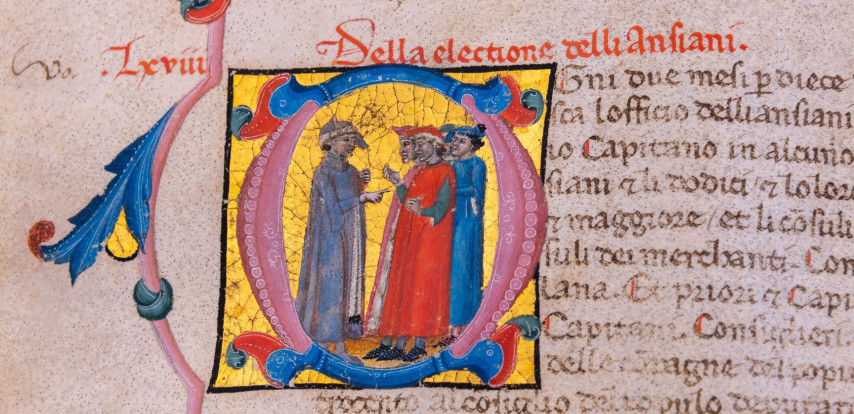
Although no rigid electoral procedure existed at least until the early fourteenth century, the Breve del Popolo of 1287—an early civic statute regulating, among other matters, institutional processes—indicates that the college consisted of twelve Anziani. These members were allocated according to quarter and professional category. Each of the four quarters into which the city had long been divided (Fuoriporta, Kinzica, Ponte, and Mezzo) elected three representatives. At least one per quarter was required to belong to the ‘arti maggiori’ (for instance, notaries, apothecaries, furriers, and similar professions), while the other two were drawn from the so-called ‘populares non artefices’—merchants, members of the Order of the Sea, and those associated with the wool trade. The institution’s popular character expressly excluded the election of nobles. In its original form, the term of office lasted two months. Ten days before its expiry, the capitano del Popolo convened the Consiglio del Popolo, which determined on each occasion the method of election for the succeeding college—though selection by lot was prohibited.
Over the years, a series of reforms affected specific aspects of the functioning of the college of the Anziani. The first major reform—one capable of giving the institution a stable structure that would endure until the Florentine conquest of 1406—dates to the early fourteenth century. This was also the period in which the toponyms ‘Piazza del Popolo’ and ‘Piazza degli Anziani’ came into use to designate the urban area that would later correspond, in broad terms, to Piazza dei Cavalieri. The reform addressed several regulatory aspects of the magistracy, including the need to ensure continuity of government by means of imborsando, that is, the placing of eligible names into a selection pool, sufficient to cover up to nine two-month terms. Above all, however, it significantly strengthened the power of the mercantile elite, which established a covert form of ‘prior consent’ over those eligible for election as Anziani, while the weight of the artefices diminished: their number was capped at four, to be distributed among the seven arts. The reforms that followed—of particular importance were those enacted during the lordship of Uguccione della Faggiuola (1313–1316), the interventions of 1345, and the measures promoted by Giovanni Dell’Agnello between 1364 and 1368—were not confined to modifying secondary aspects of the college’s life, such as the number of members, electoral procedures, or the obligation for the Anziani to reside at the seat of the magistracy, namely Palazzo degli Anziani, transformed in the sixteenth century into Palazzo della Carovana. Rather, they sought on each occasion to reshape the institution’s functions and prerogatives in accordance with the prevailing configurations of power within the Republic.
Emblematic in this respect is what occurred between 1348 and 1355, when the leading figures of the hegemonic faction—the Bergolini party—turned the magistracy of the Anziani into an instrument for managing power, either through the systematic election of their own affiliates or by granting calculated forms of participation to their opponents.
It is widely acknowledged that the Anziani constituted by far the most important governing body of the Pisan Republic, as they were responsible for both internal affairs and Pisa’s relations with foreign powers. In this capacity, the college appointed senior state officials and ambassadors, and regulated civic life; it also shaped, in part and through continual negotiation with archepiscopal prerogatives, the religious life of the community by organising festivals, ceremonies, and processions.
As Antonio Abruzzese aptly observed, the Anziani ‘possessed that authority and enjoyed those very extensive powers which, in a certain respect, are exercised by ministers of state in modern constitutional monarchies’ [‘avevano quell’autorità e godevano di quegli amplissimi poteri, di cui godono, sotto un certo rispetto, i ministri di Stato nelle moderne monarchie costituzionali’].
The college did not possess legislative authority; however, it was tasked with presenting legislative proposals, which the podestà was then obliged to submit to a vote in the Consiglio del Popolo. The magistracy came to an end with the beginning of the Florentine conquest in 1406, when it was replaced by a college of Priori appointed by the new rulers.
Media gallery
Newsletter
Stay in Touch
Sign up for the Piazza dei Cavalieri newsletter
to receive updates on project progress and news.