
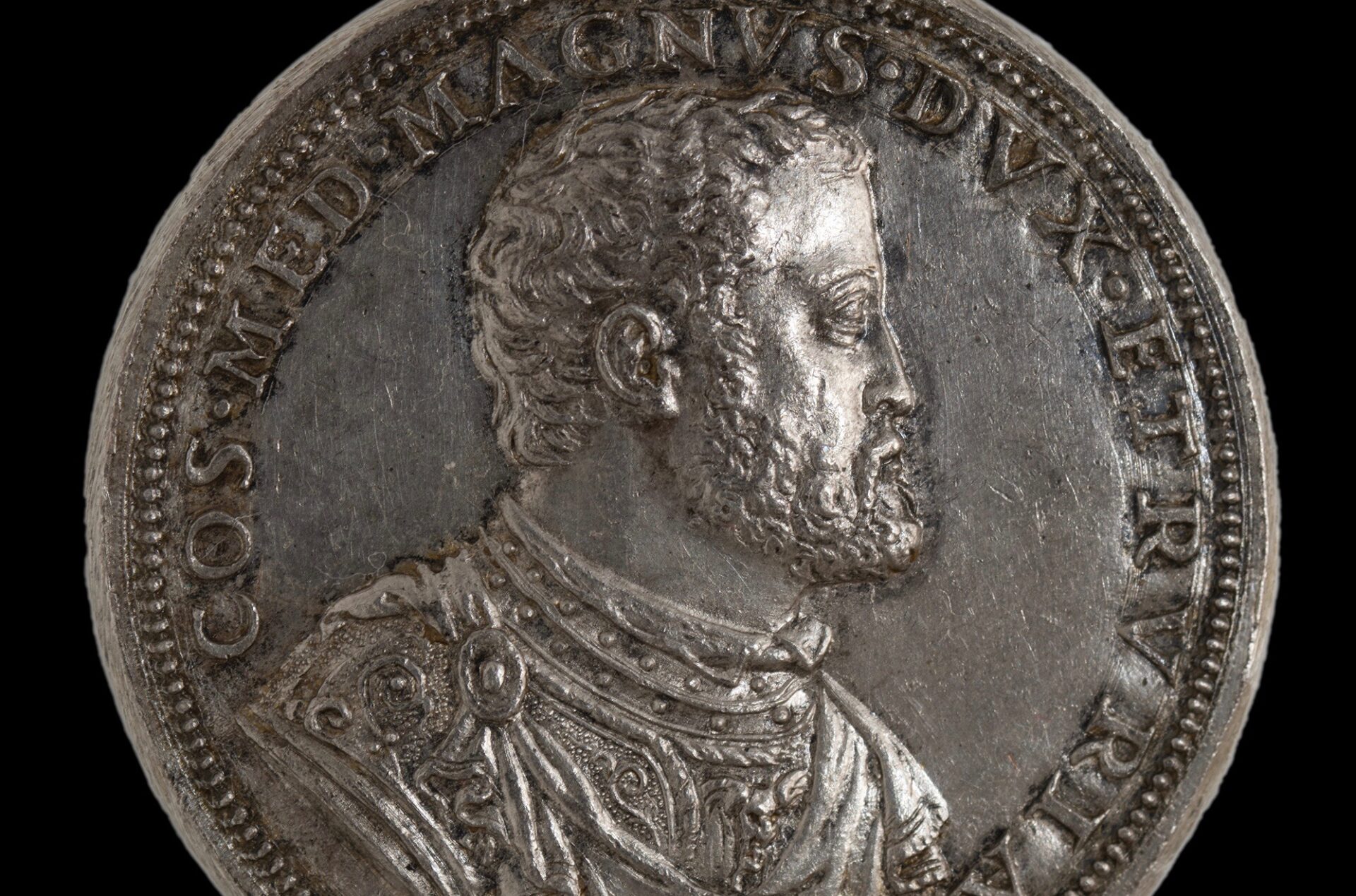
Cosimo I de’ Medici
[1519-1574]
Cosimo I de’ Medici, Grand Duke of Tuscany, was born in Florence on 19 June 1519 into a minor branch of the prominent Medici family. He was the son of the celebrated military commander Giovanni delle Bande Nere (born Lodovico di Giovanni de’ Medici) and Maria Salviati, niece of Pope Leo X. His affiliation with this lesser branch resulted in limited support from Pope Clement VII (a member of the main Medici line), consequently leading to modest financial circumstances. This relative lack of wealth and political backing contributed to his exclusion from prestigious marriage alliances. A sudden change in Cosimo’s prospects occurred following the assassination of Alessandro de’ Medici (regent duke of Florence) at the hands of his cousin Lorenzino on 6 January 1537. Given the absence of legitimate descendants of the former and the understandable exclusion of the latter from the line of succession, Cosimo rose to become the principal heir of the family, and on 10 January of the same year, the senate of Florence appointed him ‘capo e primario della città’ [head and primary figure of the city]. After a troubled period of conflicts in pursuit of a delicate international balance (with particularly complex relations with Rome and the Farnese family), Cosimo effectively assumed full sovereign power in 1543 and initiated a gradual yet profound season of political and institutional reforms. A meticulous administrator, he flanked his transformation of the Florentine state with rigorous management of justice and, in particular, of public order.
Cosimo’s relationship with Pisa was multifaceted, developing on both political and personal fronts, and featured prominently in his agenda from the beginning of his rule (especially between 1543 and 1551). First and foremost, the city was a key strategic hub for the defence of the Tuscan territory. When Charles V, upon the duke’s accession, reserved control of the fortresses of Florence and Livorno for himself, the fortress of Pisa remained one of the few significant defensive structures still under complete Medici control. Moreover, Cosimo was fully aware of the state’s need to safeguard and strengthen Tuscany’s presence in the Tyrrhenian Sea, both commercially and militarily. To this end, he prepared a programme to strengthen Pisa’s Arsenal and modernise the Tuscan fleet: ‘hence the passionate interest in the construction of galleys’, which he ‘loved to personally attend until his later years’, as Elena Fasano Guarini writes. In accordance with these principles, in 1562 the Duke founded the Order of the Knights of Saint Stephen in Pisa, of which he was the first Grand Master. He implemented targeted fiscal policies designed to attract manufacturing industries (especially wool processing) by encouraging migration to both the city and its surrounding countryside (which were undergoing extensive land reclamation) while also incentivising Jewish and Marrano merchants to establish settlements in the region. These interventions helped establish Pisa as Tuscany’s second industrial centre, surpassed only by Florence (which maintained preferential political rights and tax conditions). This development worked in tandem with Livorno’s commercial enhancement, notably through Cosimo’s 1560 sponsorship of the Navicelli canal construction connecting the two cities. To cultivate the intellectual class, Cosimo reopened the University of Pisa in 1543—two centuries after its founding—and established colleges like La Sapienza to promote the education of deserving but less affluent subjects. Cosimo would also move the winter seat of the court to Pisa. Finally, he launched an ambitious architectural programme to modernise and visually transform the city underMedici patronage, highlighted by the magnificent redevelopment of Piazza dei Cavalieri—a project born from the duke’s close collaboration with Giorgio Vasari. In Cosimo’s plans, Pisa thus rose to become a central element in the policy of consolidation and expansion of the Tuscan state.
Nevertheless, the city also played a tragic role in the private life of the Medici. While his wife Eleonora was in the Maremma with their children Giovanni, Garzia and Ferdinando, a malignant fever struck them. From a letter to his son Francesco dated 21 November 1562, we learn that Cosimo decided to send Don Garzia and Ferdinando to Pisa (then considered curative for its air quality): ‘hanno ancor loro un poco di febbre ma di mali salubri et si cureranno. Et credo al fermo non sia male di pericoli, et domani li condurremo a Pisa’ [they too have a slight fever but of the wholesome kind, and they will be cured. And I firmly believe it is not a dangerous illness, and tomorrow we will take them to Pisa]. On 18 December, Cosimo himself arrived in the city. However, shortly thereafter, both Garzia and his wife Eleonora died.
This phase marked the beginning of the duke’s gradual withdrawal from state affairs. On 1 May 1564, he handed over both governance and revenues to his son Francesco while retaining the ducal title and the right to appoint key positions. Despite this partial retirement, Cosimo continued to oversee the naval fleet’s activities and the Order of Saint Stephen. Nevertheless, the 1560s remained central to his political rise and prominence. During this period, Florence underwent a systematic urban renewal programme, again under Vasari’s direction, and Cosimo achieved his long-coveted elevation to Grand Duke of Tuscany, a title granted by Pope Pius V in 1569.
In his final years, Cosimo retreated entirely from public life, dismissing his court and withdrawing from state affairs. He lived privately with his second wife, Camilla Martelli (whom he had married morganatically), dividing his time between Pisa and his villas at Poggio a Caiano and Castello near Florence. He died at his Castello residence from a stroke on 21 April 1574. After his death, his marble effigy became the first in the Medici series to be installed on the façade of the Palazzo della Carovana.
Key Figures
Main EntryMedia gallery
Minted silver, 44 mm.
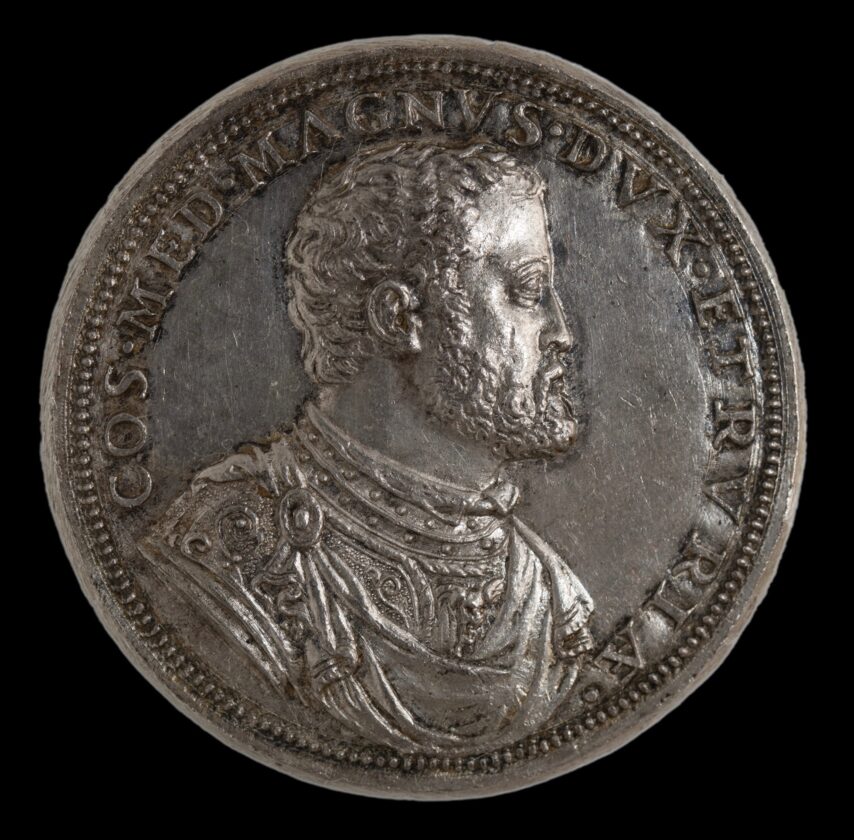
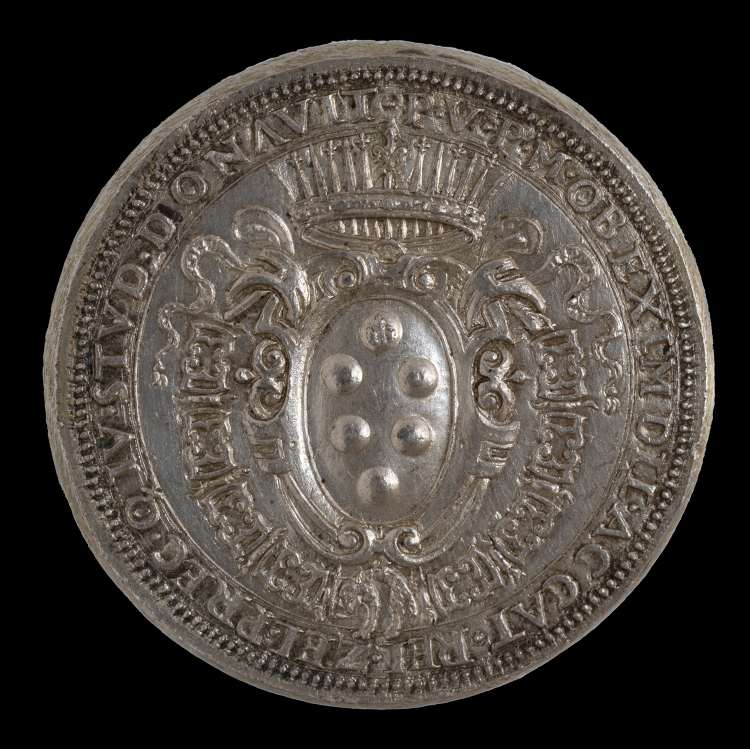
Minted silver, 44 mm.
Newsletter
Stay in Touch
Sign up for the Piazza dei Cavalieri newsletter
to receive updates on project progress and news.