
Giovanni Fancelli, called Nanni di Stocco
[first decade of the 16th century -1586]
Giorgio Vasari describes Giovanni Fancelli as follows: ‘Giovanni Fancegli, or, as others call him, Giovanni di Stoccho, an academician, has made many works in marble and stone that have turned out to be good sculptures’ [‘Giovanni Fancegli o vero, come altri il chiamano, Giovanni di Stoccho, accademico ha fatto molte cose di marmo e di pietra che sono riuscite buone sculture’ ]. In this brief remark, Vasari summarised the career of Giovanni Fancelli, known as Nanni di Stocco, who was born in Settignano (Florence) around the first decade of the sixteenth century.
Giovanni Fancelli began his career alongside his cousin Alessandro—known as Scherano—at the Certosa di Firenze. In the first half of the 1550s, he joined the ducal workshops, working at the Giardino di Boboli, Villa Medici a Pratolino, and in the Medici stables, often under the direction of, or following models by, his master Baccio Bandinelli.
Following designs and possibly models by Giorgio Vasari, Giovanni Fancelli’s work in Pisa appears to have begun with the commission for two Stephanian coats of arms to be placed on the corners of Palazzo della Carovana (1562–1564). This project formed part of Fancelli’s already extensive production of coats of arms: by then, he had executed those of Eleonora di Toledo and Cosimo I de’ Medici for the Grotticina di Madama in the Boboli Gardens, as well as another, now lost, for Palazzo Conti in Florence.
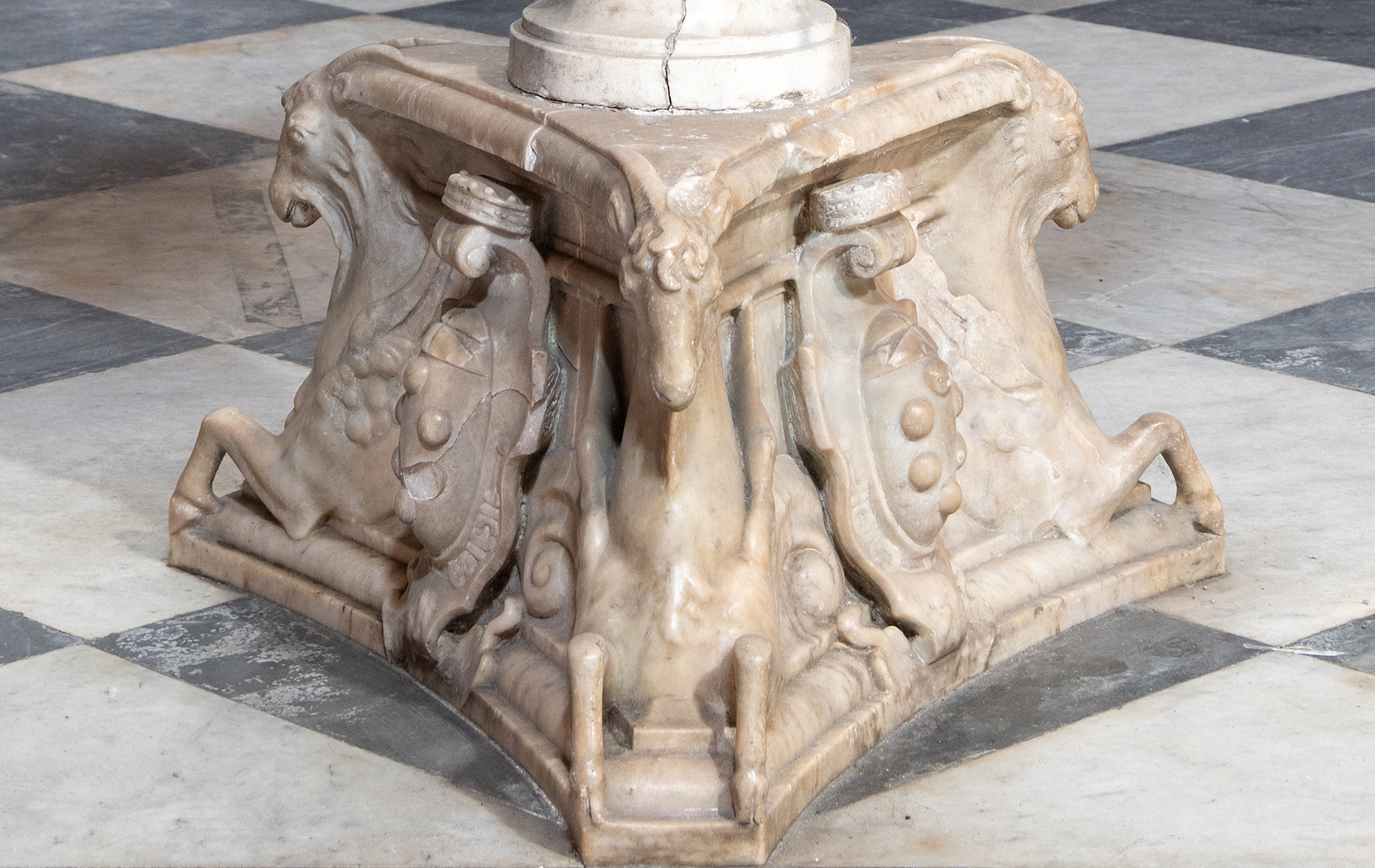
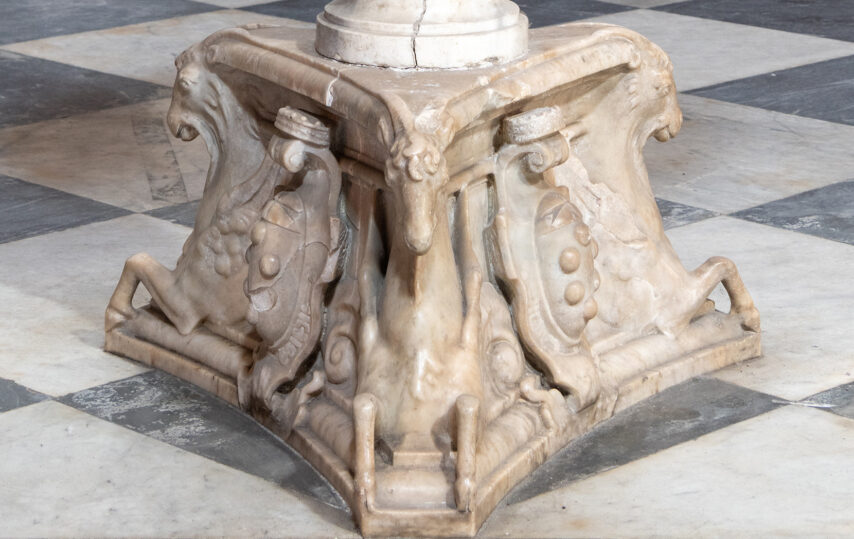
After contributing to the celebratory decorations for the 1565 wedding of Francesco I de’ Medici and Joanna of Austria in Florence, Giovanni Fancelli returned to the site of Piazza dei Cavalieri in Pisa, where he was commissioned to execute in marble and stone several of Giorgio Vasari’s designs for the interiors of Santo Stefano. Between 1566 and 1568, Fancelli produced stoups in white marble and Seravezza mischio (a multicoloured marble from northern Tuscany), the result of a simplified reworking of Vasari’s original designs. A list of Vasari’s designs for the Order of Saint Stephen also attributes to him ‘dua pilette di mischio per l’acqua santa’ [two small basins in mischio marble for holy water]. Based on appraisals of works executed for the Order, several now-lost decorations in the area of the high altar can likewise be attributed to him. On 9 September 1569, he signed a contract in Florence for the execution of the balconies supporting the organ and musicians, now situated beneath the two organs in the church.
On 21 January 1570—recorded as 1569 in Florentine style—Giovanni Fancelli signed an agreement with Giorgio Vasari and Davide Fortini to construct the four façades of the bell-tower chamber, including columns, balustrades and capitals, at a reduced price of 400 scudi, all based on Vasari’s designs. Francesca Funis suggests that Fancelli oversaw a substantial workshop of stonemasons in Florence, capable of offering such a low estimate for the Pisan bell tower. However, he later sought to have the contract revised. After this commission, little is known of his later activity in Florence until his death on 1 July 1586.
Artists
Main Entry- Nicola Pisano
- Giovanni Fancelli, called Nanni di Stocco
- Davide Fortini
- Stoldo Lorenzi
- Alessandro Forzori di Arezzo
- Tommaso di Battista del Verrocchio
- Pietro Francavilla
- Alessandro Pieroni
- Ridolfo Sirigatti
- Michelangelo Cinganelli
- Filippo e Lorenzo Paladini
- Giovanni de’ Medici
- Cosimo Pugliani
- Pietro Tacca
- Giovanni Stefano Maruscelli
- Giovanni Battista Foggini
- Adèle Poussielgue
- Leonardo Bistolfi
Media gallery
Newsletter
Stay in Touch
Sign up for the Piazza dei Cavalieri newsletter
to receive updates on project progress and news.