
Pulpit
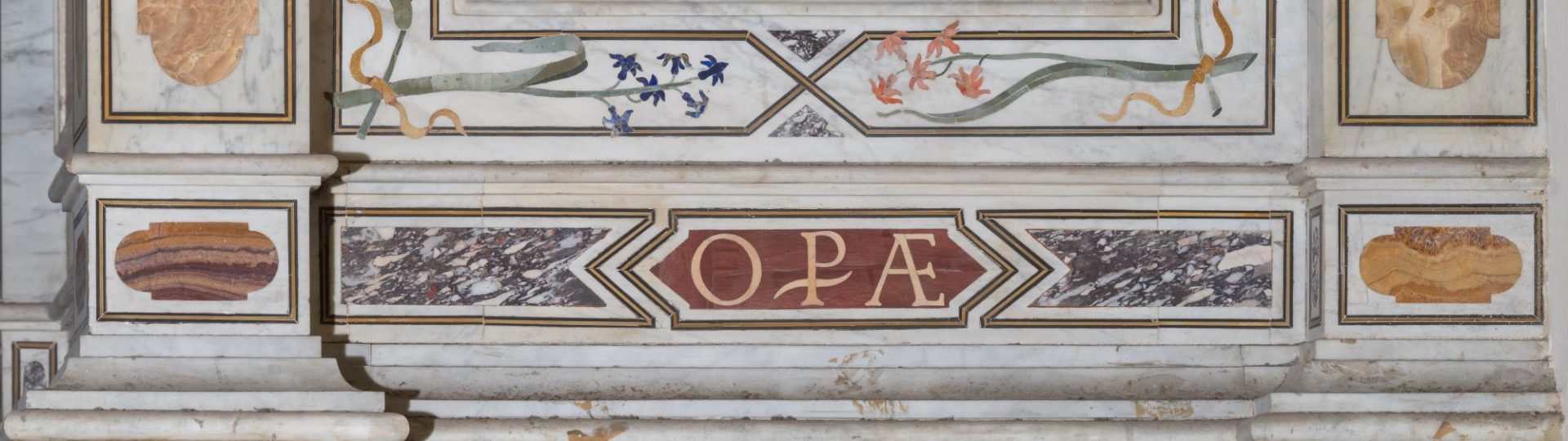
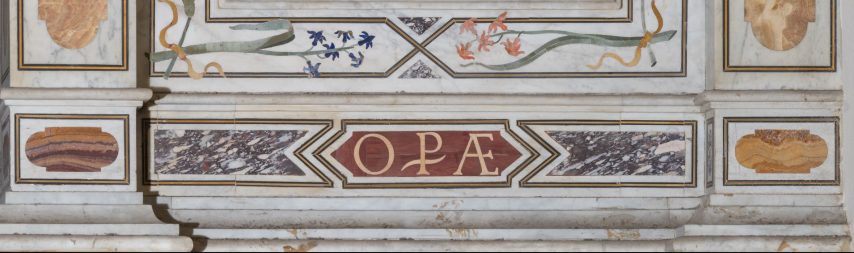
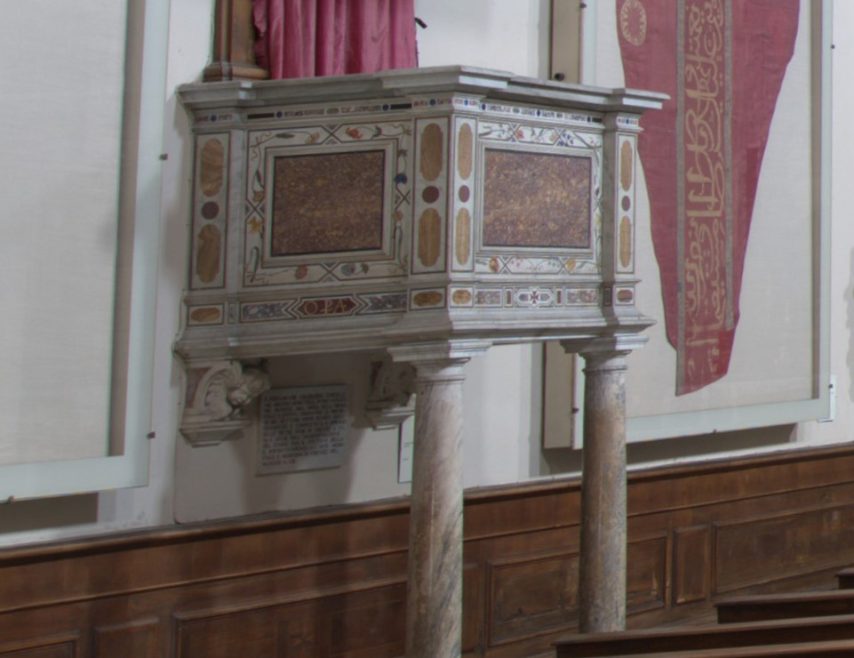
Set against the wall halfway along the left side of the church of Santo Stefano dei Cavalieri stands a three-sided pulpit of parallelepiped form, with moulded and projecting cornices. It is supported by two slender Tuscan columns in mischio(mixed) marble, rising from tall, squared plinths composed of white, green, and black marble. The three sides are adorned with commessi (stone inlay work) and inlays of polychrome stone featuring geometric and floral motifs, while along the lower cornice appear, at the centre of each, the red eight-pointed cross, symbol of the Order of Saint Stephen, and the monogram ‘O₽AE’, an abbreviated form of the Latin ‘OPERAE’, referring to the Opera of the Cathedral of Santa Maria Assunta and thus to the pulpit’s original location within that church. The pulpit was created in 1627 by the Florentine artist Chiarissimo Fancelli, commissioned by Curzio Ceuli, the administrator of the Primaziale (the institution overseeing the cathedral complex in Pisa), with the task of reassembling elements of the earlier fourteenth-century pulpit by Giovanni Pisano, which had been severely damaged in the 1595 fire and dismantled into separate parts between 1599 and 1602.
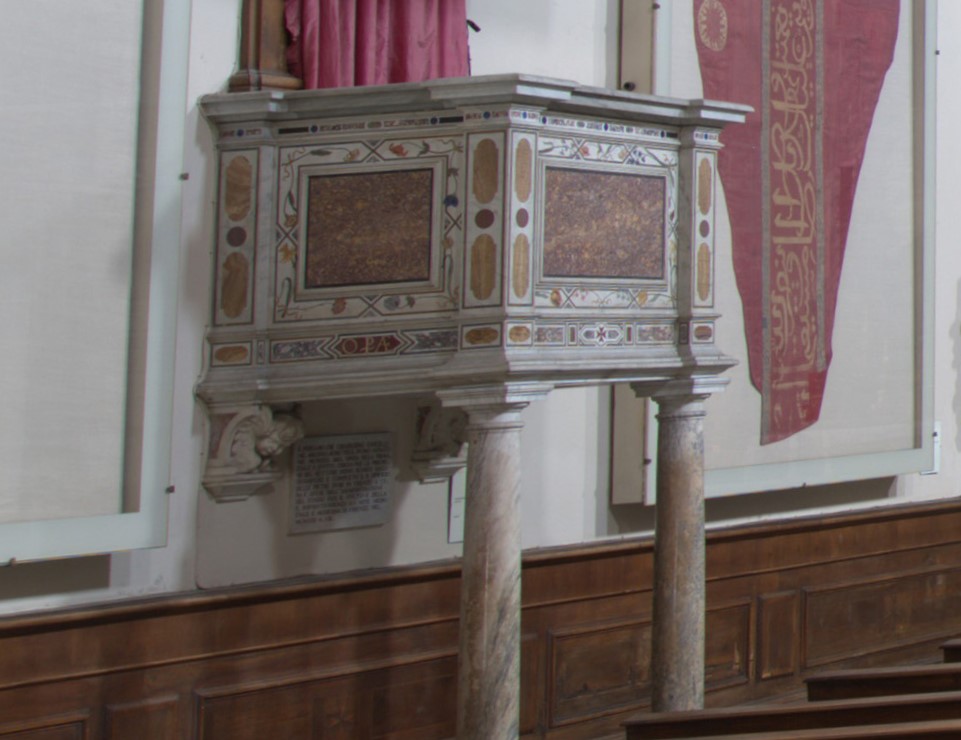
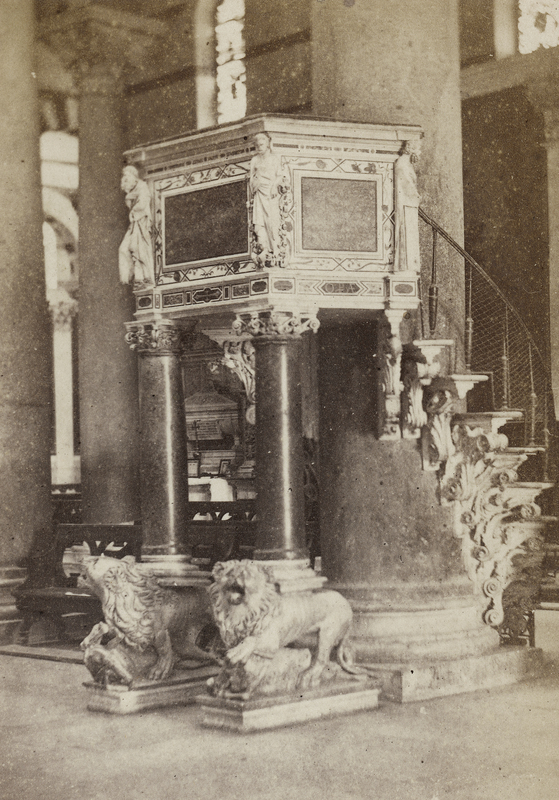
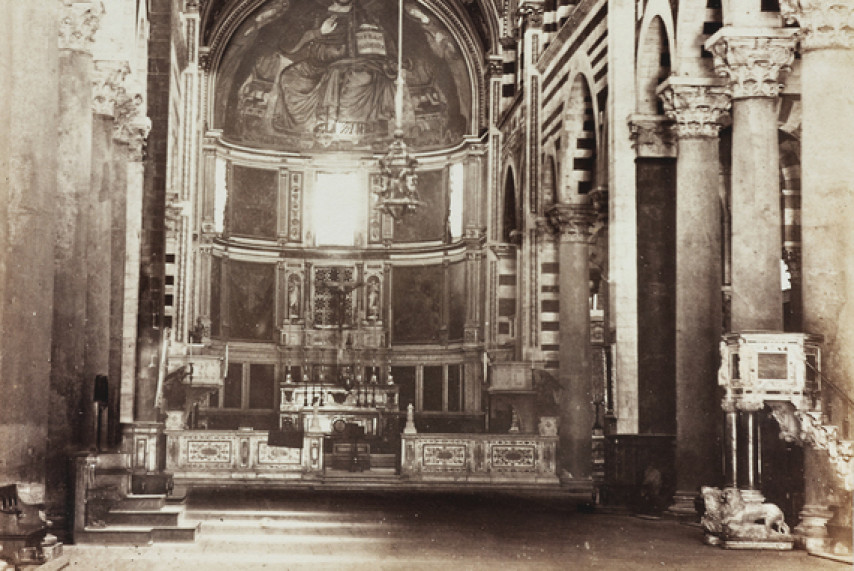
The structure was intended to follow the pentagonal shape of the wooden model provided to Fancelli, itself a reproduction of the original medieval pulpit. However, the execution proved problematic, as the sculptor did not strictly follow the approved design—endorsed by Grand Duke Ferdinando II de’ Medici himself—but instead produced a pulpit with only three sides. As a result, Curzio Ceuli refused to pay the final balance, judging the outcome to be ‘so meagre that the preaching father and his companion cannot stand in it except pressed together’ [tanto meschino che il padre predicatore con il compagno non ci puole stare se non stretto], and therefore unfit for the grandeur of the cathedral. The dispute continued throughout 1628, with Fancelli submitting multiple petitions directly to the Medici, each answered by detailed rebuttals from Ceuli. It was eventually resolved through the involvement of external assessors and a tribunal, which, in a ruling dated 29 July 1629, ordered Fancelli to ‘alter the pulpit to the agreed form at his own expense and within a specified time’ [ridurre il pulpito alla forma convenuta a tutte sue spese e dentro un tempo determinato]. Nevertheless, Fancelli failed to comply. As described by Ceuli in a letter to Ferdinando, and confirmed by mid- and late-nineteenth-century photographs, Fancelli’s pulpit was built ‘of marbles, with two columns—one of brocatello and the other of porphyry—with lions as pedestals, which had already belonged to the pulpit on the Gospel side’ [di marmi et messovi li dui colonne, una di broccatello et l’altra di porfido, con li sui leoni per piedistalli, che già erano nel pulpito del vangelo]. The upper section featured small anthropomorphic sculptures, including ‘the statue in the middle of Pisa and the four virtues … with the side panels entirely inlaid with naturalistic floral motifs, and with a double staircase … with steps and brass balustrades’ [la statua nel mezzo di Pisa e le quattro virtù … con le spallette fatte tutte commettere di fiorami al naturale, et con la scala doppia … et fattovi li scaloni et balaustri di ottone].
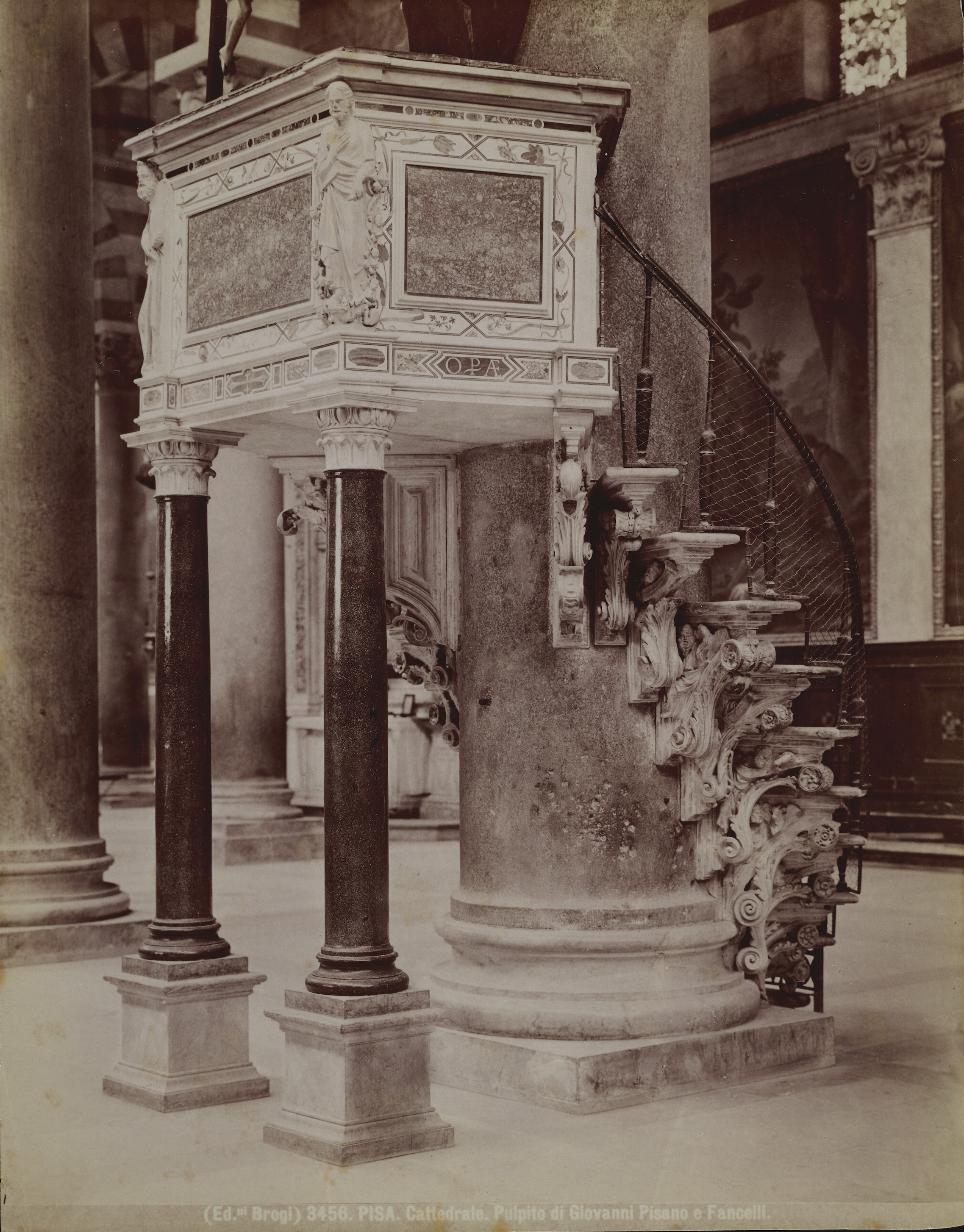
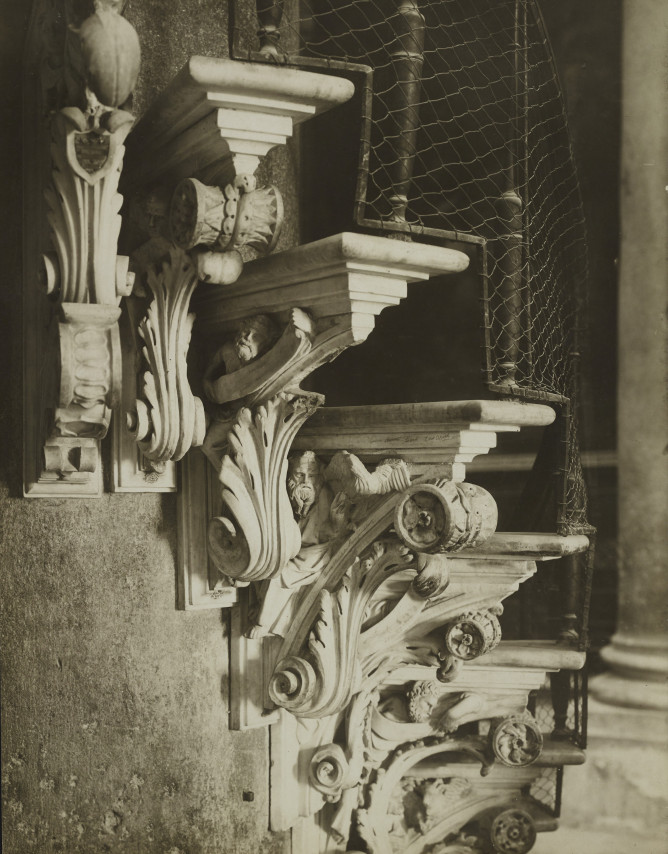
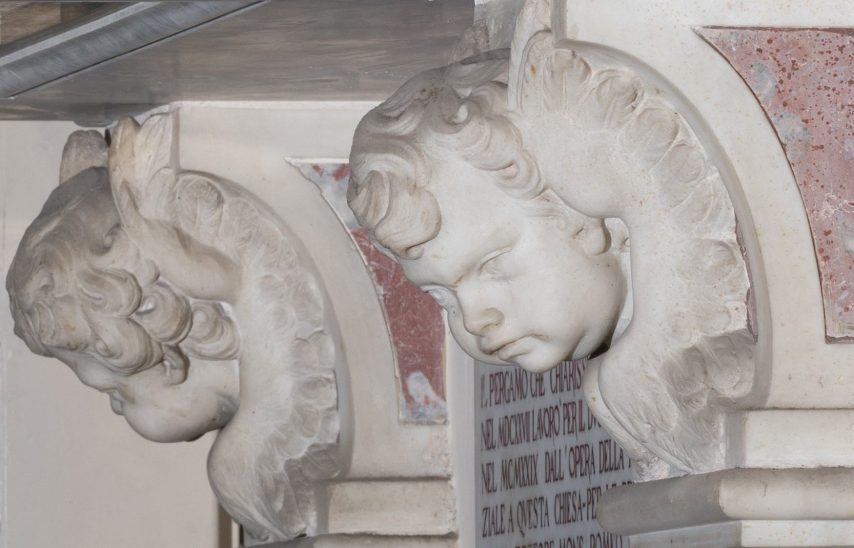
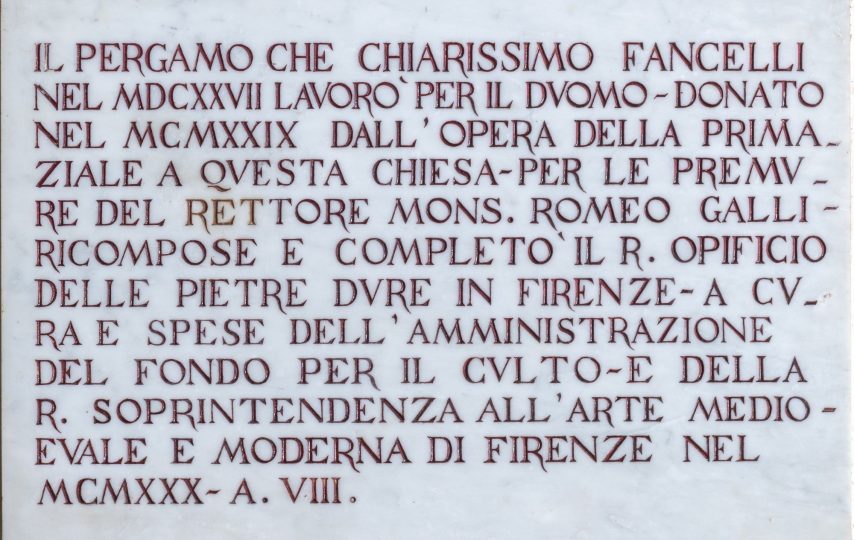
A twentieth-century commemorative plaque, placed beneath the pulpit in its current location at Santo Stefano and flanked by two white marble brackets with cherub heads supporting the side set against the wall, records that in 1929 the Opera Primaziale of Pisa donated the contested pulpit to the church of the Order. It further notes that, ‘[through the efforts of the rector Monsignor Romeo Galli’ [per le premure del rettore mons. Romeo Galli], the pulpit was reassembled and completed thanks to the intervention of the ‘Real Opificio delle Pietre Dure in Florence, under the direction and at the expense of the administration of the Fondo per il Culto and the Royal Superintendency for Medieval and Modern Art in Florence, in 1930’ [Opificio delle Pietre Dure in Firenze, a cura e spese dell’amministrazione del Fondo per il Culto, e della R. Soprintendenza all’arte medioevale e moderna di Firenze nel MCMXXX].
Extensive documentation held in the archives of the Soprintendenza of Pisa records each stage of this significant handover. By 1926, the pulpit left by Fancelli in the Cathedral had been dismantled—its gradual spoliation already evident in nineteenth-century photographs—following the decision to undertake the philological reassembly of Giovanni Pisano’s precious medieval pulpit, now once again visible within the cathedral. The marble elements carved by the seventeenth-century sculptor were set aside until Romeo Galli, rector of Santo Stefano, suggested to Ferdinando Puntoni, then warden of the Primaziale (the institution overseeing the cathedral complex in Pisa), that they be donated to the church of the Knights and reassembled in a setting worthy of their historical significance.Once the proposal was accepted, Galli, in agreement with Soprintendente Giovanni Poggi, arranged the sale of the old wooden pulpit then in Santo Stefano, raising five hundred lire, which were reinvested in the transport and assembly of Fancelli’s pieces. These were subsequently reassembled in Florence at the Opificio delle Pietre Dure, with the addition of new marble elements and two front columns. In 1931, with the pulpit installed in its new location, two seventeenth-century brackets with cherubim—specially sourced for the purpose—were finally mounted beneath it.
Media gallery
Newsletter
Stay in Touch
Sign up for the Piazza dei Cavalieri newsletter
to receive updates on project progress and news.