
Sixteenth- and Seventeenth-Century Designs
Like many other features of Santo Stefano dei Cavalieri, the high altar—admired today in the version designed by Giovanni Battista Foggini in the early eighteenth century at the behest of Cosimo III de’ Medici—was the outcome of a prolonged and complex development process.
The first to intervene on the high altar was Giorgio Vasari, who oversaw the transformation of Piazza dei Cavalieri during the Cosimian era. In 1569, he submitted an initial design that placed a ciborium in a dominant position above the altar table, reflecting the liturgical reforms enacted in the wake of the Council of Trent. This solution replaced the traditional painted altarpiece, which, according to officials of the Order of Saint Stephen, would have occupied excessive space, blocked light, and hindered visibility of the ceremonies in the choir. Bronzino’s Nativity, initially intended for the high altar, was subsequently relocated to one of the lateral walls.
A version of Vasari’s design may be recognisable in a drawing from the codex Ottoboniano Latino 3110 (no. 73) at the Biblioteca Apostolica Vaticana. However, its autograph status is contested and has been rejected by Florian Härb in his monograph on Vasari as a draughtsman. Compiled in the eighteenth century by Pier Leone Ghezzi, the codex brings together architectural studies from various periods. The drawing presents a detailed plan for a monumental altar structure, closely resembling one Vasari had devised not long before for Santa Croce in Florence: it rises on a substantial base and echoes the form of a classical triumphal arch, though surmounted by a dome and centred on an ornate ciborium.
Anthropomorphic statues flank the ciborium and appear along the upper edges of the structure, while two putti bearing a coat of arms are placed at the centre of the triangular pediment. This may correspond to the ‘design for the altar and ciborium of the Sacrament, to be made of marble and bronze, commissioned by His Most Illustrious Excellency, which remains in my possession’ [disegnio dello altare e ciborio del sagramento da farsi di marmo et di bronzo, ordinatomi da sua eccellenza illustrissima, qual’è ancora apresso di me], mentioned by Vasari in a well-known letter sent from Florence in September 1569 to the Council of the Order, in which he provided a detailed account of all works completed or in progress at the Palazzo della Carovana and the church of Santo Stefano.
It has also been suggested that Vasari’s initial concept may be recognisable in a second drawing, included in the same Vatican codex (no. 60), which Josephine von Henneberg previously associated with the altar of Santa Croce. A distinctly Vasarian character indeed marks the sheet; however, unless one assumes it to predate folio no. 73—whose overall composition more closely reflects the descriptions of the Stephanian project found in the archival documents—von Henneberg’s reconstruction, in the view of the present author, remains the most persuasive.
Further documentary evidence reveals that while Cosimo I appreciated the artistic quality of Vasari’s design, he found it overly sumptuous and likely requested a revision. In the following December, he authorised the construction of a bronze ciborium, flanked—as depicted in the first of the two Vatican sketches, on either side of the tabernacle, and possibly within frontal niches—by two marble statues: ‘One is to be Saint Stephen, pope and martyr, and the other, Saint Cosmas’ [abbino a essere Santo Stefano p(apa) e m(artire) e l’altra San Cosimo].
Despite the initial plans, the costly work on the Stephanian altar was soon halted, and no further records appear until late 1570, when the contributions of Giovanni Fancelli, called Nanni di Stocco—one of Vasari’s most consistent collaborators in Pisa—were formally assessed. These included, among other things, ‘the altar with its two steps and floor, five columns of mixed marble with their bases and capitals, and the construction of the mixed marble table’ [l’altare con esso li dua gradi di scalini e ’l suo pavimento e cinque colonne di mistio con esse le sue base e capitelli et fattura della tavola di mistio]. In 1571, the woodcarver Cosimo d’Arrigo was paid for crafting a wooden ciborium. However, this solution was never fully endorsed by the Council of the Order, which made repeated attempts to replace it with a bronze ciborium—efforts that ultimately proved unsuccessful.
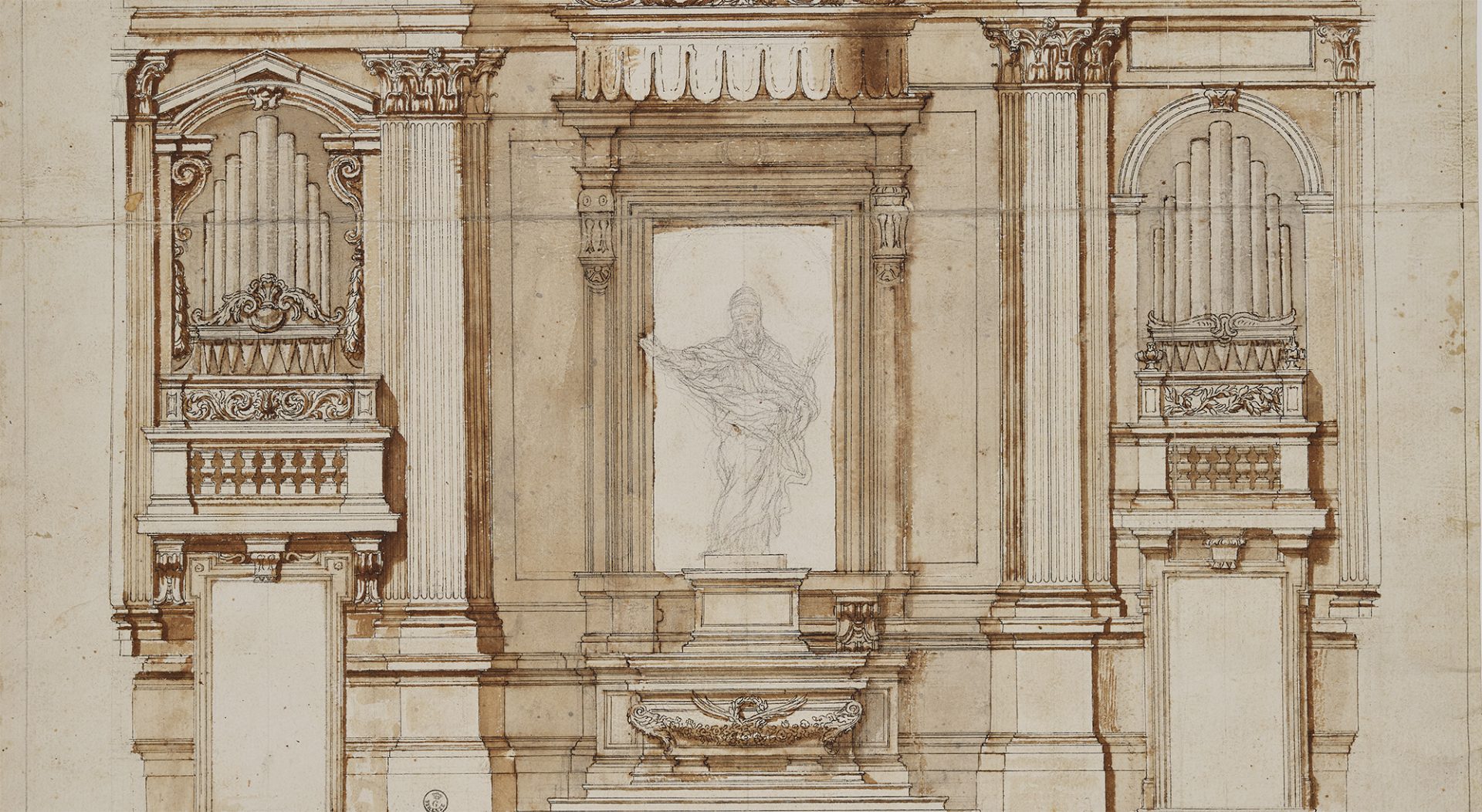
Pen, brown ink, and wash on white paper, 374 x 267 mm
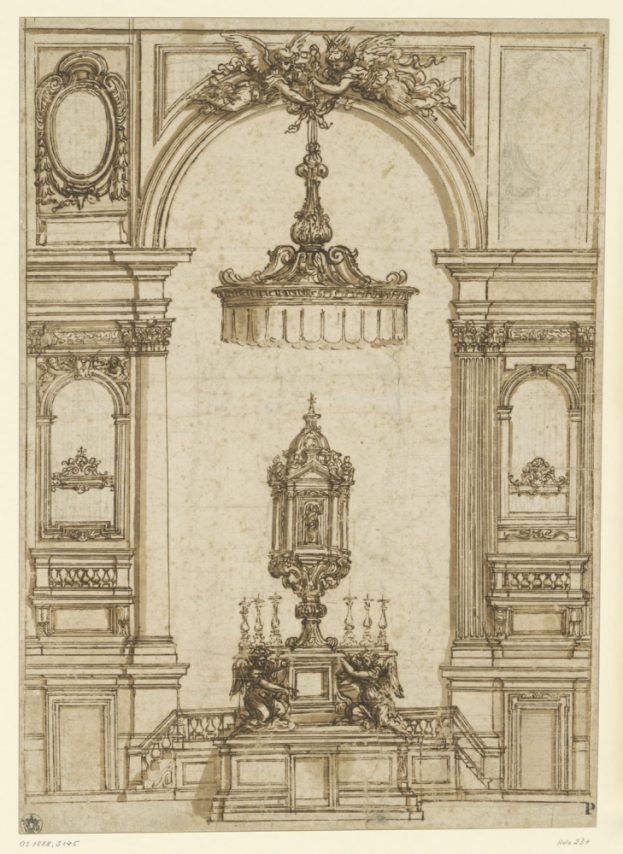
Pen, brown ink, and wash on white paper, 277 x 170 mm.
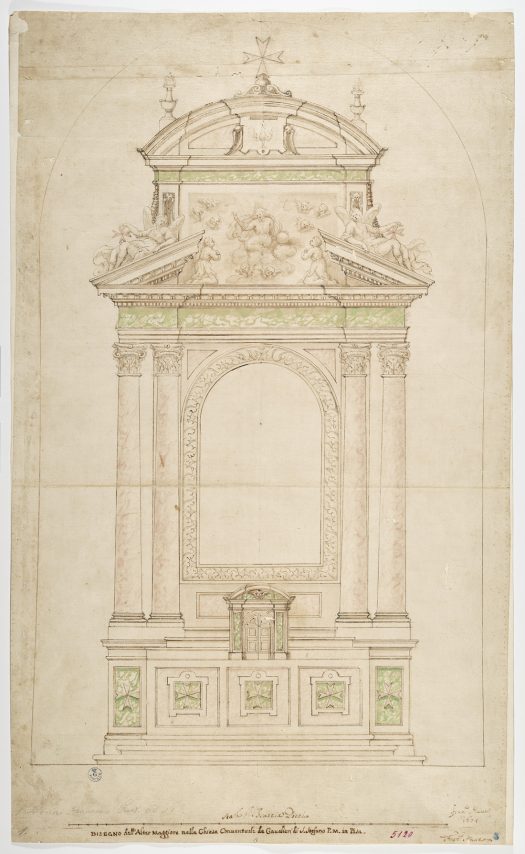
Inscriptions, lower centre:
‘Scala di braccia dieci’ /
‘Disegno dell’Altar Maggiore nella Chiesa Conventuale di S. Stefano P. M. in Pisa’.
Inscriptions, lower left: ‘Fran.co Nave / 1675» / «Fran.co Nave’.
The sixteenth-century tabernacle was demolished and replaced in 1682, when the long-sought relics of Saint Stephen—whose arrival had already been unsuccessfully requested in Vasari’s time—finally reached Pisa. Throughout the seventeenth century, amid the complex expansion of the church, several artists, including Pietro da Cortona and Gian Lorenzo Bernini, were involved in designing a new altar, although without success. The arrival of the saint’s relics, acquired in the meantime by Grand Duke and Grand Master Cosimo III de’ Medici, introduced a new requirement: the altar would now need to accommodate the sacred remains—prompting a decisive shift in design. No visual record survives of Bernini’s 1671 project. Pietro da Cortona, however, had already revisited Vasari’s concept of an altar with a central ciborium around 1650, adapting it to a Baroque idiom. This reworking is documented in a detailed drawing now preserved in Berlin (Kunstbibliothek, inv. Hdz 231).
Although it is unclear when the arrival of Saint Stephen’s relics was first anticipated—and therefore considered in the design process—a 1675 drawing now in the Uffizi shows an aedicule structure with marble inlays and a setting for a lunette-shaped altarpiece. Initially attributed to Pier Francesco Silvani and later to the architect Francesco Nave, whose signature appears on the sheet, the design does not seem to provide space for a reliquary.
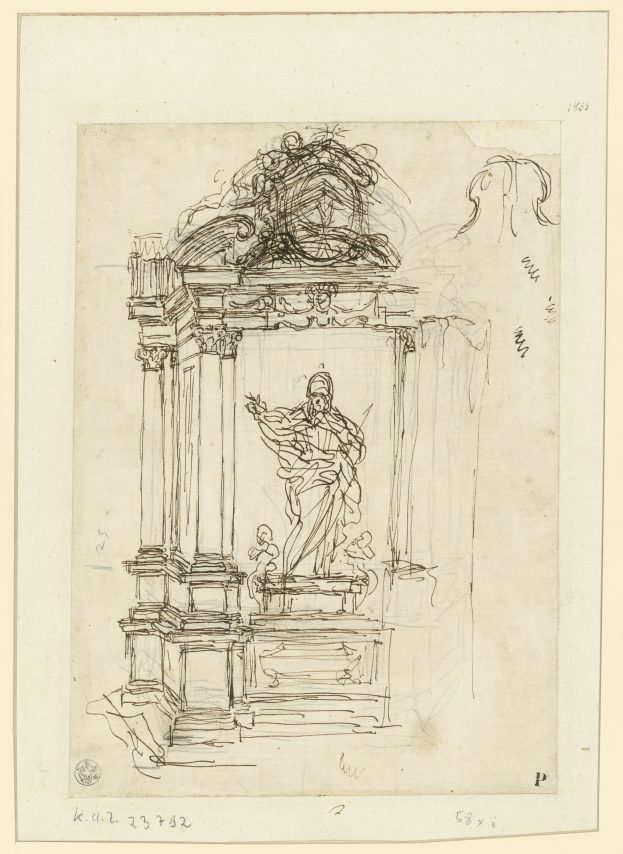
Ink on preliminary drawing, 262 x 190 mm
Pen, black chalk, and bistre on white paper, 634 x 531 mm
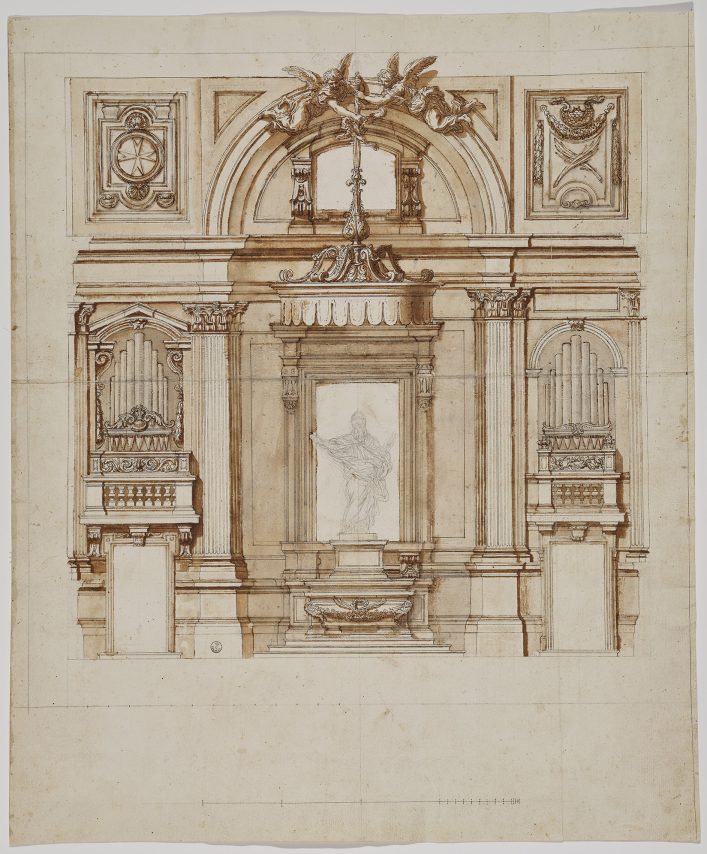
In 1682, building on Cortona’s proposals, Ciro Ferri—then engaged in various decorative projects for the church—reworked the altar design. He envisioned a sarcophagus-reliquary topped by a statue of Saint Stephen in a blessing pose, set beneath a canopy held aloft by two flying angels.
That same year, Pier Francesco Silvani and Giovanni Battista Foggini submitted a joint model for the altar, which was ultimately implemented to house the saint’s relics, conveyed to the church in 1683 with a solemn procession. Still preserved today in a room adjoining the church, the resulting wooden structure was crowned by a monumental sculptural group featuring Pope Saint Stephen in a blessing pose, flanked by putti and by female personifications of Faith and Religion.
A series of drawings held in Vienna documents the project’s successive phases, which Foggini continued alone after Silvani died in 1685. After the relic of Saint Stephen’s cathedra was transferred to Pisa in 1700—donated to the Order by Pope Innocent XII—Foggini reconfigured the altar once more, modifying the statuary and incorporating both the saint’s bodily remains and his throne, which features a gilded bronze relief of his Decapitation on the backrest.
Media gallery
Pen, brown ink, and wash on white paper, 374 x 267 mm
Pen, brown ink, and wash on white paper, 277 x 170 mm.
Inscriptions, lower centre:
‘Scala di braccia dieci’ /
‘Disegno dell’Altar Maggiore nella Chiesa Conventuale di S. Stefano P. M. in Pisa’.
Inscriptions, lower left: ‘Fran.co Nave / 1675» / «Fran.co Nave’.
Ink on preliminary drawing, 262 x 190 mm
Pen, black chalk, and bistre on white paper, 634 x 531 mm
Newsletter
Stay in Touch
Sign up for the Piazza dei Cavalieri newsletter
to receive updates on project progress and news.