
Vasari’s Project
Black chalk, pen, and brown wash on paper, 475 x 375 mm
Inscription in pen, upper right: ‘b.a 30 senza il pendio e il pendio viene a essere b.a 4 sarebbe tutto b.a 34’
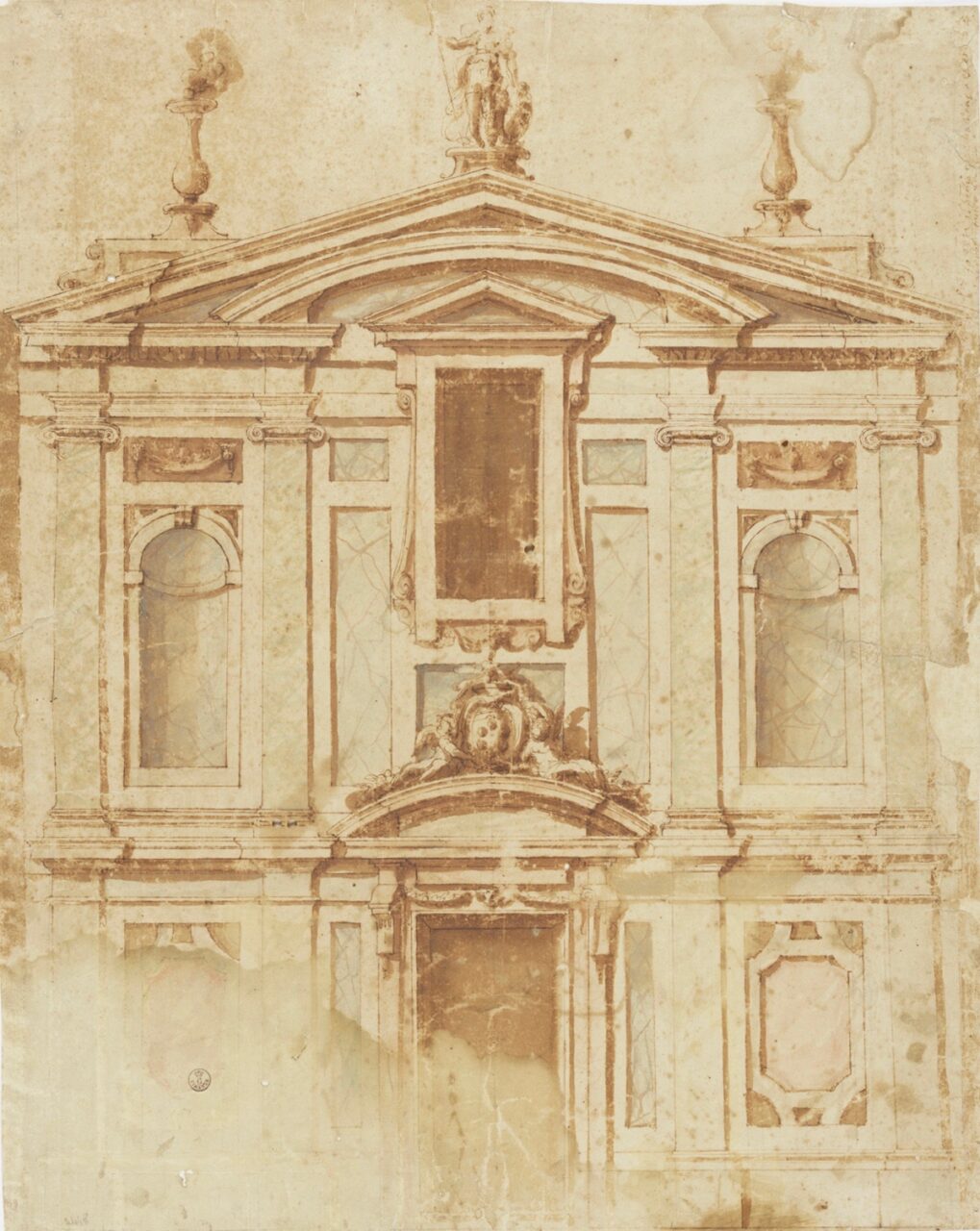
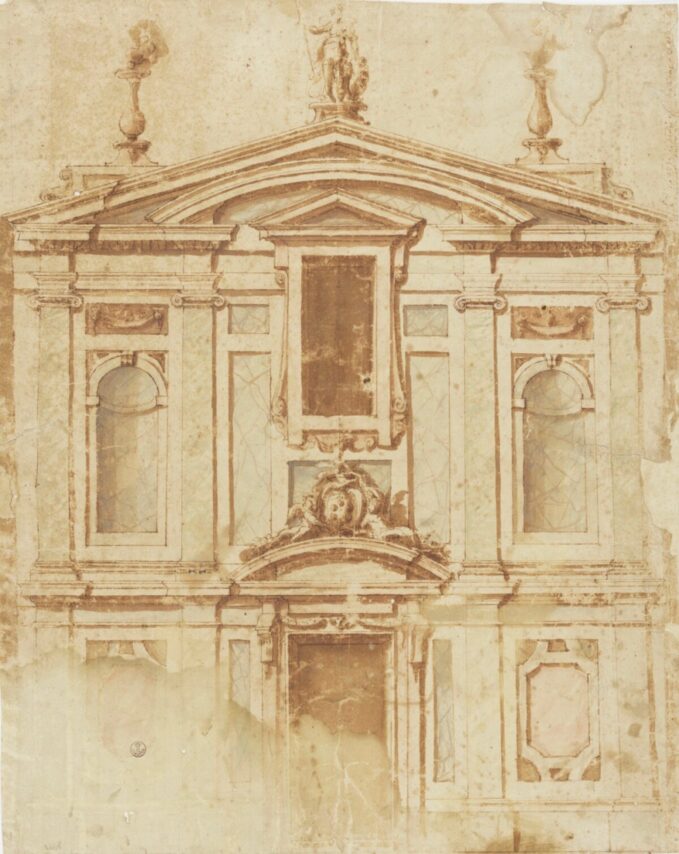
For some scholars, Giorgio Vasari’s project for the façade of Santo Stefano dei Cavalieri can be identified with drawing 2448 A, preserved in the Gabinetto dei Disegni e delle Stampe of the Gallerie degli Uffizi.
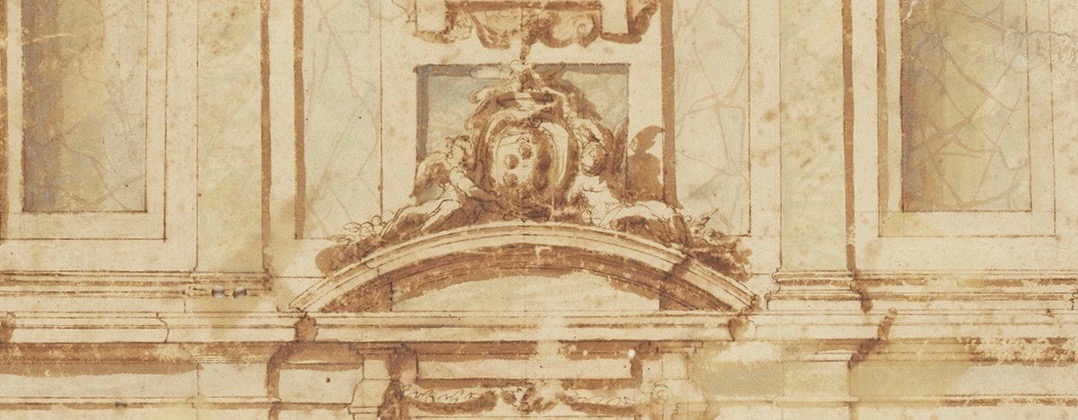
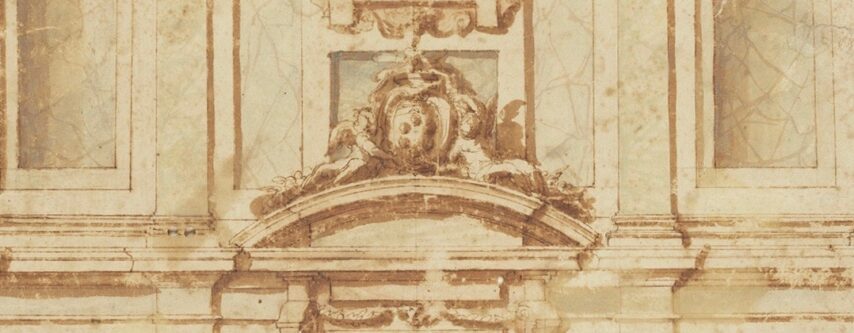
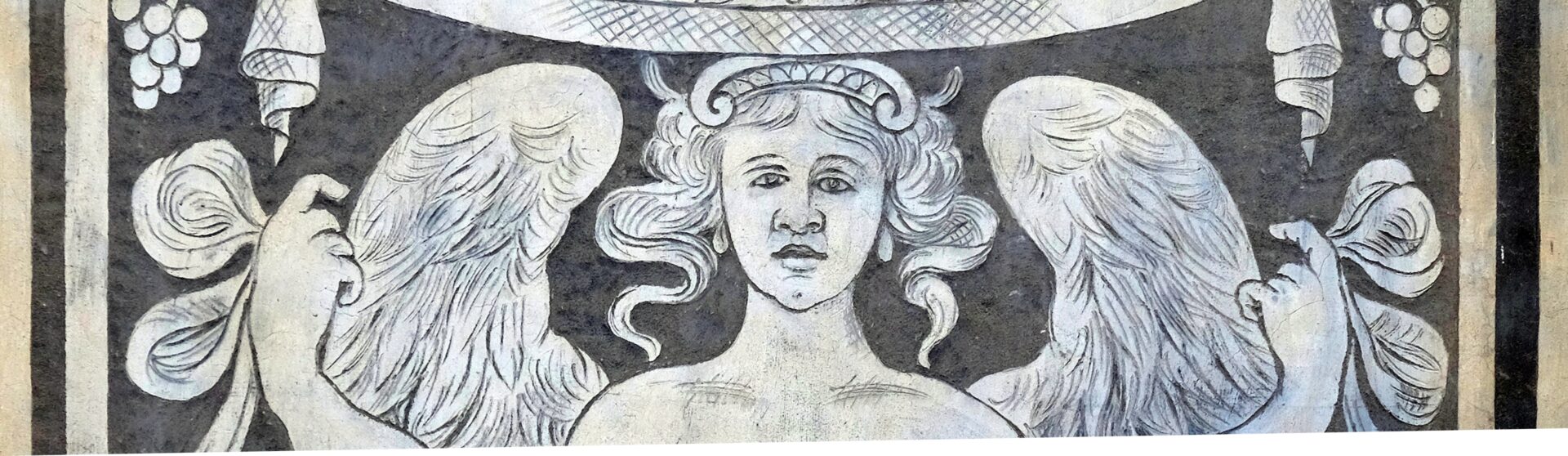
The drawing – possibly known to, or consulted by, Don Giovanni de’ Medici, who towards the end of the century supplied the definitive design – depicts a two-storey façade divided articulated into three vertical bays. The four lower pilasters frame the entrance portal and, on either side, two polychrome marble panels. The upper pilasters, of Ionic order, enclose a large window framed as an aedicule and flanked by two lateral niches, evidently intended for statues. Scant documentary evidence confirms that in 1598 two wooden and plaster figures of St Benedict and St Stephen were indeed placed ‘as a trial on the two lateral pedestals of the façade’ [‘per prova sui due piedistalli laterali della facciata’]. The crowning feature, inspired by Michelangelo’s project for Porta Pia in Rome, consists of a sequence of interlocking pediments: a large triangular pediment encloses a segmental one, which in turn contains the triangular pediment of the central window. The marble ornamentation comprises two flaming vases and the statue of the saint, while above the entrance portal, within the tympanum, two angels amid garlands of fruit support the Medici coat of arms.
The drawing, formerly attributed to Bernardo Buontalenti and associated with the church of Santa Trinita in Florence, was identified by Vera Daddi-Giovannozzi (1937) as relating to the design process for Santo Stefano dei Cavalieri. While she considered it to be by an unknown hand, she regarded it a likely indication of Vasari’s original project. That project is mentioned in a list of ‘Disegni, piante, proffili et modanature per modegli’ (‘Drawings, plans, profiles and mouldings for models’), which Vasari himself sent to the Order in 1569 and is still preserved in the Archivio di Stato di Pisa. A letter published by Karl Frey dates the Vasari drawing to 1567, at a time when the marble selection was already in progress. The high cost of this operation may well have persuaded Cosimo de’ Medici to postpone the entire undertaking.
In 1980, Franco Paliaga attributed the sheet in question to Vasari himself, pointing to the coloured marble revetment (corresponding to the ‘mischio colorito’ mentioned by the architect in the previously cited list) and to the form of the central window, which resembles those originally planned for the church’s flanks. He also noted several affinities with Vasari’s draughtsmanship: the lively, nervous line; the use of pen and brown wash, likewise employed in the preparatory drawings for the church’s interior fittings; and the habit of adding measurements to architectural studies. Although Ewa Karwacka Codini (1989) found the proposal unconvincing, it was accepted by Claudia Conforti (1993), who emphasised the shared use of the Ionic order in both the façade project and the bell-tower windows, in full agreement with Vasari’s own statement that the two decorative schemes should correspond.
Media gallery
Black chalk, pen, and brown wash on paper, 475 x 375 mm
Black chalk, pen, and brown wash on paper, 475 x 375 mm
Inscription in pen, upper right: ‘b.a 30 senza il pendio e il pendio viene a essere b.a 4 sarebbe tutto b.a 34’
Newsletter
Stay in Touch
Sign up for the Piazza dei Cavalieri newsletter
to receive updates on project progress and news.