
Palazzo del Capitano del Popolo, also known as Palazzo dell'Esecutore
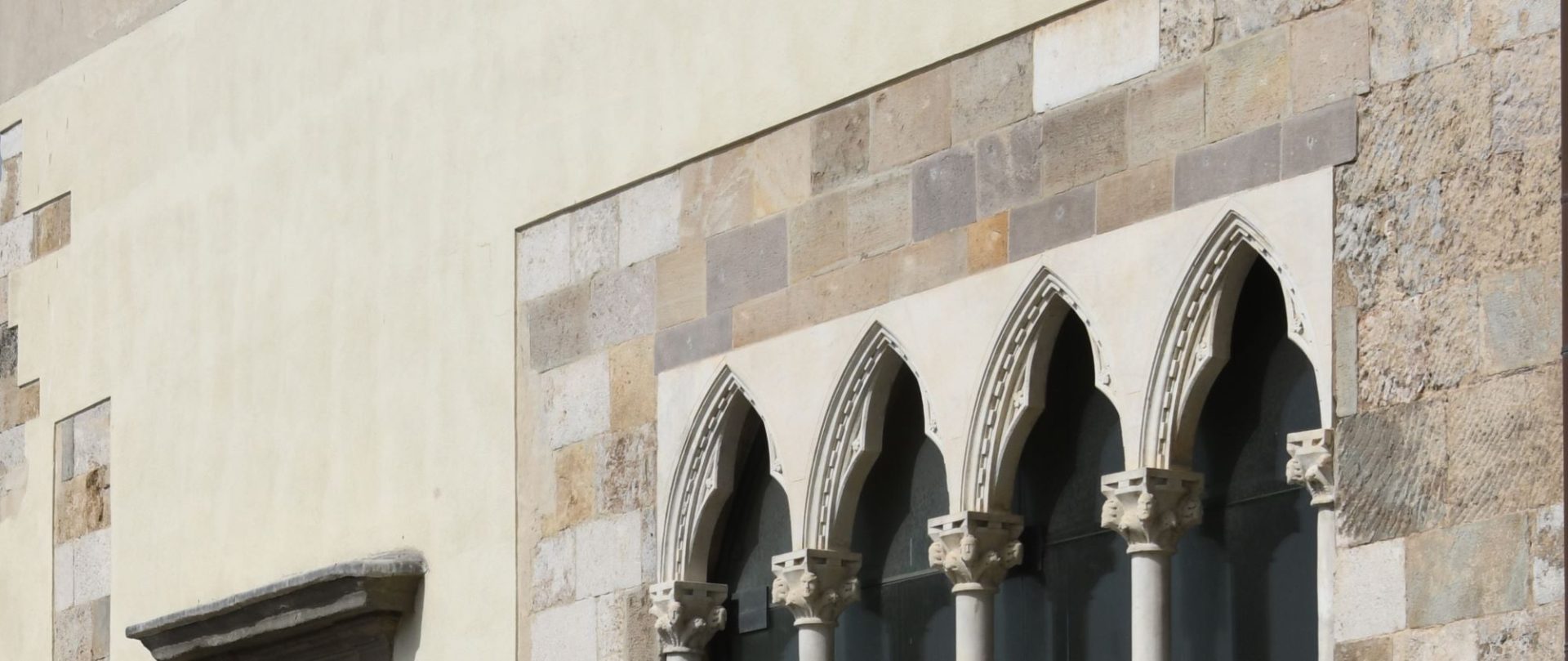
Facing Palazzo dell’Orologio from the centre of the Piazza, one can identify in the southern (left) wing of the building several medieval architectural elements belonging to a four-storey structure, built above a double-arched loggia and containing a modern quadrifora (multi-light window) on the first floor. According to the identification accepted by Gabriella Garzella, Fabio Redi and Ewa Karwacka, these would constitute the remains of the fourteenth-century Palazzo del Capitano del Popolo, seat of the important magistracy established with the advent of the Comune del Popolo by the mid-thirteenth century. Although this office is attested from 1254, like other magistracies, its residence was itinerant for several decades, as also suggested by the absence of any mention of a palazzo or dwelling attributed to the Captain of the People in the Statutes of 1287 and 1313. It is therefore necessary first to ask where its seats were located.
During the government of Ugolino della Gherardesca and Nino Visconti, when both came to proclaim themselves Captani del Popolo (a chief civic magistrate representing the interests of the popolo against the dominance of the magnate families) and podestà, the office of Capitano del Popolo appears to have been located in the ‘Palazzo del Popolo’. This was Palazzo degli Anziani, which formed the primary and fundamental centre of the new centre of popular authority. Even throughout the final quarter of the thirteenth century, neither chronicle nor the statutory sources mention a palazzo specifically assigned to the Capitano del Popolo, who must therefore have continued to reside in one wing of the same Anziani complex. In 1318, shortly before the escape of Genoese prisoners from the nearby ‘carcere delle Sette Vie’ (that is, from the Tower of Famine) cast doubt on the security of the Anziani, a proposal was made—together with moving the prison to a safer location—to exchange the residences of the Anziani and the Capitano del Popolo, which at that time occupied two distinct wings of the articulated building complex.
In 1322 a provision of the Comune attests that the Capitano del Popolo resided in the Gualandi tower known as ‘de Septem Viis’, overlooking the piazza of the same name and leased by the Comune for an annual rent of 10 lire. The first communal document expressly designating a Palazzo del Capitano dates instead to 1327: a building constructed ex novobeside the ‘Torre delle Sette Vie’according to Gabriella Garzella, or perhaps an adaptation of the Gualandi tower or domusattested in the sources, as the disparity between the lower and upper sections of the squared stone facing would appear to suggest.
According to Ronzani, the evidence found in the left wing of today’s Palazzo dell’Orologio corresponds to a building described in 1361 as a ‘palatium’ located in the chapel of San Pietro in Cortevecchia, ‘recently built by the Municipality of Pisa’ [‘edificatum et constructum nuper per Comune pisanum’]. This would not have been built for the Capitano del Popolo, but rather, Ronzani hypothesises, for the office of the vicario of Gualtieri di Hochschlitz, a position that existed from 1357 to 1362, then replaced by the ‘conservatore del buono e pacifico stato’ (conservator of the good and peaceful state), and, after 1368, by the ‘esecutore della custodia degli Anziani’ (executor of the custody of the Anziani) . A ‘Palazzo dell’Esecutore’ is in fact documented from 1370 onwards: the new identification proposed by Ronzani therefore implies a review of the interpretation and dating of the visible structures proposed in the past, in comparison with the traces found above ground.
Despite the difficulty of defining the physical layout of the individual sites mentioned in the documents, it seems possible to frame the mentions of a site belonging to the Capitano del Popolo to reflect the tendency towards agglutinative expansion of the two communal political poles between the late thirteenth and early fourteenth centuries. Both the nucleus of Sant’Ambrogio, pertaining to the podestà, and the one pertaining to the Popolo in the future Piazza dei Cavalieri initially saw, shortly after the mid-thirteenth century, the establishment of a first multifunctional structure (the domus and subsequently palatium Communis in Sant’Ambrogio; the palatium Populi in Piazza delle Sette Vie). In the following decades, owing to the growth of communal functions and the attraction exerted by the two poles, various surrounding structures were leased or purchased in order to concentrate multiple communal offices there.
A qualitative leap forward occurred in the early decades of the 14th century, with the foundation of the Palazzo del Podestà, the centralisation of the civil courts, the relocation of the Camera Nuova del Comune, the repeated transfers of the headquarters of the Capitano del Popolo and, as it appears, the creation of new government structures on the western side of Piazza degli Anziani. The expansion and repaving of the square finally completed and confirmed the relocation of offices that had taken place over more than a century.
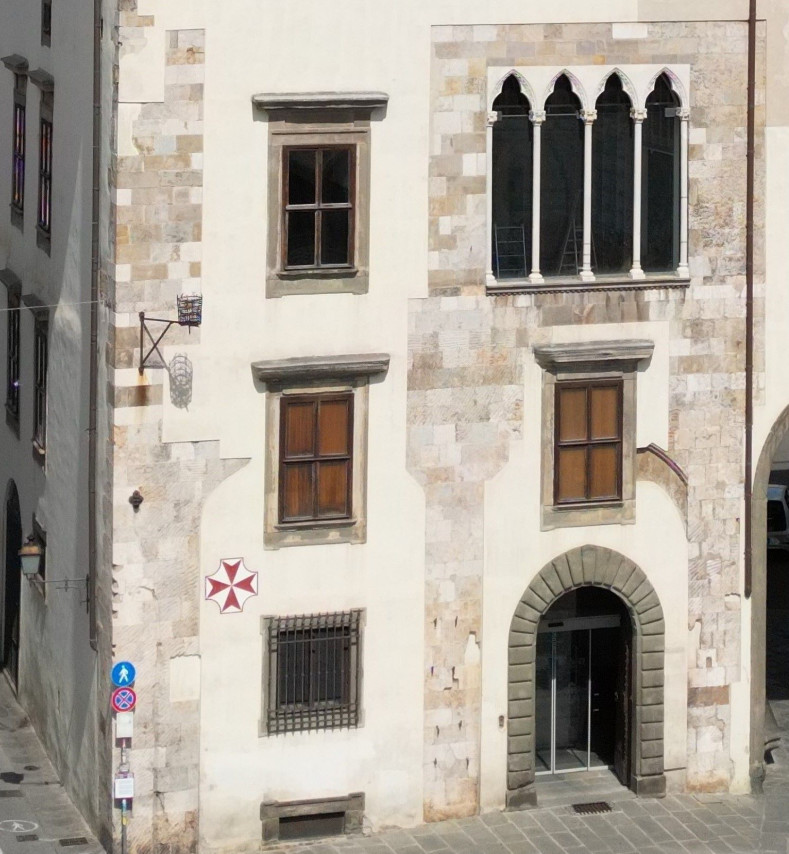
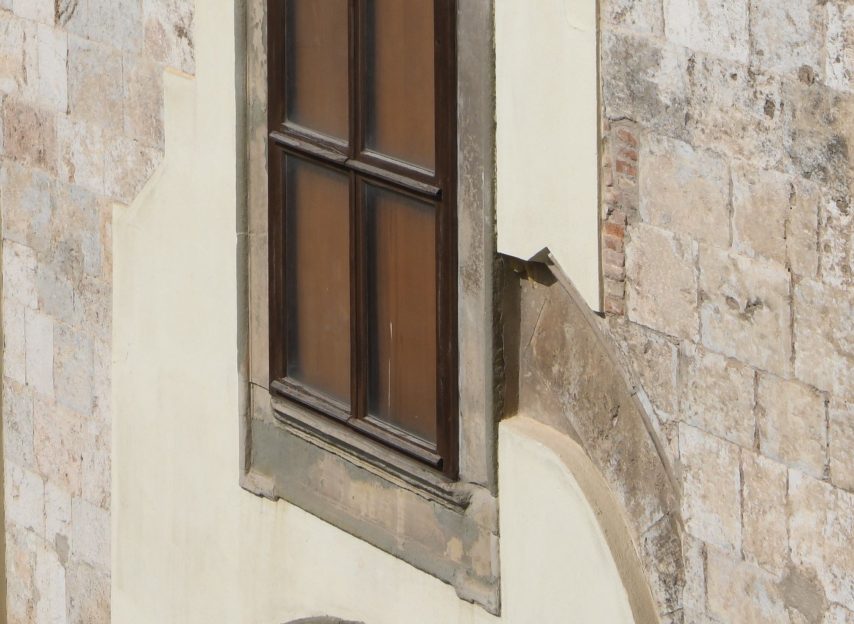
From an architectural perspective, the structure visible from the piazza represents the essential portion of the preserved medieval remains. These belong to a solid masonry construction in squared blocks of quartzite and limestone from the Monti Pisani. The ground floor consists of a two-bay loggia with almost full-centre arches, some of whose moulded arch blocks, with cavetto and dentils, are preserved. The first floor, by contrast, would have featured two four-light windows with small arches on colonnettes without connecting arches, according to the interpretation of the remains discovered during the 1919 restorations, which resulted in the reconstruction of one of the two windows. No trace of floors or roofing survives; the interior was restored in 1919 and again between 1979 and 1982.
The combination of a ground-floor loggia and a piano nobile lit by large four-light windows places Palazzo dei Dodici within a small group of Pisan buildings dated by Fabio Redi to the mid-fourteenth century: the medieval vestiges within of Palazzo dei Dodici, which housed the new Camera del Comune attested from 1338 on the same piazza, and the two private palaces with projecting loggias on columns and multi-light windows along the Borgo thoroughfare. The type of arch cornice with cavetto moulding at the base finds a parallel in the pre-existences of the current façade of Palazzo Arcivescovile (1330–1332), and an even closer comparison in the pillared building along the present Corso Italia, the ancient contrada San Gilio, opposite the Logge di Banchi (late thirteenth to fourteenth century).
Although these comparisons suggest a more ‘palatial’ and residential typology, the Palazzo does not entirely depart from the casa-torre model: its façade remains narrow and its development markedly vertical. As noted, all possible traces of the medieval internal layout have been erased by later reorganisations and reconversions: from 1406, the palazzo was assigned to the magistracy of the Capitano di Custodia e Balìa and, subsequently, to the Commissari. The connection with the adjacent Tower of Famine by means of an elevated passageway is attested from the fourteenth century, though it may be considerably older; in any case, the arrangement was perpetuated with the incorporation of both structures into the sixteenth-century Palazzotto del Buonuomo for the use of the Knights of Saint Stephen.
Palazzo dell’Orologio
Main EntryMedia gallery
Newsletter
Stay in Touch
Sign up for the Piazza dei Cavalieri newsletter
to receive updates on project progress and news.