
Medieval Structures
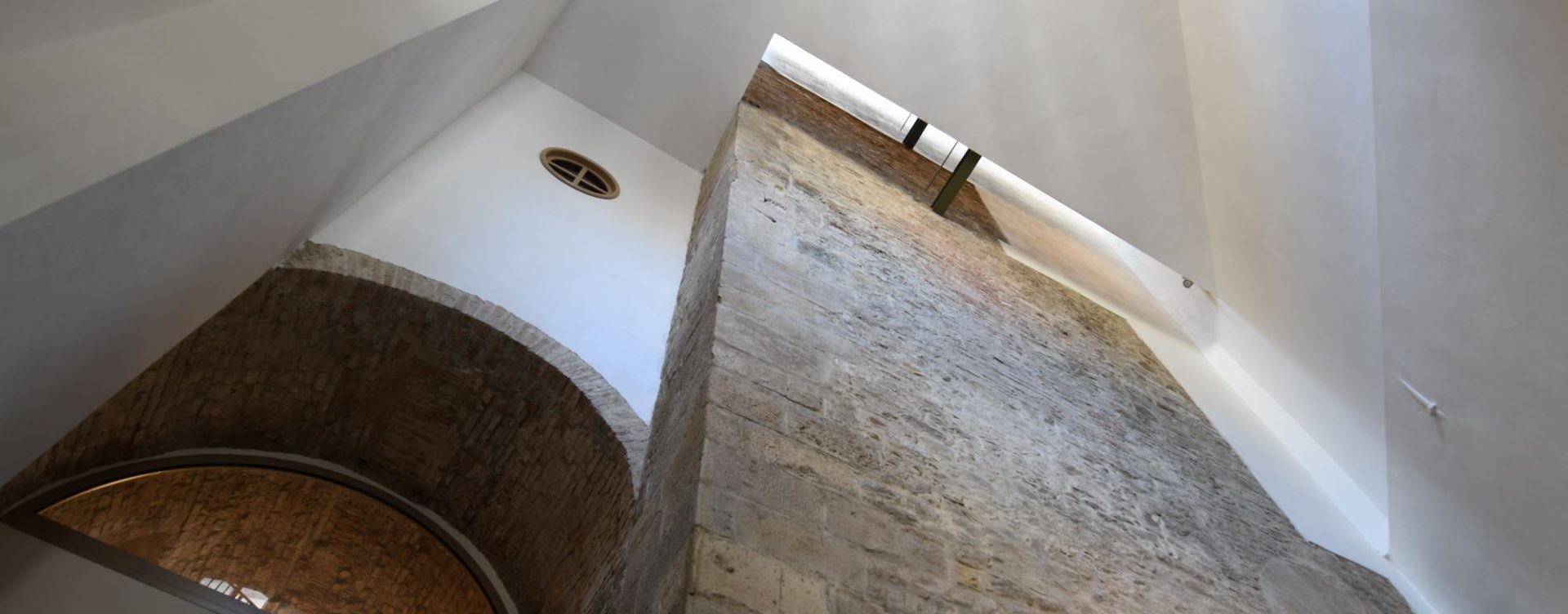
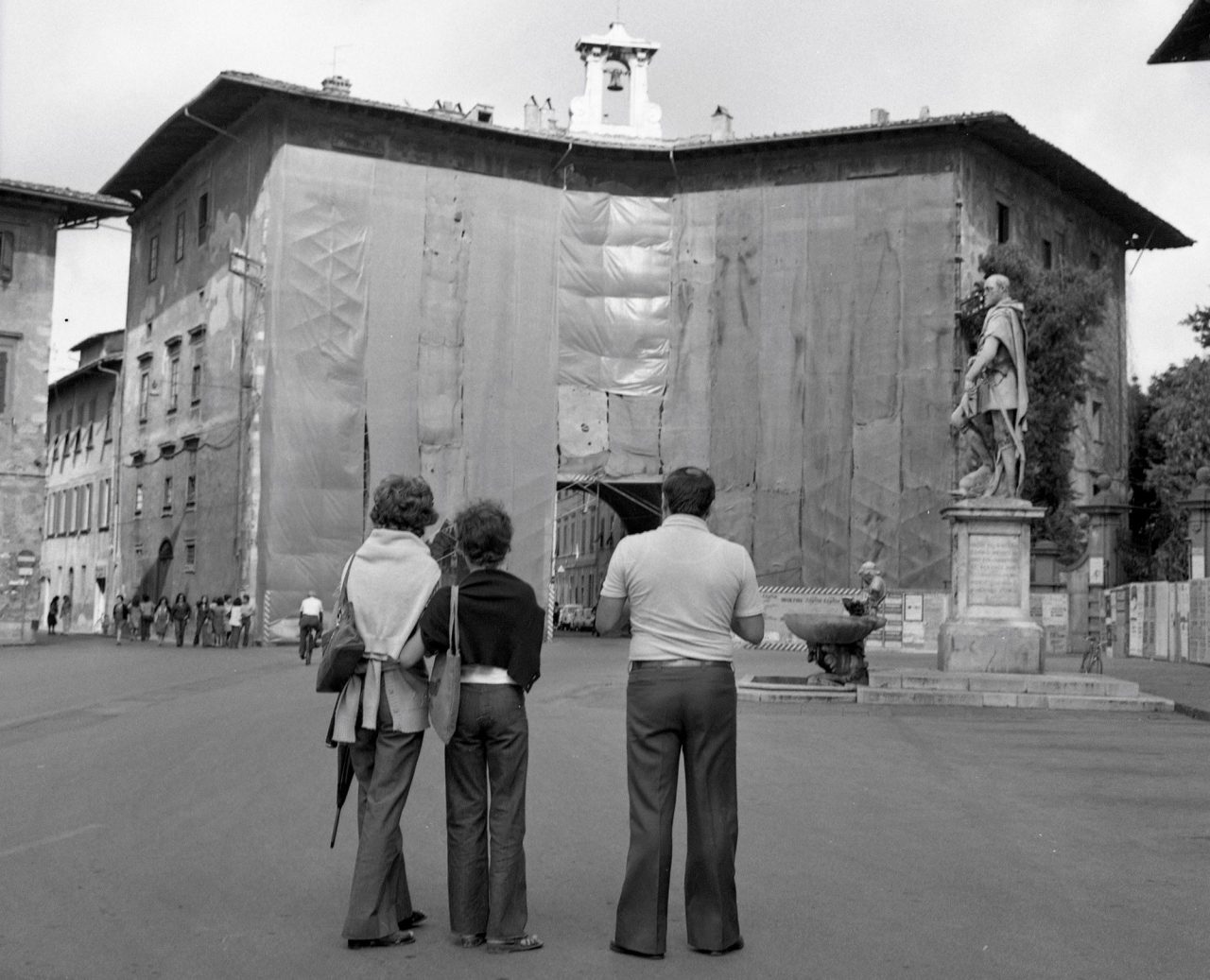
The present Palazzo dell’Orologio incorporates two medieval buildings within its structure. Each of the two lateral wings—separated by today’s Via Dalmazia and joined by a vault—stands on earlier constructions that once formed part of the system of government structures pertaining to the Popolo of the medieval Comune, overlooking the square known as Piazza del Popolo or Piazza degli Anziani.
On the right-hand side, to the north-east, these earlier structures take the form of a turris (tower): a square-plan building with few openings, rising to the height of the present fourth floor and datable to the 11th–12th century. Already known as the ‘Torre dei Gualandi’, the building became famous as the Tower of Famine after the imprisonment of Count Ugolino della Gherardesca there—an episode immortalised in Dante’s Commedia. Later concealed by the early seventeenth-century additions, it was never forgotten in literary tradition. Its remains re-emerged only around 1920, during the restoration work begun by its new owner, Count Alberto della Gherardesca. Major interventions carried out by the Scuola Normale Superiore between 1975 and 1980 then completed the uncovering, isolating the tower structure within the palazzo’s right wing, which can now be traced from the basement level upwards.
The the left-hand side, to the southwest, is recognized as having a ‘palatial’ character. According to Fabio Redi, this would coincide with the Palazzo del Capitano del Popolo – one of the most important comunal magistrates – attested to at least since the second quarter of the 14th century (around 1327). A very recent contribution by Mauro Ronzani suggests, however, that the current structure should be identified with another municipal building, erected in 1361 and used, after 1370, by the ‘executor of the custody of the Anziani, successor to the previous office of conservatore’ [‘esecutore della custodia degli Anziani, erede del precedente ufficio del conservatore’].
Later in date than the adjoining tower, it reflects the transition from the verticality of the fortified structure to the horizontality of the public palazzo, as shown by the presence of an entrance arch with a groove-and-dentil moulding, perhaps originally part of a ground-floor loggia. The façade in squared stone blocks is the only surviving element from this phase, as none of the medieval internal partitions have been preserved. Its oblique orientation was respected when the Order of Saint Stephen took possession of the site, although the arrangement of the openings was considerably altered: in 1919, the obliterated traces of two quadrifore ((four-light windows) were identified by Peleo Bacci on the piano nobile of the palazzo and served as the model for the stylistic reconstruction of one of them.
Palazzo dell’Orologio
Main EntryMedia gallery
Newsletter
Stay in Touch
Sign up for the Piazza dei Cavalieri newsletter
to receive updates on project progress and news.