
Original Structure
11th-early 12th century
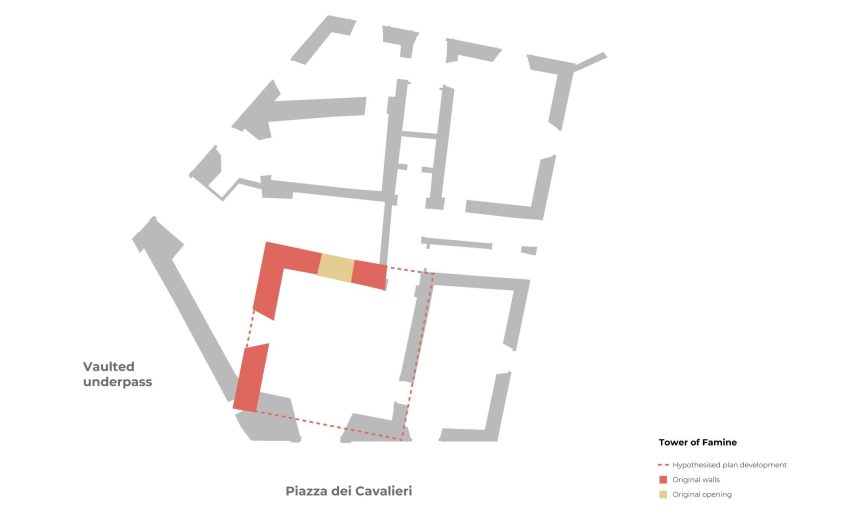
Graphic rendering by Zaki Srl, based on the scientific proposal by Giuseppe Tumbiolo
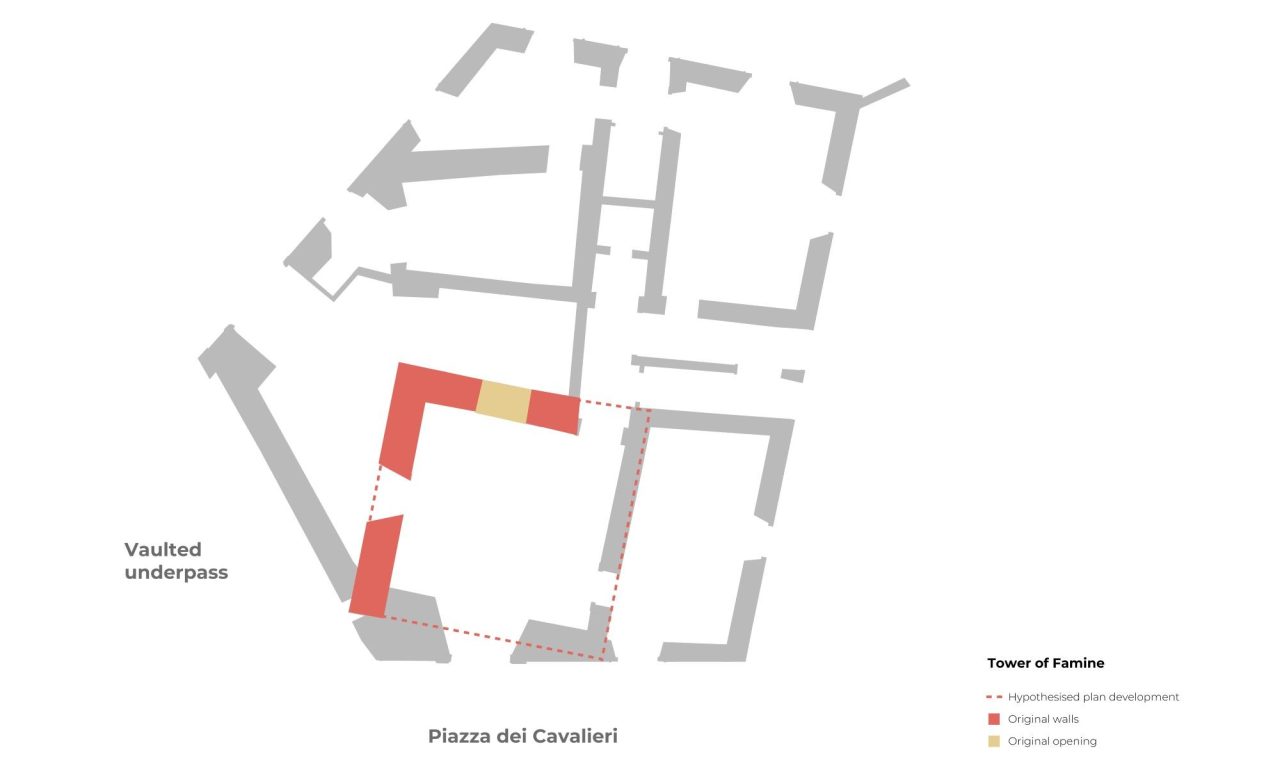
The earliest written record of the Tower of Famine is found in a document dated 27 March 1207, when it is referred to as ‘Turris Gualandorum’. The record not only confirms the existence of the building at that time but also identifies its owners: the Gualandi, one of Pisa’s most prominent families, who held several properties in the area during the thirteenth century. The tower occupied a highly prominent position at the end of one of the ‘sette vie’ converging on Piazza del Popolo—now Piazza dei Cavalieri—the political and administrative heart of the city. Immediately to its left stood Palazzo del Popolo o degli Anziani, one of several communal magistracy buildings in the vicinity, attested in written sources from the second half of the thirteenth century (1261/1273).
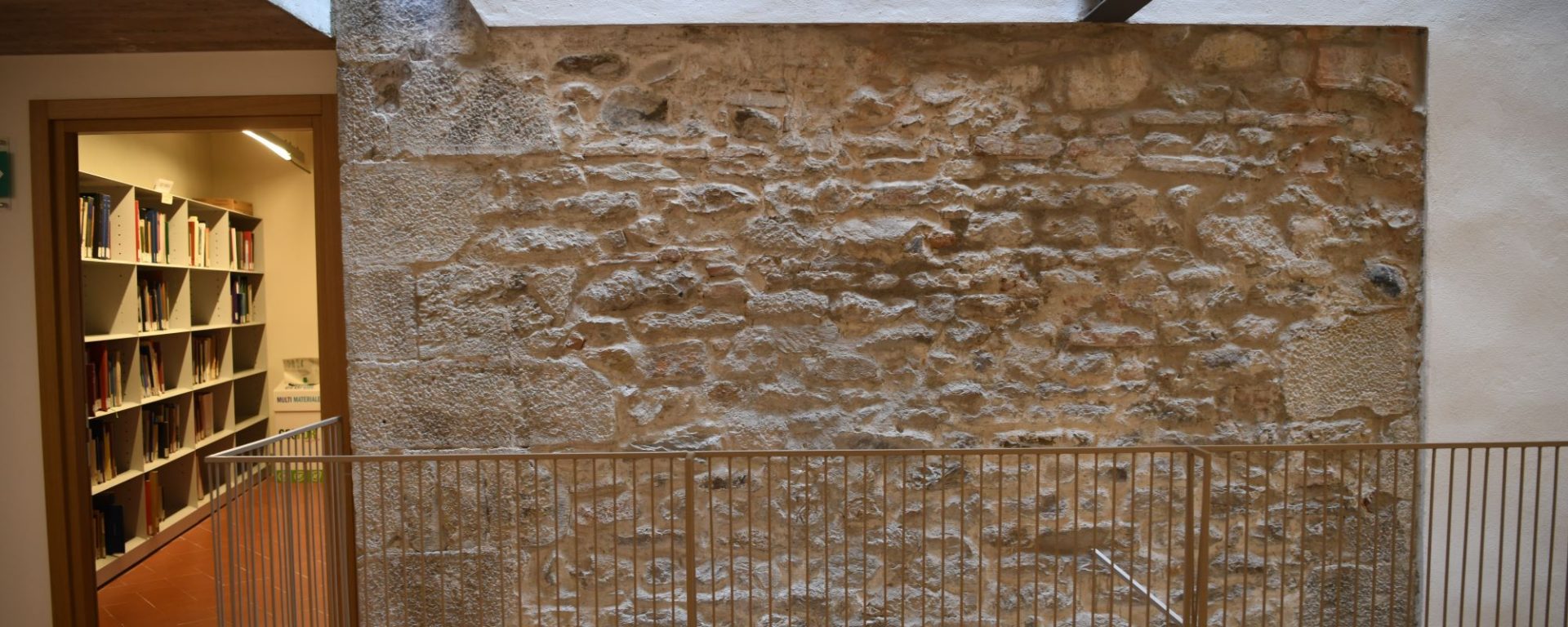
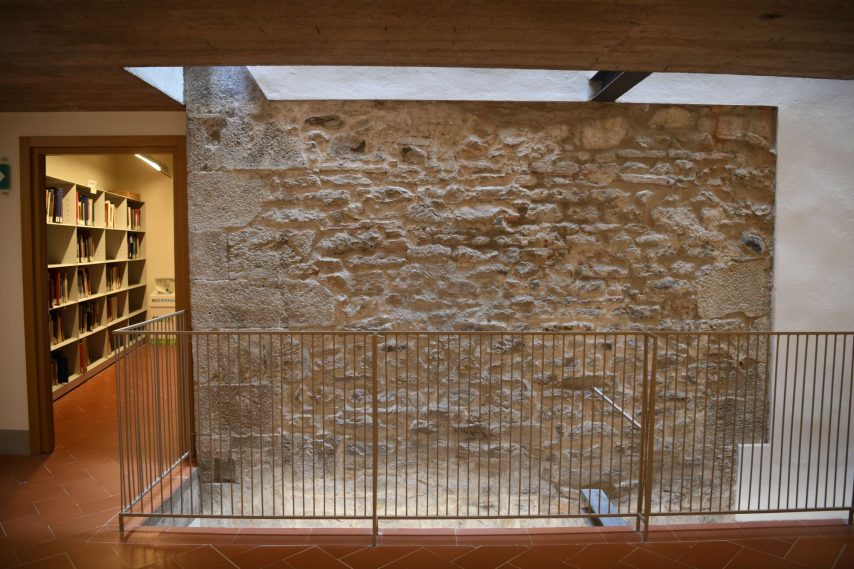
The Tower of Famine’s first appearance in written records does not coincide with its actual construction, which, as suggested by its structural characteristics and building materials, must have been earlier. Stratigraphic analysis of the masonry—revealed during restoration work in the 1970s and now incorporated into the right wing of Palazzo dell’Orologio—has made it possible to reconstruct the building’s history. Originally built entirely of stone, the structure survives today in substantial sections of its northern and western walls, both internal and external. The remaining sides, largely stripped during the early modern period, are no longer visible.
The Tower of Famine has a quadrangular plan, with sides measuring approximately 8 metres (14 Pisan braccia) and perimeter walls about 90 centimetres thick. Although not preserved in its entirety, the building initially rose to four storeys, reaching a height of around 21 metres (36 braccia), the maximum allowed under the lodo delle torri—the tower regulations issued by Bishop Daiberto between 1082 and 1092. Its structural features, including continuous walling and a quadrangular layout, together with the materials used, indicate a construction date in the eleventh century or, at the latest, the early twelfth.
The wall facings of the Tower of Famine were constructed using a single building technique, based on the use of stone blocks sourced from the south-eastern slopes of Monte Pisano—primarily quartzite, with more occasional use of limestone. The stones, ranging in size from small to medium, were only roughly worked, typically split rather than dressed, resulting in irregular surfaces. To compensate for this, large quantities of mortar were applied, producing thick and conspicuous joints. The masonry is arranged in broadly regular horizontal courses, obtained by selecting stones of similar size. In some areas, to ensure the continuity of the coursing, wedges or small superimposed fragments were inserted.
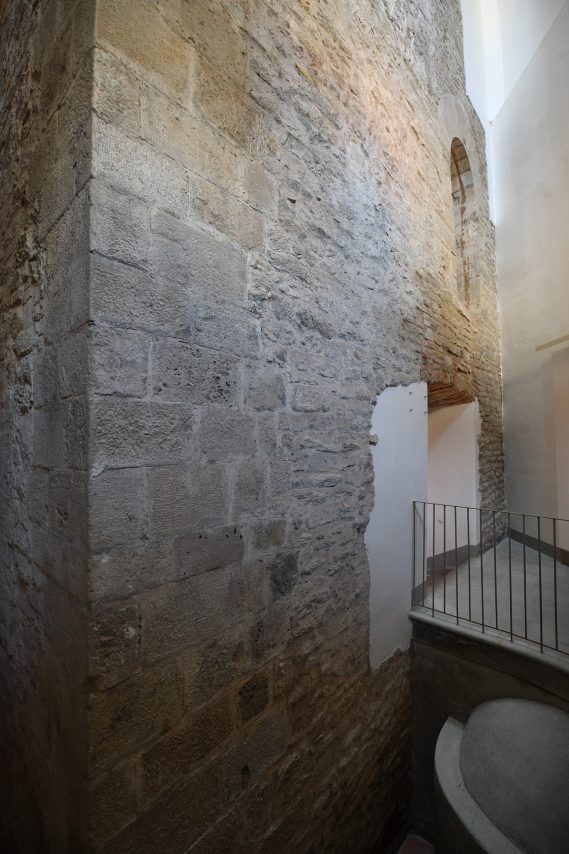
By contrast, the corners and openings of the Tower of Famine were constructed with greater precision, owing to structural requirements. The stone blocks were carefully squared, and their visible surfaces finely smoothed using pointed tools. These medium to large-sized blocks—known as ashlars—were set in place with exceptionally thin joints.
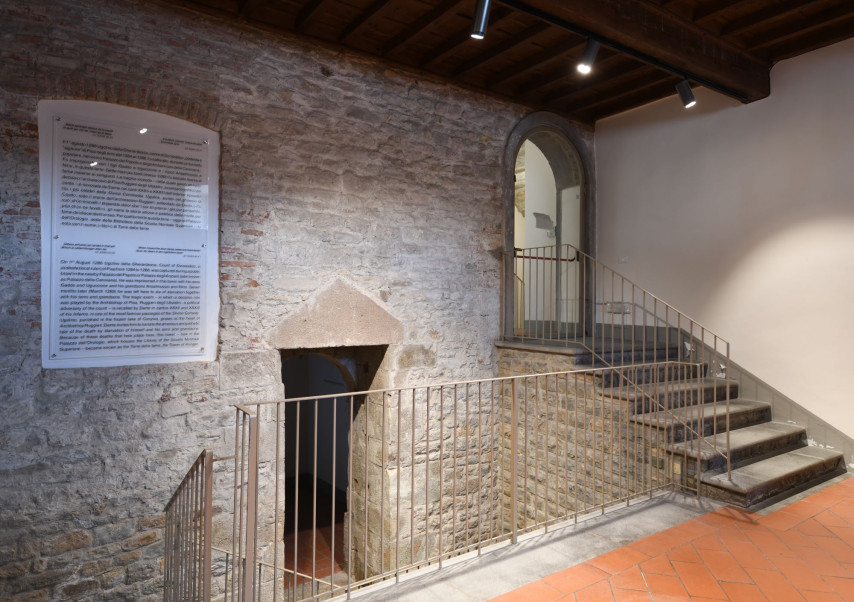
Three of the Tower of Famine’s original openings, located on the ground and first floors, remain visible today and share a consistent design: a round-headed arch on the exterior and a pentagonal lintel on the interior. Two further openings, on the second and third floors, are instead the result of later interventions. By comparison with similar structures, the upper-level openings most likely served as door-like windows providing access to wooden superstructures. However, no corbels or beam sockets are visible today, as they were probably shaved down or sealed.
Although no physical evidence remains of the Tower of Famine’s interior or roofing system, the floors and the staircases leading to the upper levels were likely made of wood, while the roof was constructed in stone, as the most widespread method in the city at the time employed stone slabs.
Palazzo dell’Orologio
Main EntryMedia gallery
Graphic rendering by Zaki Srl, based on the scientific proposal by Giuseppe Tumbiolo
Newsletter
Stay in Touch
Sign up for the Piazza dei Cavalieri newsletter
to receive updates on project progress and news.