
Fresco Decoration
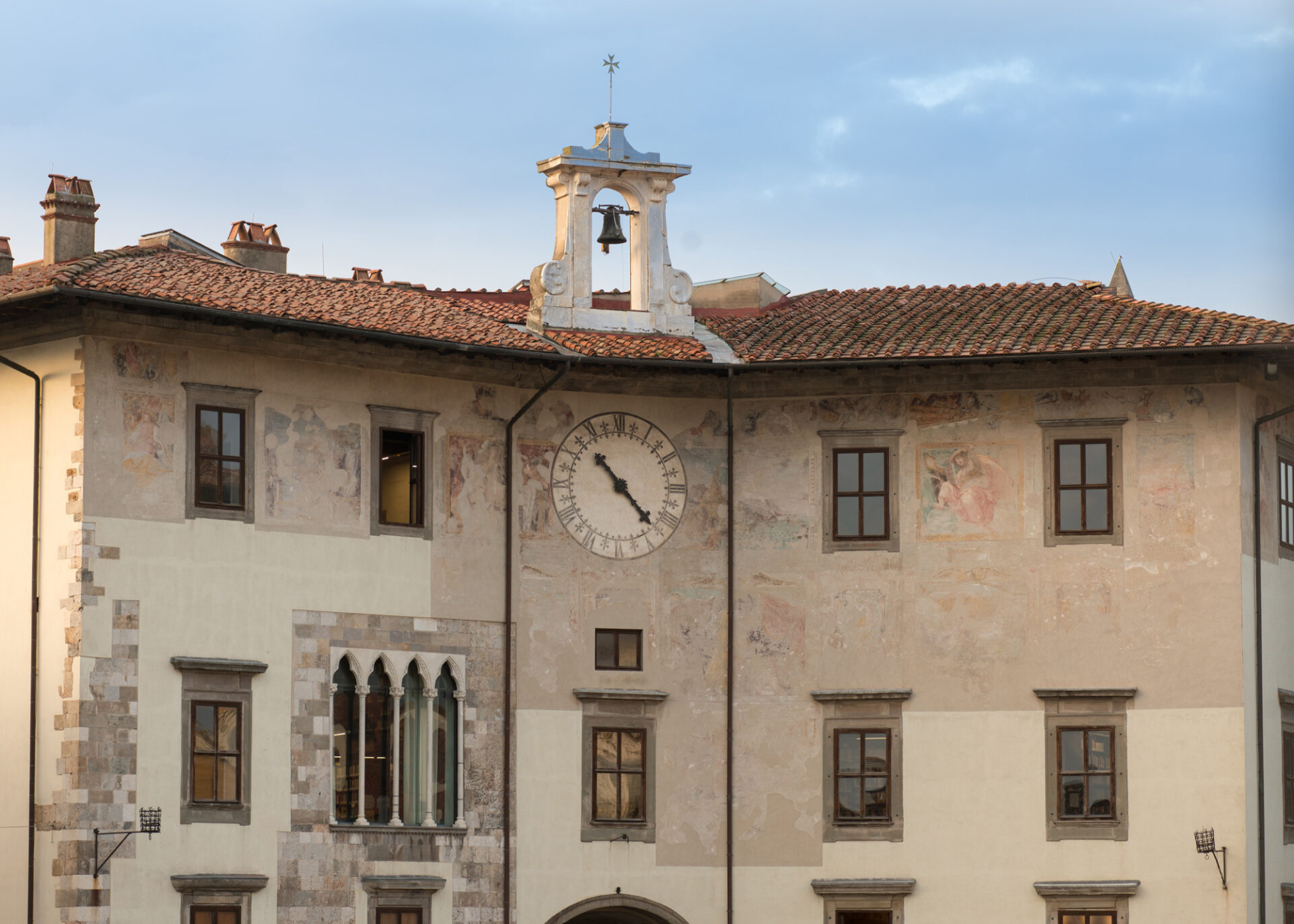
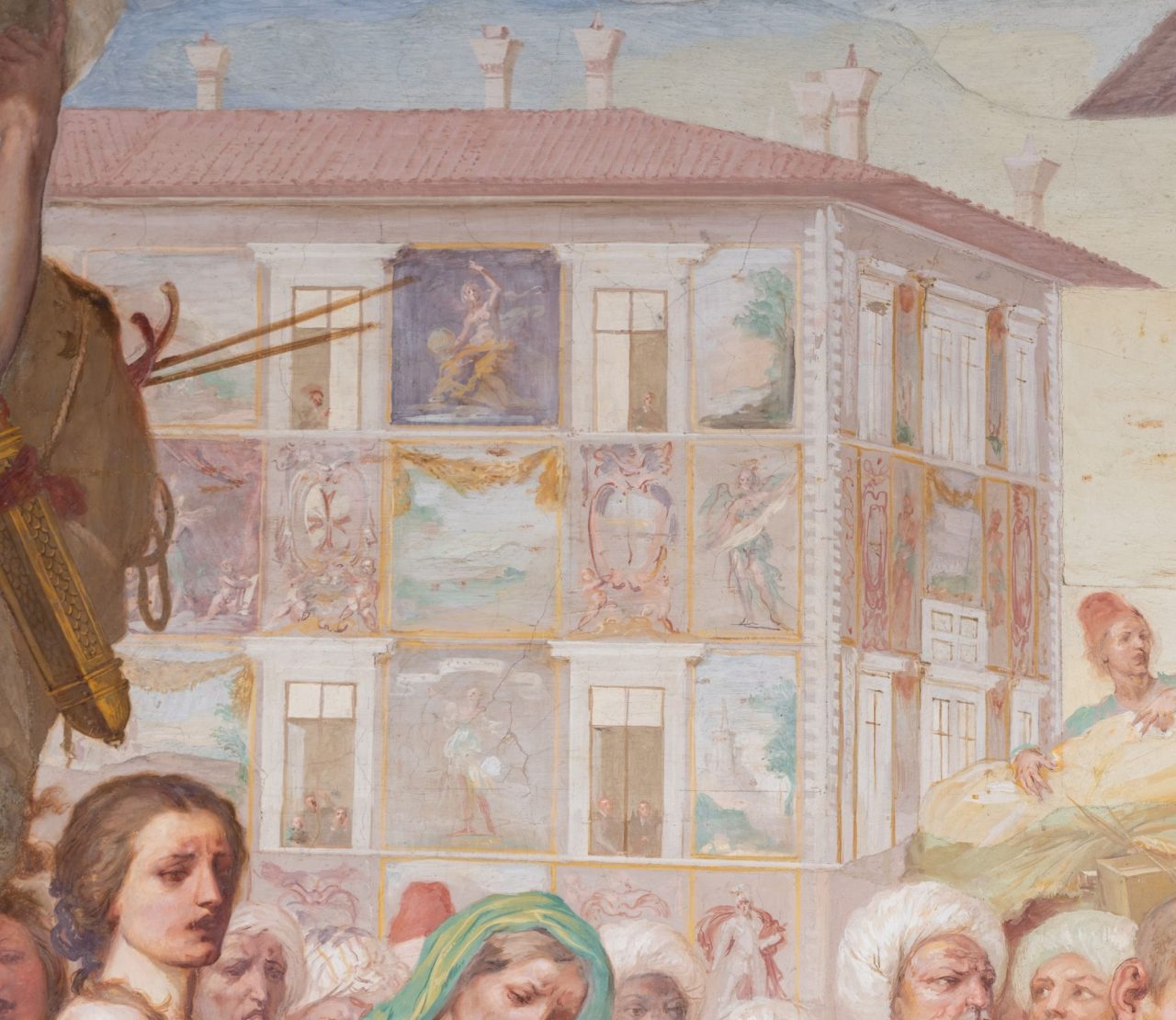
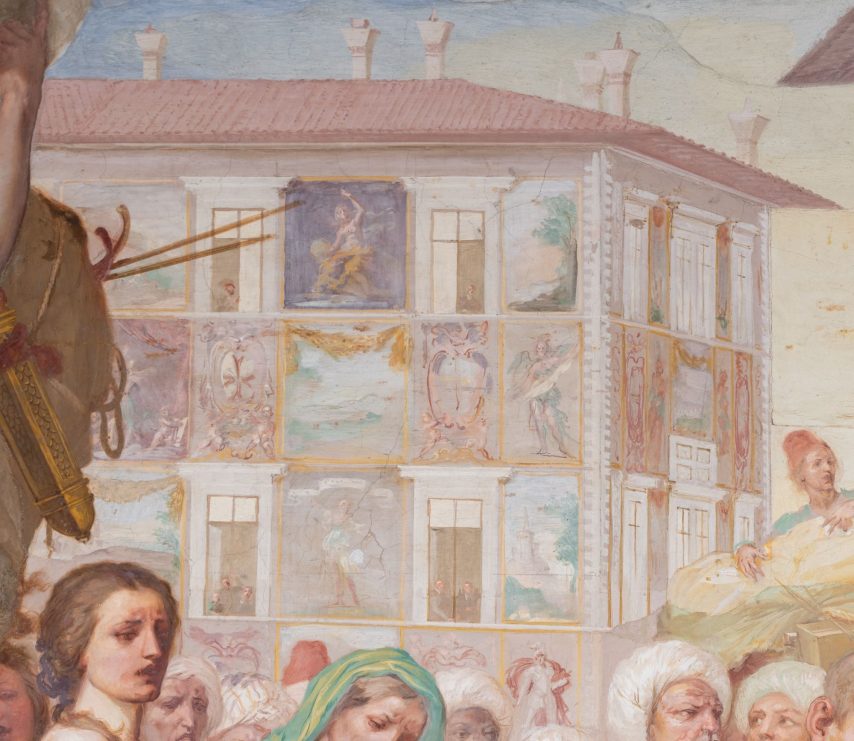
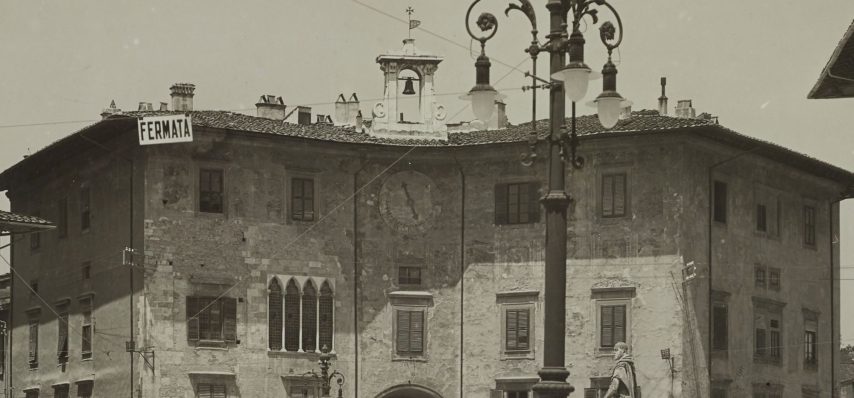
The fresco decoration on the façade of Palazzo dell’Orologio was carried out between 1607 and 1609, probably on a design by Ridolfo Sirigatti, then Conservator of the Property of the Order of Saint Stephen. In 1607, Sirigatti commissioned the woodcarver Bartolomeo Atticciati to produce the ‘modello della pittura’ (‘model of the painting’) for the palazzo, intended to serve as a guide for the fresco painters. According to Filippo Baldinucci, the iconographic programme included ‘symbolic figures of Virtues or of the Liberal and Mechanical Arts, with various landscapes and perspectives’ [‘simboliche figure di Virtù o d’Arti Liberali e Meccaniche, con diversi paesi e prospettive’]. This account can be contextualised by reference to a fresco by Baldassarre Franceschini, known as Il Volterrano, in Villa della Petraia (Castello, Florence), painted between 1636 and 1646 to commemorate the event that took place in Piazza dei Cavalieri in 1609, when Grand Duke Cosimo II de’ Medici presided over the celebrations in Pisa for the victors of the Battle of Bona. In the background of the fresco appears a depiction of Palazzo dell’Orologio’s decoration, most of which was lost within the following century and a half. The decorative scheme of the main façade, arranged in four horizontal registers with allegorical figures alternating with landscapes and Medicean-Stephanian coats of arms, can be appreciated even more clearly in the engraving made by Georg Martin Preisler from Volterrano’s painting in the mid-eighteenth century.
As can be partly discerned from these surviving visual records, the scheme must originally have been repeated on the lateral façades. A geometric grid arranges Medicean-Stephanian coats of arms, war trophies, and landscapes along the long sides of the vault’s intrados, while the short sides and the central field feature allegorical figures framed by architectural motifs and grotesques.
The decoration was long attributed to Bernardino Poccetti and Giovanni Stefano Maruscelli, with the latter explicitly mentioned by Filippo Baldinucci. It is, however, likely that Poccetti was associated with the work because of his well-known activity as a fresco painter of façades and his particular mastery of the grotesque genre. Only from 1821 did Alessandro Da Morrona add the name of Filippo Paladini to that of Maruscelli; later, mention also emerged of Paladini’s son, Lorenzo—probably on the basis of documents identified but not cited.
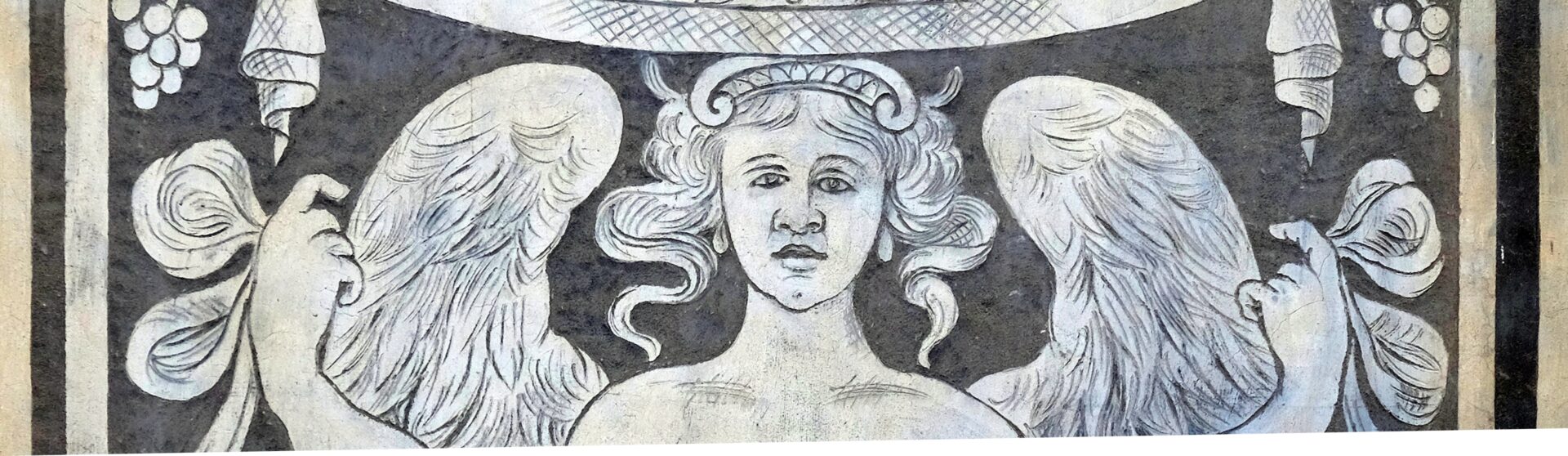
Thanks to the discovery by Augusto Bellini Pietri of the payments made to the painters, it has been possible to reconstruct the chronological sequence of the work: Filippo was the first to be engaged, and upon his death in 1608 his son Lorenzo—active for only two weeks—collaborated with Giovanni Stefano Maruscelli, who is credited with the vault of the Arco dei Gualandi. The documents also reveal the extent of the work, measured in braccia (a linear unit corresponding to almost 60 centimetres): on the three main façades, 1,106 braccia were executed by Filippo, 414 by Lorenzo in collaboration with Maruscelli, and a further 282 by Maruscelli alone; on the vault, Maruscelli executed 428¾ braccia of fresco. In 1979, Dino Frosini discovered an account of the work carried out by the mason Paolo Antonio da Lucca, who had collaborated with both Filippo Paladini and Maruscelli. The sheet he dictated lists the allegorical figures painted by each artist during the period of his activity at the palazzo, and also provides brief—though not always clear—indications of their placement. Alongside several landscapes, in which he was particularly skilled, Paladini executed Glory, Intelligence, and Peace, while Maruscelli—also responsible for several landscape scenes—painted Abundance, Earth, and two Angels.
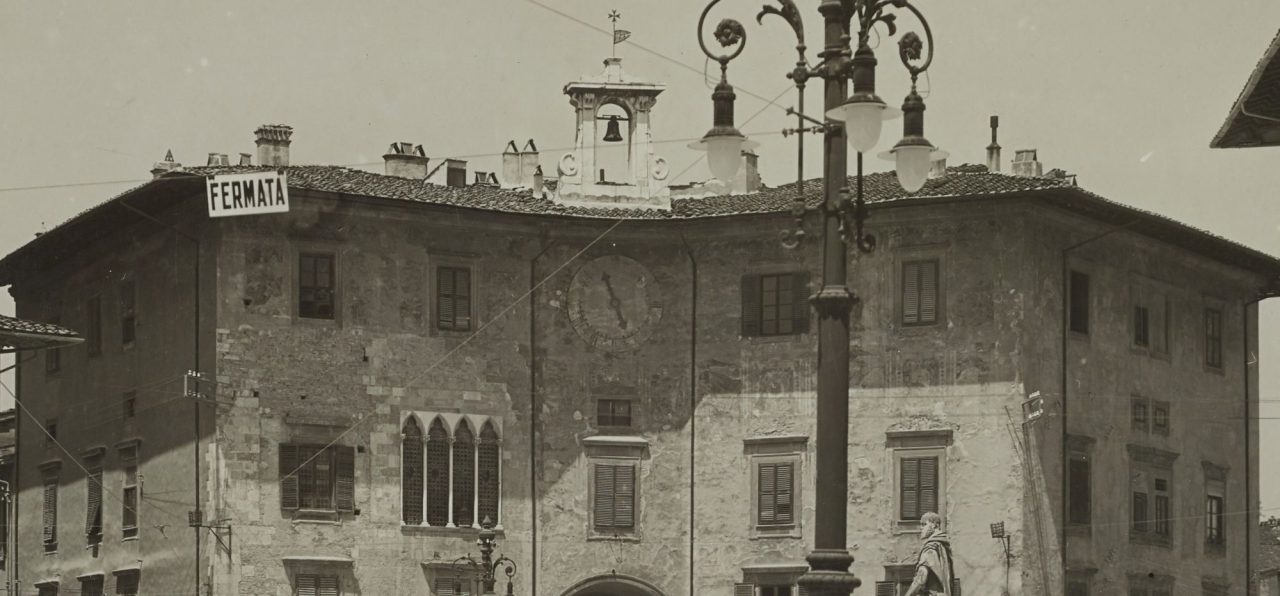
The condition of the frescoes—lamented by critics since the early twentieth century and documented in photographs of the period—prevents a clear identification of all the figures, despite the detachment, restoration, and reinstallation undertaken between the mid-1970s and mid-1990s, during which a lower fragment depicting a male figure was also rediscovered and is now housed in Palazzo della Carovana. During these operations, several allegories and fragments of the decorative band—with festoons, trophies, masks, and coats of arms—that framed the main panels and had been entirely omitted from Volterrano’s visual record were restored to public view.
A recent study by Lucia Tongiorgi Tomasi has clarified the iconography of several allegories through comparison with Cesare Ripa’s famous Iconografia while also offering several attributional hypotheses. In general, the iconographic programme, presumably devised by Sirigatti, while drawing on the traditional sixteenth- and seventeenth-century repertoire, aims to exalt the beneficial effects of Medicean rule and, at the same time, through the use of war trophies and coats of arms, the action of the Order of Santo Stefano. While in the trophies Tongiorgi Tomasi discerned affinities with the reliefs on the inner panels of the bronze doors of Pisa Cathedral, executed in the same years, the façade decoration also reveals echoes of the rich sixteenth-century figurations of Vasari’s workshop at Palazzo Vecchio, confirming the lasting impact of that enterprise on artists engaged, even decades later, in other grand-ducal projects. As noted by Franco Paliaga, the style of the vault figurations is instead indebted to that of Andrea Boscoli, who was Maruscelli’s master.
Palazzo dell’Orologio
Main EntryMedia gallery
Newsletter
Stay in Touch
Sign up for the Piazza dei Cavalieri newsletter
to receive updates on project progress and news.