

The Coats of Arms of the Knights
Palazzo della Carovana preserves 451 coats of arms belonging to knights of the Order of Saint Stephen. These form the oldest surviving group of blazons from the series, dating from 1562 to 1604, except for the arms of the Pisan Cesare Bertacchi, who became a knight in 1679. Approximately 1,500 coats of arms from the series still exist, most of which are stored at the Museo Nazionale del Palazzo Reale (Pisa). Others are preserved elsewhere, including fourteen—among them that of Cosimo I de’ Medici currently on display in the antechamber of the Sala dell’Udienza in Palazzo dei Dodici.
The heraldic collection began to take shape with the founding of the Order in 1562, following a rule that required candidates to provide proof of their noble title and pay a sum into the treasury of the Order to fund the production of the family emblem. This was combined with the red bifurcated cross of Saint Stephen, placed in a horizontal band across the top of the shield. The Provanze di nobiltà—the documents through which aspiring members demonstrated the four quarters of nobility required to enter the Order—are still preserved in the Archivio di Stato di Pisa.
The families of the Knights whose coats of arms are preserved in Palazzo della Carovana predominantly came from Medici territories or cities and towns with strong ties of alliance to the Grand Duchy of Tuscany. The largest group—around 20%—consists of Florentine knights. These are followed by the major cities of the Grand Duchy, with Siena standing out (8%), along with Pisa, Arezzo, and Pistoia (each around 4%). Among other cities on the Italian peninsula, Bologna accounts for 4%, Milan 3%, and Perugia and Rome 2% each. Many knights were also of Spanish origin (6%). The remainder came from other Italian cities and, to a lesser extent, from abroad.

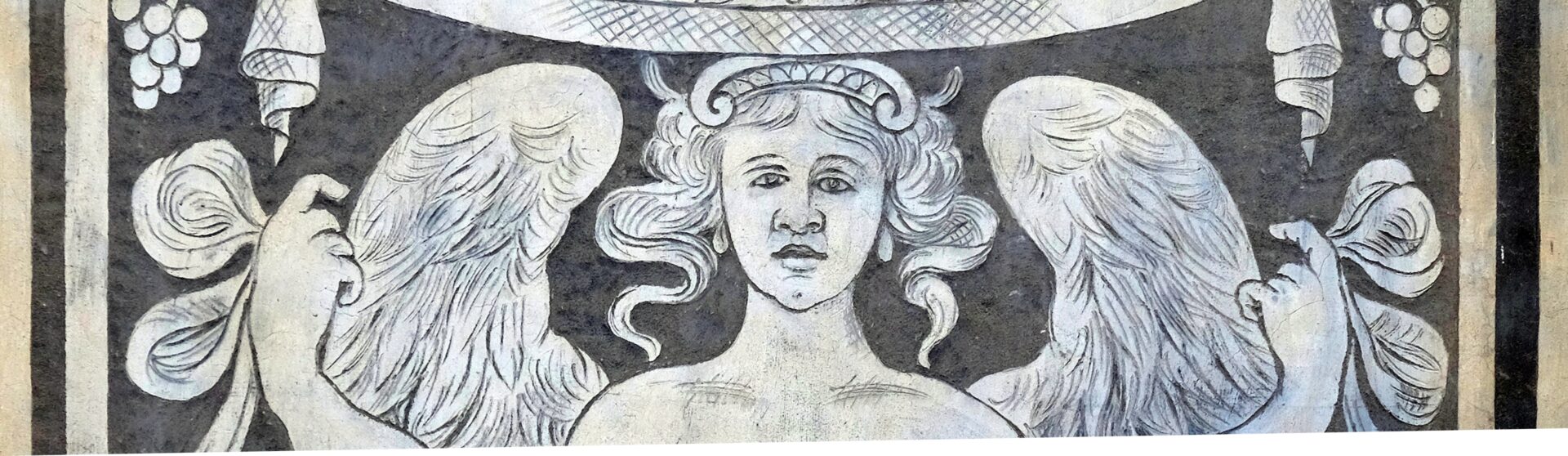
The coats of arms are found in various areas within Palazzo della Carovana, always set above a projecting masonry cornice: in the Sala Azzurra, in several corridors on the second and third floors, along the staircase connecting the two levels, and in the Sala degli Stemmi. Originally known as the ‘sala grande’ or ‘sala delle Armi’—a reference to heraldic arms (arma in Latin)—the room renovated by Giorgio Vasari and now called the Sala Azzurra was immediately designated as the site for displaying the Knights’ coats of arms. This is confirmed by a resolution of the Order dated 26 January 1564, ‘that the arms of all Knights be made to be placed in the great hall, and that the Treasury pay for the work, keeping account and making each Knight indebted for his own’ [‘che si faccia far l’armi di tutti i Cavalieri da metter nella sala grande, e che il Tesoro paghi le fatture mettendo a conto e facendone debitare ciascun Cavaliere delle sue’], as well as by the dating of the 116 blazons preserved here, which range from 1562 to 1564. In the following decades, as the number of Knights grew, the corridors and staircase were used for display between 1566 and 1594, and the present-day Sala degli Stemmi between 1594 and 1604. In other words, this is a coherent heraldic cycle still visible in its original context.
Among the most prominent figures whose coats of arms are preserved in Palazzo della Carovana is Cassiano dal Pozzo, knighted in 1599, nephew of Carlo Antonio dal Pozzo and patron of the Museum Chartaceum. Among the blazons in the Sala Azzurra, one of the oldest is that of Giulio de’ Medici, illegitimate son of Alessandro, the first Duke of Florence.
The compositional model for the Order’s coats of arms appears to derive from Stoldo Lorenzi da Settignano. The sculptor is thought to have created a Medici blazon in 1564, at the beginning of the series, which has been identified as the arms of Duke Cosimo now housed in Palazzo dei Dodici. He was likely also paid to carve around fifty additional coats of arms. Each has an oval shape framed by a stylised cartouche, with two curled volutes at the top. Below the oval is a panel with an inscription arranged on three lines, inscribed across three lines: the first with the name and surname, the second with the city of origin, and the third with the year he was knighted in the Order of Saint Stephen. All the coats of arms are carved in stone and decorated using a mixed technique: Lead white in oil paint for the background of the shield, tempera grassa for the surface decoration, and shell gold for the finishing details. Their design remained essentially unchanged over the centuries, with the only noticeable difference between sixteenth- and seventeenth-century examples being a slight reduction in the size of the oval field.
All the coats of arms in Palazzo della Carovana were restored in 2012, carried out under the direction of the Technical Services Area of the Scuola Normale Superiore, with financial support from the Fondazione Pisa. The project was also accompanied by new studies of the collection and the creation of a dedicated database.

Palazzo della Carovana
Main Entry- Preesistenze medievali
- Fasi costruttive
- Functions
- Façade
- Interior
- Varisco, Quadri comunicanti – Jarred
- Aula Bianchi
- La collezione dei calchi epigrafici
- Le opere del Centro Pecci
- Sala della Mensa
- The Coats of Arms of the Knights
- Sala Azzurra
- Sala del Ballatoio
- Sale della Direzione
- Scalone
- Gastini, «… e finire è cominciare»
- Maruscelli (attr.), Figura virile
- Sala degli Stemmi
- Sala della Colonna
- Cortile
Media gallery


Newsletter
Stay in Touch
Sign up for the Piazza dei Cavalieri newsletter
to receive updates on project progress and news.