
Interior
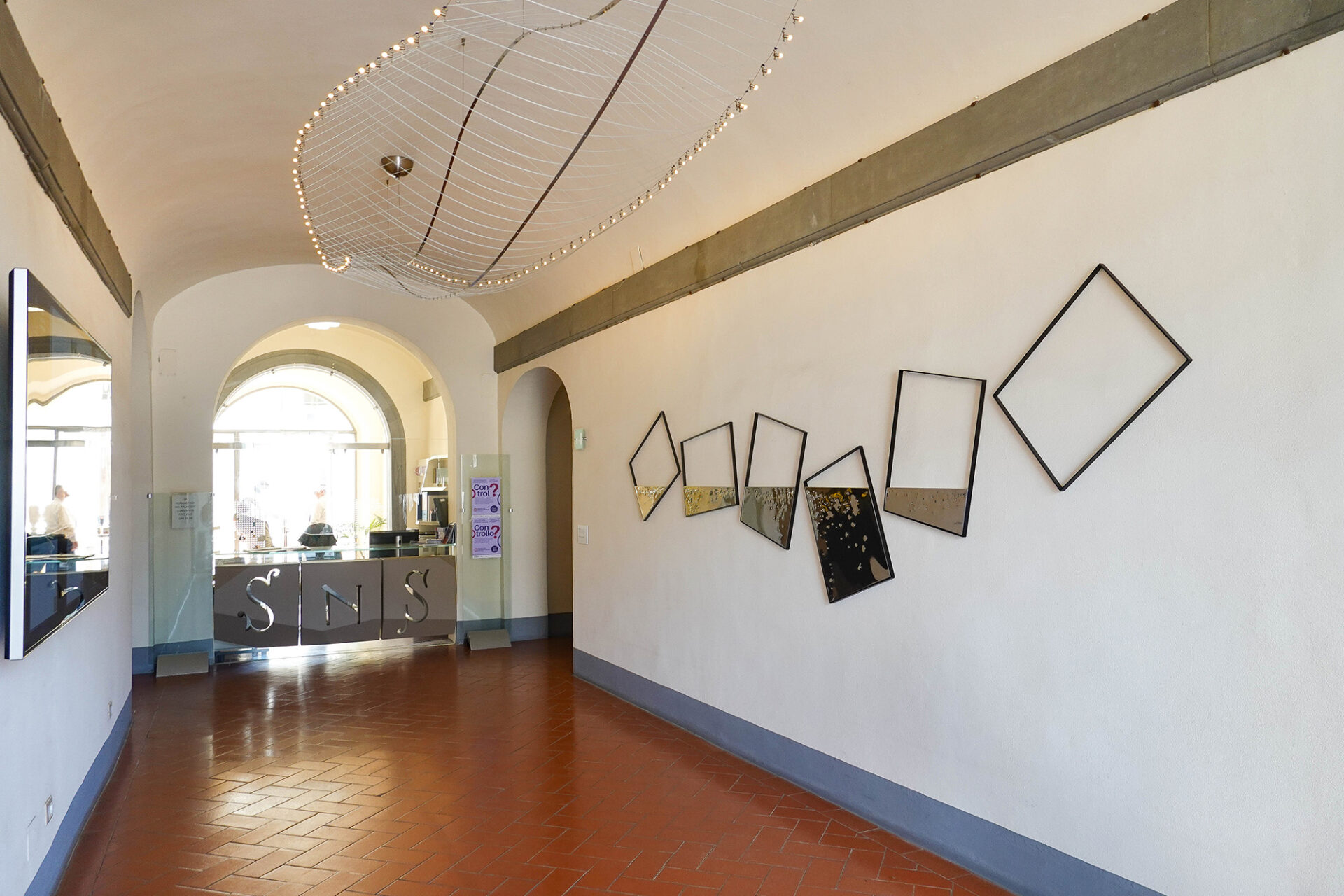
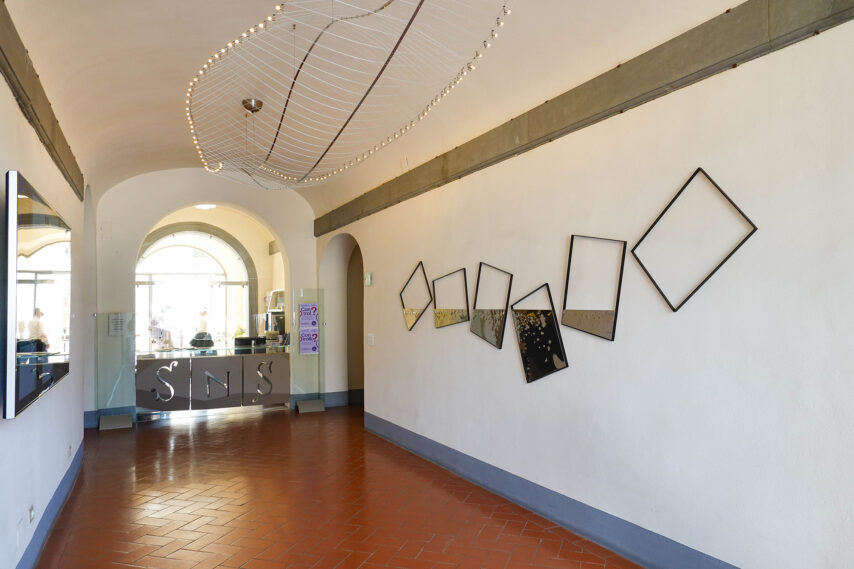
Access to Palazzo della Carovana, the main seat of the Scuola Normale Superiore, is via the double-flight staircase on the façade. This leads to the first floor of the building, where the porter’s lodge is located, within an entrance hall displaying Quadri comunicanti – Jarred by Grazia Varisco.
On this floor are the offices of the professors of the Class of Letters and Humanities. These overlook either Piazza dei Cavalieri or the internal courtyard and are accessed from a corridor housing a permanent display of epigraphic casts. The collection continues along the adjoining southern corridor (towards the Santo Stefano dei Cavalieri), where the recently established Aula Barocchi is located. From this corridor one enters the east wing of the palazzo, which contains several of the principal teaching rooms: Aula Tonelli, Aula Contini, Aula Mancini, and Aula Russo. Before reaching the porter’s lodge, a sequence of rooms preserving evidence of the building’s original medieval structure provides access to the Aula Bianchi. This space is usually divided by a movable partition into Aula Bianchi Lettere and Aula Bianchi Scienze. The latter contains a fragment of a fifteenth-century fresco depicting Truth by Álvaro Pirez de Évora. Traces of masonry associated with the so-called Palazzo degli Anziani remain visible in both sections. Adjacent to Aula Bianchi Scienze is the Aula Pasquali. In the facing corridor, which leads to the double-flight staircase overlooking the courtyard, works from the Collezione Pecci are displayed on a temporary basis. Further works from the same collection are also exhibited in corridors and various rooms on the second and third floors. The so-called Sala della Mensa, located on this level in the north wing, is accessible only from the Library of the Normale, whose entrance is in Palazzo dell’Orologio.
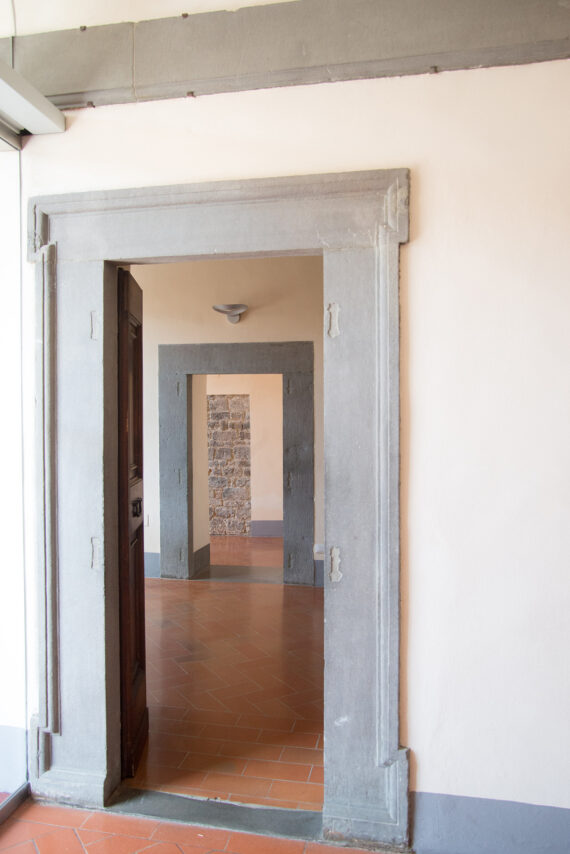

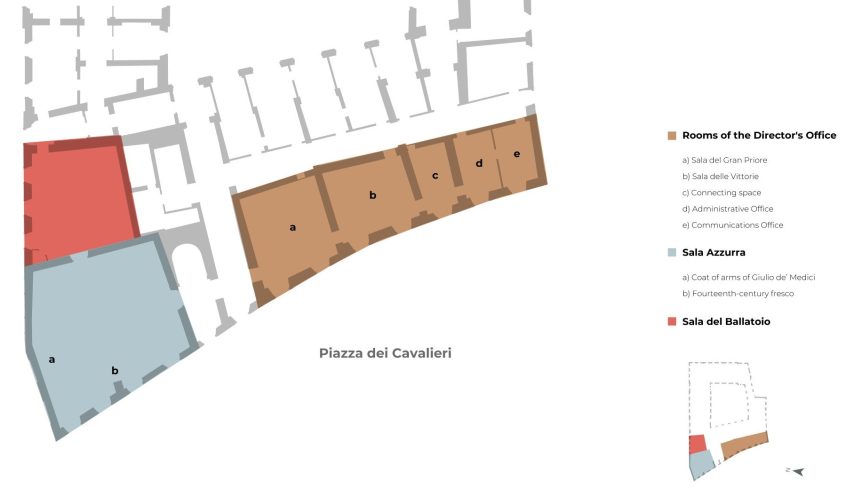
A Vasari-designed staircase, with a single flight and a moulded handrail in Golfolina stone, leads up to the second floor. To the right lies the Sala Azzurra, one of the building’s principal state rooms. Inside, beneath the finely crafted coffered ceiling, a rich sequence of coats of arms of the knights of the Order of Saint Stephen stands out, together with a detached fourteenth-century fresco, complete with its sinopia, originating from the palazzo. Stephanian coats of arms are also found in the corridors and in other rooms on the second and third floors. From the Sala Azzurra—whose shelving houses the Salviati archive—it is possible to enter the Sala del Ballatoio. This space now forms part of the Normale’s Archive Centre, located on this level and extending into several rooms of the north wing, where the institution’s historical archive is preserved among other holdings. To the left of the staircase opens the Sala del Gran Priore, one of the most prestigious rooms of the so-called Sale della Direzione. These run along the west wing of the Carovana, overlooking Piazza dei Cavalieri—the oldest part of the building renovated in the second half of the sixteenth century. The remaining twentieth-century wings on this level are occupied by administrative offices.
Graphic rendering by Zaki Srl
Graphic rendering by Zaki Srl
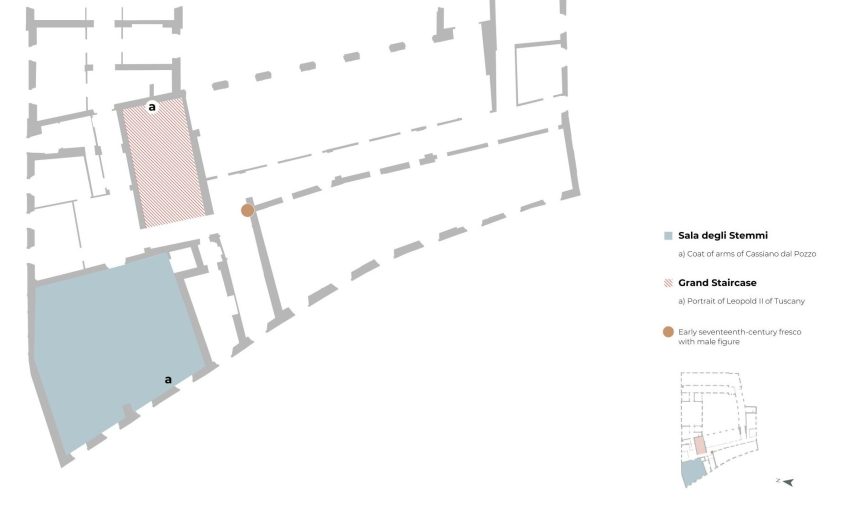
A broad nineteenth-century staircase, surmounted by a twentieth-century skylight bearing the cross of the Order of Santo Stefano and decorated with coats of arms of the Knights, a portrait of Grand Duke Leopold II of Tuscany, and works temporarily displayed from the Collezione Pecci, leads to the third floor. Here is the Sala degli Stemmi, enriched by sixteenth-century paintings from the circle of Giorgio Vasari, by Giovambattista Naldini, and by Tosini (a Saint Catherine and a Holy Family), as well as by two early seventeenth-century monochrome canvasses by Benedetto Veli. Before entering the corridor within the Vasari-designed block—which at this level houses the offices of the professors of the Class of Sciences, overlooking both the piazza and the internal courtyard—there is a detached fresco from the original decoration of Palazzo dell’Orologio. On this floor, as on the level above (the fourth), which extends only across the three twentieth-century wings of the palazzo (north, east, and south), there are additional offices for teaching staff and researchers, teaching rooms, and administrative offices.
Part of the ground floor of the building—the Vasari-designed block and the north wing, where the Sala della Colonna (beneath the Aula Bianchi) is located—is accessed via an underground passage from Palazzo dell’Orologio. This area currently houses some of the institution’s library collections, which also extend into rooms on the first floor of the same north wing overlooking the courtyard, including the Sala della Mensa. The east and south wings, which contain teaching rooms and an enclosed loggia, are instead reached from within the palazzo, thanks to the building’s vertical circulation (also provided by service staircases), as well as via the access linking the courtyard to the garden, where the modern Palazzo D’Ancona is located, which now serves as the Normale’s refectory.
Palazzo della Carovana
Main Entry- Preesistenze medievali
- Fasi costruttive
- Functions
- Façade
- Interior
- Varisco, Quadri comunicanti – Jarred
- Aula Bianchi
- La collezione dei calchi epigrafici
- Le opere del Centro Pecci
- Sala della Mensa
- The Coats of Arms of the Knights
- Sala Azzurra
- Sala del Ballatoio
- Sale della Direzione
- Scalone
- Gastini, «… e finire è cominciare»
- Maruscelli (attr.), Figura virile
- Sala degli Stemmi
- Sala della Colonna
- Cortile
Media gallery
Graphic rendering by Zaki Srl
Graphic rendering by Zaki Srl
Newsletter
Stay in Touch
Sign up for the Piazza dei Cavalieri newsletter
to receive updates on project progress and news.