
Ridolfo Sirigatti
Cosimo I de' Medici
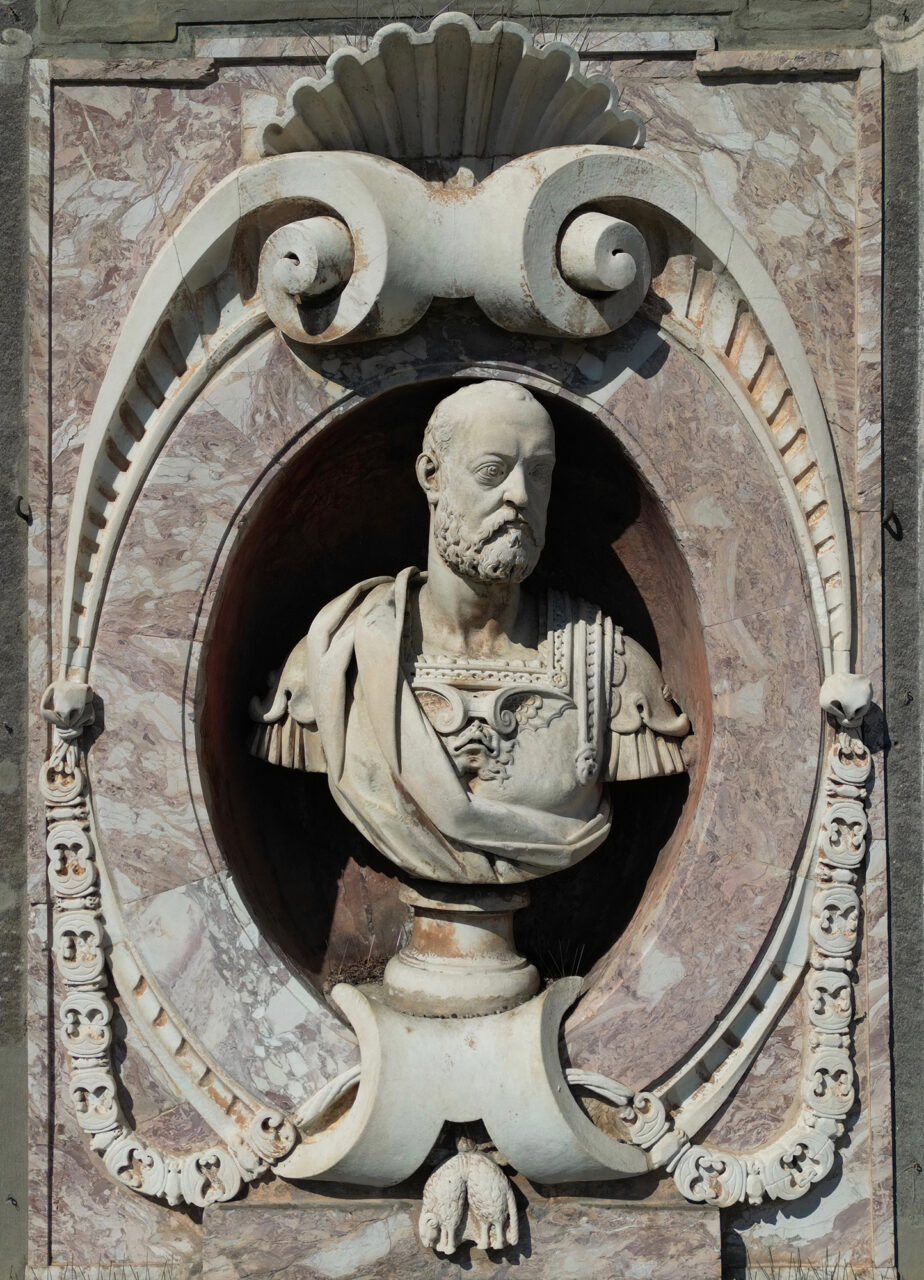
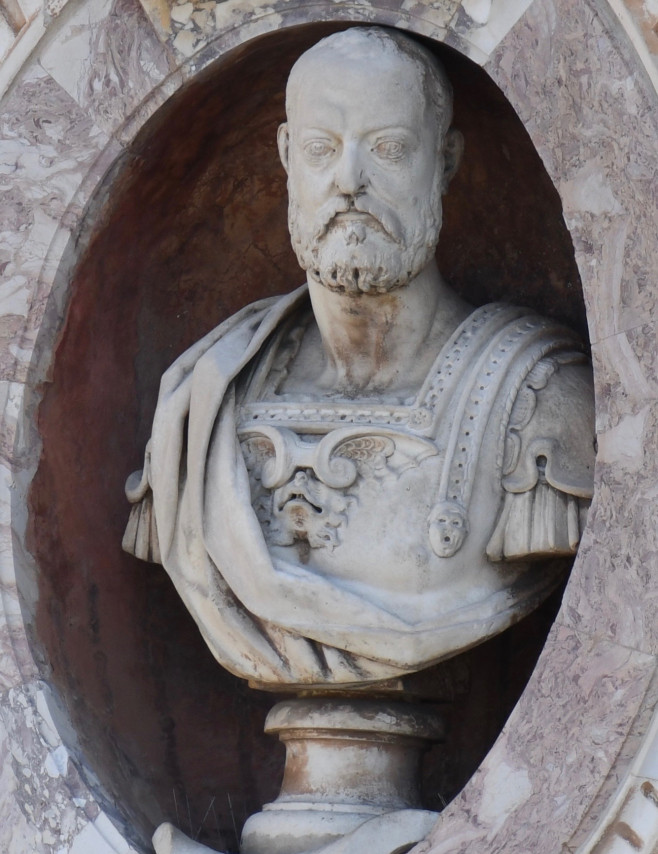
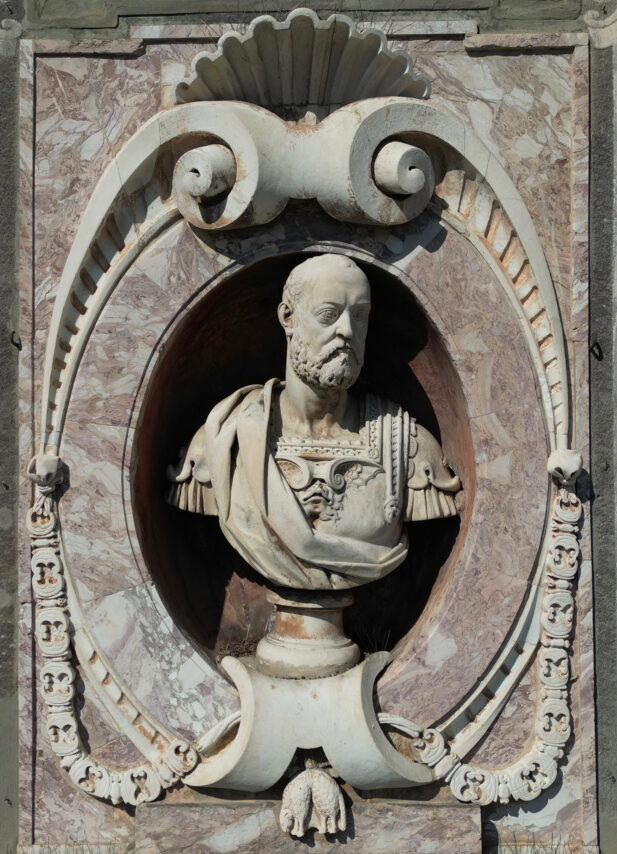
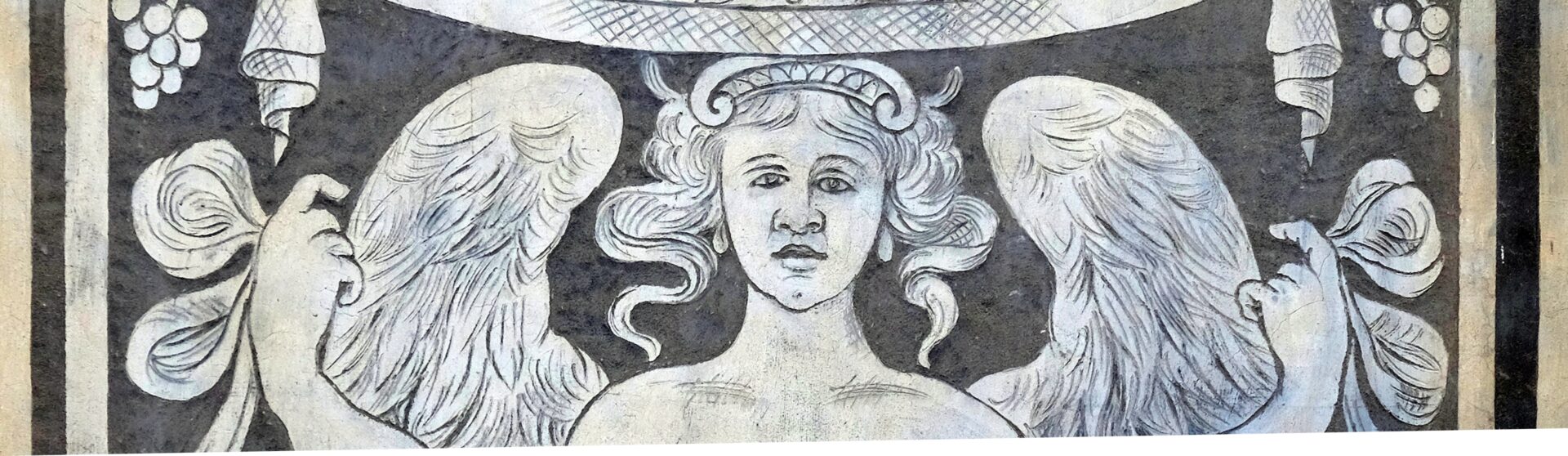
Cosimo I de’ Medici is depicted in military attire, wearing a cuirass and a cloak that falls from his right shoulder across his chest. At its centre is a winged mask, possibly representing a bat.
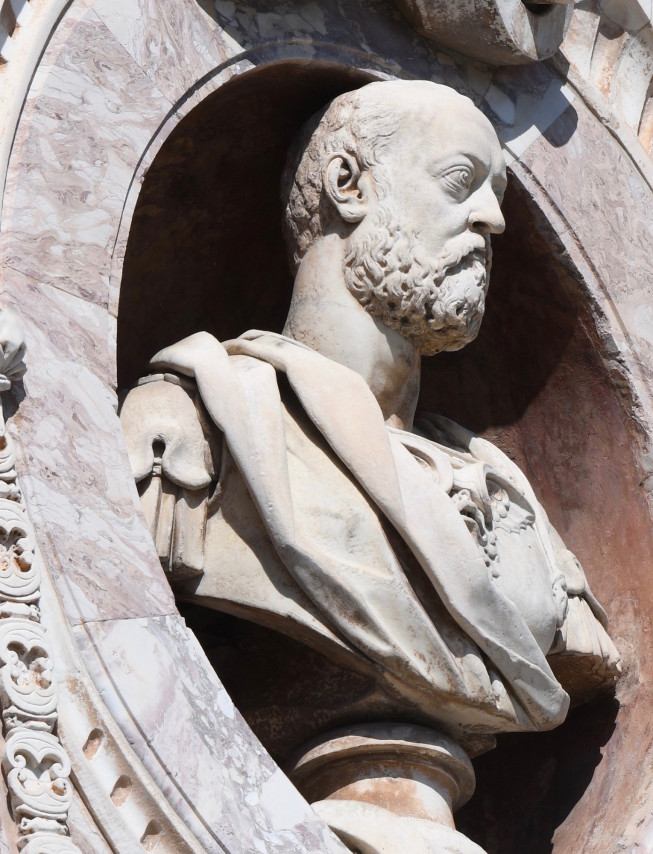
The portrait is executed with exceptional precision, as seen in the finely rendered studs along the neckline of the cuirass, which continue over the left shoulder and culminate in an anthropomorphic detail. Such refinement—unnecessary for viewing from a distance—nonetheless characterises all the busts in the gallery of Grand Dukes that adorn the façade of the palace.
The portrait of Cosimo I, the first in the series, was executed between 1588 and 1590. Political considerations likely played a role in the decision to honour the leading figures of the Grand Duchy—taken either by his son, Ferdinando I de’ Medici, or, if the date of the earliest surviving document is interpreted according to the Pisan calendar, by his predecessor, Francesco. During the Battle of Lepanto, Cosimo sent twelve Stephanian galleys in support of the Christian fleet, which, as a result of the disputes that followed the proclamation of the Grand Duchy, were compelled to sail under the papal flag. According to scholars, it was in response to this affront that Ferdinando resolved to reaffirm the prestige of the Medici house and assert its authority on the façade of Palazzo della Carovana by initiating the series of busts—confident that the dynastic line was now firmly established, with two Grand Dukes already secured.
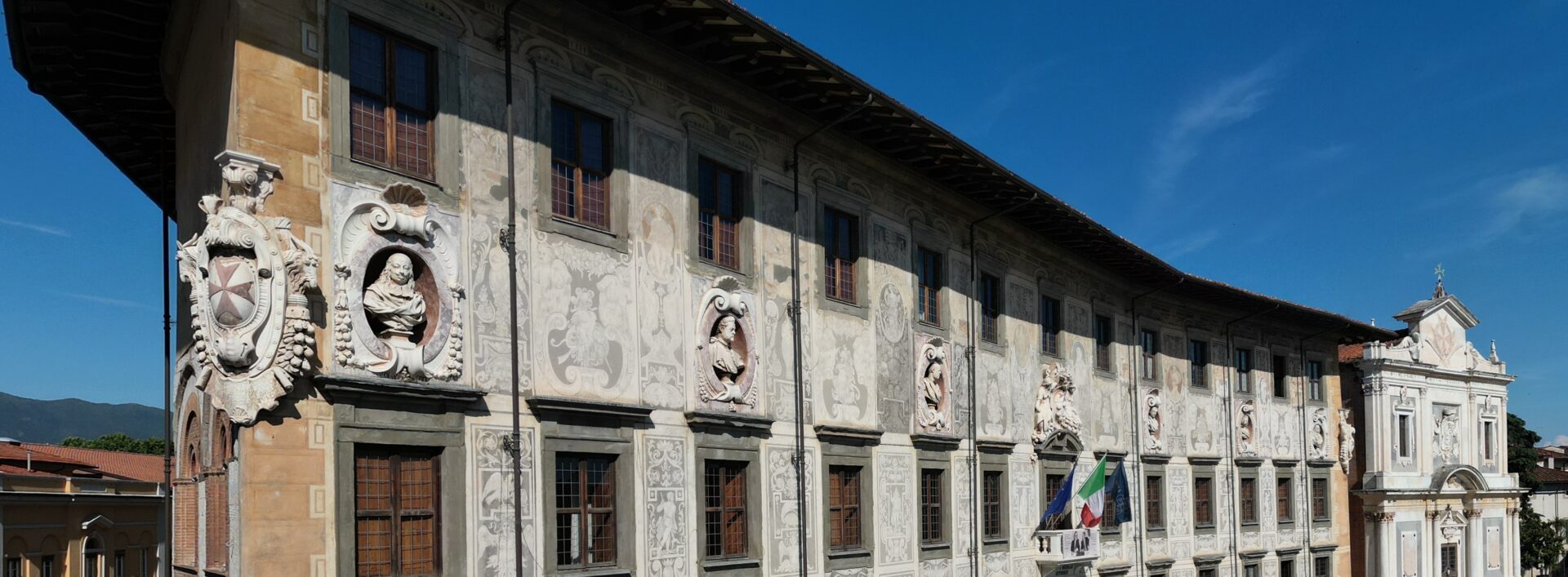
The bust of Cosimo I was executed by the versatile artist Ridolfo Sirigatti. The marble block was acquired from Giovanni Battista Lorenzi, a sculptor then working at the Duomo, and brought to the Palazzo della Carovana together with a terracotta model prepared by Sirigatti during the same period. It was in the palazzo ‘della Reliogione’ [of the Order] that the artist likely carried out the work. He was assisted by Lorenzi and a group of stonecutters: first to rough out the block, tracing the essential outlines of the figure, and then to polish the completed sculpture with pumice. The bust was placed on a bracket made by the carpenter Leonardo Potenti, positioned above the landing over the palace entrance. The niche framing the bust was a later addition: in 1593, the woodcarver Scipione Malaspina, also active at the Opera del Duomo, received payment for a setting ‘in white and variegated marble’ constructed between the second and third floors. The interior is painted to imitate red marble, while the richly scrolled frame incorporates the chain of the Order of the Golden Fleece, the high honour conferred on Cosimo by Emperor Charles V.
Although often viewed with scepticism by scholars, Sirigatti’s authorship remains, in my view, securely supported by comparison with the busts of his parents, now in the Victoria and Albert Museum in London—regrettably among the few sculptures currently attributed to his hand.
More difficult to accept is the idea that the terracotta head in the Loeser Collection at Palazzo Vecchio served as the model for the bust. While the two share a similar tilt of the head and a comparable treatment of the eyes, the marble version shows no trace of the tunic fastened with a fibula that characterises the terracotta, nor do its more substantial form and introspective quality find a counterpart in the bust at the Palazzo della Carovana. That said, the weathered condition of the marble—eroded by prolonged exposure to the elements—does limit the possibility of a closer comparison.
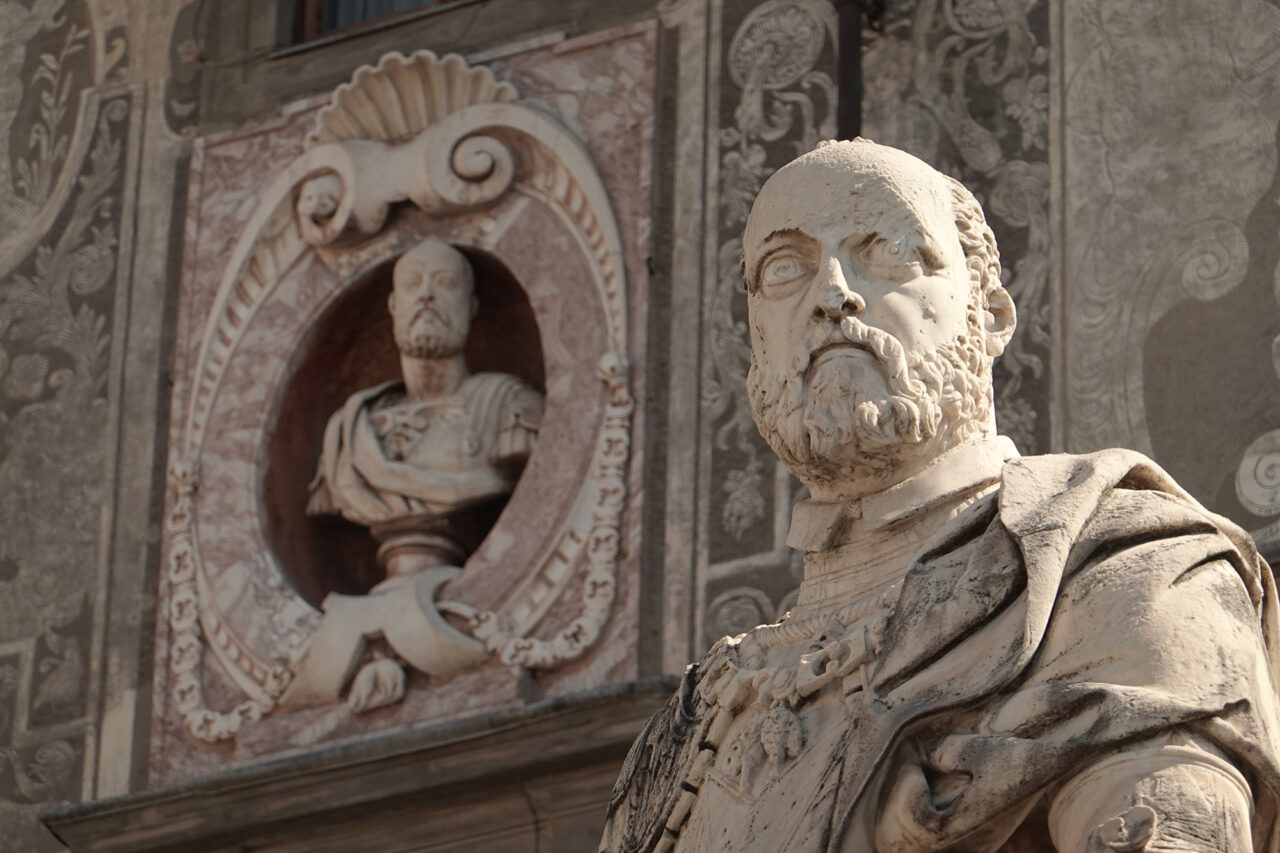
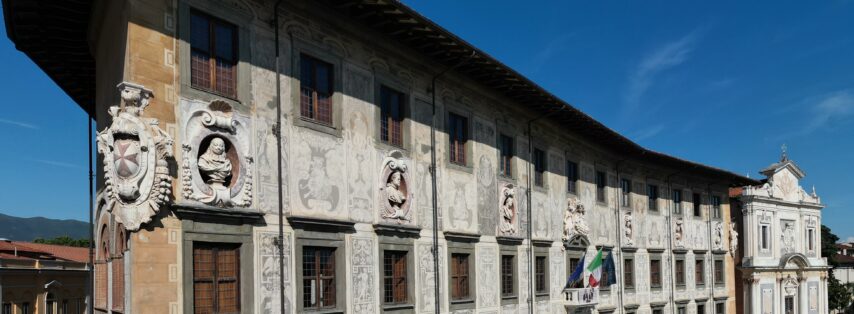
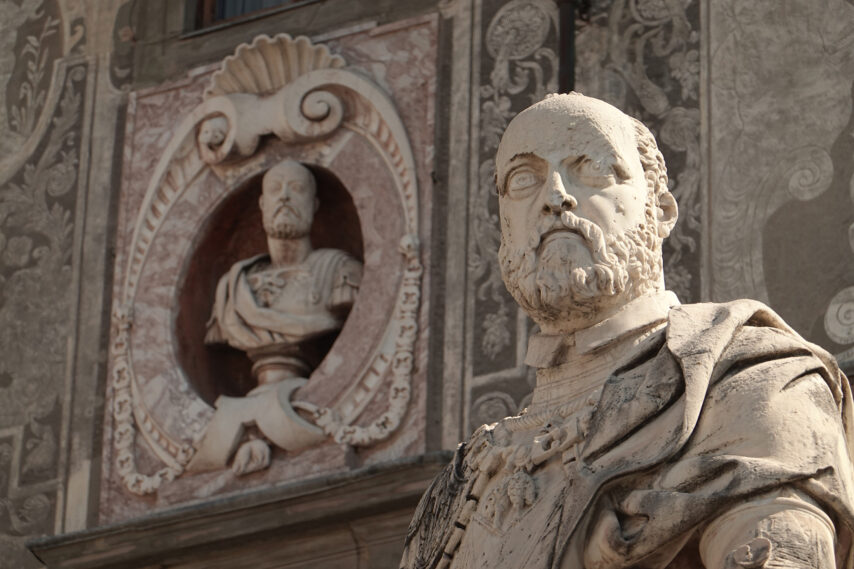
It is striking to note how Cosimo’s portrait now presides over Piazza dei Cavalieri, overlooking his own full-length statue, executed by Pietro Francavilla between 1594 and 1596.
Palazzo della Carovana
Main Entry- Preesistenze medievali
- Fasi costruttive
- Functions
- Façade
- Interior
- Varisco, Quadri comunicanti – Jarred
- Aula Bianchi
- La collezione dei calchi epigrafici
- Le opere del Centro Pecci
- Sala della Mensa
- The Coats of Arms of the Knights
- Sala Azzurra
- Sala del Ballatoio
- Sale della Direzione
- Scalone
- Gastini, «… e finire è cominciare»
- Maruscelli (attr.), Figura virile
- Sala degli Stemmi
- Sala della Colonna
- Cortile
Media gallery
Newsletter
Stay in Touch
Sign up for the Piazza dei Cavalieri newsletter
to receive updates on project progress and news.