
Busts
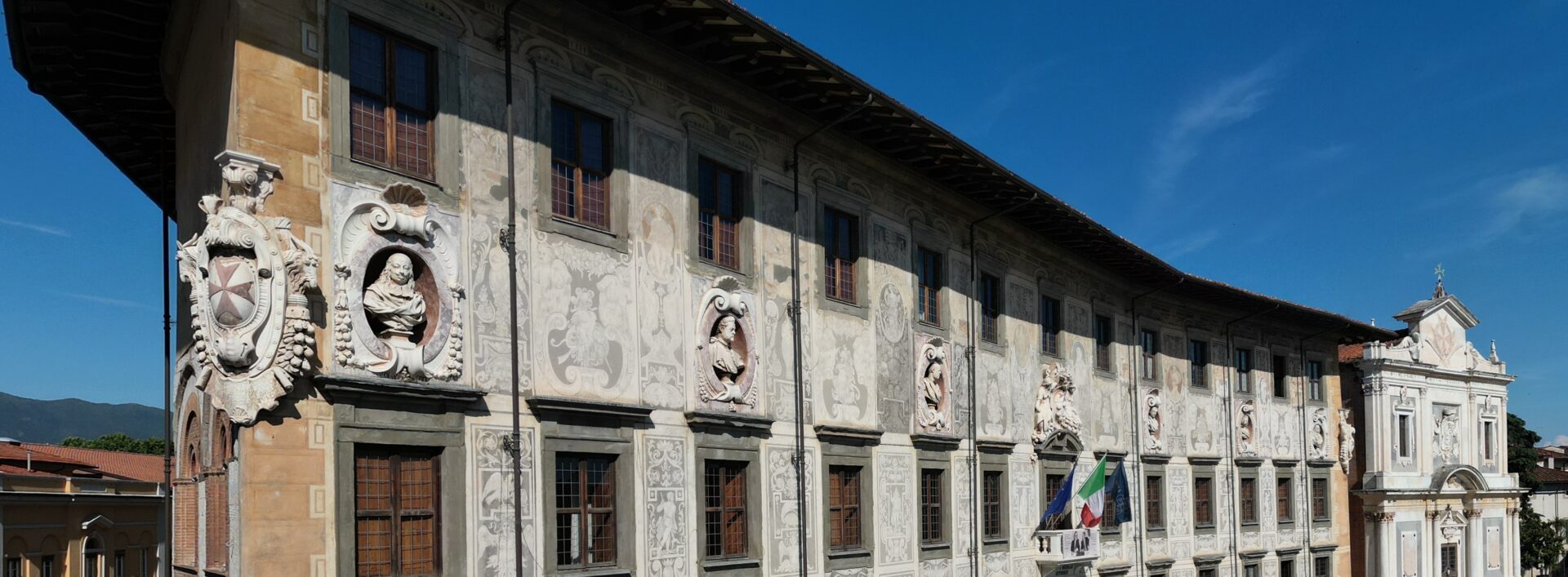
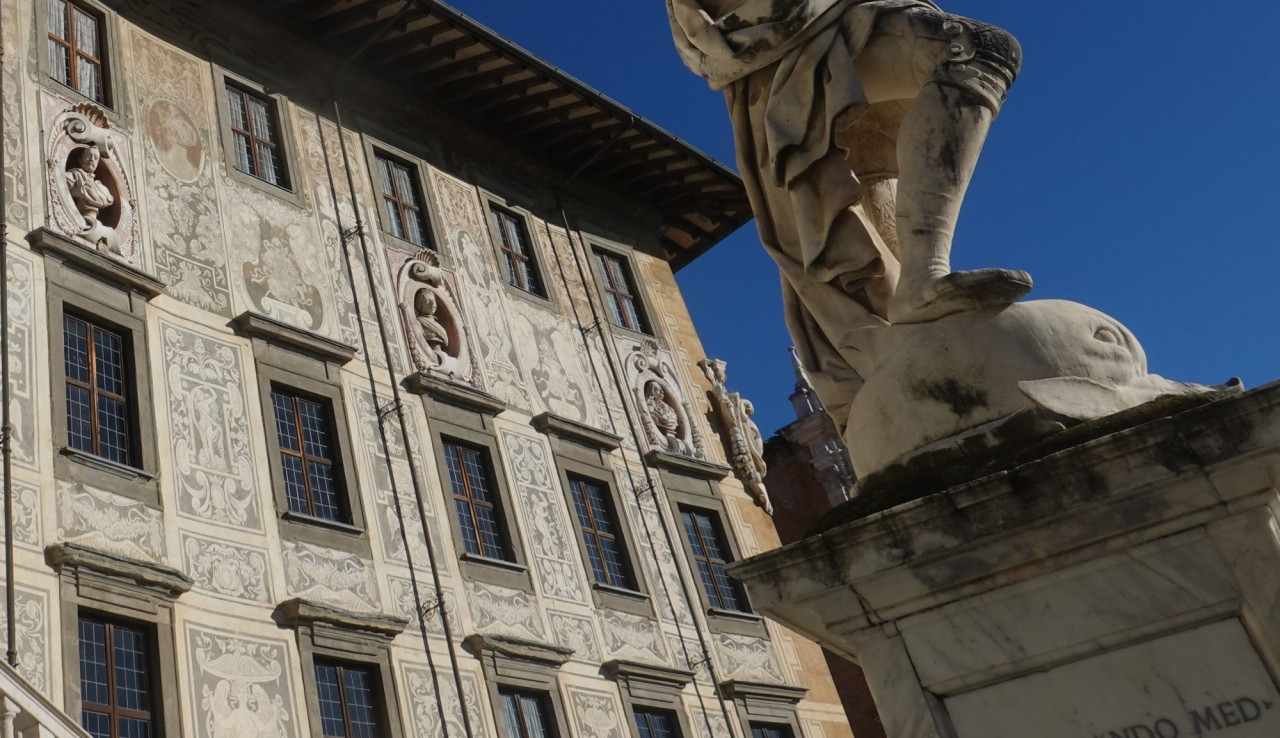
The marble busts on the façade of the Palazzo della Carovana form a veritable gallery of portraits of the Grand Dukes of Tuscany and Grand Masters of the Order of Saint Stephen spanning the period from the mid-sixteenth to the early eighteenth century.
The decorative programme is generally attributed to Ferdinando I de’ Medici, who, confident in the stability of his dynasty, is thought to have initiated the series by commissioning the bust of his father, Cosimo I, followed shortly afterwards by those of his brother Francesco I and of himself. That said, the possibility remains that Francesco I decided to produce the busts I: the earliest surviving document relating to the series dates to April 1588, though it is unclear whether it follows the Florentine or Pisan calendar. The Florentine system placed the start of the year two months and 25 days later than the modern calendar, while the Pisan system placed it nine months and seven days earlier. If the document reflects the Florentine calendar, the decision would date to April 1587—seven months before Francesco’s sudden death, which left the Grand Duchy in the hands of his brother Ferdinando. This would, in any case, be the only autonomous artistic initiative undertaken by the second Grand Duke of Tuscany in Piazza dei Cavalieri—an eventuality that, in fact, strengthens the case for Ferdinando’s authorship of the project. His successors continued the tradition by honouring their immediate predecessors: it was Gian Gastone de’ Medici who commissioned the final bust, that of Cosimo III (1642–1723).
The busts were installed on the façade starting from the centre, with one placed to the right and one to the left of the Medici-Stephanian coat of arms, alternating in this way until the available space had been filled.
Under Cosimo de’ Medici, an early plan envisioned decorating the band between the second and third-floor windows with sculpted heads—initially of emperors, and later of the founders of the principal chivalric orders: the Knights of Malta, the Militia of Our Lord Jesus Christ, and the Orders of Santiago, Alcántara, Calatrava, and St Stephen. The heads were to be set beneath six of the twelve windows, alternating with inscriptions, while in the oval fields now occupied by the sgraffito personifications of the Virtues, Giorgio Vasari proposed representations of the saints venerated by each of the respective orders. According to the artist’s correspondence, the project was ultimately abandoned owing to technical difficulties: no suitable visual or textual sources could be found to reconstruct the appearance of the founders—except, of course, for Cosimo himself, Godfrey of Bouillon (Knights of Rhodes), and Alfonso of Castile (Order of Santiago). It remains unclear, in my view, whether the proposed gallery of founders was intended as sgraffito work or as sculpture; Vasari’s letters are ambiguous on this point, though they seem to favour the latter. In any case, the programme was revised, and it is not known whether the spaces now occupied by the marble busts of the Grand Dukes were in fact undecorated prior to Ferdinando I’s intervention.
The busts and their niches, exposed over time to weathering, guano, and airborne particulate matter, have undergone at least two modern conservation campaigns: one in the early 1990s and another in 2008.
Palazzo della Carovana
Main Entry- Preesistenze medievali
- Fasi costruttive
- Functions
- Façade
- Interior
- Varisco, Quadri comunicanti – Jarred
- Aula Bianchi
- La collezione dei calchi epigrafici
- Le opere del Centro Pecci
- Sala della Mensa
- The Coats of Arms of the Knights
- Sala Azzurra
- Sala del Ballatoio
- Sale della Direzione
- Scalone
- Gastini, «… e finire è cominciare»
- Maruscelli (attr.), Figura virile
- Sala degli Stemmi
- Sala della Colonna
- Cortile
Media gallery
Newsletter
Stay in Touch
Sign up for the Piazza dei Cavalieri newsletter
to receive updates on project progress and news.