
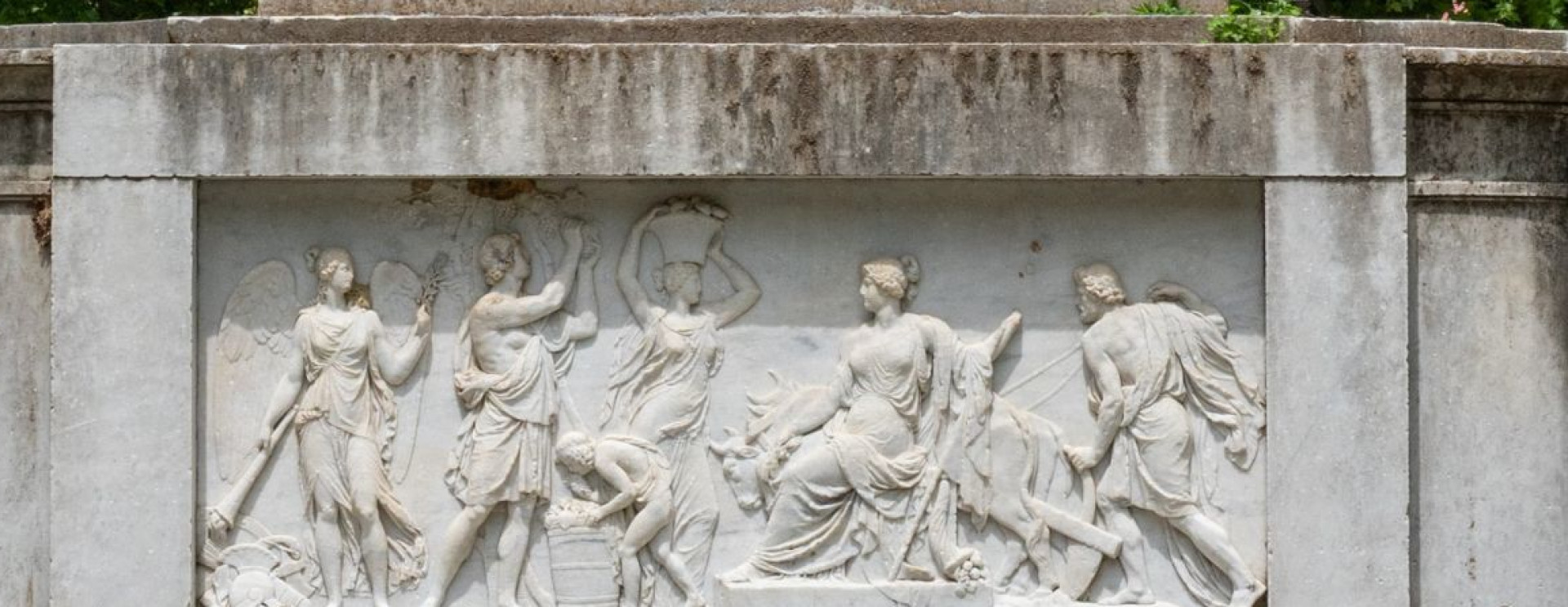
The Lorraine Dynasty
Upon the death of Gian Gastone (1671–1737), the seventh and last descendant of the Medici dynasty, the government of the Grand Duchy of Tuscany entered into a period of uncertainty. After a moment in which the transfer of power to the Spanish Bourbon branch seemed possible, the House of Lorraine officially assumed control on 12 July 1737.
Their ties with Tuscany stretched back to 1589, when Ferdinando I de’ Medici married Christina of Lorraine, daughter of Duke Charles III. The Lorraine dynasty would rule the Grand Duchy during a period of pivotal importance in European history: from 1737—with the brief yet crucial Napoleonic interlude of 1799–1815—until March 1860, when Tuscany was formally incorporated into the newly established Kingdom of Italy.
The first ruler of the new dynasty was Francis Stephen (Nancy 1708–Innsbruck 1765), who reigned as Grand Duke under the name Francis (Francesco) II. Linked to the Habsburgs through his marriage to Maria Theresa, he chose to govern from Vienna. He visited Florence only once, in the early months of 1739, and entrusted the exercise of authority to a regency council.
It was nevertheless during his reign, in the mid-eighteenth century, that a campaign of restructuring and modernisation began for the buildings of the Order of Saint Stephen, an institution whose strategic importance had diminished in the new international context. The initiative stemmed from a systematic survey of their condition carried out by Giovanni Michele Piazzini, an engineer of Pisa’s Ufficio Fiumi e Fossi. Between 1751 and 1757, he produced detailed graphic drawings of the structures overlooking Piazza dei Cavalieri—material now preserved only in part.
In some cases, Piazzini undertook direct interventions, but above all, he formulated proposals that would be taken up during the subsequent reign of Francis’s son.
Peter Leopold—who from 1790 reigned as Emperor Leopold II of Habsburg-Lorraine—occupies a place of an entirely different order, significant not only for regional history but for Europe as a whole. He succeeded his father on the latter’s sudden death in 1765, also observed in Pisa with ceremonies in Santo Stefano. Born at Schönbrunn in 1747 and dying in Vienna in 1792, he was one of the leading figures of the reformist movement inspired by French Enlightenment ideals that advocated the pursuit of human happiness and self-improvement.
During the 1770s and 1780s, he undertook an extensive reorganisation of central and provincial government, introduced economic measures inspired by liberal principles, and carried out a thorough reform of the taxation system. In the same period, he advanced a revision of Church–state relations that resulted, as Renato Pasta has described it, in a ‘dismantling of ecclesiastical jurisdiction’ [‘smantellamento della giurisdizione ecclesiastica’]. Particularly noteworthy, though never implemented, was his constitutional project for the Tuscan states, which envisaged organised popular participation through assemblies based on property qualifications.
Pisa occupies a notable place in Leopold’s reform activity. He revised the statutes of the Order of Saint Stephen, abolishing its military role, and promoted the city’s university. Most importantly, however, it was in Pisa that on 30 November 1786 he promulgated what can be considered his most far-reaching political measure: the Nuova legge criminale. This landmark legislation—the first in Europe—abolished both torture and capital punishment and formally separated police responsibilities from those of the judiciary.
Ferdinand III (Florence 1769–Florence 1824) succeeded his father. His rule followed a sometimes uneven course, alternately confirming and revoking the reformist measures introduced under his father—developments that unfolded during a period of profound upheaval marked by the outbreak of the French Revolution. After a protracted attempt to maintain diplomatic balance amid escalating tensions among European powers—and in particular the rapid expansion of Napoleonic France—Ferdinand III was forced to leave Florence on 27 March 1799. He returned, reinstated in his functions, on 17 September 1814. On 9 June, with the signing of the Vienna Congress protocols concerning Italy, the Grand Duchy regained its former boundaries. Once restored, Ferdinand faced a difficult internal situation characterised by financial disorder and by the complex task of reconstructing the legal order. This required both the reinstatement of pre-1799 provisions and the retention of several innovations introduced during the Napoleonic period. The change of regime had significant consequences for Pisa and for Piazza dei Cavalieri. The Order of Saint Stephen, abolished by Napoleonic decree in 1809, was reinstated in 1817.
Upon Ferdinand’s death in 1824—an event likewise commemorated at Santo Stefano—he was succeeded by his son Leopold II of Tuscany, the last de facto grand duke of Tuscany, who governed until 1859, shortly before the region’s annexation to the Kingdom of Italy in 1860. His reign was marked above all by an ambitious programme of infrastructural modernisation, combining extensive land reclamation works with the creation of new road and railway lines. During these same decades, Pisa increasingly emerged as a renowned destination for European intellectual tourism and as a leading academic centre; notably, it hosted the first Italian scientific congress in 1839. Finally, Leopold II was responsible in 1846 for restoring the Scuola Normale Superiore—an institution of Napoleonic origin—and for establishing it in its present seat in Palazzo della Carovana.
Media gallery

Newsletter
Stay in Touch
Sign up for the Piazza dei Cavalieri newsletter
to receive updates on project progress and news.