
Morgiano
[1583/1595- after 1634]
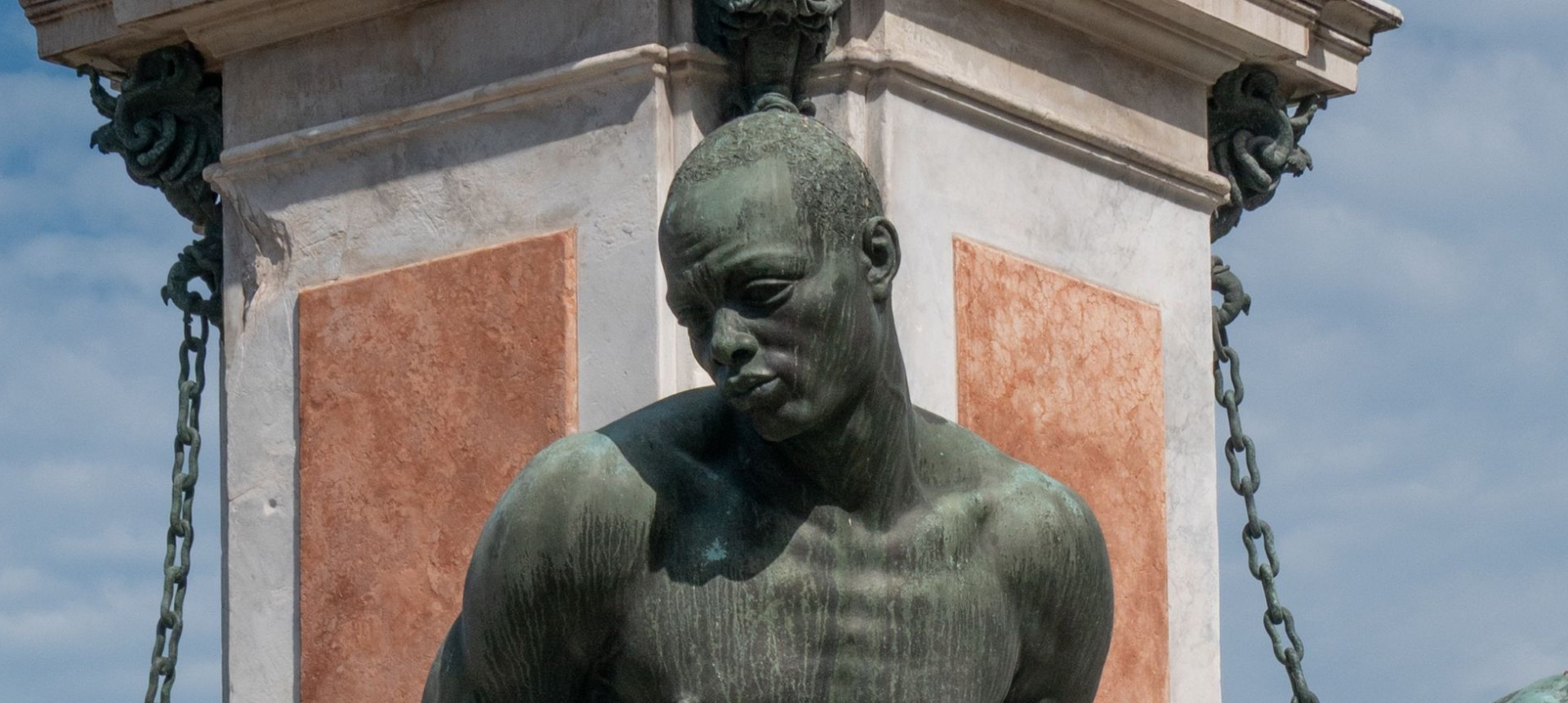
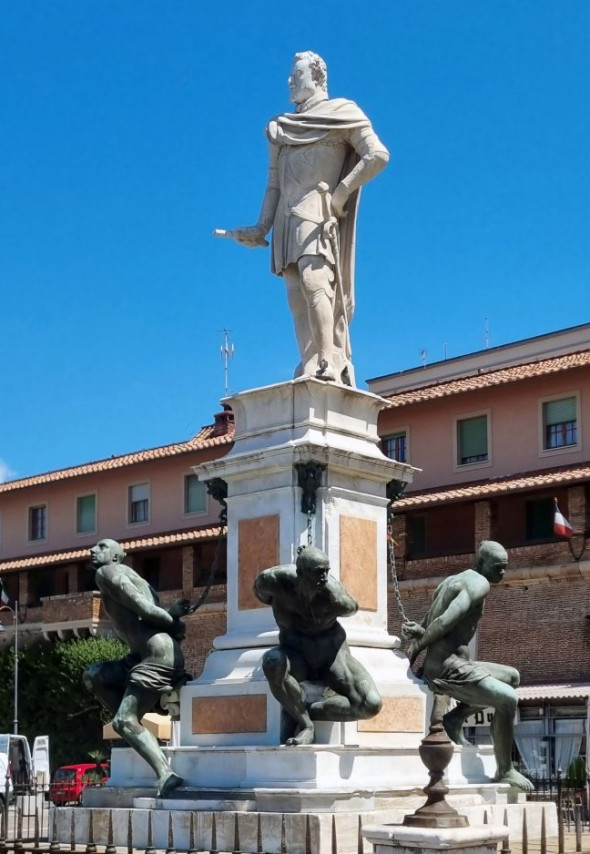
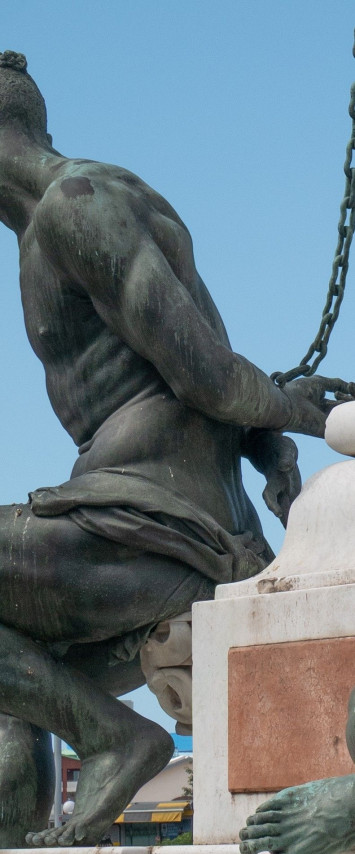
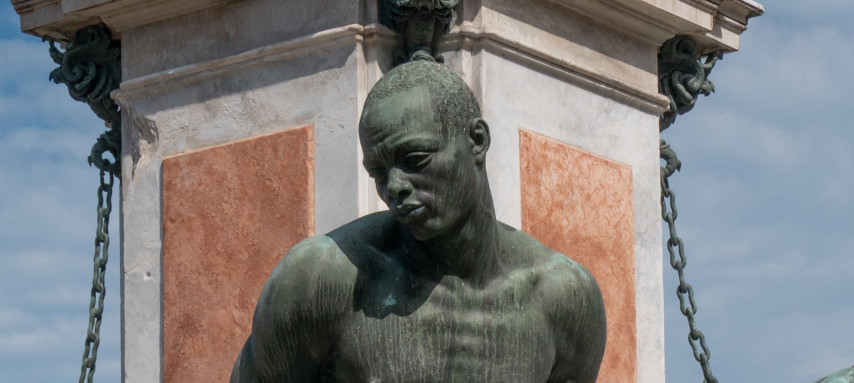
Among the many—and often contested—reasons the monument to Ferdinando I de’ Medici in the port of Livorno has attracted increasing scholarly attention is that at least one of the bronze figures at its base, known as the Quattro Mori (‘Four Moors’), represents a real person: Morgiano. It is thought to be the earliest known sculpted portrait of an enslaved man whose identity is documented. This essay seeks to sketch his biography, intertwining the fragmentary documentary and literary evidence that survives with current knowledge of the conditions of enslaved people under the Order of the Knights of Saint Stephen.
In his biography of the sculptor Pietro Tacca, creator of the four bronze figures, Filippo Baldinucci recounts that Tacca visited Livorno’s Bagno—the fortified prison where both forced labourers and slaves captured by the Knights of Saint Stephen were held—to conduct studies from life. He selected men with ‘the most elegant musculature’ [‘de’ muscoli più leggiadri’] for his work. ‘One of these,’ Baldinucci writes, ‘was a Moorish Turk slave known as Morgiano, who, for his stature and the beauty of every part of his body, was extraordinarily handsome and greatly assisted Tacca in modelling that beautiful figure with the natural likeness that we see today’ [‘Uno di costoro fu uno schiavo moro turco, che chiamavasi per soprannome Morgiano, che per grandezza di persona e per fattezze d’ogni sua parte era bellissimo, e fu di grande aiuto al Tacca per condurne la bella figura, con una naturale effigie, che oggi vediamo’]. This account is corroborated by a later Livornese chronicle compiled in the eighteenth century by Mariano Santelli, based on seventeenth-century documents, which confirms that Tacca made studies from life for two of the figures later cast in bronze: the first, ‘a Turkish slave from Algiers, youthful, strong, well built, most muscular—in short, perfect in every part and of uncommon height—named Morgiano’ [‘un certo turco schiavo, nativo d’Algeri, di giovanile età, forte, ben piantato, meglio muscolato, insomma perfettissimo in ogni sua parte e di non comune altezza detto Morgiano’]; the second, ‘a robust old man from [the Moroccan city of] Salé, called Alì’ [‘un robusto vecchio Saletino detto Alì’]. Scholars have long remarked on the vivid realism of the faces of the Quattro Mori, so distinctive as to resemble true portraits. Eike D. Schmidt regards them as among Tacca’s finest and most affecting works. Yet the historical basis of Baldinucci’s and Santelli’s accounts was established only when Steven Ostrow discovered a valuable document in the James Ford Bell Library at the University of Minnesota: the Nota di numero 164 schiavi mori de galeoni quali sono nel Bagnio, dated to around 1608–1620. This record mentions several men named Alì but only one Morgiano, described as ‘from Macamutto of Tangier, aged twenty-five, to be sold’ [‘di Macamutto di Tangiur, di anni 25, da vendersi’].
If we accept this identification, Morgiano was likely the son of a certain Macamutto and was born between 1583 and 1595. The name ‘Morgiano’, derived from the Arabic Marjān, meaning ‘coral’, was not used as a personal name at the time and may have been a pseudonym given to him as a slave—Baldinucci, in fact, refers to it as a soprannome (nickname). This detail suggests that Morgiano may have previously been held captive by the Ottoman Turks before his capture by the Knights of Saint Stephen. His place of birth remains uncertain due to conflicting sources. Both the Nota and Santelli indicate North African origins, mentioning Algiers and Tangier, respectively, while Ostrow focuses on Baldinucci’s term ‘Turkish Moor’ [‘moro turco’]. According to Baldinucci’s Vocabolario toscano dell’arte del disegno (1681), in Florence at that time the word moro generally referred to ‘a person with dark skin, such as Ethiopians and other peoples living in Africa’ [‘nero di carnagione, come sono gli etiopi e gli altri popoli, abitatori dell’Africa’]. From this, Ostrow infers that Morgiano was the only figure of sub-Saharan African origin among the four represented in the Livorno monument—the one occupying the south-eastern corner, although some scholars instead identify him with the figure in the north-western corner. Considering the complex maritime and caravan routes of the early modern slave trade, it is plausible that Morgiano was captured in Sudan by the Turks or in West Africa by the Moroccans—then under the Saadian dynasty—before being taken by the Knights of Saint Stephen, possibly during one of their raids against Ottoman or Barbary fleets, in which the Order had specialised.
Etching, 235 × 348 mm
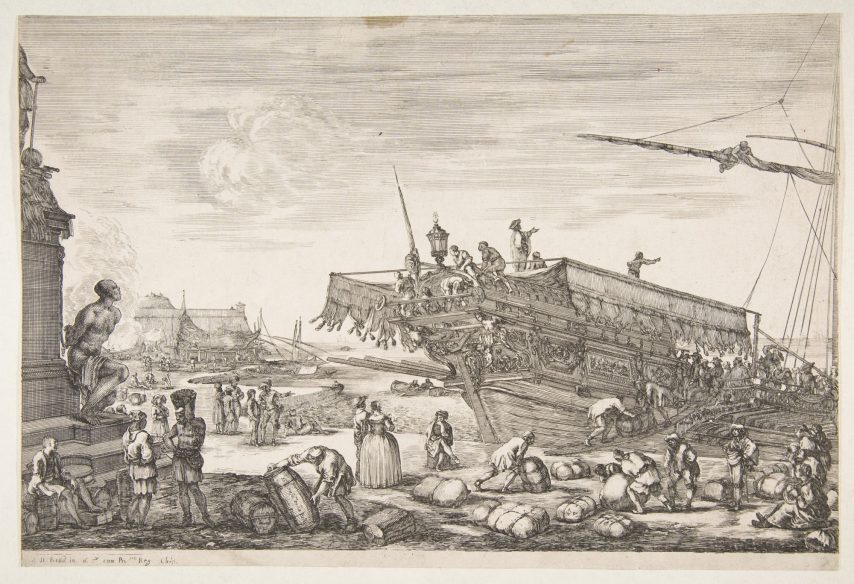
Although it was possible—as happened with some Turkish prisoners captured at Bona in 1607—there is no evidence that Morgiano was ever brought to Pisa’s Piazza dei Cavalieri as a ‘trophy’. What is certain is that he was held captive in Livorno’s Bagno. Livorno was then among the busiest ports in the Mediterranean and served as a key operational base for the Order of the Knights of Saint Stephen, as vividly depicted in Stefano della Bella’s etchings (c. 1655). Despite certain concessions, such as the provision of a mosque within the Bagno to allow freedom of worship, numerous accounts attest to the harsh living conditions endured by the enslaved individuals confined there. Among the testimonies closest to Morgiano’s lifetime is that of William Davies, a British citizen from Hereford who was captured in 1598 by Grand Ducal galleys while travelling aboard a merchant ship from Tunis. In his memoirs, Davies recalled receiving ‘more blows than any cart-horse in England’ and subsisting on ‘bread and water, and not so much bread in three days as we might have eaten at . He also described the exhausting labour of transporting ‘sand, or lime, or for ‘their buildings’ —a reference that may well relate to the construction of the Medici aqueduct or to the building of the Bagno itself. His account finds an echo a century later in De Rogissart’s writings.
It is uncertain whether Morgiano ever contributed his labour to a Grand Ducal construction project; more likely, he served as an oarsman on a galley of the Knights of Saint Stephen. This was the principal duty assigned to slaves and convicts under the Order’s control, as also indicated in the previously mentioned List, where Morgiano and the other 163 men are described as ‘good at the oars’ [‘boni nei remi’]. William Davies, too, was employed as a galley slave and vividly recalled the experience in his memoirs: ‘The misery of the galleys surpasses all judgement or imagination, and no man would think that such torture or torment existed in the world, except those who endure it; the extremity of misery causes many slaves to kill themselves, or to attempt to kill their officer’
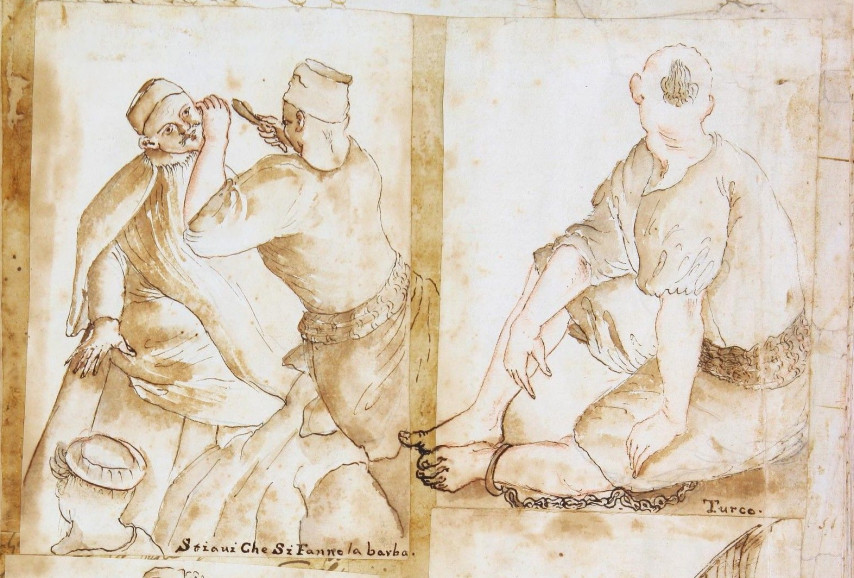
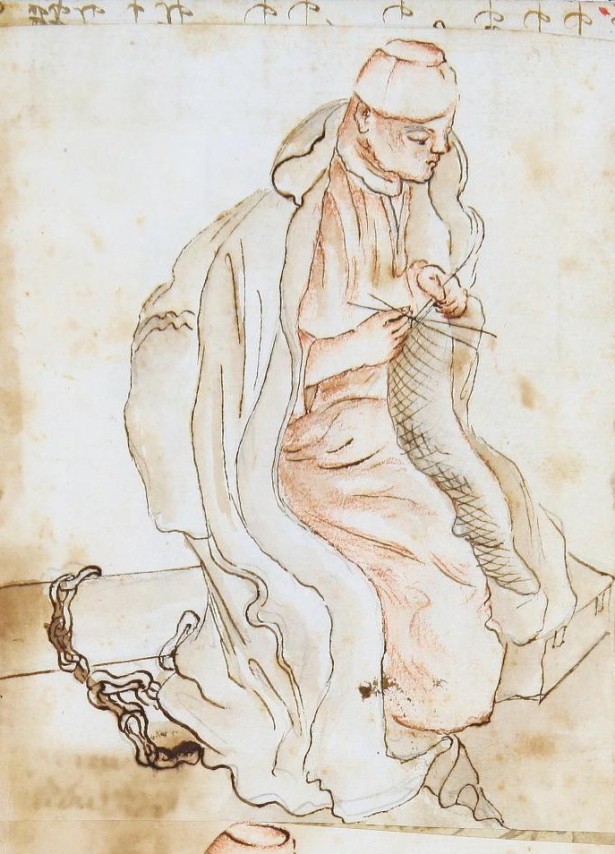
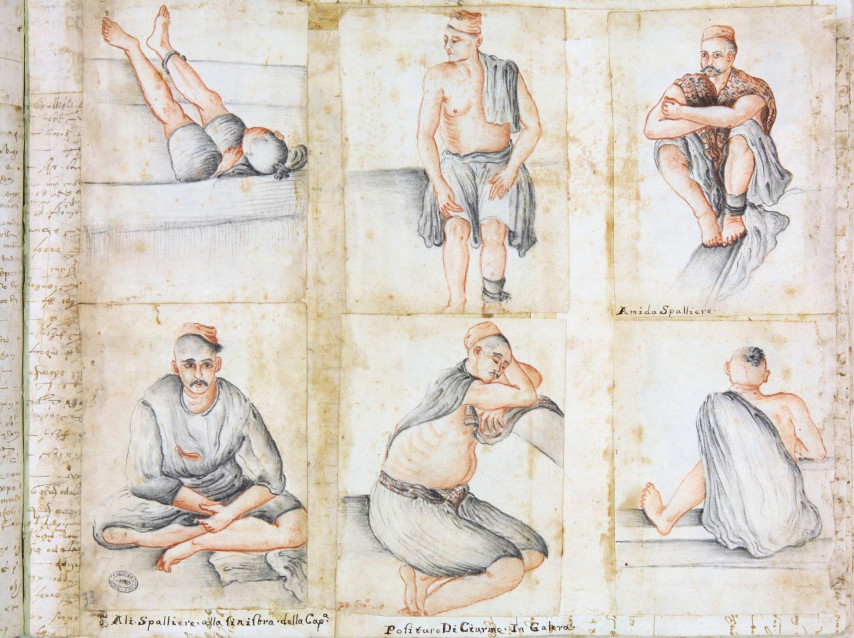

Morgiano’s experiences as a galley slave can be vividly imagined through an extraordinary visual record: an album of drawings by the Pistoian knight Ignazio Fabroni, preserved in the Biblioteca Nazionale Centrale, Florence. Produced between 1664—the year of Fabroni’s first sea journey on the galley San Cosimo—and 1687, this collection of more than eight hundred sketches captures with striking realism the many activities carried out on board, offering an unparalleled insight into the material culture of the navy of the Knights of Saint Stephen. Each galley typically employed over two hundred and fifty oarsmen, making enslaved people and convicts the central figures in Fabroni’s drawings. Their condition was signalled by a distinctive haircut: their heads were completely shaved except for a long tuft on the parietal area of the skull—the same style seen in the Quattro mori of Livorno, which Morgiano himself likely wore. Their usual clothing included a fustian shirt, loose trousers, a woollen jacket, a red cap, and, at times, a heavy coat that also served as a blanket. This visual evidence is especially significant, as it offsets the deliberate nudity of the Medicean Quattro Mori—a choice informed both by classical models and by the dehumanising stereotype of enslaved figures depicted as ‘pre-civilised’. William Davies, an Englishman, likewise described this imposed ‘uniform’: ‘We were all shaven both head and beard, and every man had given him a red coat and a red cap, telling us that the Duke had made us all slaves, for our great woe and grief’. Fabroni portrayed the galley slaves mainly in moments of rest, when a favourable wind allowed the sails to propel the vessel. He depicted them smoking, shaving one another, fishing for molluscs (gnacchere), or lying along the rigging and rowing benches. Many are shown knitting—an unsurprising activity, since merchants on land supplied them with wool and cotton to make caps, stockings, and other garments for resale. It is therefore plausible that Morgiano, too, took part in this small-scale trade, an activity permitted and sometimes encouraged by the Knights of Saint Stephen both aboard the galleys and within the Bagno.
It was at the Bagno of Livorno, in the early seventeenth century, that Morgiano met the sculptor Pietro Tacca and, later, Tacca’s biographer, Filippo Baldinucci. The last known detail of Morgiano’s life concerns a conversation he had in 1634 with Baldinucci, then only ten years old. Baldinucci recalled that he spoke ‘with him not without pleasure’ [‘con esso non senza gusto’], a remark that reveals Morgiano’s amiable nature and, above all, his proficiency in Italian—suggesting a degree of integration, at least on a linguistic level.
Scholars have dwelt extensively on the rhetoric of beauty used by contemporary sources to describe Morgiano’s physique, yet rarely from his own point of view or from that of the human experience implied in the obsessive fetishisation of a body so relentlessly observed, studied, and exposed in its nakedness. Today, we can only partly shed light on that experience—in meeting, however faintly, the melancholy gaze with which Morgiano has sat for centuries at the foot of the controversial Medicean monument.
Bronzo

Prominent Personalities
Main Entry- Ugolino della Gherardesca
- Anna di Świdnica
- Francesco I de’ Medici
- Carlo Antonio dal Pozzo
- Ferdinando I de’ Medici
- Morgiano
- Cosimo II de’ Medici
- Ferdinando II de’ Medici
- Cosimo III de’ Medici
- Azzolino Bernardino della Ciaia
- Gian Gastone I de’ Medici
- Leopoldo II d’Asburgo-Lorena (imperatore)
- Napoleone Bonaparte
- Elisa Bonaparte
- Leopoldo II di Toscana (granduca)
- Ulisse Dini
Media gallery
Bronzo
Newsletter
Stay in Touch
Sign up for the Piazza dei Cavalieri newsletter
to receive updates on project progress and news.