
Giovanni Battista Foggini
[1652-1725]
A pivotal figure in Medici patronage from the late seventeenth to the early eighteenth century, the architect and sculptor Giovanni Battista Foggini was also active in Piazza dei Cavalieri, where he contributed to the series of busts in marble depicting grand-ducal portraits on the façade of Palazzo della Carovana and to both the temporary and permanent furnishings of the church of Santo Stefano.
Born in Florence in April 1652, Giovanni Battista Foggini showed precocious talent, described by his family as ‘a genius of uncommon gift in these fine arts’ [‘un genio non ordinario a queste bell’arti’]. At the age of ten, he was sent to study under several painters, including Vincenzo Dandini, but was most deeply influenced by his uncle, Jacopo Maria Foggini, a sculptor who encouraged him to ‘model and make figures in wood as he pleased’ [‘modellare e far figure in legno a suo piacimento’]. By around 1665, the young Foggini had produced a wooden relief of The Beheading of Saint John the Baptist and several medals (now lost), which, through the mediation of the mathematician Vincenzo Viviani, brought him to the attention of Grand Duke Ferdinando II and secured him a monthly allowance of four scudi.
Once admitted to the circle of court artists, Giovanni Battista Foggini ‘applied himself to study with such intensity that within a few months he produced several marble heads and bas-reliefs, alongside a series of drawings and clay models’ [‘si messe con tale sforzo allo studio che in pochi mesi diede fuori – con diversi disegni e modelli di terra – alcune teste e bassorilievi di marmo’]. Following the death of Ferdinando II and the accession of his son Cosimo III, Foggini was sent to Rome in 1673 to study at the newly founded Medici Academy, housed in Palazzo Madama. Patronised by the Grand Duke to train young Florentine artists and revitalise the Tuscan arts, the academy enabled Foggini to study painting and drawing under Ciro Ferri and sculpture under Ercole Ferrata. Ferrata’s studio—filled with casts and models, including those by Alessandro Algardi, whom Foggini admired though never studied under—became a lasting source of inspiration throughout his career.
In Rome, Foggini devoted himself to the works of Raphael, Pietro da Cortona, Michelangelo, and the art of classical antiquity, of which he ‘copied in clay almost every statue and drew every other work that presented itself to him’ [‘copiò in terra quasi ogni statua e disegnò ogn’altr’opera che a lui si fosse presentata’].
Recalled to Florence after three years by the Grand Duke, Foggini devoted himself to marble portraiture and undertook a major commission from the Corsini family for their chapel in Santa Maria del Carmine, dedicated to Saint Andrea Corsini. The project consisted of three marble altarpieces in high relief, executed over more than two decades: Apotheosis of the Saint (1677–1678), Battle of Anghiari (1684–1689), and Apparition of the Virgin to the Saint during Mass (1694–1701). During this period, Foggini enjoyed the continued favour of the Grand Duke, who in 1687 granted him a house and atelier in Borgo Pinti—previously occupied by Giambologna and Pietro Tacca—and in 1694 appointed him First Court Architect.
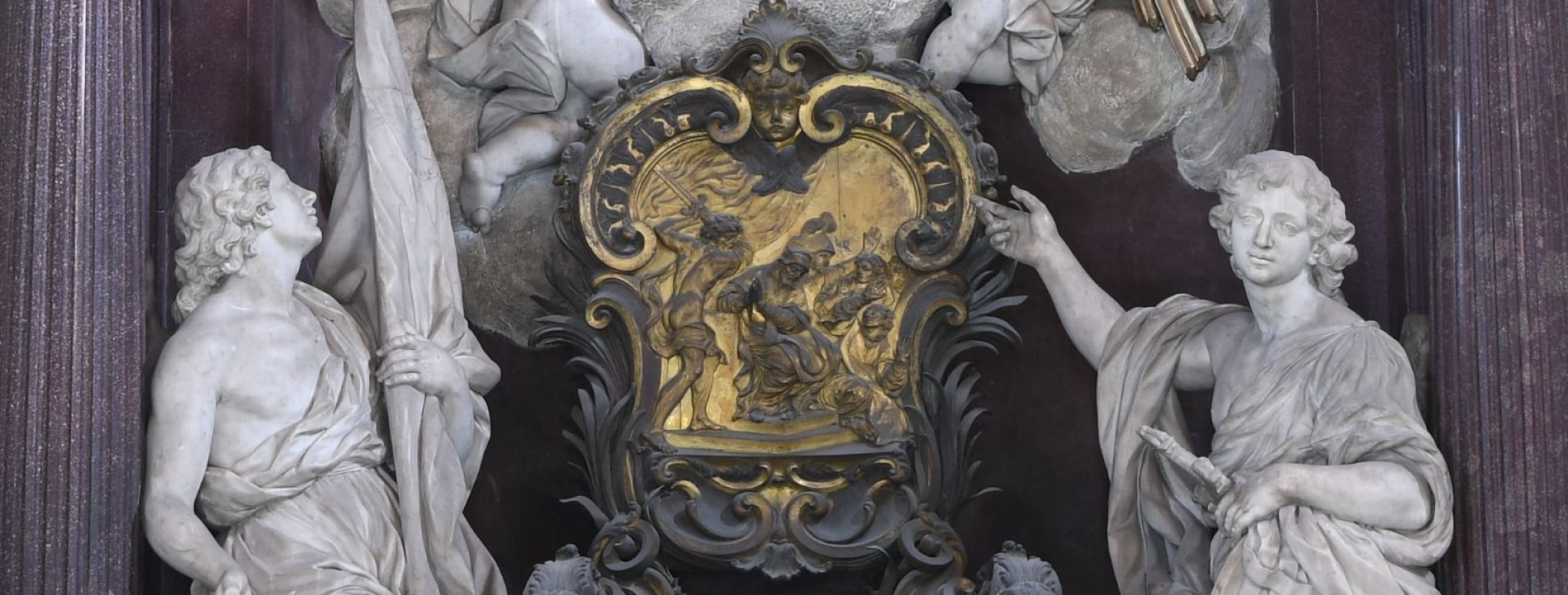
While work on the Corsini commission was still in its early stages, another major project began—one to which Foggini would devote his attention over several decades: the high altar of Santo Stefano. In 1682 the sculptor received a request to create a large wooden model depicting Saint Stephen between Religion and Faith, still preserved today in a secondary space of the church. The model was intended to decorate, within a temporary structure designed by Pier Francesco Silvani, the presbytery of the church on the occasion of the translation of Saint Stephen’s relics, an event organised with great splendour in Pisa by Cosimo III on 25 April 1683.
For the same occasion, the artist also produced another sculpture, now lost: a gilded bas-relief—possibly made of papier-mâché—showing Saint Stephen in a blessing gesture. Circular in shape and of considerable size, it was designed to crown the upper section of the church façade, as suggested by contemporary drawings. After the ceremony, this work disappeared from the record, while the wooden group remained on the altar for about twenty years, until Cosimo III himself commissioned Foggini to produce the definitive marble version. The new group made necessary by the acquisition of a second relic—the chair of Saint Stephen—was completed by 1709.
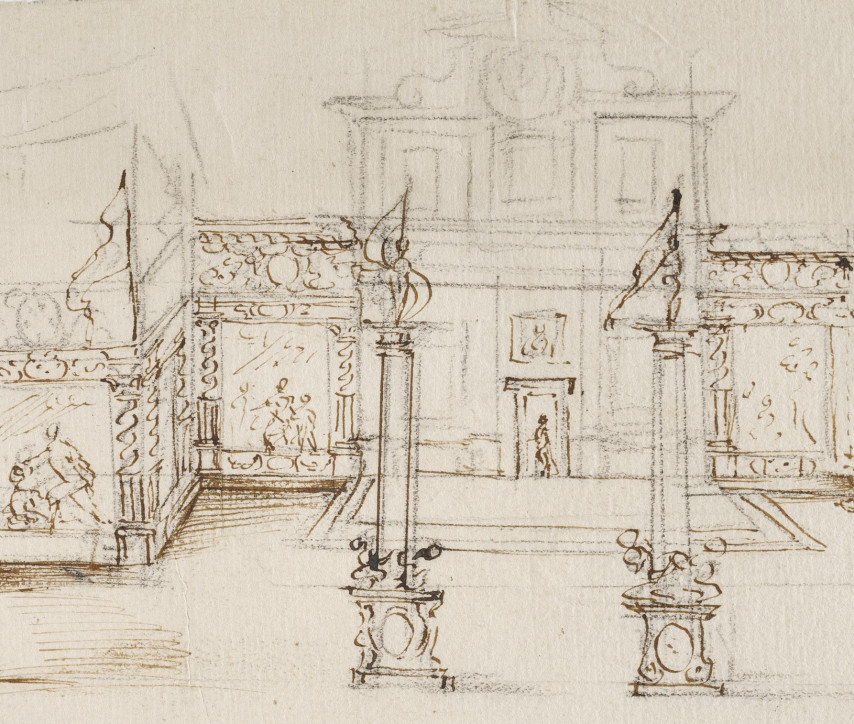
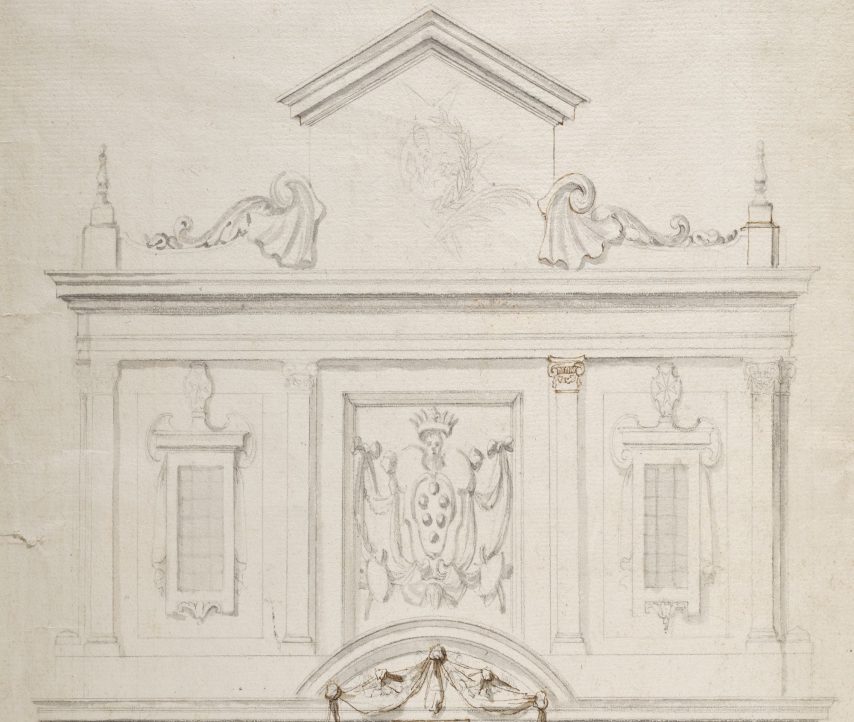
In the meantime, Foggini’s ties with Pisa had strengthened—both with the Cathedral, where by 1690 he completed an altar for the relics of Saint Ranieri, and more specifically with Piazza dei Cavalieri. By 1681, he had already delivered the first of two busts he would execute for the façade of the Carovana, that of Ferdinando II. Shortly afterwards, Foggini turned his attention to two structural interventions at Santo Stefano, taking over from Silvani, who had died in 1685, to complete the Grand Duke’s plan for two lateral wings. The revised design, reduced from the original proposal, was not conceived as new aisles but rather as unlit spaces serving as simple changing rooms and storerooms for the Order of Saint Stephen. The works could be considered concluded in 1691, with the opening of four large pediment portals connecting the main body of the building and the two new wings. A few years later, in 1693, it would be the bell tower of Santo Stefano that would require Foggini’s attention, not only for the replacement of some decorative elements, but also for structural consolidation. Finally, documentary evidence records the artist’s intention, once the altar was completed, to accept a commission from the Order to create an ornament for the silver Crucifix (attributed to Alessandro Algardi) then kept in the church. This work was later replaced—after a number of vicissitudes—by the bronze Crucifix now in place, attributed to Felice Palma.
Esteemed by the Medici for his skill in coordinating a diverse entourage of artists proficient in different techniques and materials, as well as for his prolific talent as a draughtsman, Giovanni Battista Foggini completed his second bust, depicting Cosimo III, for the façade of Palazzo della Carovana shortly before his death in April 1725. He was laid to rest in the church of Santa Maria del Carmine, where he had worked throughout much of his career.
Artists
Main Entry- Nicola Pisano
- Giovanni Fancelli, called Nanni di Stocco
- Davide Fortini
- Stoldo Lorenzi
- Alessandro Forzori di Arezzo
- Tommaso di Battista del Verrocchio
- Pietro Francavilla
- Alessandro Pieroni
- Ridolfo Sirigatti
- Michelangelo Cinganelli
- Filippo e Lorenzo Paladini
- Giovanni de’ Medici
- Cosimo Pugliani
- Pietro Tacca
- Giovanni Stefano Maruscelli
- Giovanni Battista Foggini
- Adèle Poussielgue
- Leonardo Bistolfi
Media gallery
Newsletter
Stay in Touch
Sign up for the Piazza dei Cavalieri newsletter
to receive updates on project progress and news.