
Urban Development, 20th Century (and up to the Present)
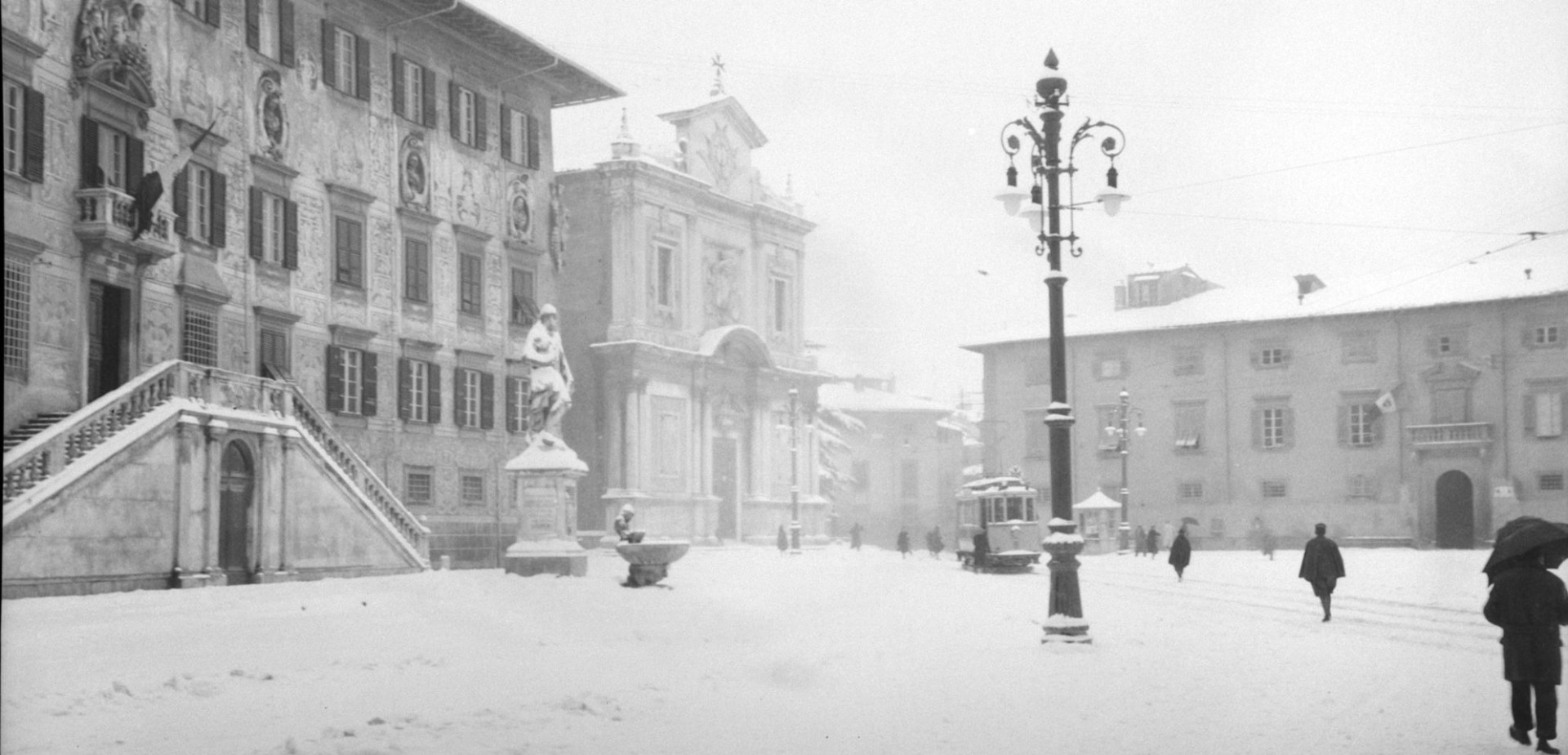
Throughout the twentieth century—inaugurated in Piazza dei Cavalieri with a major refurbishment of the façade of the Palazzo della Carovana—the development of this urban area regained momentum, particularly in its paving and lighting.
In January 1912, Piazza dei Cavalieri became one of the principal stops on Pisa’s new tramway network. The inauguration of this system marked a significant milestone in the city’s urban history, as it gradually replaced the horse-drawn tram, modernising mobility and daily life for the inhabitants. Work on laying the rails had begun the previous year and ultimately covered a route of more than five kilometres, developing two main lines from the railway station: one terminating at Piazza del Duomo and the other at Porta a Piagge.
The introduction of the tramline and the new road system brought a radical transformation to the piazza’s layout. The earlier mixed paving, partly in sandstone (inherited from the eighteenth century and updated in the nineteenth century), was replaced in the following decades by a uniform asphalt pavement designed to meet new transit demands. This was a pivotal moment in the functional and formal redefinition of the space, as it increasingly became assimilated into a modern urban hub.
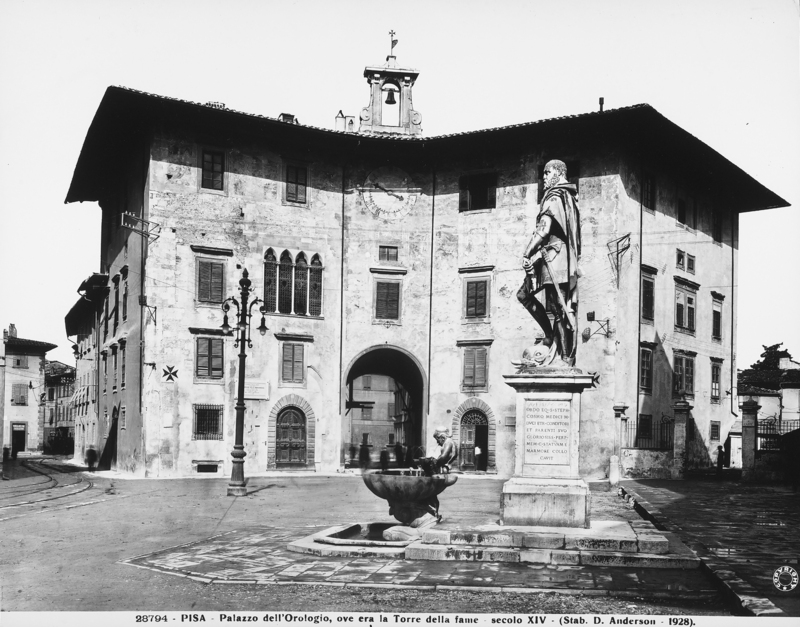
In 1866, Enrico Betti, director of the Scuola Normale Superiore, requested the Compagnia Svizzera del Gaz, which had secured the contract for Pisa’s public lighting the previous year, to extend supply to the piazza. Already fitted with lanterns since the late eighteenth century, Piazza dei Cavalieri requested to be supplied with gas under the same economic conditions as the rest of the city. After the First World War, the gas system was replaced by electric lighting, making the piazza more accessible at night. New lamp posts were installed near major monumental buildings, including the Palazzo della Carovana and the Church of Santo Stefano. Photographs, such as those from the Anderson campaign of 1928 or those capturing the heavy snowfall of 1929, depict these lamps as a defining feature of the piazza’s character.


Caption: ‘28794 – PISA – Palazzo dell’Orologio, ove era la Torre della Fame – secolo XIV (Stab. D. Anderson – 1928)’
The tram network was dismantled in the early 1950s. Wartime damage to the rail system, combined with the rapid urbanisation and suburban growth of the mid-twentieth century, created a need to reorganise Pisa’s public transport. This led to the replacement of trams with trolleybuses, which the municipal administration considered a more versatile solution, with services commencing in 1952. The trolleybus route still passed through Piazza dei Cavalieri, provoking significant concern.
Initially, the municipal plan envisioned attaching metal hooks directly to the façades of the piazza’s principal buildings to support the overhead cables. This proposal met with strong opposition from Ettore Remotti, then director of the Scuola Normale Superiore, and from Piero Sanpaolesi, the superintendent of cultural heritage, both of whom were concerned about its impact on the piazza’s artistic and architectural integrity. In May 1952, a compromise was reached: the planned route remained unchanged, but three metal poles were erected in the piazza to carry the cable network instead of the hooks. These poles also bore new central light fittings, while the elegant early twentieth-century lamp posts were permanently removed.
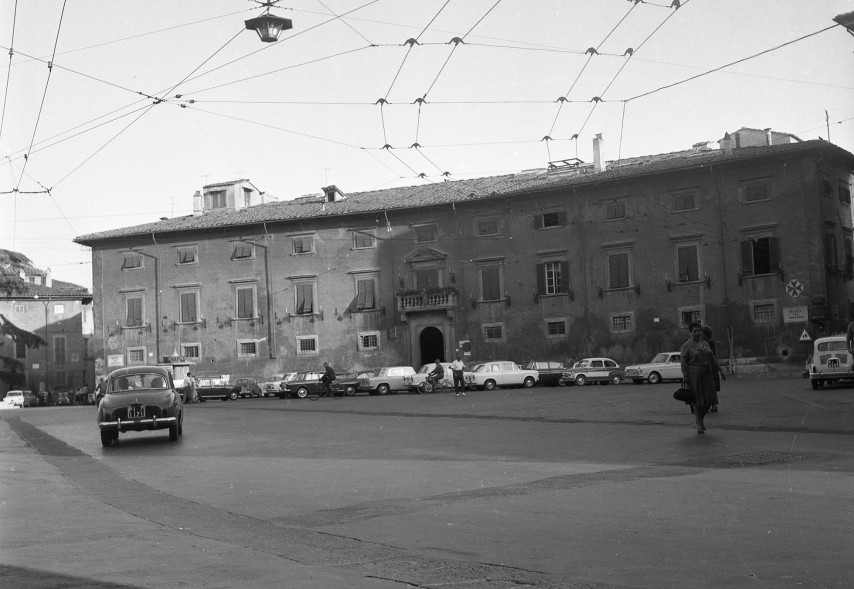
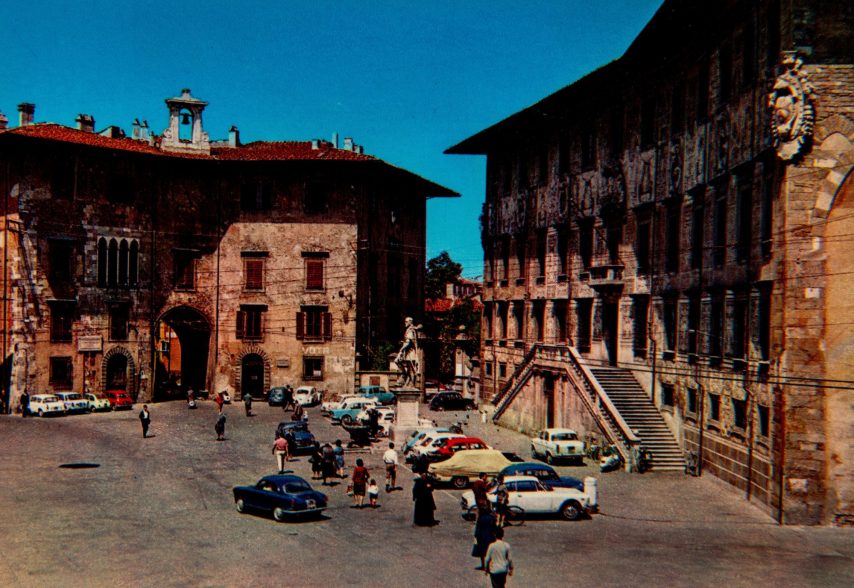
The system ensured more even lighting but accentuated the piazza’s functional role, weakening its monumental character. Even after the trolleybus line was removed in the late 1960s, by which time road transport—especially private cars—had become dominant, the piazza did not regain its former grandeur. Throughout the 1970s, cars and motorcycles were allowed to pass through and park in the area without significant restrictions, effectively transforming Vasari’s Mannerist theatre into a public car park.
At the end of the decade, another intervention temporarily disrupted the harmony of the piazza: in 1977, a thirty-metre underground tunnel was constructed to connect the Palazzo della Carovana with the Palazzo dell’Orologio, recently acquired by the Scuola Normale Superiore as the new home of its humanities library. Supervised by the institution’s Technical Office and monitored by the Pisa Monuments Authority (Soprintendenza ai Monumenti di Pisa), the project provoked widespread criticism. The delegate of the Tuscan Superintendency for Archaeological Heritage (Soprintendenza per i Beni Archeologici della Toscana) voiced opposition, and several scholars condemned the operation as ‘lacking scientific intent’ and methodologically inadequate, since it disregarded the site’s pre-modern significance and was carried out without a proper stratigraphic excavation. Nevertheless, the work was completed swiftly within the same year, and the piazza’s paving was promptly restored.
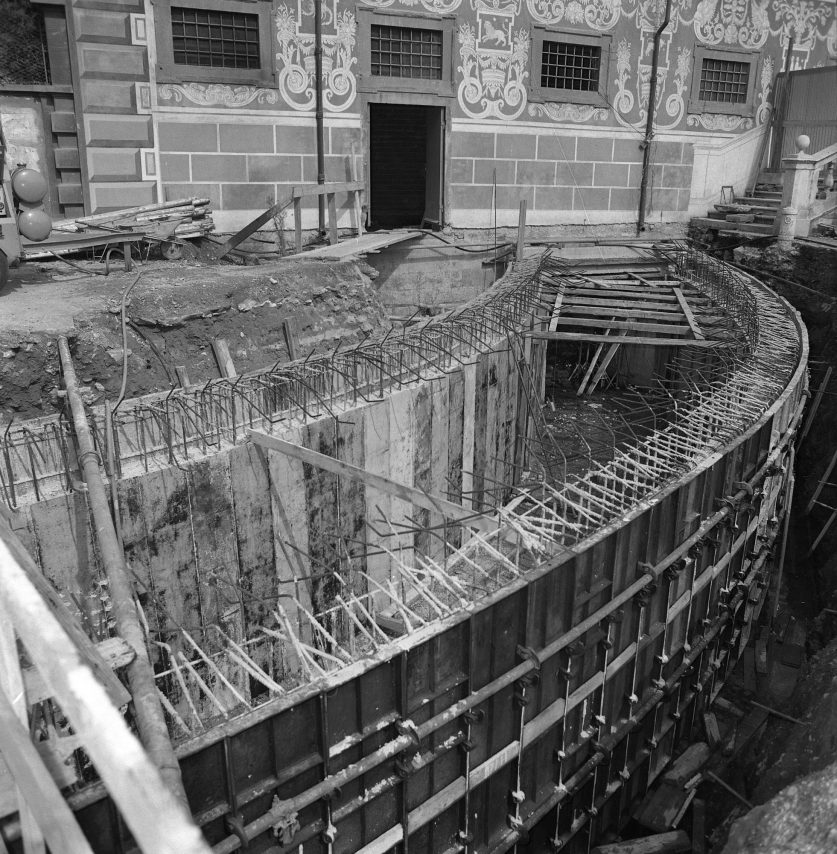

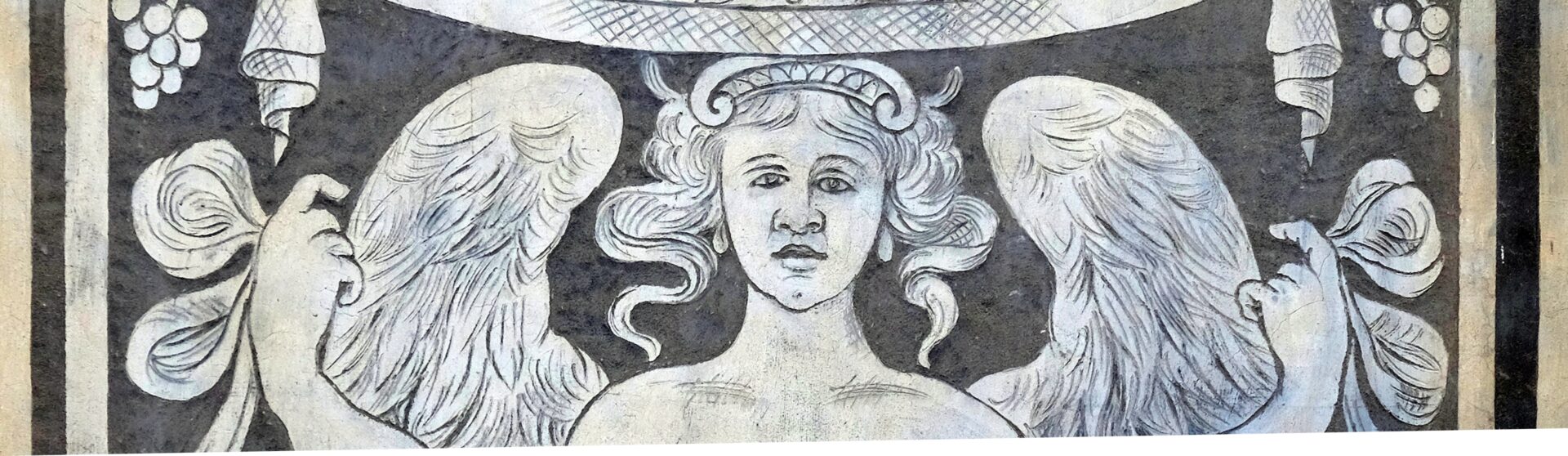
Meanwhile, after decades of neglect, the Scuola Normale Superiore’s extensive restoration of the Palazzo dell’Orologio included the recovery of some frescoes on its façade, and the rediscovery of the Tower of Famine, whose remains were brought back into view. Alongside this, significant work on Palazzo della Carovana’s sgraffito decoration in the early 1970s initiated a gradual reshaping of the piazza, aimed at restoring its historical and monumental significance. This process reached a pivotal moment with the establishment of a pedestrian zone, initially confined to Piazza dei Cavalieri but later expanded to the surrounding area. Confirmed by a 2001 municipal ordinance, this decision marked a turning point in managing vehicular traffic, enabling the piazza to return to primarily pedestrian use and reinforcing its historical and symbolic role within the urban fabric.
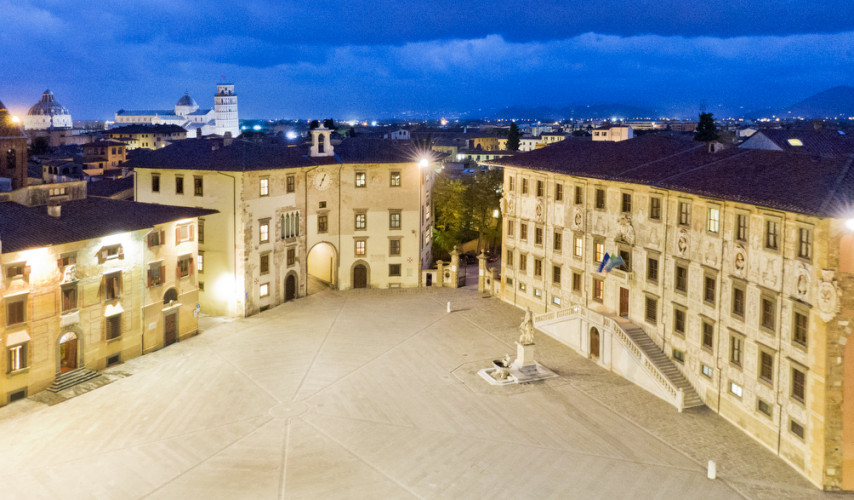
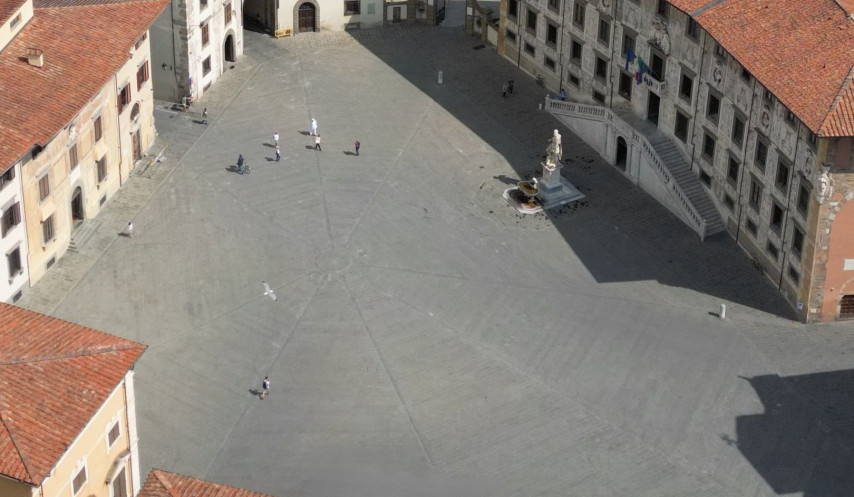
In 2011–12, the Municipality of Pisa renovated Piazza dei Cavalieri, installing new sandstone paving with a flame-finished surface and stone drainage channels that give the piazza a convex profile. The project, the outcome of years of planning, provoked lively debate. Some scholars criticised the choice of sandstone as unsuitable for the piazza’s historical and artistic context, the geometric design as excessively modern and uniform, and the convex surface as a distortion of the site’s original concave form. The municipal administration, however, defended the design, emphasising its adherence to the guidelines of the Superintendency and its aim to enhance the piazza’s formal dignity while maintaining continuity with the pedestrian fabric of the historic centre.
As part of the same restoration project, the lighting system was redesigned. Previously, this had been done using lights placed along the sidewalks around the square, designed by French architect Roland Jéol. With the new paving, LED spotlights were placed under the roofs of the surrounding buildings. Casting their light downward, they continue to produce a striking theatrical effect, enhancing the façades of Piazza dei Cavalieri’s principal palaces.
Media gallery
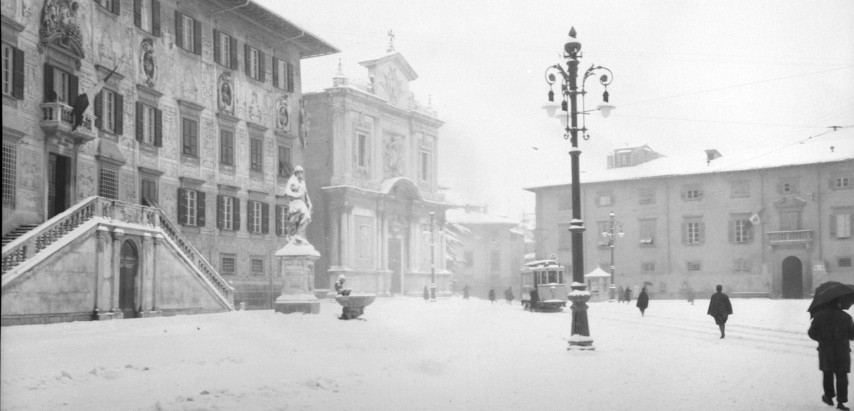
Caption: ‘28794 – PISA – Palazzo dell’Orologio, ove era la Torre della Fame – secolo XIV (Stab. D. Anderson – 1928)’
Newsletter
Stay in Touch
Sign up for the Piazza dei Cavalieri newsletter
to receive updates on project progress and news.